
1. Introduction
Florida represents one of the most complex and dynamic water markets in the United States. With a population exceeding 22 million and a unique hydrogeology characterized by a high water table and sensitive ecosystems (including the Everglades and extensive coastlines), the state’s wastewater infrastructure is under immense pressure. Florida currently operates over 2,000 active domestic wastewater permits, with a total design capacity exceeding 2,700 MGD (Million Gallons per Day).
The engineering landscape in Florida is currently defined by two major regulatory drivers: Senate Bill 64 (2021), which mandates the elimination of non-beneficial surface water discharges by 2032, and the Ocean Outfall Legislation (OOL), requiring southeast Florida utilities to cease ocean discharge. These mandates, combined with rapid population influx and aging infrastructure, have triggered a capital improvement boom. The Florida Department of Environmental Protection (FDEP) maintains rigorous oversight, particularly regarding nutrient loading in priority watersheds like the Indian River Lagoon and Biscayne Bay.
2. Recent Developments & Projects
In the last 24 months, Florida has seen a pivotal shift toward Potable Reuse and Advanced Water Treatment (AWT). Major utilities are moving away from deep injection wells and ocean outfalls toward reclaiming water for aquifer recharge and irrigation. The State Revolving Fund (SRF) has been bolstered by federal allocations from the Bipartisan Infrastructure Law (IIJA), specifically targeting emerging contaminants like PFAS and increasing resiliency against sea-level rise.
Notable developments include:
- Miami-Dade’s Capital Improvement Program: A multi-billion dollar overhaul driven by consent decrees to upgrade aging mains and treatment facilities.
- Tampa’s PURE Project: A controversial but necessary initiative exploring highly treated effluent for aquifer recharge to sustain the Hillsborough River.
- Septic-to-Sewer Conversions: Massive initiatives in Jacksonville (JEA), Port St. Lucie, and Martin County to reduce nutrient loading from failing septic tanks.
- Public-Private Partnerships (P3): Growing interest in P3 models for biosolid processing and energy neutrality projects.
3. Top 20 Largest Treatment Plants in Florida
The following list ranks Florida’s wastewater treatment facilities by permitted Design Capacity (MGD). These facilities represent the backbone of the state’s sanitary infrastructure.
| Rank | Plant Name | Location | Design Capacity (MGD) | Population Served | Operating Authority |
|---|---|---|---|---|---|
| 1 | Central District WWTP | Virginia Key | 143.0 | ~1.0M | Miami-Dade WASD |
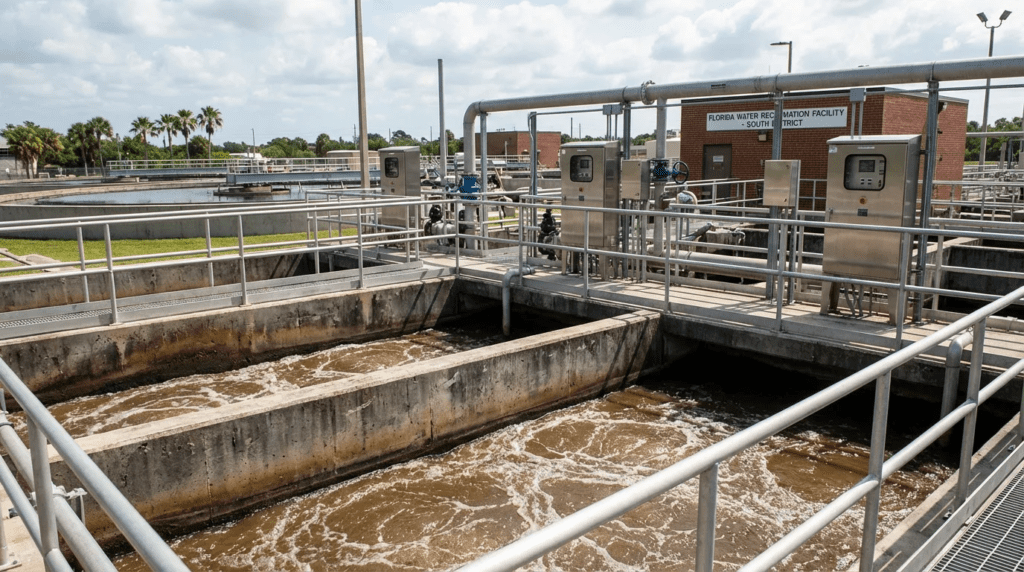
| 2 | South District WWTP | Miami | 112.5 | ~0.8M | Miami-Dade WASD |
| 3 | Howard F. Curren AWTP | Tampa | 96.0 | ~0.4M | City of Tampa |
| 4 | North District WWTP | North Miami | 112.5 | ~0.7M | Miami-Dade WASD |
| 5 | Buckman WRF | Jacksonville | 52.5 | ~0.4M | JEA |
| 6 | North Regional WWTP | Pompano Beach | 100.0 | ~0.6M | Broward County WWS |
| 7 | South Central Regional | Delray Beach | 24.0 | ~0.3M | Boynton/Delray Joint |
| 8 | District 2 WRF | Orlando | 25.5 | ~0.2M | City of Orlando |
| 9 | Ironbridge WRF | Oviedo | 40.0 | ~0.4M | City of Orlando |
| 10 | Kanapaha WRF | Gainesville | 14.9 | ~0.15M | GRU |
| 11 | Southwest WRF | St. Petersburg | 20.0 | ~0.15M | City of St. Petersburg |
| 12 | Falkenburg AWTF | Tampa | 12.0 | ~0.1M | Hillsborough County |
| 13 | Eastern Regional WRF | West Palm Beach | 64.0 | ~0.5M | Palm Beach County |
| 14 | Northwest Regional WRF | Margate | 15.0 | ~0.1M | Broward County |
| 15 | Conserv II WRF | Orlando | 44.0 | ~0.3M | City of Orlando/Orange Co |
| 16 | South Cross Bayou WRF | St. Petersburg | 33.0 | ~0.2M | Pinellas County |
| 17 | Glendale WRF | Lakeland | 13.7 | ~0.1M | City of Lakeland |
| 18 | George T. Lohmeyer | Fort Lauderdale | 56.6 | ~0.25M | City of Fort Lauderdale |
| 19 | Emerald Coast UA | Pensacola | 22.5 | ~0.3M | ECUA |
| 20 | Southwest WRF | Pembroke Pines | 18.0 | ~0.15M | City of Pembroke Pines |
Top 5 Largest Plant Profiles
1. Central District Wastewater Treatment Plant (CDWWTP)
- Location: Virginia Key, Miami-Dade County
- Design Capacity: 143 MGD
- Current Average Flow: ~105 MGD
- Operating Authority: Miami-Dade Water and Sewer Department (WASD)
- Receiving Water: Atlantic Ocean (via Outfall) / Deep Well Injection
Treatment Process: The plant utilizes a pure oxygen activated sludge process. Primary sedimentation is followed by high-purity oxygen aeration tanks. Secondary clarifiers separate solids before chlorination. Due to Ocean Outfall Legislation, the plant is transitioning toward Deep Injection Wells (DIW) and high-level disinfection.
Infrastructure Highlights:
Biosolids: Anaerobic digestion producing Class B biosolids, transitioning to Class AA via new drying facilities.
Energy: Cogeneration facility utilizing methane gas from digesters meets approximately 30% of plant power needs.
Recent Upgrades: A massive $1.2B upgrade program is underway to replace aging digesters, headworks, and switchgear, alongside the construction of injection wells to comply with the Ocean Outfall Legislation.
2. South District Wastewater Treatment Plant (SDWWTP)
- Location: Miami (Black Point), Miami-Dade County
- Design Capacity: 112.5 MGD
- Operating Authority: Miami-Dade WASD
- Receiving Water: Deep Injection Wells
Treatment Process: SDWWTP employs High-Level Disinfection (HLD). The process includes grit removal, pure oxygen activated sludge, secondary clarification, and deep-bed sand filtration prior to disinfection.
Compliance & Performance: This facility is a flagship for the county’s move toward deep injection well disposal, significantly reducing nutrient discharge into surface waters. It recently completed a significant expansion of its chlorine contact chambers.
3. Howard F. Curren Advanced Wastewater Treatment Plant
- Location: Port of Tampa, Hillsborough County
- Design Capacity: 96 MGD
- Operating Authority: City of Tampa
- Receiving Water: Hillsborough Bay
Treatment Process: As an Advanced Wastewater Treatment (AWT) facility, it utilizes a rigorous 5-stage Bardenpho process for biological nutrient removal (BNR), specifically targeting nitrogen and phosphorus to protect Tampa Bay.
Infrastructure: The plant features massive denitrification filters and high-efficiency turbo blowers installed during recent energy optimization projects.
4. North District Wastewater Treatment Plant (NDWWTP)
- Location: North Miami, Miami-Dade County
- Design Capacity: 112.5 MGD
- Operating Authority: Miami-Dade WASD
Treatment Process: Similar to its sister plants, utilizing pure oxygen activated sludge. The North District is currently the focus of a major capacity expansion to handle redirected flows from the Central District.
5. Buckman Water Reclamation Facility
- Location: Jacksonville, Duval County
- Design Capacity: 52.5 MGD
- Operating Authority: JEA
- Receiving Water: St. Johns River
Treatment Process: Conventional activated sludge with biological nutrient removal. JEA is heavily investing in UV disinfection upgrades and thermal hydrolysis for biosolids management at this regional hub.
Large Regional Plants (Rank 6-10)
- North Regional WWTP (Broward): 100 MGD capacity serving Pompano Beach and surrounding areas. Operated by Broward County Water & Wastewater Services. Notable for its large-scale deep injection well system.
- South Central Regional (Delray Beach): 24 MGD facility serving Delray and Boynton Beach. Known for high-percentage water reuse for golf course irrigation.
- District 2 WRF (Orlando): 25.5 MGD. Operated by the City of Orlando. Utilizes advanced BNR to protect the Econlockhatchee River basin.
Major Municipal Plants (Rank 11-15)
- Ironbridge WRF (Orlando): 40 MGD. Features advanced biological treatment and large-scale artificial wetlands for effluent polishing.
- Eastern Regional WRF (Palm Beach): 64 MGD. Operated by Palm Beach County Utilities. A critical facility for the county’s reclaimed water program.
4. Plants with Approved Budgets & Expansion Projects
Florida is currently witnessing unprecedented capital investment in wastewater infrastructure, driven by the consent decrees in Miami-Dade, the Ocean Outfall Legislation, and statewide septic-to-sewer mandates.
Summary Statistics
- Total Active Capital Investment: $6.5 Billion+ (Statewide)
- Number of Major Active Projects: 40+ Facilities
- New Capacity Being Added: ~180 MGD
- Primary Funding Sources: SRF Loans (45%), Revenue Bonds (35%), WIFIA (15%), Grants (5%)
A. Major Projects Under Construction (2024-2026)
Miami-Dade Central District – Ocean Outfall Legislation Compliance Program
- Location: Virginia Key, FL
- Project Scope: Construction of new industrial injection wells, new electrical distribution buildings, and oxygenation train rehabilitation to cease ocean discharge.
- Total Budget: $1.2 Billion (Program wide)
- Funding: WIFIA Loans, Revenue Bonds, SRF
- Timeline: Construction ongoing; Mandated completion by 2025/2030.
- Key Contractors: Jacobs (Program Manager), Black & Veatch, Poole & Kent.
- Drivers: Regulatory Compliance (OOL), Climate Resilience.
Southwest Water Reclamation Facility Capacity Expansion
- Location: St. Petersburg, FL
- Project Scope: Expansion from 20 MGD to 21 MGD average daily flow, including new aeration basins, clarifiers, and blower building improvements to handle peak wet weather flows.
- Total Budget: $65 Million
- Funding: State Revolving Fund (SRF), Local Capital Funds
- Timeline: Completion expected Q4 2025.
- Technology: High-efficiency aeration, SCADA modernization.
- Drivers: Population growth and wet weather flow management.
Altamonte Springs “PURE ALTA” Project
- Location: Altamonte Springs, FL
- Project Scope: Construction of an advanced water treatment facility for direct potable reuse (DPR) pilot and eventual full-scale implementation.
- Total Budget: $15 Million (Pilot/Phase 1)
- Funding: St. Johns River Water Management District Grants, Local Funds.
- Technology: Ozone, Biological Filtration, Ultrafiltration (UF), Granular Activated Carbon (GAC), UV/AOP.
- Drivers: Alternative Water Supply (AWS) development.
B. Projects in Design/Planning Phase (2025-2027)
- Clearwater Groundwater Replenishment Project:
- Budget: ~$35 Million
- Scope: Advanced purification of wastewater to drinking water standards for aquifer recharge.
- Status: Final Design / Permitting.
- JEA Septic Tank Phase Out (Various Locations):
- Budget: $100 Million+ (Multi-year)
- Scope: Extending sanitary sewer lines to neighborhoods currently on failing septic systems (Beverly Hills, Christobel).
- Status: Phased Design and Construction.
C. Recently Completed Major Projects (2022-2024)
- Palm Beach County Western Region North WRF Expansion: Increased capacity to handle western county growth. Investment: $45M.
- City of Largo Wet Weather Project: Upgrades to equalization tanks and headworks to prevent sanitary sewer overflows (SSOs). Investment: $28M.
5. Regulatory & Compliance Landscape
Engineers operating in Florida must navigate a rigorous regulatory environment enforced primarily by the Florida Department of Environmental Protection (FDEP) and the five Water Management Districts.
- Ocean Outfall Legislation (2008/2013): Prohibits the discharge of domestic wastewater through ocean outfalls by 2025, with exceptions for peak flows. It mandates that 60% of the baseline flow be reused.
- Senate Bill 64 (2021): Requires utilities to submit plans to eliminate non-beneficial surface water discharges by 2032. This is the primary driver for water reuse projects statewide.
- Numeric Nutrient Criteria (NNC): Florida has strict limits on Total Nitrogen (TN) and Total Phosphorus (TP) to combat harmful algal blooms.
- Biosolids Rule (Chapter 62-640, F.A.C.): Recent updates have tightened restrictions on land application of Class B biosolids, pushing utilities toward Class AA technologies (thermal drying/hydrolysis).
6. Technology Trends in Florida
Due to the specific challenges of nutrient removal and water scarcity, Florida is a leader in adopting advanced treatment technologies:
- Deep Injection Wells (DIW): Florida has the highest concentration of Class I injection wells in the US, used for the disposal of treated effluent below the lowest drinking water aquifer.
- Membrane Bioreactors (MBR): Increasingly standard for new satellite plants to produce high-quality reclaimed water with a small footprint.
- Peracetic Acid (PAA): Rapidly replacing chlorine for disinfection to reduce disinfection byproducts (DBPs) in sensitive receiving waters.
- Thermal Hydrolysis & Drying: Driven by biosolids regulations, utilities like JEA and Miami-Dade are investing in thermal technologies to reduce volume and achieve Class AA status.
7. Resources for Engineers & Operators
For detailed technical guidance, certification, and networking in Florida:
- Florida Water Environment Association (FWEA) – The state WEF member association.
- Florida Rural Water Association (FRWA) – Support for smaller utilities.
- FDEP State Revolving Fund – Primary source for low-interest infrastructure loans.
- Florida Professional Board of Engineers – Licensing and regulation.
8. Frequently Asked Questions (FAQ)
How many wastewater treatment plants are in Florida?
There are over 2,000 permitted domestic wastewater facilities in Florida, though less than 200 are considered major facilities (capacity > 1 MGD).
What is the largest wastewater treatment plant in Florida?
The Miami-Dade Central District Wastewater Treatment Plant is the largest, with a design capacity of 143 MGD.
What is the “Ocean Outfall Legislation”?
It is a state law requiring facilities in southeast Florida to cease discharging treated wastewater into the Atlantic Ocean by 2025 and requires the implementation of water reuse systems.
What funding is available for WWTP upgrades in Florida?
Funding is available through the Clean Water State Revolving Fund (CWSRF), the Water Infrastructure Finance and Innovation Act (WIFIA), and the Resilient Florida Grant Program.
How is Florida addressing biosolids disposal?
Due to stricter land application rules regarding phosphorus runoff, many utilities are upgrading to Thermal Hydrolysis Processes (THP) or thermal drying to produce Class AA fertilizer pellets.