1. Introduction
Florida represents one of the most complex and dynamic water markets in the United States. With a population exceeding 22 million and a unique hydrogeology characterized by a high water table and sensitive ecosystems (including the Everglades and extensive coastlines), the state’s wastewater infrastructure is under immense pressure. Florida currently operates over 2,000 active domestic wastewater permits, with a total design capacity exceeding 2,700 MGD (Million Gallons per Day).
The engineering landscape in Florida is currently defined by two major regulatory drivers: Senate Bill 64 (2021), which mandates the elimination of non-beneficial surface water discharges by 2032, and the Ocean Outfall Legislation (OOL), requiring southeast Florida utilities to cease ocean discharge. These mandates, combined with rapid population influx and aging infrastructure, have triggered a capital improvement boom. The Florida Department of Environmental Protection (FDEP) maintains rigorous oversight, particularly regarding nutrient loading in priority watersheds like the Indian River Lagoon and Biscayne Bay.
Within the national picture of US wastewater treatment plants, Florida is the clearest case of disposal method rather than treatment level driving plant design. The state holds the country’s largest concentration of Class I deep injection wells, its remaining ocean outfalls are on a legislated shutdown schedule, and its inland facilities are increasingly measured on how much reclaimed water they deliver rather than on effluent concentration alone. This page indexes every Florida facility profiled on the site, groups them by region and disposal pathway, and sets out the regulatory and design benchmarks that apply to a Florida project.
2. Recent Developments & Projects
In the last 24 months, Florida has seen a pivotal shift toward Potable Reuse and Advanced Water Treatment (AWT). Major utilities are moving away from deep injection wells and ocean outfalls toward reclaiming water for aquifer recharge and irrigation. The State Revolving Fund (SRF) has been bolstered by federal allocations from the Bipartisan Infrastructure Law (IIJA), specifically targeting emerging contaminants like PFAS and increasing resiliency against sea-level rise.
Notable developments include:
- Miami-Dade’s Capital Improvement Program: A multi-billion dollar overhaul driven by consent decrees to upgrade aging mains and treatment facilities.
- Tampa’s PURE Project: A controversial but necessary initiative exploring highly treated effluent for aquifer recharge to sustain the Hillsborough River.
- Septic-to-Sewer Conversions: Massive initiatives in Jacksonville (JEA), Port St. Lucie, and Martin County to reduce nutrient loading from failing septic tanks.
- Public-Private Partnerships (P3): Growing interest in P3 models for biosolid processing and energy neutrality projects.
Two further pressures are reshaping capital plans across the state. Sea level rise and groundwater intrusion are forcing coastal utilities to re-evaluate plant elevation, pump station flood protection, and the buoyancy of below-grade structures, with several southeast Florida agencies now applying resilience design criteria that exceed current building code minimums. At the same time, saltwater intrusion into the Biscayne and Floridan aquifers has raised the value of reclaimed water as a barrier and recharge source, which changes the economics of reuse projects that would not pencil out on irrigation demand alone.
3. Top 20 Largest Treatment Plants in Florida
The following list ranks Florida’s wastewater treatment facilities by permitted Design Capacity (MGD). These facilities represent the backbone of the state’s sanitary infrastructure.
| Rank | Plant Name | Location | Design Capacity (MGD) | Population Served | Operating Authority |
|---|---|---|---|---|---|
| 1 | Central District WWTP | Virginia Key | 143.0 | ~1.0M | Miami-Dade WASD |
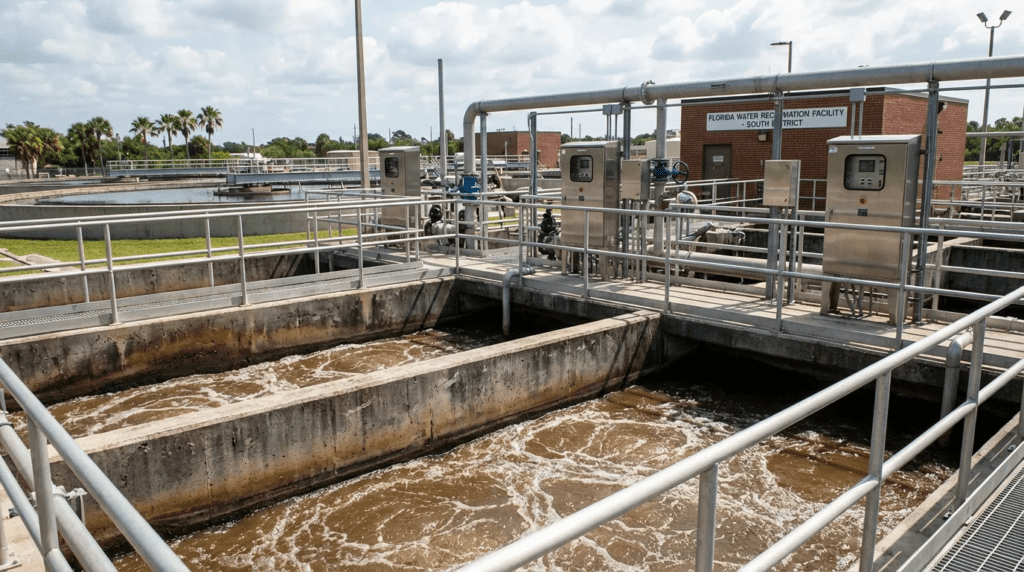
| 2 | South District WWTP | Miami | 112.5 | ~0.8M | Miami-Dade WASD |
| 3 | Howard F. Curren AWTP | Tampa | 96.0 | ~0.4M | City of Tampa |
| 4 | North District WWTP | North Miami | 112.5 | ~0.7M | Miami-Dade WASD |
| 5 | Buckman WRF | Jacksonville | 52.5 | ~0.4M | JEA |
| 6 | North Regional WWTP | Pompano Beach | 100.0 | ~0.6M | Broward County WWS |
| 7 | South Central Regional | Delray Beach | 24.0 | ~0.3M | Boynton/Delray Joint |
| 8 | District 2 WRF | Orlando | 25.5 | ~0.2M | City of Orlando |
| 9 | Ironbridge WRF | Oviedo | 40.0 | ~0.4M | City of Orlando |
| 10 | Kanapaha WRF | Gainesville | 14.9 | ~0.15M | GRU |
| 11 | Southwest WRF | St. Petersburg | 20.0 | ~0.15M | City of St. Petersburg |
| 12 | Falkenburg AWTF | Tampa | 12.0 | ~0.1M | Hillsborough County |
| 13 | Eastern Regional WRF | West Palm Beach | 64.0 | ~0.5M | Palm Beach County |
| 14 | Northwest Regional WRF | Margate | 15.0 | ~0.1M | Broward County |
| 15 | Conserv II WRF | Orlando | 44.0 | ~0.3M | City of Orlando/Orange Co |
| 16 | South Cross Bayou WRF | St. Petersburg | 33.0 | ~0.2M | Pinellas County |
| 17 | Glendale WRF | Lakeland | 13.7 | ~0.1M | City of Lakeland |
| 18 | George T. Lohmeyer | Fort Lauderdale | 56.6 | ~0.25M | City of Fort Lauderdale |
| 19 | Emerald Coast UA | Pensacola | 22.5 | ~0.3M | ECUA |
| 20 | Southwest WRF | Pembroke Pines | 18.0 | ~0.15M | City of Pembroke Pines |
Top 5 Largest Plant Profiles
1. Central District Wastewater Treatment Plant (CDWWTP)
The Central District Wastewater Treatment Plant on Virginia Key is the largest facility in Florida and the focal point of Miami-Dade’s ocean outfall compliance program.
- Location: Virginia Key, Miami-Dade County
- Design Capacity: 143 MGD
- Current Average Flow: ~105 MGD
- Operating Authority: Miami-Dade Water and Sewer Department (WASD)
- Receiving Water: Atlantic Ocean (via Outfall) / Deep Well Injection
Treatment Process: The plant utilizes a pure oxygen activated sludge process. Primary sedimentation is followed by high-purity oxygen aeration tanks. Secondary clarifiers separate solids before chlorination. Due to Ocean Outfall Legislation, the plant is transitioning toward Deep Injection Wells (DIW) and high-level disinfection.
Infrastructure Highlights:
Biosolids: Anaerobic digestion producing Class B biosolids, transitioning to Class AA via new drying facilities.
Energy: Cogeneration facility utilizing methane gas from digesters meets approximately 30% of plant power needs.
Recent Upgrades: A massive $1.2B upgrade program is underway to replace aging digesters, headworks, and switchgear, alongside the construction of injection wells to comply with the Ocean Outfall Legislation.
2. South District Wastewater Treatment Plant (SDWWTP)
The South District Wastewater Treatment Plant at Black Point was the first of the county’s three regional plants to move fully to subsurface disposal.
- Location: Miami (Black Point), Miami-Dade County
- Design Capacity: 112.5 MGD
- Operating Authority: Miami-Dade WASD
- Receiving Water: Deep Injection Wells
Treatment Process: SDWWTP employs High-Level Disinfection (HLD). The process includes grit removal, pure oxygen activated sludge, secondary clarification, and deep-bed sand filtration prior to disinfection.
Compliance & Performance: This facility is a flagship for the county’s move toward deep injection well disposal, significantly reducing nutrient discharge into surface waters. It recently completed a significant expansion of its chlorine contact chambers.
3. Howard F. Curren Advanced Wastewater Treatment Plant
- Location: Port of Tampa, Hillsborough County
- Design Capacity: 96 MGD
- Operating Authority: City of Tampa
- Receiving Water: Hillsborough Bay
Treatment Process: As an Advanced Wastewater Treatment (AWT) facility, it utilizes a rigorous 5-stage Bardenpho process for biological nutrient removal (BNR), specifically targeting nitrogen and phosphorus to protect Tampa Bay.
Infrastructure: The plant features massive denitrification filters and high-efficiency turbo blowers installed during recent energy optimization projects.
4. North District Wastewater Treatment Plant (NDWWTP)
The North District Wastewater Treatment Plant serves the northern third of the county and is absorbing flow redirected from Central District during outfall compliance work.
- Location: North Miami, Miami-Dade County
- Design Capacity: 112.5 MGD
- Operating Authority: Miami-Dade WASD
Treatment Process: Similar to its sister plants, utilizing pure oxygen activated sludge. The North District is currently the focus of a major capacity expansion to handle redirected flows from the Central District.
5. Buckman Water Reclamation Facility
- Location: Jacksonville, Duval County
- Design Capacity: 52.5 MGD
- Operating Authority: JEA
- Receiving Water: St. Johns River
Treatment Process: Conventional activated sludge with biological nutrient removal. JEA is heavily investing in UV disinfection upgrades and thermal hydrolysis for biosolids management at this regional hub.
Large Regional Plants (Rank 6-10)
- North Regional WWTP (Broward): 100 MGD capacity serving Pompano Beach and surrounding areas, profiled in detail in our article on the North Regional Wastewater Treatment Plant. Operated by Broward County Water & Wastewater Services. Notable for its large-scale deep injection well system.
- South Central Regional (Delray Beach): 24 MGD facility serving Delray and Boynton Beach. Known for high-percentage water reuse for golf course irrigation.
- District 2 WRF (Orlando): 25.5 MGD. Operated by the City of Orlando. Utilizes advanced BNR to protect the Econlockhatchee River basin.
Major Municipal Plants (Rank 11-15)
- Ironbridge WRF (Orlando): 40 MGD. Features advanced biological treatment and large-scale artificial wetlands for effluent polishing.
- Eastern Regional WRF (Palm Beach): 64 MGD. Operated by Palm Beach County Utilities. A critical facility for the county’s reclaimed water program.
4. Florida Treatment Plant Directory by Region
Florida’s treatment capacity concentrates in four metropolitan clusters, and each cluster is defined less by its treatment technology than by where the effluent goes. Southeast Florida disposes to deep injection wells and, for now, to ocean outfalls scheduled for retirement. Tampa Bay and the Gulf Coast combine reclaimed water distribution with injection. Central Florida relies on rapid infiltration basins, wetlands, and one of the oldest large-scale agricultural reuse systems in the country. Northeast Florida discharges to the St. Johns River under a basin-wide nutrient allocation. The sections below index every Florida facility profiled on this site, grouped accordingly.
Miami-Dade County
Miami-Dade Water and Sewer Department operates three regional plants totaling roughly 368 MGD of permitted capacity, all using high-purity oxygen activated sludge and all subject to the same consent decree and ocean outfall compliance schedule. Because the three plants share a single interconnected transmission system, capacity decisions at one facility directly change the hydraulic duty at the others.
Central District, facility profile. Our article on the Central District Wastewater Treatment Facility covers the Virginia Key site itself: a barrier island location with severe space constraints, limited construction laydown area, and exposure to storm surge that drives elevation and flood protection requirements well above those of an inland plant of the same size.
Central District, WASD system view. The Miami-Dade Water and Sewer Department Central District facility entry places the plant inside the county utility’s operating structure, including the consent decree obligations, the pump station rehabilitation program feeding it, and the interplant transmission that allows flow diversion during outages.
Central District, injection well program. A further profile of the Central District plant under the WASD injection program focuses on the shift from outfall to Class I deep injection wells, including the mechanical integrity testing regime and the monitoring wells required to demonstrate confinement below the Underground Source of Drinking Water.
South District, department profile. The WASD South District Wastewater Treatment Plant article covers the Black Point facility’s high-level disinfection train, the deep-bed filtration ahead of it, and why full subsurface disposal made this the county’s proving ground for the technology.
South District, plant operations. A companion entry on the South District plant operations examines process control, chlorine contact capacity, and the wet weather performance of a plant that sits at low elevation adjacent to Biscayne Bay.
North District, department profile. The WASD North District Wastewater Treatment Plant article addresses the northern service area, the existing ocean outfall, and the expansion work required to absorb flow redirected from Central District during compliance construction.
North District, plant detail. A second article on the North District facility covers unit process configuration and the site’s odor control and electrical reliability upgrades, both of which have been priority items under the county’s capital improvement program.
Broward County and Southeast Florida
Broward County’s two regional systems face the same outfall retirement deadline as Miami-Dade but with a different disposal mix: a heavier reliance on injection wells and a more developed reclaimed water distribution network serving golf courses, residential irrigation, and groundwater recharge in the eastern well fields.
Broward North District Regional. The Broward County North District Regional Wastewater Treatment Plant article covers the county’s largest facility at roughly 100 MGD, including its injection well field, the reuse commitments that count toward the 60 percent baseline flow requirement under the Ocean Outfall Legislation, and its role as regional treatment for a group of member municipalities.
Broward South District Regional. The Broward County South District Regional Wastewater Treatment Plant serves the southern portion of the county’s regional system, where dense development and a shallow water table constrain both plant expansion and collection system rehabilitation.
Western Regional facility. Our profile of the Western Regional Wastewater Treatment Plant covers an inland regional facility serving western suburban growth areas, where reclaimed water demand and groundwater protection govern the treatment level rather than surface water discharge limits.
Central Florida and the Orlando Metro
Central Florida has no ocean outfall option and limited surface water assimilative capacity, which pushed the region toward land application and reuse decades before the rest of the state. Rapid infiltration basins, constructed wetlands, and agricultural irrigation are standard disposal pathways here, and the Floridan aquifer sits directly beneath, making groundwater protection the controlling design constraint.
Eastern Water Reclamation Facility. Our overview of the Eastern Water Reclamation Facility covers an advanced treatment plant serving the eastern Orlando metro, producing reclaimed water for irrigation distribution and directing surplus flow to rapid infiltration basins. Facilities of this class run nitrification and denitrification year-round because their effluent effectively recharges the aquifer, so nitrogen limits are set by drinking water considerations rather than by surface water criteria.
Tampa Bay and Pinellas County
The Tampa Bay region operates under nutrient management commitments developed through the Tampa Bay Estuary Program, one of the earliest and most successful nitrogen load reduction efforts in the country. Pinellas County utilities in particular have effectively eliminated surface discharge, relying on a combination of reclaimed water distribution and deep injection.
St. Petersburg Southwest Water Reclamation Facility. The City of St. Petersburg Southwest facility is one of four plants in a citywide system built around reclaimed water delivery and injection well disposal rather than surface discharge. St. Petersburg’s reclaimed distribution network is among the oldest large municipal systems of its kind in the United States, and the operational challenge is matching wet season production against irrigation demand that falls exactly when rainfall is highest.
South Cross Bayou Water Reclamation Facility. The Pinellas County South Cross Bayou Water Reclamation Facility treats roughly 33 MGD to advanced standards, supplying the county reclaimed water system and using injection for surplus flow. Recent capital work at the site has focused on biosolids handling and on odor control in a service area where residential development has grown up against the plant boundary.
Northeast Florida
Northeast Florida discharges to the Lower St. Johns River, which operates under a total maximum daily load for nutrients. Load allocation across dischargers means individual plant permits are written against a basin-wide budget, and JEA’s septic-to-sewer program is as much a nutrient compliance strategy as a service extension.
JEA Arlington. The Jacksonville Electric Authority Arlington Wastewater Treatment Plant serves the Arlington area of Jacksonville with biological nutrient removal ahead of discharge to the St. Johns River system. As a combined electric and water utility, JEA can evaluate energy and treatment decisions on a single balance sheet, which is why thermal biosolids processing and cogeneration have advanced further here than at comparably sized municipal utilities elsewhere in the state.
5. Plants with Approved Budgets & Expansion Projects
Florida is currently witnessing unprecedented capital investment in wastewater infrastructure, driven by the consent decrees in Miami-Dade, the Ocean Outfall Legislation, and statewide septic-to-sewer mandates.
Summary Statistics
- Total Active Capital Investment: $6.5 Billion+ (Statewide)
- Number of Major Active Projects: 40+ Facilities
- New Capacity Being Added: ~180 MGD
- Primary Funding Sources: SRF Loans (45%), Revenue Bonds (35%), WIFIA (15%), Grants (5%)
A. Major Projects Under Construction (2024-2026)
Miami-Dade Central District – Ocean Outfall Legislation Compliance Program
- Location: Virginia Key, FL
- Project Scope: Construction of new industrial injection wells, new electrical distribution buildings, and oxygenation train rehabilitation to cease ocean discharge.
- Total Budget: $1.2 Billion (Program wide)
- Funding: WIFIA Loans, Revenue Bonds, SRF
- Timeline: Construction ongoing; Mandated completion by 2025/2030.
- Key Contractors: Jacobs (Program Manager), Black & Veatch, Poole & Kent.
- Drivers: Regulatory Compliance (OOL), Climate Resilience.
Southwest Water Reclamation Facility Capacity Expansion
- Location: St. Petersburg, FL
- Project Scope: Expansion from 20 MGD to 21 MGD average daily flow, including new aeration basins, clarifiers, and blower building improvements to handle peak wet weather flows.
- Total Budget: $65 Million
- Funding: State Revolving Fund (SRF), Local Capital Funds
- Timeline: Completion expected Q4 2025.
- Technology: High-efficiency aeration, SCADA modernization.
- Drivers: Population growth and wet weather flow management.
Altamonte Springs “PURE ALTA” Project
- Location: Altamonte Springs, FL
- Project Scope: Construction of an advanced water treatment facility for direct potable reuse (DPR) pilot and eventual full-scale implementation.
- Total Budget: $15 Million (Pilot/Phase 1)
- Funding: St. Johns River Water Management District Grants, Local Funds.
- Technology: Ozone, Biological Filtration, Ultrafiltration (UF), Granular Activated Carbon (GAC), UV/AOP.
- Drivers: Alternative Water Supply (AWS) development.
B. Projects in Design/Planning Phase (2025-2027)
- Clearwater Groundwater Replenishment Project:
- Budget: ~$35 Million
- Scope: Advanced purification of wastewater to drinking water standards for aquifer recharge.
- Status: Final Design / Permitting.
- JEA Septic Tank Phase Out (Various Locations):
- Budget: $100 Million+ (Multi-year)
- Scope: Extending sanitary sewer lines to neighborhoods currently on failing septic systems (Beverly Hills, Christobel).
- Status: Phased Design and Construction.
C. Recently Completed Major Projects (2022-2024)
- Palm Beach County Western Region North WRF Expansion: Increased capacity to handle western county growth. Investment: $45M.
- City of Largo Wet Weather Project: Upgrades to equalization tanks and headworks to prevent sanitary sewer overflows (SSOs). Investment: $28M.
6. Regulatory & Compliance Landscape
Engineers operating in Florida must navigate a rigorous regulatory environment enforced primarily by the Florida Department of Environmental Protection (FDEP) and the five Water Management Districts.
- Ocean Outfall Legislation (2008/2013): Prohibits the discharge of domestic wastewater through ocean outfalls by 2025, with exceptions for peak flows. It mandates that 60% of the baseline flow be reused.
- Senate Bill 64 (2021): Requires utilities to submit plans to eliminate non-beneficial surface water discharges by 2032. This is the primary driver for water reuse projects statewide.
- Numeric Nutrient Criteria (NNC): Florida has strict limits on Total Nitrogen (TN) and Total Phosphorus (TP) to combat harmful algal blooms.
- Biosolids Rule (Chapter 62-640, F.A.C.): Recent updates have tightened restrictions on land application of Class B biosolids, pushing utilities toward Class AA technologies (thermal drying/hydrolysis).
- Reuse Rule (Chapter 62-610, F.A.C.): Defines the reclaimed water use categories and their treatment requirements, from restricted access land application through public access reuse requiring filtration and high-level disinfection.
- Underground Injection Control (Chapter 62-528, F.A.C.): Governs Class I injection wells, including construction standards, mechanical integrity testing, and the monitoring well network required to demonstrate that injected fluid remains confined.
The disposal pathway hierarchy
Florida’s rules effectively rank disposal options, and the ranking — not the treatment technology — is what determines a project’s permitting timeline and cost. Public access reuse sits at the top: it counts fully toward SB 64 and Ocean Outfall Legislation compliance, and it carries the highest treatment requirement, typically filtration plus high-level disinfection with continuous turbidity monitoring. Groundwater recharge and indirect potable reuse follow, adding advanced treatment and monitoring obligations. Deep injection is permitted and widely used, but it counts as disposal rather than beneficial use, so it does not satisfy the reuse percentage requirements on its own. Surface water discharge is the pathway being actively eliminated, and ocean outfalls are on a legislated retirement schedule.
The practical consequence is that a Florida utility rarely selects a treatment train to meet a discharge limit. It selects a disposal portfolio first, then works backward to the treatment level each pathway requires. A design proposal that optimizes for effluent quality without addressing where the water goes will miss the actual evaluation criteria.
7. Technology Trends in Florida
Due to the specific challenges of nutrient removal and water scarcity, Florida is a leader in adopting advanced treatment technologies:
- Deep Injection Wells (DIW): Florida has the highest concentration of Class I injection wells in the US, used for the disposal of treated effluent below the lowest drinking water aquifer.
- Membrane Bioreactors (MBR): Increasingly standard for new satellite plants to produce high-quality reclaimed water with a small footprint.
- Peracetic Acid (PAA): Rapidly replacing chlorine for disinfection to reduce disinfection byproducts (DBPs) in sensitive receiving waters.
- Thermal Hydrolysis & Drying: Driven by biosolids regulations, utilities like JEA and Miami-Dade are investing in thermal technologies to reduce volume and achieve Class AA status.
- Five-stage Bardenpho and other AWT trains: The default configuration where advanced wastewater treatment limits apply, generally understood as 5 mg/L BOD, 5 mg/L TSS, 3 mg/L total nitrogen, and 1 mg/L total phosphorus on an annual average basis.
- Rapid infiltration basins and constructed wetlands: Long-standing Central Florida practice, now re-evaluated statewide as a lower-energy polishing and disposal option where land is available and the aquifer is adequately confined.
- Resilience retrofits: Flood walls, elevated electrical rooms, submersible-rated equipment, and buoyancy control for below-grade structures, increasingly written into coastal plant upgrades as standard scope rather than as an add-on.
8. Comparing Florida Facility Classes
Florida facilities sort into recognizable classes by disposal pathway and treatment level. The table below summarizes how those classes differ in the terms that drive equipment selection and capital planning.
| Facility Class | Representative Plants | Typical Capacity | Disposal Pathway | Treatment Level | Primary Design Driver |
|---|---|---|---|---|---|
| Large southeast regional plant | Central District Wastewater Treatment Plant, South District Wastewater Treatment Plant, North District Wastewater Treatment Plant | 110-145 MGD | Deep injection, outfall retirement in progress | Secondary with high-level disinfection | Ocean Outfall Legislation compliance, consent decree |
| County regional with injection and reuse | North Regional Wastewater Treatment Plant, Broward County South District Regional Wastewater Treatment Plant | 40-100 MGD | Injection plus reclaimed water distribution | Secondary to filtered public access reuse | 60% reuse baseline requirement |
| Estuary-protective AWT plant | Howard F. Curren AWTP, Pinellas County South Cross Bayou Water Reclamation Facility | 20-100 MGD | Surface water or injection | Advanced wastewater treatment, 5-stage BNR | Numeric nutrient criteria, estuary load allocation |
| Inland reuse and recharge facility | Eastern Water Reclamation Facility, Western Regional Wastewater Treatment Plant | 10-65 MGD | Rapid infiltration basins, wetlands, irrigation | Filtered reuse with nitrogen removal | Floridan aquifer protection, irrigation demand |
| Reclaimed-water municipal system | City of St. Petersburg Southwest facility | 10-25 MGD | Reclaimed distribution plus injection for surplus | Filtered public access reuse | Seasonal demand mismatch, zero surface discharge |
| River basin discharger under TMDL | Jacksonville Electric Authority Arlington Wastewater Treatment Plant, Buckman WRF | 15-55 MGD | St. Johns River | Secondary with biological nutrient removal | Basin-wide nutrient load allocation |
9. Benchmarking and Site Selection
A state directory gets used three ways: to size a market, to find a comparable facility for a design or bid basis, and to anticipate what a permit will require before the treatment train is fixed. In Florida each of those readings starts from disposal, not from flow.
Selecting a comparable facility
Match on disposal pathway first. A 60 MGD plant injecting to the Boulder Zone and a 60 MGD plant delivering public access reuse have almost nothing in common downstream of secondary clarification, and their capital cost per MGD will differ by a wide margin in both directions depending on whether well construction or filtration and distribution dominates. Once the pathway matches, screen for water table depth and site elevation, since below-grade construction cost in coastal Florida is driven by dewatering and buoyancy control to a degree that is unusual elsewhere in the country.
Worked example: sizing a comparison set
Consider a proposed 25 MGD facility in coastal southwest Florida that will deliver public access reuse with injection for wet season surplus. Filtering the directory by disposal pathway eliminates the St. Johns River dischargers and the Miami-Dade plants whose current pathway is outfall transition. What remains is the Pinellas and St. Petersburg group, which matches on pathway and roughly on scale, plus the Broward regional plants if the injection component dominates the cost estimate. Normalizing those to a per-MGD basis requires separating the treatment plant cost from the reclaimed water distribution investment, which in St. Petersburg’s case was built incrementally over decades and does not appear in any single project figure. Three comparables, carefully adjusted, will produce a better estimate than a dozen matched on flow alone.
Comparing Florida to other state markets
Florida’s disposal-first framework is unusual enough that cross-state comparison is often the fastest way to separate a genuine Florida requirement from regional practice. The Georgia wastewater treatment plants directory covers the closest neighboring market, sharing the Floridan aquifer and Southeast permitting culture but relying far more on surface water discharge to river systems. The California wastewater treatment plants directory covers the other national reuse leader, where the constraint runs in the opposite direction: California has abundant ocean disposal capacity and scarce brine disposal options, precisely inverting Florida’s position. The Texas wastewater treatment plants directory covers a comparable Sun Belt growth market with established direct potable reuse precedent, useful context for Florida utilities working through DPR pilots such as PURE ALTA.
10. Field Notes
Injection wells are a permitting problem before they are an engineering one
Class I well construction is straightforward relative to the approval sequence around it. Site characterization, confinement demonstration, monitoring well installation, and mechanical integrity testing dominate the schedule, and a single adverse finding in the monitoring network can suspend injection at a plant with no alternative disposal pathway. Utilities that treat wells as redundant capacity rather than as single points of failure carry a compliance risk that does not appear on the process flow diagram.
Reclaimed water demand is seasonal and production is not
Irrigation demand collapses during the wet season, exactly when influent flow peaks from inflow and infiltration. Every Florida reuse system therefore needs a surplus outlet — storage, injection, rapid infiltration, or surface discharge — sized for the mismatch. Reuse percentages calculated on annual average flow routinely overstate what the system can actually deliver in August.
Pro Tip
When evaluating a Florida plant’s compliance position, look at the reuse percentage against baseline flow rather than at effluent quality. The Ocean Outfall Legislation’s 60 percent requirement and SB 64’s elimination of non-beneficial discharge are both volumetric tests. A facility producing excellent effluent that injects all of it is not on a compliance path, while a facility producing merely adequate effluent that distributes most of it is.
Common Mistake
Treating Florida’s 2,000-plus permitted domestic facilities as the addressable market. Fewer than 200 exceed 1 MGD, and the large regional plants concentrated in Miami-Dade, Broward, Palm Beach, Hillsborough, Pinellas, Orange, and Duval counties carry the overwhelming majority of both treated volume and capital spending. Sizing a market on permit count rather than on design capacity and capital improvement program value overstates it by an order of magnitude.
11. Permitting & Design Standards Reference
Florida applies its own administrative code on top of the federal framework, and the applicable chapters differ depending on whether a project discharges, injects, or reuses.
Domestic wastewater facility permitting in Florida is governed by Chapter 62-600 F.A.C., with reuse requirements in Chapter 62-610, biosolids in Chapter 62-640, and underground injection control in Chapter 62-528. These are administered by the Florida Department of Environmental Protection, with water supply and consumptive use permitting handled separately by the five Water Management Districts.
Specification checklist for a Florida project
- Establish the disposal portfolio — reuse, injection, surface discharge, or a combination — before selecting any unit process.
- Confirm the Chapter 62-610 reuse category, since public access reuse, restricted access land application, and groundwater recharge carry materially different treatment and monitoring requirements.
- Determine whether the facility falls under Ocean Outfall Legislation or SB 64 obligations, and quantify the reuse volume required against baseline flow.
- Verify whether advanced wastewater treatment limits apply, and confirm the averaging period for nitrogen and phosphorus.
- Check for an applicable TMDL or basin management action plan in the receiving watershed.
- Establish the seasonal high water table elevation and its effect on below-grade construction, dewatering, and buoyancy.
- Confirm design flood elevation and storm surge exposure for coastal sites, including electrical and control room siting.
- For injection projects, verify confinement, monitoring well requirements, and mechanical integrity testing intervals under Chapter 62-528.
- Determine biosolids end use and whether Class AA is required, since Chapter 62-640 restrictions on Class B land application shape the entire solids train.
- Establish peak wet weather flow and the inflow and infiltration contribution, which in older coastal collection systems can dominate the hydraulic design.
- Confirm disinfection approach, including whether peracetic acid or UV is preferred over chlorine for disinfection byproduct control.
- Identify the Water Management District and any consumptive use permit conditions tied to alternative water supply commitments.
- Verify operator certification requirements for the facility class under FDEP rules.
- Confirm funding source, since SRF and WIFIA participation carry procurement, labor, and reporting obligations that affect schedule.
12. Resources for Engineers & Operators
For detailed technical guidance, certification, and networking in Florida:
- Florida Water Environment Association (FWEA) – The state WEF member association.
- Florida Rural Water Association (FRWA) – Support for smaller utilities.
- FDEP State Revolving Fund – Primary source for low-interest infrastructure loans.
- Florida Professional Board of Engineers – Licensing and regulation.
- FDEP Division of Water Resource Management – Domestic wastewater permitting and the annual reuse inventory.
- Water Management Districts – South Florida, Southwest Florida, St. Johns River, Suwannee River, and Northwest Florida, each administering consumptive use and alternative water supply programs.
- WateReuse Florida – Trade section focused on reclaimed water policy and potable reuse development.
- Florida Section AWWA – Drinking water and potable reuse technical resources.
13. Frequently Asked Questions (FAQ)
How many wastewater treatment plants are in Florida?
There are over 2,000 permitted domestic wastewater facilities in Florida, though less than 200 are considered major facilities (capacity > 1 MGD).
What is the largest wastewater treatment plant in Florida?
The Miami-Dade Central District Wastewater Treatment Plant is the largest, with a design capacity of 143 MGD.
What is the “Ocean Outfall Legislation”?
It is a state law requiring facilities in southeast Florida to cease discharging treated wastewater into the Atlantic Ocean by 2025 and requires the implementation of water reuse systems.
What funding is available for WWTP upgrades in Florida?
Funding is available through the Clean Water State Revolving Fund (CWSRF), the Water Infrastructure Finance and Innovation Act (WIFIA), and the Resilient Florida Grant Program.
How is Florida addressing biosolids disposal?
Due to stricter land application rules regarding phosphorus runoff, many utilities are upgrading to Thermal Hydrolysis Processes (THP) or thermal drying to produce Class AA fertilizer pellets.
Why does Florida use so many deep injection wells?
Florida’s geology includes a highly transmissive saline zone well below the lowest underground source of drinking water, separated by confining units that allow treated effluent to be injected without affecting potable aquifers. That combination is uncommon elsewhere in the country. Injection provides a reliable, weather-independent disposal outlet in a state where surface waters have limited assimilative capacity and land application is constrained by a shallow water table. The trade-off is that injection is classified as disposal rather than beneficial use, so it does not count toward the reuse volumes required by the Ocean Outfall Legislation or SB 64.
What is the difference between reclaimed water and reuse in Florida’s rules?
Reclaimed water is the product: domestic wastewater treated to a standard defined in Chapter 62-610. Reuse is the act of putting it to a beneficial purpose such as irrigation, industrial process water, groundwater recharge, or wetland hydration. The distinction matters for compliance because only beneficial use counts toward statutory reuse requirements. Effluent that meets reclaimed water standards but is injected or discharged does not count, which is why utilities invest in distribution infrastructure that is often more expensive than the treatment producing the water.
What does advanced wastewater treatment mean in Florida?
Advanced wastewater treatment is a defined statutory standard, generally understood as annual average limits of 5 mg/L carbonaceous BOD, 5 mg/L total suspended solids, 3 mg/L total nitrogen, and 1 mg/L total phosphorus. It is required at facilities discharging to designated sensitive water bodies, and it typically drives a five-stage Bardenpho or equivalent biological nutrient removal train with denitrification filtration. The Howard F. Curren plant in Tampa is the best-known example in the state.
How does the septic-to-sewer push affect treatment plants?
Converting neighborhoods from septic systems to sewer service transfers nutrient load from diffuse groundwater seepage to a permitted point source, which means the receiving plant must have both hydraulic capacity and the nitrogen removal capability to handle it within its allocation. For utilities such as JEA and the Indian River Lagoon-area agencies, conversion programs are therefore paired with plant upgrades rather than executed independently. The collection system extension is usually the larger cost, but the plant-side nutrient capacity is the binding constraint.
Key Takeaways
- Disposal drives design in Florida — select the disposal portfolio first; the treatment train follows from it, not the other way around.
- Reuse requirements are volumetric — the Ocean Outfall Legislation’s 60 percent test and SB 64 measure beneficial use volume, not effluent quality, so injection alone does not achieve compliance.
- Miami-Dade concentrates the capital program — three plants totaling roughly 368 MGD sit under a single consent decree and outfall compliance schedule.
- Seasonal mismatch is the reuse system’s real constraint — irrigation demand falls when wet weather flow peaks, so every reuse system needs a sized surplus outlet.
- A shallow water table sets construction cost — dewatering and buoyancy control make below-grade work in coastal Florida materially more expensive than equivalent work elsewhere.
- Market count overstates opportunity — fewer than 200 of Florida’s 2,000-plus permitted facilities exceed 1 MGD, and a handful of counties carry most of the spending.
14. Conclusion
Florida is running the largest coordinated disposal transition in the country. Ocean outfalls are being retired on a legislated schedule, non-beneficial surface discharge is being eliminated statewide under SB 64, and utilities that spent decades optimizing for effluent concentration are now being measured on how much water they put back into productive use. That shift favors reclaimed water distribution, aquifer recharge, and potable reuse, and it puts a premium on treatment trains that can meet public access reuse standards reliably rather than on those that merely clear a discharge permit.
Use this directory as an index organized around that reality. Start from the disposal pathway and the governing rule chapter, narrow to the facility class, and only then compare capacity and cost. The regional listings above link to detailed profiles of every Florida facility covered on this site, and the cross-state comparisons in Section 9 help distinguish what is a genuine Florida requirement from what is simply regional practice.