
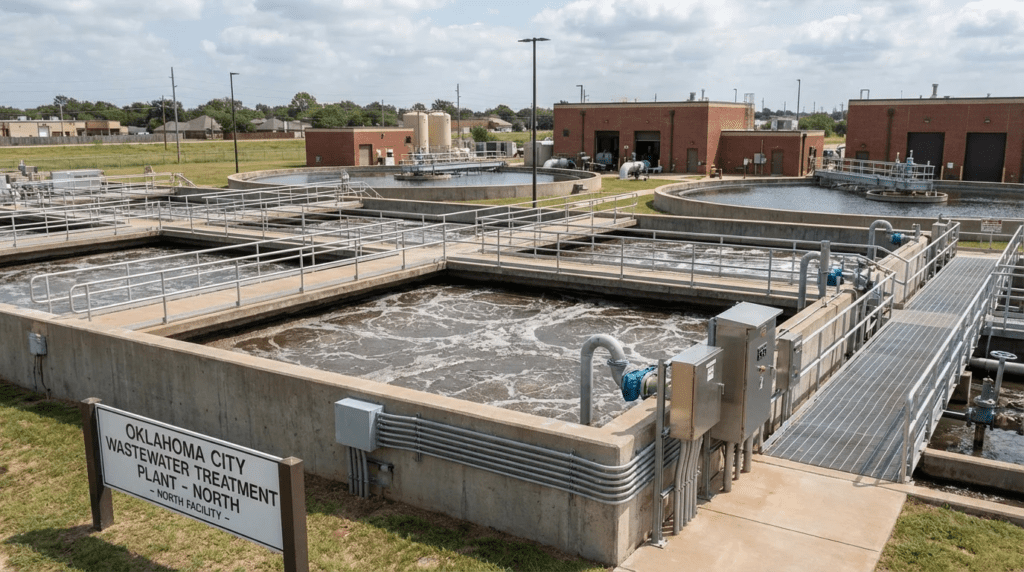
Oklahoma Water & Wastewater Infrastructure Overview
Oklahoma’s wastewater infrastructure represents a critical intersection of aging municipal systems and cutting-edge water reuse initiatives. Managed primarily under the regulatory oversight of the Oklahoma Department of Environmental Quality (ODEQ), the state’s infrastructure serves a population of approximately 4 million residents across diverse geography, from the arid high plains of the panhandle to the water-rich reservoirs of the east.
The sector is currently defined by two major trends: regionalization of treatment in major metropolitan areas (Oklahoma City and Tulsa) and a strategic pivot toward indirect potable reuse (IPR) to address long-term drought resilience. The Oklahoma Water Resources Board (OWRB) remains a pivotal player, financing billions in infrastructure through the Clean Water State Revolving Fund (CWSRF) and state bond programs.
Key Statistics:
- Total Permitted Facilities: 500+ (Municipal and Industrial)
- Largest Operating Authority: Oklahoma City Water Utilities Trust (OCWUT)
- Total Daily Treatment Capacity: >450 MGD (Major Municipal)
- Primary Receiving Waters: Arkansas River, Canadian River, Red River
Recent Developments & Infrastructure Trends
In the last 24 months, Oklahoma has accelerated capital improvement plans (CIPs) driven by the necessity of nutrient removal compliance and population growth in the OKC-Tulsa corridor. The Oklahoma City Water Utilities Trust has embarked on a multi-billion dollar capital plan that includes significant upgrades to its four major wastewater plants to support future reuse capabilities.
Funding availability has increased significantly via the Infrastructure Investment and Jobs Act (IIJA), which is supplementing the OWRB’s robust loan programs. A notable trend is the deployment of thermal hydrolysis for biosolids management in Tulsa, marking a shift toward energy neutrality. Furthermore, the “Water for 2060” act continues to drive efficiency, pushing facilities toward water reclamation for industrial and irrigation use.
Rural water districts are also consolidating, utilizing USDA Rural Development funds and Indian Health Service (IHS) grants to replace failing lagoon systems with mechanical plants capable of meeting stricter ammonia and phosphorus limits.
Top 20 Largest Wastewater Treatment Plants in Oklahoma
The following ranking is based on Design Capacity (MGD) as reported in ODEQ permits, OWRB data, and municipal annual reports.
| Rank | Plant Name | City/Location | Design Capacity (MGD) | Population Served | Operating Authority |
|---|---|---|---|---|---|
| 1 | North Canadian WWTP | Oklahoma City | 82.0 MGD | ~520,000 | OCWUT |
| 2 | South Canadian WWTP | Oklahoma City | 74.0 MGD | ~400,000 | OCWUT |
| 3 | Southside WWTP | Tulsa | 42.0 MGD | ~320,000 | TMUA |
| 4 | Northside WWTP | Tulsa | 42.0 MGD | ~210,000 | TMUA |
| 5 | Chisholm Creek WWTP | Oklahoma City | 25.0 MGD | ~150,000 | OCWUT |
| 6 | Deer Creek WWTP | Oklahoma City | 20.0 MGD | ~130,000 | OCWUT |
| 7 | Lawton WWTP | Lawton | 18.0 MGD | 94,000 | City of Lawton |
| 8 | Norman Water Reclamation Facility | Norman | 17.0 MGD | 128,000 | NUA |
| 9 | Haikey Creek WWTP | Broken Arrow | 16.0 MGD | 145,000 | Regional Metro Authority |
| 10 | Broken Arrow (Lynn Lane) WWTP | Broken Arrow | 11.0 MGD | 110,000 | BAMMA |
| 11 | Enid Water Reclamation Plant | Enid | 10.5 MGD | 50,000 | City of Enid |
| 12 | Muskogee WWTP | Muskogee | 10.0 MGD | 37,000 | City of Muskogee |
| 13 | Stillwater WWTP | Stillwater | 10.0 MGD | 48,000 | Stillwater Utilities |
| 14 | Midwest City WWTP | Midwest City | 10.0 MGD | 58,000 | Midwest City MA |
| 15 | Coffee Creek WWTP | Edmond | 9.0 MGD | 95,000 | Edmond Public Works |
| 16 | Ponca City WWTP | Ponca City | 9.0 MGD | 24,000 | City of Ponca City |
| 17 | Moore WWTP | Moore | 8.5 MGD | 63,000 | City of Moore |
| 18 | Bartlesville Chickasaw WWTP | Bartlesville | 7.0 MGD | 37,000 | City of Bartlesville |
| 19 | Shawnee WWTP | Shawnee | 6.5 MGD | 31,000 | Shawnee MA |
| 20 | Ardmore WWTP | Ardmore | 6.0 MGD | 25,000 | City of Ardmore |
Top 5 Plant Profiles
1. North Canadian Wastewater Treatment Plant
- Location: Oklahoma City, Oklahoma County
- Design Capacity: 82.0 MGD
- Current Average Flow: 55 MGD
- Operating Authority: Oklahoma City Water Utilities Trust (OCWUT)
- Receiving Water: North Canadian River
Treatment Process: The facility utilizes advanced activated sludge treatment with anaerobic selectors. Processes include coarse and fine screening, grit removal, primary clarification, aeration basins, secondary clarification, and UV disinfection.
Infrastructure Highlights: The plant serves the majority of downtown and northern OKC. It features a robust biosolids program utilizing anaerobic digestion and land application.
Recent Upgrades: Recent capital projects include a $14M headworks improvement and the installation of new turbo blowers for energy efficiency. The plant is central to OKC’s long-term water reuse strategy.
2. South Canadian Wastewater Treatment Plant
- Location: Oklahoma City, Cleveland County
- Design Capacity: 74.0 MGD
- Operating Authority: OCWUT
- Receiving Water: South Canadian River
Treatment Process: Employs conventional activated sludge with nitrification capabilities. The facility is designed to handle significant wet weather flows from the southern metro area.
Infrastructure: Features extensive odor control systems due to encroaching residential development. Biosolids are processed via belt filter presses.
Compliance: Maintains high compliance with NPDES permits, specifically regarding ammonia toxicity limits in the Canadian River.
3. Southside Wastewater Treatment Plant
- Location: Tulsa, Tulsa County
- Design Capacity: 42.0 MGD
- Operating Authority: Tulsa Metropolitan Utility Authority (TMUA)
- Receiving Water: Arkansas River
Treatment Process: A biological treatment plant utilizing trickling filters and activated sludge (bio-towers). It serves the majority of Tulsa’s residential and commercial districts.
Notable Features: The site of a major Biosolids Facility improvement utilizing thermal hydrolysis (CAMBI process), positioning Tulsa as a leader in Class A biosolid production in the region.
4. Northside Wastewater Treatment Plant
- Location: Tulsa, Tulsa County
- Design Capacity: 42.0 MGD
- Operating Authority: TMUA
- Receiving Water: Bird Creek
Treatment Process: Uses an activated sludge process designed to handle complex influent, including significant industrial discharge from Tulsa’s northern industrial corridor.
Upgrades: Recent improvements have focused on grit removal efficiency and aeration basin rehabilitation to reduce energy consumption.
5. Chisholm Creek Wastewater Treatment Plant
- Location: Oklahoma City, Oklahoma County
- Design Capacity: 25.0 MGD
- Operating Authority: OCWUT
- Receiving Water: Chisholm Creek
Overview: Serving the rapidly growing northwest quadrant of OKC, this plant is critical for supporting suburban expansion. It utilizes oxidation ditches and UV disinfection.
Regional & Mid-Sized Facilities (Rank 6-20)
Deer Creek (Rank 6) and Norman (Rank 8) are notable for their rapid expansion trajectories. The Norman Water Reclamation Facility is currently the site of a pioneering Indirect Potable Reuse (IPR) pilot project, testing technologies to recharge Lake Thunderbird. Haikey Creek (Rank 9) is a unique regional partnership between Tulsa and Broken Arrow, managed by the Regional Metropolitan Utility Authority (RMUA).
Plants with Approved Budgets & Expansion Projects
Summary Statistics:
- Total Active Capital Investment: ~$850 Million (Statewide)
- Primary Funding Source: OWRB Clean Water SRF & Revenue Bonds
- Key Driver: Aging Infrastructure Replacement & Nutrient Removal
A. Major Projects Under Construction (2024-2026)
Tulsa Southside WWTP – Biosolids & Energy Recovery Project
- Location: Tulsa, OK
- Total Budget: ~$90 Million
- Project Scope: Implementation of Thermal Hydrolysis Process (THP) and anaerobic digester upgrades to produce Class A biosolids and recover biogas for energy.
- Funding: OWRB Loans, TMUA Revenue Bonds.
- Key Contractors: Jacobs (Engineering), Archer Western (Construction).
- Status: Construction active; expected completion 2025.
- Impact: Will significantly reduce biosolids disposal costs and offset plant energy usage.
Norman Water Reclamation Facility – Phase 2 Expansion & IPR Pilot
- Location: Norman, OK
- Total Budget: ~$65 Million
- Project Scope: Expansion of treatment capacity, UV disinfection upgrades, and continued development of the Indirect Potable Reuse infrastructure to augment Lake Thunderbird.
- Funding: Norman Utilities Authority Bonds, CWSRF.
- Engineering: Garver.
- Timeline: Ongoing phased construction through 2026.
- Drivers: Water supply resilience and population growth.
Broken Arrow Lynn Lane WWTP Improvements
- Location: Broken Arrow, OK
- Total Budget: $45 Million
- Project Scope: Hydraulic capacity improvements, headworks replacement, and SBR (Sequencing Batch Reactor) modifications.
- Funding: OWRB FAP Loan.
- Status: Construction Phase.
- Drivers: Compliance with stricter ODEQ discharge permits.
OKC North Canadian WWTP – Grit & Screening Improvements
- Location: Oklahoma City, OK
- Total Budget: $28 Million
- Project Scope: Complete rehabilitation of the preliminary treatment building, installation of new bar screens and vortex grit removal systems.
- Operating Authority: OCWUT.
- Status: Construction.
- Expected Benefits: Protection of downstream pumps and process equipment from inorganic debris.
B. Projects in Design/Planning Phase (2025-2027)
- Edmond Coffee Creek Expansion: Planning for capacity increase from 9 MGD to 12 MGD to accommodate northern suburban growth. Budget estimate: $35M.
- Lawton WWTP Rehabilitation: Phase II upgrades to the activated sludge basins and blower complex. Funding secured via OWRB.
- Enid Water Reclamation Plant Upgrade: Design phase for nutrient removal enhancements to meet new Arkansas River basin standards.
C. Future Projects with Committed Funding
- OKC South Canadian Solids Handling: $50M+ allocation for new dewatering facility and digester rehabilitation (2026 start).
- Choctaw WWTP New Construction: Proposed new regional facility to handle Eastern Oklahoma County growth, moving away from lagoon systems.
Regulatory & Compliance Landscape
The Oklahoma Department of Environmental Quality (ODEQ) Water Quality Division enforces the Oklahoma Pollutant Discharge Elimination System (OPDES). Engineers and operators must navigate several key regulatory pressures:
- Nutrient Trading & Removal: Strict phosphorus limits are enforced for plants discharging into Scenic Rivers (e.g., Illinois River basin) and sensitive reservoirs (e.g., Lake Thunderbird). This drives the adoption of BNR (Biological Nutrient Removal) technologies.
- Water Reuse (Title 252:627): Oklahoma has progressive regulations for water reuse. “Category 2” (Process Water) and “Category 3” (Restricted Access Irrigation) reuse are becoming standard for golf courses and power plants.
- PFAS Monitoring: ODEQ is currently conducting statewide sampling. While no strict MCLs are yet enforced for wastewater effluent, larger utilities are preparing for anticipated EPA guidelines.
Infrastructure Challenges & Opportunities
Challenge: Aging Collection Systems. While treatment plants are being upgraded, inflow and infiltration (I/I) in older collection systems (particularly in mid-sized cities) remain a massive challenge, causing wet-weather bypasses.
Challenge: Workforce Shortage. Oklahoma faces a significant retirement wave of Class A and B certified operators. There is a high demand for automated SCADA solutions to bridge the labor gap.
Opportunity: Energy Neutrality. With abundant wind energy and solar potential, plus biogas opportunities from sludge digestion, Oklahoma plants are prime candidates for net-zero energy projects.
Technology Trends in Oklahoma
- Indirect Potable Reuse (IPR): Led by Norman and OKC, technologies including microfiltration (MF), reverse osmosis (RO), and advanced oxidation are being piloted and deployed.
- Thermal Hydrolysis: The Tulsa Southside project serves as a regional flagship for high-efficiency biosolids processing.
- Aerobic Granular Sludge (AGS): Smaller footprint technologies like AGS are being evaluated for retrofitting land-constrained plants in suburban areas.
- UV Disinfection: Rapidly replacing chlorine gas across the state due to safety concerns and THM (Trihalomethane) reduction requirements.
Resources for Engineers & Operators
- Oklahoma Department of Environmental Quality (ODEQ) – Water Quality Division
- Oklahoma Water Resources Board (OWRB) – Financial Assistance
- Oklahoma Water Environment Association (OWEA)
- Oklahoma Rural Water Association (ORWA)
Frequently Asked Questions
- What is the largest wastewater treatment plant in Oklahoma?
- The North Canadian Wastewater Treatment Plant in Oklahoma City is the largest, with a design capacity of 82 MGD.
- Which agency funds wastewater projects in Oklahoma?
- The Oklahoma Water Resources Board (OWRB) administers the Clean Water State Revolving Fund (CWSRF) and the Financial Assistance Program (FAP), providing the majority of low-interest loans for infrastructure.
- Are there water reuse projects in Oklahoma?
- Yes. Norman is leading with an Indirect Potable Reuse (IPR) pilot for Lake Thunderbird, and Oklahoma City uses treated effluent for cooling towers at power plants and golf course irrigation.
- What is the typical treatment process in Oklahoma?
- Most major facilities use Activated Sludge. However, there is a strong trend toward BNR (Biological Nutrient Removal) to meet stricter phosphorus and ammonia limits.
- How much is being invested in Oklahoma wastewater infrastructure?
- Currently, there is approximately $850 million in active major capital projects under construction or in design across the state’s municipal systems.