
Top 10 Impeller Manufacturers for Water and Wastewater
Introduction
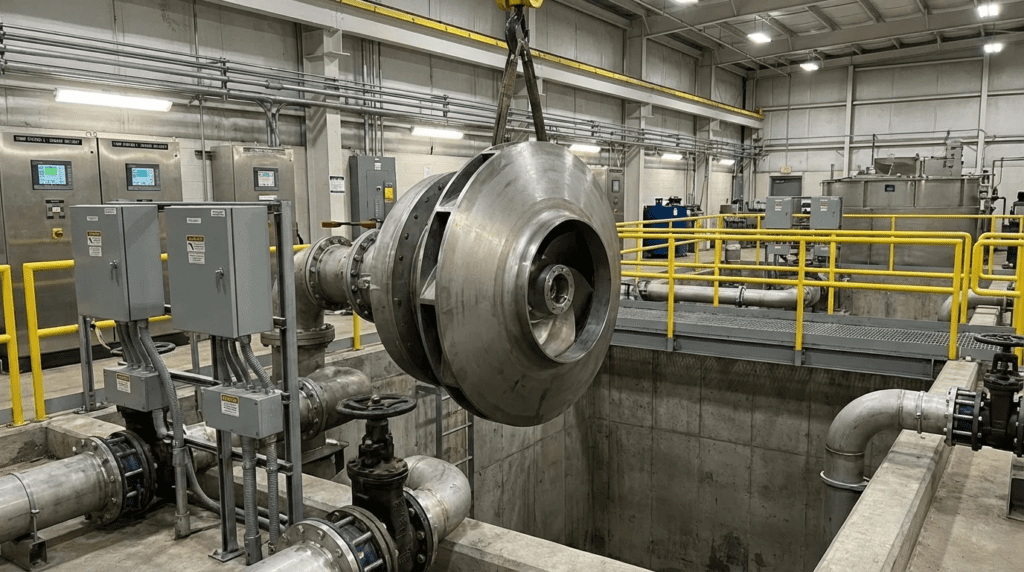
For municipal and industrial engineers, the “pump” is often treated as a singular asset, yet the success or failure of a pumping station frequently hinges on a single component: the impeller. The rise of non-dispersible solids (flushable wipes) and the demand for higher energy efficiency have created a paradox in modern wastewater design. High-efficiency geometries are often prone to clogging, while traditional open-channel non-clog designs may consume excessive power. This article analyzes the Top 10 Impeller Manufacturers for Water and Wastewater, focusing on the Original Equipment Manufacturers (OEMs) that engineer specific hydraulic geometries to solve these complex fluid dynamics challenges.
In water and wastewater treatment, impellers are rarely commodity items; they are the heart of the hydraulic end, dictating head, flow, efficiency, and solids handling capability. Consulting engineers and plant directors must navigate a marketplace filled with proprietary designs—from screw centrifugal to semi-open chopper configurations. Selecting the wrong impeller type for a specific sludge profile or raw influent stream can lead to catastrophic ragging events, motor overloads, and reduced Mean Time Between Failures (MTBF).
This comprehensive guide moves beyond marketing claims to evaluate the engineering principles behind leading impeller technologies. We will examine how to specify these components for maximum reliability, compare the top manufacturers based on application fit, and explore the lifecycle cost implications of hydraulic selection.
How to Select / Specify
Selecting the correct hydraulic end requires a rigorous analysis of the intersection between fluid properties and mechanical design. When evaluating the Top 10 Impeller Manufacturers for Water and Wastewater, engineers must look past the pump curve to understand the underlying geometry and its interaction with the process media.
Duty Conditions & Operating Envelope
The foundation of impeller specification lies in the system curve. While flow (Q) and Head (H) determine the Best Efficiency Point (BEP), the operating envelope in wastewater is rarely static.
- Variable Flow Profiles: Wastewater influent follows diurnal patterns. An impeller selected for peak wet weather flow may operate efficiently for only 5% of the year. It is critical to analyze the impeller’s performance at minimum flows where recirculation and cavitation risks increase.
- Solids Loading: “Solids handling” is a vague specification term. Engineers must define the nature of the solids: stringy fibrous material (requiring shear or self-cleaning actions), abrasive grit (requiring hardened materials), or heavy sludge (requiring screw centrifugal or recessed designs).
- VFD Turn-down: When pairing impellers with Variable Frequency Drives (VFDs), verify that the minimum scouring velocity (typically 2-3 ft/s in the discharge piping) is maintained at low speeds to prevent sedimentation.
Materials & Compatibility
The material of construction (MOC) for the impeller is often the first line of defense against erosion and corrosion. Standard cast iron is frequently insufficient for modern wastewater streams.
- High Chrome Iron (ASTM A532): Essential for grit chambers and primary sludge applications where abrasion is the primary failure mode. Hardness levels often exceed 600 Brinell.
- Duplex Stainless Steel (CD4MCu): The industry standard upgrade for resistance to both abrasion and chemical corrosion (H2S). It offers superior tensile strength compared to 316SS.
- Hardening Processes: Some manufacturers offer flame hardening or proprietary coatings on the leading edges of vanes to maintain cutting capability in chopper pumps.
Hydraulics & Process Performance
Balancing hydraulic efficiency with passage size is the central trade-off in impeller design.
- Sphere Passing Size: A critical specification parameter (e.g., passing a 3-inch sphere). However, a 3-inch sphere requirement does not guarantee the ability to pass a 3-foot long rag.
- NPSH Margin: Net Positive Suction Head Required (NPSHr) varies significantly by impeller type. Vortex impellers typically require lower NPSH but offer lower efficiency compared to enclosed channel impellers.
- Steep vs. Flat Curves: For applications with variable static head (e.g., filling a tank), a steep Head-Capacity curve is desirable to minimize flow variation.
Installation Environment & Constructability
The physical constraints of the wet well or dry pit influence impeller choice, particularly regarding the suction approach.
- Suction Conditions: Poor wet well design (e.g., lack of baffles, air entrainment) will destroy even the best-designed impeller. Screw centrifugal impellers are generally more tolerant of poor inlet conditions than high-speed multi-vane impellers.
- Clearance Adjustment: How is the clearance between the impeller and the wear plate/volute maintained? Designs that allow external adjustment without disassembling the pump casing reduce maintenance labor hours significantly.
Reliability, Redundancy & Failure Modes
Reliability analysis should focus on the consequences of clogging. A clogged impeller creates imbalance, leading to:
- Radial Loading: Excessive radial forces deflect the shaft, destroying mechanical seals and bearings.
- Vibration: High vibration leads to structural fatigue in the piping supports and baseplates.
- Heat Buildup: In submersible applications, a stalled impeller can overheat the stator windings if thermal protection fails.
Controls & Automation Interfaces
Modern impellers, particularly “smart” pumping systems, integrate closely with control logic.
- Anti-Clog Functionality: Many modern VFDs include algorithms that detect high torque/low flow conditions indicative of a rag ball forming. The drive can reverse the impeller rotation to clear the obstruction. This requires an impeller locking system capable of handling reverse torque.
- Power Monitoring: Constant power monitoring can detect wear ring degradation. As the recirculation gap increases, volumetric efficiency drops, and specific energy (kW/MGD) rises.
Maintainability, Safety & Access
Safety is paramount when operators must access pumps to clear blockages. Impellers that require frequent de-ragging expose staff to:
- Confined space entry hazards.
- Biohazards (raw sewage contact).
- Sharps and heavy lifting injuries.
Specifying self-cleaning or chopper impellers reduces the frequency of these hazardous interventions.
Lifecycle Cost Drivers
The Total Cost of Ownership (TCO) for a wastewater pump is heavily skewed toward energy and maintenance.
- Efficiency vs. Reliability: An enclosed channel impeller may have 80% wire-to-water efficiency but clog weekly. A vortex impeller may have 50% efficiency but never clog. If the labor cost to de-rag is $500 per event, the lower efficiency pump often yields a lower TCO.
- Wear Components: Evaluate the cost and lead time of wear rings and suction liners. Impellers that rely on tight clearances to maintain efficiency will incur higher parts costs over 20 years.
Comparison Tables
The following tables provide an engineering comparison of the major market players and specific impeller technologies. Table 1 focuses on the OEMs who design and manufacture proprietary impeller geometries. Table 2 provides an application matrix to assist in selecting the correct hydraulic type for specific process streams.
Table 1: Top 10 Impeller Manufacturers (OEMs) Engineering Profile
| Manufacturer (OEM) | Primary Hydraulic Strength | Key Technologies / Series | Typical Applications | Engineering Limitations / Considerations |
|---|---|---|---|---|
| Xylem (Flygt) | Self-Cleaning / Adaptive | N-Technology, Concertor | Raw sewage, lift stations, heavy ragging environments. | Requires precise wear ring adjustment to maintain efficiency. Proprietary designs limit aftermarket parts options. |
| Sulzer | High-Efficiency Non-Clog | Contrablock, ABS series | Municipal wastewater, large axial flow flood control. | Contrablock system requires occasional adjustment. Excellent hydraulic coverage but verify material options for abrasive grit. |
| KSB | Optimized Hydraulics | Amarex, Sewatec (F-max) | Wastewater treatment plants, sludge transport. | Focus on free-flow impellers (vortex) leads to lower efficiency in exchange for reliability. Large portfolio requires careful selection. |
| Hidrostal | Screw Centrifugal | Original Screw Centrifugal Impeller | RAS/WAS, delicate floc, fish friendly, heavy sludge. | Single-vane screw design requires large Ns. Can be sensitive to suction conditions. Efficiency drops significantly if liner gap widens. |
| Vaughan | Chopper / Conditioning | Chopper Pumps (E-Series) | Digester recirculation, scum pits, lift stations with heavy debris. | “Conditioning” pump; not designed for high hydraulic efficiency. Higher HP required for chopping action. Wear on cutting edges requires monitoring. |
| Gorman-Rupp | Self-Priming Trash Handling | Super T-Series, Ultra V | Above-ground lift stations, bypassing. | Two-vane open impellers are robust but less efficient than submersible counterparts. Suction lift limitations apply (physically limited to ~25ft). |
| Wilo | Solid Impellers (Ceram) | SOLID Impellers, Ceram coatings | Sewage collection, abrasive fluids. | Strong focus on specialized coatings (Ceram) to extend life, which can be costly to repair if chipped. |
| Fairbanks Morse (Pentair) | Vortex & Non-Clog | Vortex, VTSH | Municipal solids handling, grit applications. | Traditional robust designs (cast iron heavy). May lag in “smart” integrated hydraulics compared to European competitors. |
| Ebara | Submersible Grinder/Non-Clog | DL Series, DGF | Small to medium municipal stations. | Excellent availability for smaller HP ranges. Semi-open impellers in some series may be prone to ragging if not sized correctly. |
| Hayward Gordon | Recessed / Vortex | Torus, XCS Screw | Grit, heavy sludge, industrial wastewater. | Specializes in difficult fluids. Recessed impellers have lower hydraulic efficiency (35-50%) but pass large solids without contact. |
Table 2: Impeller Application Fit Matrix
| Application | Recommended Impeller Type | Alternate Option | Key Constraint / Decision Factor | Risk of Incorrect Selection |
|---|---|---|---|---|
| Raw Sewage Lift Station | Self-Cleaning Semi-Open | Vortex / Recessed | Presence of wipes/rags. | Immediate clogging; frequent operator call-outs. |
| RAS / WAS Return | Screw Centrifugal | Mixed Flow | Need for gentle handling to preserve biological floc. | Shearing of floc, reducing downstream settling efficiency. |
| Digester Recirculation | Chopper | Screw Centrifugal | Hair and fibrous material accumulation; heat exchanger protection. | Heat exchanger plugging; scum blanket formation. |
| Grit Chamber / Pumping | Recessed (Vortex) Ni-Hard/Hi-Chrome | Hardened Enclosed | Extreme abrasion. | Rapid wear of vanes and volute; loss of performance in weeks. |
| Effluent / Reuse Water | Enclosed Channel (High Eff.) | Mixed Flow | Energy efficiency (clean water). | Wasted energy OPEX; unneeded solids handling capability. |
| Primary Sludge (Thick) | Screw Centrifugal | Recessed (Vortex) | High viscosity / High solids %. | Cavitation; inability to prime; line plugging. |
Engineer & Operator Field Notes
Real-world performance often deviates from the test curves generated in controlled factory environments. The following sections detail practical insights for commissioning and maintaining these components.
Commissioning & Acceptance Testing
During the commissioning phase, verifying the impeller’s performance is critical.
- Rotation Check: It sounds elementary, but running a 3-phase pump in reverse is a common error. A centrifugal pump will still pump flow in reverse (at roughly 40-60% capacity and head), often leading engineers to believe the pump is simply underperforming. Always verify rotation via bump test or phase rotation meter.
- Vibration Baselines: Establish a vibration baseline (velocity in in/s or mm/s) at the bearings immediately upon startup. This “fingerprint” is essential for detecting future impeller imbalance caused by uneven wear or rag accumulation.
- Amp Draw Analysis: Verify that the amp draw aligns with the curve at the operating point. High amps may indicate a higher specific gravity than anticipated or rubbing internal clearances.
Common Specification Mistakes
Avoid these frequent pitfalls in bid documents:
- Over-specifying Efficiency: Mandating a minimum efficiency of 80% for a raw sewage pump often forces manufacturers to offer tight-clearance enclosed impellers that are prone to clogging. Prioritize sustained efficiency over clean-water factory efficiency.
- Ignoring Cable Entry: For submersible units, the cable entry is a weak point. Ensure the specification requires capillary barriers to prevent water wicking into the motor if the cable jacket is cut.
- Vague Material Specs: Specifying “Stainless Steel” is insufficient. 304SS offers poor abrasion resistance. Specify CD4MCu or Hardened Chrome Iron for wastewater service.
O&M Burden & Strategy
Maintenance strategies depend heavily on the impeller type selected.
- Clearance Adjustments: Semi-open and screw centrifugal impellers require periodic clearance adjustments (tightening the gap between impeller and liner) to maintain head and efficiency. This should be scheduled annually or based on performance degradation.
- Chopper Maintenance: Chopper pumps require sharpening or replacement of the cutter bar/anvil. Dull cutters increase motor load and reduce effectiveness.
- Predictive Maintenance: Use SCADA trends. A gradual increase in power consumption for the same flow rate indicates wear (recirculation). A sudden increase in vibration typically indicates a rag ball caught on a vane or a chipped impeller.
Troubleshooting Guide
- Symptom: High Amps / Trip.
Possible Cause: Ragging, high specific gravity, or rubbing wear rings.
Action: De-rag pump; check clearances; verify fluid density. - Symptom: Low Flow / Head.
Possible Cause: Reverse rotation, excessive wear ring clearance, air binding.
Action: Check phase rotation; adjust liner gap; check wet well levels for vortexing. - Symptom: Excessive Vibration.
Possible Cause: Imbalanced impeller (erosion or clogging), bent shaft, resonance.
Action: Inspect impeller for missing mass; check alignment; perform vibration spectrum analysis.
Design Details / Calculations
Engineering the correct hydraulic selection involves understanding the physics of the application.
Sizing Logic & Methodology
Impeller sizing is not arbitrary; it is governed by the Specific Speed ($N_s$) of the application.
$$ N_s = frac{N times sqrt{Q}}{H^{0.75}} $$
Where:
- $N$ = Pump Speed (RPM)
- $Q$ = Flow (GPM) at BEP
- $H$ = Head (ft) at BEP
Interpretation:
- Low $N_s$ (500-1000): Radial flow impellers. High head, low flow. Narrow channels. High risk of clogging in small sizes.
- Medium $N_s$ (2000-4000): Mixed flow impellers. The “sweet spot” for most municipal sewage applications. Good balance of solids handling and efficiency.
- High $N_s$ (5000+): Axial flow (propeller). High flow, low head. Used for flood control and recirculation.
Specification Checklist
When writing the equipment schedule or technical specification, ensure these items are explicitly defined:
- Design Operating Point: Flow (GPM) and Head (ft).
- Secondary Operating Points: Minimum flow and run-out flow.
- NPSH Available (NPSHa): calculated at the lowest wet well level.
- Max Solid Size: Required sphere passing diameter.
- Fluid Characteristics: Temp, pH, Specific Gravity, abrasiveness (Mohs scale if known).
- Impeller Type Preference: (e.g., “Single vane screw centrifugal” or “Two-vane semi-open non-clog”).
- Balancing Standard: ISO 1940-1 Grade G6.3 is typical for wastewater impellers.
Standards & Compliance
- Hydraulic Institute (HI) Standards: Reference HI 1.1-1.2 for nomenclature and HI 1.3 for testing. Acceptance Grade 1U or 1B is standard for municipal pumps.
- AWWA E-Standards: Ensure compliance with applicable AWWA standards for coatings and materials.
- UL/FM: If the environment is classified (Class 1 Div 1 or 2), the pump/impeller assembly must be part of a hazardous location rated system.
Frequently Asked Questions
What is the difference between a vortex impeller and a channel impeller?
A channel impeller (enclosed or semi-open) directs flow through defined vane passages, physically pushing the liquid. It offers higher efficiency but tighter clearances where solids can lodge. A vortex (recessed) impeller sits back in the volute housing, creating a swirling fluid mass (vortex) that pulls the liquid through. The impeller rarely touches the solids, making it excellent for grit and large debris, but it is significantly less energy-efficient (typically 35-50% efficiency).
How do I select the right impeller material for abrasive grit?
Standard cast iron wears quickly in grit applications. High Chrome Iron (ASTM A532) is the industry standard for abrasion resistance due to its high hardness (approx. 600 Brinell). However, High Chrome is brittle and hard to machine. If corrosion is also a concern (e.g., acidic grit), Duplex Stainless Steel (CD4MCu) provides a balanced compromise between hardness and chemical resistance.
Why are screw centrifugal impellers popular for sludge?
Screw centrifugal impellers combine the properties of a positive displacement screw and a centrifugal impeller. They have a single spiral vane with a long, open channel. This design handles high-viscosity sludge (up to 6-8%) and large solids gently without the turbulence that damages biological floc or emulsifies oil and grease. They also have a steep head curve, which helps maintain flow as line pressure varies.
Can I trim a wastewater impeller to change performance?
It depends on the design. Enclosed channel impellers can often be trimmed (diameter reduced) to lower head and power consumption, similar to clean water pumps. However, single-vane, screw centrifugal, and some vortex impellers generally cannot be trimmed easily without altering the hydraulic geometry or unbalancing the unit. VFDs are the preferred method for adjusting performance in wastewater applications.
What is the “best” impeller for flushable wipes?
There is no single “best” impeller, but “self-cleaning” semi-open designs with backswept leading edges and relief grooves (like Xylem’s N-tech or similar designs from KSB/Sulzer) are specifically engineered for this. Chopper pumps are also effective but are generally used as a last resort due to higher energy costs and maintenance needs. Avoid standard enclosed channel impellers in stations prone to heavy wiping loading.
How often should impeller clearances be adjusted?
Clearances should be checked annually or whenever a drop in pump performance (flow/pressure) is noticed. For severe service (grit/sand), checks may be needed quarterly. As the gap between the impeller and the suction liner increases, internal recirculation rises, causing a drop in efficiency and an increased risk of clogging. Most modern pumps allow external adjustment of this gap.
Conclusion
Key Takeaways for Engineers
- Geometry Over Brand: Focus on the hydraulic topology (Screw, Vortex, Chopper) that fits your fluid profile before selecting a manufacturer.
- Efficiency Paradox: In wastewater, the highest efficiency pump is often the most prone to clogging. Sacrifice 5-10% wire-to-water efficiency for non-clog reliability to lower TCO.
- Material Matters: Match the metallurgy to the failure mode. High Chrome for wear, Duplex for corrosion/strength.
- Solids Definition: “Solids handling” is meaningless without defining the solid. Rags behave differently than grit.
- System Integration: An impeller does not operate in a vacuum. VFD settings, suction piping, and wet well design dictate its success.
Specifying the right hydraulic end from the Top 10 Impeller Manufacturers for Water and Wastewater is an exercise in risk management. The engineer must balance the competing demands of energy efficiency (OPEX), capital cost (CAPEX), and operational reliability. While manufacturers like Flygt, Sulzer, and KSB offer broad portfolios covering most applications, specialized OEMs like Vaughan and Hidrostal provide critical solutions for extreme process conditions.
Successful selection requires moving beyond the catalog curve. It demands a thorough understanding of the specific wastewater matrix—be it fibrous influent, abrasive grit, or delicate floc. By prioritizing the hydraulic geometry’s ability to handle the specific solid profile and ensuring the materials of construction match the chemical and physical environment, engineers can design pumping systems that deliver decades of reliable service rather than constant maintenance headaches.