
Aqua-Aerobic vs WesTech for Filtration: Pros/Cons & Best-Fit Applications
Introduction to Tertiary Filtration Selection
For municipal and industrial engineers, the tertiary filtration stage is frequently the final safeguard between regulatory compliance and permit violations. As National Pollutant Discharge Elimination System (NPDES) permits tighten—particularly regarding total phosphorus (TP) limits of < 0.1 mg/L and strict turbidity requirements for Title 22 water reuse—the margin for error in equipment selection has vanished. A common misconception among design engineers is treating filtration as a commodity unit process, assuming that "a disk filter is a disk filter" or that deep bed granular media is obsolete. This oversimplification often leads to hydraulic bottlenecks, excessive backwash waste volumes, and unforeseen Operations and Maintenance (O&M) burdens.
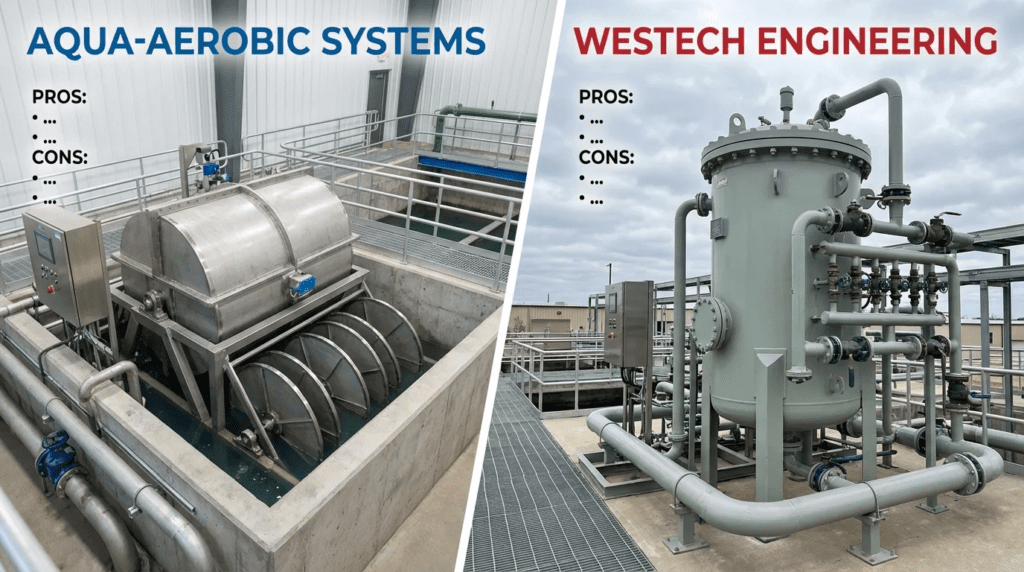
When evaluating market leaders, the comparison of Aqua-Aerobic vs WesTech for Filtration: Pros/Cons & Best-Fit Applications represents a critical decision point. This choice is rarely about one manufacturer being objectively “better” than the other; rather, it is a complex analysis of specific technology fits. Aqua-Aerobic Systems is widely recognized for pioneering pile cloth media filtration (the AquaDisk®), creating a paradigm shift toward low-head, small-footprint solutions. WesTech Engineering, while a formidable competitor in the cloth media space (SuperDisc), also brings a massive portfolio of conventional deep bed, moving bed, and compressibility media filters.
This article provides a rigorous, specification-safe breakdown of these technologies. It moves beyond sales literature to examine the hydraulic profiles, solids loading capacities, mechanical reliability, and lifecycle costs necessary to engineer a robust treatment train.
How to Select and Specify Filtration Technologies
Proper specification requires a granular analysis of the plant’s hydraulic and biological profile. Engineers must evaluate Aqua-Aerobic vs WesTech for Filtration: Pros/Cons & Best-Fit Applications based on the following engineering criteria.
Duty Conditions & Operating Envelope
The first step in selection is defining the boundary conditions of the influent. Cloth media filters (CMF), such as those offered by both manufacturers, operate primarily via surface filtration. They are exceptionally efficient at handling hydraulic peaks but have finite solids loading capacities.
- Solids Loading: Cloth media filters typically handle influent Total Suspended Solids (TSS) up to 20-30 mg/L effectively. If the secondary clarifiers are prone to bulking sludge or washouts where TSS spikes exceed 50 mg/L, deep bed granular media (a WesTech strength) may offer better depth storage and resistance to blinding.
- Hydraulic Throughput: Calculate the peak hourly flow (PHF). CMF units operate at high hydraulic loading rates (HLR), typically 3.0 to 6.0 gpm/ft². Deep bed filters generally operate at 2.0 to 4.0 gpm/ft². Space constrained sites often favor the higher HLR of cloth media.
- Variable Flow: Both technologies handle intermittent flow, but cloth media filters (standing water level) are often easier to bring online/offline automatically without the “ripening” period required for granular media to achieve effective filtration.
Materials & Compatibility
Material selection drives the longevity of the asset, particularly in corrosive wastewater environments.
- Tankage: Both manufacturers offer units in stainless steel (304 or 316) or concrete tank retrofits. For high-chloride environments or industrial effluents, verifying the grade of stainless steel and the passivation process is critical.
- Media Substrate:
- Cloth (Aqua-Aerobic & WesTech): Typically Nylon or Polyester pile cloth. Engineers must verify chemical compatibility with coagulants (Alum, PAC, Ferric) and polymers. Polyamide materials may degrade in high-chlorine residuals (>1-2 mg/L) over long durations.
- Granular (WesTech): Silica sand, anthracite, or garnet. Extremely resistant to abrasion and chemical attack but susceptible to cementing if calcium carbonate potential is high.
Hydraulics & Process Performance
The hydraulic profile is a major differentiator when analyzing Aqua-Aerobic vs WesTech for Filtration: Pros/Cons & Best-Fit Applications.
- Headloss: Cloth media filters are low-head devices. Total headloss across a clean filter is often inches of water column, with terminal headloss typically set around 12 inches (300 mm). This often allows for gravity flow through the plant without intermediate pumping.
- Deep Bed Filters: Require significantly more head (6 to 10 feet) to drive water through the media bed and underdrain system. This frequently necessitates an intermediate lift station, adding to CAPEX and OPEX.
- Backwash Hydraulics:
- Cloth: Utilizes a vacuum backwash shoe. Backwash is continuous or intermittent while the filter remains online. Reject water volume is low (typically < 3% of influent).
- Granular: Requires taking the cell offline. High-rate backwash pumps and air scour blowers are required. Reject volume can be higher (3-8%), necessitating larger washwater equalization basins.
Installation Environment & Constructability
Retrofit Capability: This is a primary driver for cloth media selection. The vertical orientation of disks allows massive surface area to be installed in existing concrete basins (e.g., abandoned traveling bridge sand filters). Aqua-Aerobic has a long history of custom-fitting the AquaDiamond® or AquaDisk® into existing rectangular basins. WesTech offers similar retrofit capabilities for their SuperDisc.
Footprint: A typical 10 MGD cloth media filter station may occupy 20-25% of the footprint required for a conventional rapid sand filter station. This constructability advantage is often the deciding factor in urban plants with limited real estate.
Reliability, Redundancy & Failure Modes
Reliability analysis focuses on the consequences of component failure.
- Mechanical Complexity: Cloth media filters involve moving parts submerged in wastewater (center tube, drive chain/gearbox, vacuum shoes, rollers). While reliable, these are wear items. Failure of a drive motor takes the entire disk unit offline.
- Static Beds: Conventional gravity filters have no moving parts in the filter cell. The mechanical complexity is shifted to the gallery (actuated valves, blowers, backwash pumps). If a valve fails, it can often be manually actuated; if a disk drive fails, the process stops.
- Redundancy: Specifications must mandate N+1 redundancy at peak flow. For cloth filters, this implies one redundant disk unit. For sand filters, one redundant cell.
Controls & Automation Interfaces
Modern filtration requires tight SCADA integration. The control logic for backwashing is critical.
- Level-Based Control: Primary control for both technologies. As solids accumulate, water level (or differential pressure) rises.
- Timer-Based Backup: Prevents biological fouling during low-flow periods by initiating a wash cycle even if headloss hasn’t risen.
- Instrumentation: Turbidity meters (influent and effluent) are mandatory. For P-removal applications, orthophosphate analyzers usually feed forward to chemical dosing pumps upstream of the filters.
Maintainability, Safety & Access
Confined Space: Maintenance on submerged disk filter components often requires tank drainage and confined space entry. Some designs allow for individual disk segment removal without draining the tank, but this is a wet, labor-intensive task.
Media Replacement:
- Cloth: Socks/panels are consumables, typically replaced every 3-7 years depending on loading and cleaning frequency. Replacement is a manual operation.
- Sand/Anthracite: Typically lasts 15-20+ years unless upset conditions cause media loss or cementing. Topping off media is common; full replacement is a major capital project involving vactor trucks.
Lifecycle Cost Drivers
The total cost of ownership (TCO) analysis for Aqua-Aerobic vs WesTech for Filtration: Pros/Cons & Best-Fit Applications usually yields the following split:
- CAPEX: Cloth media filters generally have lower CAPEX due to reduced concrete work and smaller footprint.
- OPEX (Energy): Cloth media filters save energy by eliminating intermediate pumping (low headloss) and using low-horsepower backwash pumps.
- OPEX (Maintenance): Cloth media requires periodic cloth replacement and chemical cleaning (acid/hypo) to remove fouling. Granular media has lower material maintenance but higher energy costs for backwash pumping and air scour.
Comparison Tables: Technologies and Applications
The following tables provide a direct comparison between the equipment types and their suitability for various engineering scenarios. These tables are designed to assist in preliminary equipment selection and specification development.
Table 1: Technology & Manufacturer Comparison
| Manufacturer / Technology | Primary Strengths | Typical Applications | Limitations / Considerations | Maintenance Profile |
|---|---|---|---|---|
| Aqua-Aerobic (AquaDisk® / AquaDiamond®) |
|
|
|
Medium: Periodic cloth replacement (3-7 yrs), vacuum shoe adjustment, drive chain lubrication. |
| WesTech (SuperDisc) |
|
|
|
Medium: Similar to Aqua-Aerobic; emphasizes ease of panel replacement. |
| WesTech (Conventional Deep Bed / Gravity) |
|
|
|
Low/High Split: Low daily maintenance, but high effort for media replacement or underdrain repair (rare events). |
Table 2: Application Fit Matrix
| Application Scenario | Constraint: Space | Constraint: Hydraulics | Constraint: O&M Staffing | Best-Fit Technology Direction |
|---|---|---|---|---|
| Strict P-Removal (Tertiary) New Construction |
Unlimited | Pumping available | High Skill | Deep Bed Sand (WesTech) – Provides polishing depth and chemical reaction time. |
| Strict P-Removal (Tertiary) Retrofit / Constrained |
Limited | Gravity flow preferred | Limited Staff | Cloth Media (Aqua-Aerobic or WesTech) – Fits in tight spaces, handles chemical precipitates well. |
| Water Reuse (Title 22) Variable Flow |
Moderate | Low Head Available | Moderate Skill | Cloth Media – Approved for Title 22 high loading rates (up to 6 gpm/ft²). |
| CSO / Wet Weather Intermittent High Flow |
Critical | Gravity Flow | Unattended | Cloth Media – Rapid startup, no ripening period required. |
| Industrial / High Oil & Grease | Variable | Variable | Variable | Deep Bed / Media – Cloth media is prone to irreversible blinding by free oil/grease. |
Engineer & Operator Field Notes
Real-world performance often deviates from catalog data. The following notes are compiled from field observations regarding Aqua-Aerobic vs WesTech for Filtration: Pros/Cons & Best-Fit Applications.
Commissioning & Acceptance Testing
During the Factory Acceptance Test (FAT) and Site Acceptance Test (SAT), engineers must be vigilant.
- Solids Loading Stress Test: Do not just test hydraulic throughput with clean water. The specification should require performance verification at design solids loading. For cloth filters, observe the backwash frequency. If the unit backwashes continuously at 50% of design solids loading, the media pore size may be too small or the effective filtration area is overestimated.
- Vacuum Shoe Alignment (Aqua/WesTech Cloth): A critical punch list item. If the vacuum shoe does not ride perfectly flush against the cloth media face, suction is lost, and the cloth is not cleaned effectively. This leads to “racetracking” or uneven cleaning patterns visible on the disks.
- Level Sensor Calibration: Ensure the ultrasonic or pressure transducers controlling the backwash trigger are calibrated to the actual weir elevation. Incorrect settings cause short-cycling.
Common Specification Mistakes
Over-Specifying Media Life: Specifications often demand a “guaranteed” media life of 5+ years for cloth. Manufacturers will agree to this mechanically, but biological fouling or mineral scaling is a process issue, not a warranty defect. Specification language should focus on mechanical integrity, not process-dependent longevity.
Ignoring Clarifier Performance: Engineers often size filters assuming secondary clarifiers will always output < 15 mg/L TSS. Real-world upsets happen. Aqua-Aerobic vs WesTech for Filtration: Pros/Cons & Best-Fit Applications discussions must account for upset conditions. If the plant has a history of clarifier washouts, a deep bed filter (WesTech) might survive the event better than a cloth filter, which may plug solidly and bypass.
O&M Burden & Strategy
Algae Control: Both Aqua-Aerobic and WesTech cloth filters are susceptible to algae growth on the upper (exposed) portion of the disks if installed outside. Covers are mandatory in most climates to prevent photosynthesis on the media, which blinds the cloth. If covers are value-engineered out, expect increased manual power washing requirements.
Spare Parts Inventory:
- Cloth Filters: Stock 10-15% spare cloth socks/panels, one vacuum pump rebuild kit, and one drive motor.
- Granular Filters: Stock valve actuators and limit switches. Media is not a shelf-spare.
Troubleshooting Guide
Symptom: Continuous Backwashing (Cloth Media)
- Cause 1: High influent solids loading exceeding design.
- Cause 2: Biological fouling (biofilm) on the cloth reducing porosity. Solution: Perform a chemical clean (shock chlorination or acid wash).
- Cause 3: Vacuum pump failure or clogged suction lines. Solution: Check vacuum gauges; clean suction manifold.
Symptom: High Effluent Turbidity (Granular Media)
- Cause: Channeling or “mud-balling” in the media bed. Solution: Inspect bed surface during backwash. If distribution is uneven, the underdrain nozzles may be clogged or broken.
Design Details and Calculations
Sizing Logic & Methodology
When engineering a system involving Aqua-Aerobic vs WesTech for Filtration: Pros/Cons & Best-Fit Applications, sizing is driven by the Surface Loading Rate (SLR).
1. Calculate Required Surface Area:
$$ Area_{required} (ft^2) = frac{Q_{peak} (gpm)}{SLR (gpm/ft^2)} $$
Typical SLR Values:
- Deep Bed Sand: 2.0 – 4.0 gpm/ft²
- Cloth Media (Standard): 3.0 – 6.0 gpm/ft²
- Cloth Media (Peak/Wet Weather): up to 9.0 gpm/ft² (vendor specific)
2. Determine Net vs. Gross Area:
For cloth media, manufacturers rate units based on submerged effective area. As water level rises during filtration, effective area increases. Specifications must define the SLR at the average operating level, not just the maximum overflow level, to ensure conservative design.
3. Backwash Waste Calculation:
Engineers must size the plant’s headworks or return stream handling to accommodate filter backwash.
- Cloth Media: Backwash Rate $approx$ 2-3% of Forward Flow. Pumping is intermittent but high frequency.
- Granular Media: Backwash Volume $approx$ 150-200 gallons per $ft^2$ of bed area per wash. This is a massive slug of water that usually requires an equalization tank before returning to the head of the plant.
Specification Checklist
To ensure a competitive yet high-quality bid environment:
- Definition of Filtration Area: Explicitly define how area is calculated to prevents manufacturers from over-claiming effective area.
- Material Origin: Specify “AIS” (American Iron and Steel) compliance if federal funding is involved. Both Aqua-Aerobic and WesTech can comply, but it affects lead time and cost.
- Performance Bond: Require a process performance bond tied to effluent turbidity (e.g., < 2 NTU) and Phosphorus limits based on defined influent conditions.
- Control System: Specify “Non-Proprietary” PLC hardware (e.g., Allen-Bradley CompactLogix) so plant staff can troubleshoot code if necessary. Avoid “Black Box” controllers.
Standards & Compliance
- AWWA Standards: Reference AWWA B100 for Granular Filter Material. Note that cloth media is generally proprietary and not covered by a generic AWWA material standard, requiring stricter performance-based specifications.
- Title 22 (California): The de facto standard for water reuse. Verify the specific model number proposed has current Title 22 unconditional acceptance. Both Aqua-Aerobic (AquaDisk) and WesTech (SuperDisc) have lists of approved loading rates for specific influent turbidities.
Frequently Asked Questions
What is the main difference between Aqua-Aerobic AquaDisk and WesTech SuperDisc?
While both are cloth media filters, the primary differences lie in the drive mechanism and cloth attachment. Aqua-Aerobic typically uses a cloth “sock” pulled over the disk segments, whereas WesTech’s SuperDisc often utilizes a panel-based system where cloth is mechanically bonded or clamped to a frame. Additionally, the backwash shoe mechanics and drive chain configurations differ. From a process standpoint, both achieve similar effluent quality, but maintenance procedures for changing the media differ.
How do you select between cloth media and sand filters for phosphorus removal?
Selection depends on the phosphorus limit and chemical usage. Both Aqua-Aerobic vs WesTech for Filtration: Pros/Cons & Best-Fit Applications can achieve TP < 0.1 mg/L with upstream coagulation. Cloth media is preferred for footprint-constrained sites and lower energy use. Sand filters are preferred if the influent has high biological solids potential or if the facility desires a "polishing" step that also provides some biological denitrification (deep bed). Sand filters generally offer more buffer against chemical overdosing (blinding) than cloth.
What is the typical lifespan of cloth filtration media?
In municipal wastewater applications, cloth media typically lasts 3 to 7 years. Lifespan is reduced by high influent solids, frequent high-pressure backwashing, presence of abrasive grit, or exposure to high chlorine residuals which can degrade Nylon/Polyester fibers. Operators should budget for replacement every 5 years as a baseline.
Why does my cloth filter backwash continuously?
Continuous backwashing indicates the filter cannot process the incoming flow at the current headloss. This is usually caused by (1) Influent TSS exceeding design capacity, (2) Excessive polymer dosing causing “sticky” floc that blinds the cloth, (3) Biological fouling (slime) that requires a chemical clean, or (4) Mechanical failure of the backwash pump/shoe failing to clean the media surface effectively.
How much does a 10 MGD tertiary filtration system cost?
Costs vary wildly by site complexity, but generally, cloth media equipment packages range from $0.08 to $0.15 per gallon of installed capacity (approx. $800k – $1.5M for equipment only for 10 MGD). Conventional deep bed sand filters have higher civil/concrete costs, often making the total installed project cost 20-40% higher than a cloth media solution. Always obtain current quotes from manufacturers.
Can WesTech filters be retrofitted into Aqua-Aerobic basins?
Yes, and vice versa. Since both manufacturers offer cloth media solutions (discs or diamonds) designed to drop into existing concrete basins, engineers can often design a “technology neutral” concrete basin that accommodates either manufacturer’s equipment with minor modifications to baffle walls and grout fillets.
Conclusion
KEY TAKEAWAYS
- Process Fit First: Use Cloth Media (Aqua/WesTech) for low headloss, small footprint, and reuse applications. Use Deep Bed (WesTech) for massive solids loading capacity and shock resistance.
- Headloss Matters: Cloth filters save energy by often eliminating intermediate pump stations (requiring only ~12-24″ hydraulic profile).
- Define “Equivalent”: When bidding Aqua-Aerobic vs WesTech for Filtration: Pros/Cons & Best-Fit Applications, ensure the “active filtration area” definitions are identical in the spec to prevent undersizing.
- Redundancy: Always design N+1. Mechanical filters (cloth) fail “closed/offline,” whereas sand filters are static.
- Maintenance Strategy: Cloth filters trade daily operational simplicity for periodic intensive maintenance (cloth changes). Sand filters are the opposite (complex daily backwash ops, rare media replacement).
The choice between Aqua-Aerobic and WesTech is not simply a brand preference; it is a selection between specific filtration philosophies and mechanical executions. Aqua-Aerobic remains the standard-bearer for cloth media filtration with a massive installation base and a focus on optimization of the pile cloth technology. WesTech offers a broader, agnostic approach, able to supply cloth media where it fits, but also providing industry-leading deep bed and continuous backwash sand solutions where the application demands robustness over compactness.
For the design engineer, the path forward involves rigorous hydraulic modeling and a clear understanding of the facility’s O&M capabilities. If the facility has limited staff and tight space, the cloth media route (comparing AquaDisk vs SuperDisc) is logical. If the facility demands maximum resilience to upset conditions and has ample space, the deep bed approach remains valid. By focusing on the specific duty conditions—loading rates, backwash waste handling, and lifecycle costs—engineers can specify a system that ensures compliance for decades to come.