Non-Clog Wastewater Pumps VFD Setup: Preventing Overheating
INTRODUCTION
The integration of Variable Frequency Drives (VFDs) with non-clog wastewater pumps has become the standard for modern municipal lift stations and treatment plants. While VFDs offer significant benefits regarding energy efficiency, flow matching, and reduced mechanical stress during startup, they introduce complex thermal challenges that are often underestimated during the design phase. A critical failure point in these systems is the breakdown of motor insulation or bearing lubricant due to excessive heat generation when the Non-Clog Wastewater Pumps VFD Setup: Preventing Overheating strategy is flawed. Engineers frequently encounter scenarios where pumps sized for peak flow operate inefficiently at low speeds, leading to inadequate cooling and eventual catastrophic failure.
This challenge is pervasive in both dry-pit and submersible applications. In municipal wastewater systems, pumps must handle solids-laden fluids while adhering to wide operating ranges. The disconnect often lies between the hydraulic design—focused on passing 3-inch solids and meeting Total Dynamic Head (TDH)—and the electrical reality of pulse-width modulation (PWM) waveforms and reduced cooling fan efficiency. If the VFD parameters are not harmonized with the motor’s thermal capabilities and the system’s static head requirements, the result is often a shortened equipment lifespan.
The consequences of poor thermal management are severe. A motor winding failure can cost municipalities tens of thousands of dollars in emergency bypass pumping, rewinding services, and crane mobilization. Furthermore, heat stress is cumulative; a motor that consistently runs 10°C above its rated temperature can see its insulation life reduced by 50%. This article aims to provide consulting engineers and plant directors with a rigorous technical framework for specifying, installing, and tuning VFD-driven non-clog pumping systems to ensure thermal stability and long-term reliability.
HOW TO SELECT / SPECIFY
To ensure a robust lifecycle for wastewater pumping systems, the specification process must move beyond simple duty points. It requires a holistic view of the electromechanical system. The following criteria outline the essential considerations for Non-Clog Wastewater Pumps VFD Setup: Preventing Overheating.
Duty Conditions & Operating Envelope
The most common cause of overheating in VFD applications is operating the pump below its minimum thermal or hydraulic speed. Unlike constant speed pumps, VFD-driven units have a variable operating envelope that is constrained by the system curve.
Engineers must define the Minimum Continuous Stable Flow (MCSF) not just for hydraulic stability (recirculation cavitation) but for thermal stability. In wastewater applications with high static head, there is a specific frequency (e.g., 38 Hz) below which the pump produces zero flow (churning). Operating at or near this point generates immense heat within the volute and transfers it to the motor shaft and bearings. Specifications must explicitly state the minimum allowable frequency based on the intersection of the pump curve and the static head, plus a safety margin.
Furthermore, the duty cycle matters. Intermittent duty (S3) allows for cooling periods, whereas continuous duty (S1) at partial load requires robust heat dissipation strategies. Future capacity planning often results in oversized pumps; if these pumps are forced to run at 30% speed for the first 5 years, the lack of cooling airflow (for TEFC motors) can lead to premature failure.
Materials & Compatibility
When VFDs are involved, standard NEMA Design B motors are often insufficient. Specifications should mandate NEMA MG1 Part 31 compliance, which ensures the insulation system is capable of withstanding the voltage spikes (dV/dt) associated with VFD operation. The insulation class is a primary defense against overheating.
- Class F Insulation: Standard for many submersible motors, rated for 155°C.
- Class H Insulation: Preferred for VFD applications, rated for 180°C. Specifying Class H insulation with a Class B temperature rise provides a significant thermal buffer, allowing the motor to run cooler relative to its limit.
Additionally, the choice of impeller material impacts thermal performance indirectly. Hardened iron (e.g., ASTM A532) resists abrasion, maintaining hydraulic efficiency. Worn impellers require higher speeds (and current) to maintain flow, increasing the thermal load on the motor.
Hydraulics & Process Performance
The relationship between the pump’s best efficiency point (BEP) and the VFD operating range is critical. Operating too far left on the curve (low flow) increases radial loads and vibration, which generates heat in the bearings. Operating too far right (runout) increases amp draw.
For Non-Clog Wastewater Pumps VFD Setup: Preventing Overheating, the system curve must be accurately modeled. In force mains, the static head component is constant. As pump speed decreases according to the Affinity Laws, flow drops linearly, but head drops with the square of the speed. Engineers must verify that at the lowest VFD speed, the pump still overcomes static head and check valve cracking pressure to maintain forward flow and fluid cooling.
Installation Environment & Constructability
The physical environment dictates the cooling methodology. For dry-pit submersible or immersive pumps, the surrounding air temperature in the dry well is a limiting factor. If a motor is designed to rely on the pumped media for cooling (via a cooling jacket), the system must ensure the jacket does not clog with grease or sludge.
For standard TEFC (Totally Enclosed Fan Cooled) motors in dry pits, the cooling fan is mounted on the shaft. At 30 Hz, the fan turns at half speed, but air volume drops by a factor of roughly four to eight. This drastic reduction in cooling capacity necessitates separately driven cooling fans or significantly de-rating the motor for low-speed operation.
Reliability, Redundancy & Failure Modes
Reliability analysis must account for the “thermal memory” of the equipment. Frequent start/stops heat a motor faster than continuous running due to inrush currents (though VFDs mitigate this, soft starting still generates heat). Redundancy logic in the PLC should alternate pumps to balance thermal loading.
Common failure modes linked to overheating include:
- Bearing Grease Liquefaction: High temperatures reduce grease viscosity, leading to metal-on-metal contact.
- Stator Short Circuits: Thermal degradation of winding varnish leads to turn-to-turn shorts.
- Cable degradation: Submersible power cables can harden and crack if exposed to sustained high temperatures, leading to moisture intrusion.
Controls & Automation Interfaces
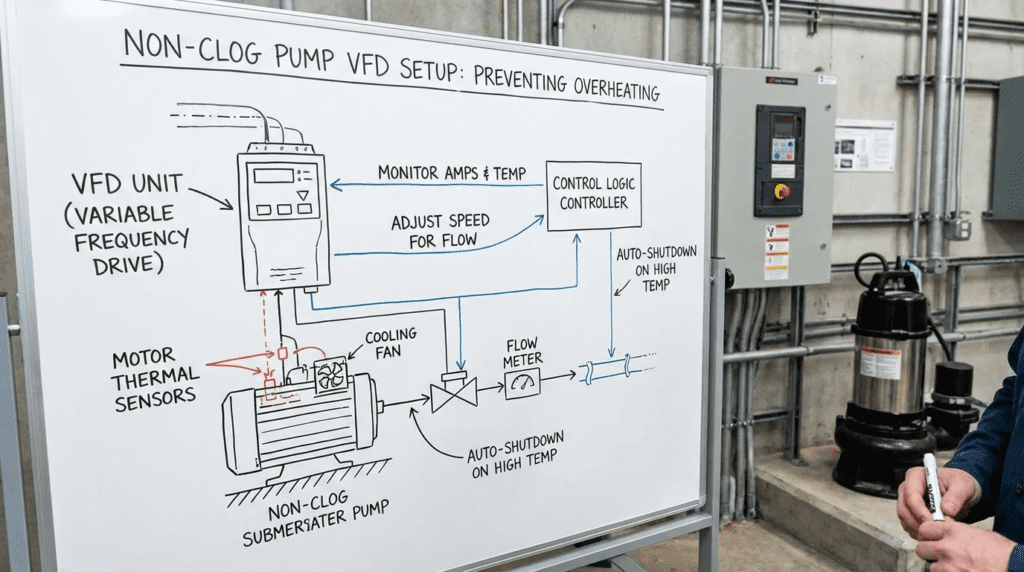
To actively prevent overheating, the setup requires direct thermal monitoring. While calculated thermal models in VFD firmware are useful, they are estimations. Physical sensors are mandatory for critical wastewater assets.
- Stator RTDs (Resistance Temperature Detectors): One per phase is standard. These should be wired into the pump protection relay or directly to the PLC.
- Bearing RTDs: Critical for larger pumps (over 50 HP) to detect mechanical heat generation before it impacts the motor windings.
- Leak Detection: Moisture in the stator housing often signifies a seal failure, but it can also be caused by condensation in a motor that heats and cools rapidly.
Maintainability, Safety & Access
Maintenance teams must be able to clean cooling surfaces. For submersible pumps with cooling jackets, the jacket often utilizes a glycol loop or pumped media. If pumped media is used (open loop), the internal channels will eventually foul with struvite or sludge. The design must allow for easy removal of the jacket for cleaning without requiring a complete motor teardown.
Safety considerations include the touch temperature of the motor housing. In a dry pit, a motor running at Class F limits (155°C internal) can have a skin temperature exceeding 100°C, posing a severe burn hazard to operators. Heat shields or insulation blankets may be required for personnel protection, though these must be designed not to impede motor cooling.
Lifecycle Cost Drivers
While VFDs are often justified by energy savings (OPEX), the cost of overheating failures can obliterate those savings. A Total Cost of Ownership (TCO) analysis should compare the cost of a VFD-rated, inverter-duty motor with upgraded cooling (e.g., closed-loop glycol) against a standard motor. The upgraded cooling system increases CAPEX but significantly reduces the risk of thermal failure, extending the mean time between failures (MTBF) from 5 years to 15+ years.
COMPARISON TABLES
The following tables assist engineers in selecting the appropriate cooling architecture and application fit for VFD-driven wastewater pumps. These comparisons focus on thermal management capabilities and operational risks.
Table 1: Motor Cooling Methodologies for VFD Applications
| Cooling Method | Mechanism | VFD Turndown Capability | Best-Fit Application | Limitations/Risks |
|---|---|---|---|---|
| TEFC (Standard Shaft Fan) | Fan mounted on motor shaft blows air over external fins. | Poor to Moderate. Cooling decreases drastically below 45-50 Hz due to fan laws. | Dry pit installations with narrow speed ranges (50-60 Hz). | High risk of overheating at low speeds. Fins can clog with dust/debris. |
| TENV (Totally Enclosed Non-Ventilated) | Relies on passive radiation and convection to surrounding air/fluid. | Moderate. Limited by surface area and ambient temperature. | Submersibles fully submerged 100% of the time. Small HP pumps. | Cannot run dry or unsubmerged. Large frame sizes required for higher HP to dissipate heat. |
| Open-Loop Cooling Jacket | Pumps a fraction of the process wastewater through a jacket around the stator. | Good. Flow is maintained as long as the pump is pumping. | Submersible or dry pit pumps where continuous submersion isn’t guaranteed. | High Clog Risk. Wastewater solids can clog jacket channels, leading to rapid overheating. |
| Closed-Loop Glycol Jacket | Internal impeller circulates glycol mixture transferring heat to process media via heat exchanger. | Excellent. Cooling is independent of pumped media quality. | Critical municipal lift stations, raw sewage with high grit/rag content. | Higher initial cost. Mechanical seal failure can contaminate glycol. |
| Blower Cooled (Force Vent) | Independent electric fan mounted to motor cowl runs at full speed constantly. | Excellent. Full cooling capacity even at 0 RPM (stall). | Dry pit pumps with wide operating ranges (e.g., 20-60 Hz). | Requires separate power source. Additional moving part to maintain. |
Table 2: Application Fit Matrix – Non-Clog Wastewater Pumps VFD Setup
| Scenario | Static Head Profile | Recommended Pump Type | VFD Thermal Strategy | Key Constraint |
|---|---|---|---|---|
| Deep Wet Well Lift Station | High Static / Low Friction | Submersible (Jacketed) | Set Minimum Frequency strictly above shut-off head. | Motor uncovers as level drops; jacket required to prevent overheat. |
| Treatment Plant Influent | Low Static / High Friction | Dry Pit Submersible or Vertical Non-Clog | Wide turndown possible. Monitor stator temps. | Low load operation at low speed may cause poor power factor/heating. |
| Stormwater / CSO | Variable | Axial Flow or Mixed Flow | Limited VFD range due to flat curve. | Churning Risk. Fast ramp times required to pass unstable zones. |
| Sludge Recirculation (RAS/WAS) | High Friction / Viscosity Changes | Horizontal Dry Pit or Chopper | Torque boost settings in VFD; External Blower Cooling. | Viscosity changes affect cooling load; standard TEFC often fails here. |
ENGINEER & OPERATOR FIELD NOTES
This section details practical strategies for managing Non-Clog Wastewater Pumps VFD Setup: Preventing Overheating in the field, drawing on lessons learned from commissioning and troubleshooting.
Commissioning & Acceptance Testing
Commissioning is the gatekeeper of reliability. Simply verifying the pump turns in the correct direction is insufficient for VFD systems. The startup plan must validate the thermal baseline.
- Determine Zero-Flow Frequency: Close the discharge valve (briefly) and slowly ramp the pump up until discharge pressure equals static head. Record this frequency. This is the absolute minimum floor. The operational minimum frequency should be set at least 2-5 Hz above this point to ensure cooling flow.
- Temperature Rise Test: Run the pump at its minimum design speed for 2-4 hours. Monitor the stator RTDs via the VFD keypad or SCADA. If the temperature fails to stabilize and continues to climb, the cooling methodology is insufficient for that duty point.
- Harmonic Check: Use a power quality analyzer to measure Total Harmonic Distortion (THD). High harmonics can cause excessive heating in the rotor. If voltage THD exceeds 5% or current THD exceeds 8-10% (depending on the drive topology), additional filtering (line reactors or DC chokes) may be required.
Common Specification Mistakes
One of the most frequent errors in RFP documents is copying “Standard Pump” specifications into a “VFD Application” without adjusting the motor requirements.
- Mistake: Specifying a “1.15 Service Factor” for VFD operation.
Reality: On a VFD, the Service Factor is effectively 1.0 due to harmonic heating. Engineers should size the motor brake horsepower (BHP) to be below the motor’s nameplate HP, not the Service Factor HP. - Mistake: Ignoring cable length.
Reality: Long lead lengths (>100 ft) between the VFD and the motor create reflected waves (voltage standing waves) that can double the voltage at the motor terminals, punching through insulation and causing internal arcing/heating. Specification of dV/dt filters or VFD-rated shielded cable is mandatory for long runs.
O&M Burden & Strategy
Operational strategies are the final line of defense against overheating. Maintenance teams should adopt a predictive mindset.
- Cooling Jacket Flushing: For open-loop jacketed pumps, flush ports should be exercised and jackets back-flushed annually, or more frequently in high-grease applications.
- Filter Maintenance: VFD cabinet filters are often neglected. A clogged cabinet filter causes the VFD itself to overheat. Modern VFDs will de-rate their output (limit current) to protect themselves, which may cause the pump to stall or fail to meet head, leading to system backups.
- Trend Analysis: Operators should set up SCADA trends for “Stator Temp vs. Speed.” A change in this slope indicates a developing issue (e.g., clogged cooling jacket or bearing wear) long before a hard failure occurs.
Troubleshooting Guide: Overheating Symptoms
Symptom: Motor Overheat Alarm at Low Speed
Root Cause: Insufficient cooling air (TEFC) or insufficient fluid velocity (Submersible).
Correction: Increase the “Minimum Frequency” parameter in the VFD. Verify the pump is actually moving fluid and not churning against a closed check valve.
Symptom: Motor Runs Hot Immediately After Start
Root Cause: Locked rotor, single phasing, or blocked volute (ragging).
Correction: Check amp draw on all three phases. Perform a “de-rag” cycle (reverse rotation) if the VFD supports it. Inspect impeller clearance.
Symptom: Recurring Bearing High Temp
Root Cause: Shaft currents caused by VFD switching frequency (common mode voltage).
Correction: Install a shaft grounding ring (e.g., AEGIS ring) or insulated bearings on the non-drive end to break the current path.
DESIGN DETAILS / CALCULATIONS
Engineering the correct Non-Clog Wastewater Pumps VFD Setup: Preventing Overheating requires specific calculations and adherence to standards.
Sizing Logic & Methodology
The determination of the minimum allowable VFD speed is a hydraulic calculation with thermal implications. The Affinity Laws state:
(N1 / N2)^2 = (H1 / H2)
Where N is speed and H is Head. To find the speed (N_min) required to overcome the Static Head (H_static) of the system:
N_min = N_rated * SquareRoot(H_static / H_shutoff_rated)
Example:
A pump is rated for 1770 RPM (60 Hz) and produces 100 ft of head at shutoff (zero flow).
The system static head (elevation difference) is 64 ft.
N_min = 1770 * sqrt(64 / 100)
N_min = 1770 * 0.8 = 1416 RPM.
In Hertz: 60 Hz * 0.8 = 48 Hz.
Crucial Insight: If the VFD minimum frequency is set to 30 Hz (a common default), and the system requires 48 Hz just to overcome gravity, the pump will operate between 30 Hz and 47 Hz without moving any water. It will churn, heat up rapidly, and fail. The design minimum must be set above this calculated value, typically +2 Hz (e.g., 50 Hz in this example).
Specification Checklist
To ensure thermal reliability, specifications must explicitly include:
- Motor Standard: “Motors shall be Inverter Duty rated in accordance with NEMA MG1, Part 31.”
- Insulation: “Class H insulation system with Class B temperature rise at full load.”
- Sensors: “Provide three (3) PT100 RTDs in stator windings (one per phase) and one (1) PT100 RTD in the lower bearing housing.”
- Cooling: “Motors shall utilize [Closed Loop Glycol / External Blower / Oversized Frame TENV] cooling suitable for continuous operation at 30% speed.”
- Cable: “VFD power cable shall be shielded, symmetric ground, rated for 2000V insulation.”
Standards & Compliance
Engineers must reference the following standards to ensure compliance and safety:
- NEMA MG1 Part 31: Defines “Definite-Purpose Inverter-Fed Polyphase Motors.” It requires insulation capable of withstanding 1600V peak spikes with a rise time of 0.1 microseconds.
- NFPA 70 (NEC) Article 430: Covers motor circuits and controllers. Specifically, look at overload protection adjustments for VFDs.
- HI 9.6.3 (Hydraulic Institute): Guideline for Allowable Operating Region (AOR) and Preferred Operating Region (POR). Operating outside the AOR is a primary cause of vibration-induced heating.
FAQ SECTION
What is the minimum speed recommended for a non-clog wastewater pump on a VFD?
There is no single universal number. The minimum speed is dictated by two factors: the hydraulic requirement to overcome static head (see the Sizing Logic section) and the thermal requirement to cool the motor. For TEFC motors, 30-40 Hz is a typical floor without auxiliary cooling. For submersible pumps, 30 Hz is common, provided the pump produces flow. However, if the static head is high, the minimum speed might be as high as 45 or 50 Hz. You must calculate the zero-flow speed and set your minimum VFD frequency above it.
How does “Carrier Frequency” affect motor overheating?
Carrier frequency (switching frequency) is the rate at which the VFD’s IGBTs switch on and off to create the sine wave. Higher carrier frequencies (e.g., 8-12 kHz) reduce audible motor noise but increase heat generation in the VFD itself. Lower carrier frequencies (e.g., 2-4 kHz) run the VFD cooler but can increase audible noise and induce higher voltage spikes at the motor terminals, potentially stressing insulation. For Non-Clog Wastewater Pumps VFD Setup: Preventing Overheating, a carrier frequency of 2.5 kHz to 4 kHz is typically optimal to balance motor insulation stress and VFD thermal performance.
Why do bearings fail more often with VFDs?
VFDs create common-mode voltages that try to find a path to ground. Often, this path is through the motor shaft and bearings. This results in Electrical Discharge Machining (EDM), where arcs pit the bearing races and degrade the grease (fluting). As the grease degrades and races pit, friction increases, leading to rapid overheating and seizure. Shaft grounding rings or insulated bearings are recommended for motors over 10-20 HP to prevent this.
Can I retrofit a VFD to an existing non-clog pump?
Yes, but with caveats. You must verify the existing motor is “Inverter Duty” or at least has Class F insulation. Old motors with Class B insulation will likely fail quickly due to voltage spikes. Furthermore, you must analyze the cooling. If the existing motor is TEFC, you may need to install an external cooling fan kit if you plan to run at low speeds. A “darning needle” filter or load reactor is also highly recommended to protect the older motor’s insulation.
What is the difference between Class F and Class H insulation?
The class denotes the maximum temperature the insulation can withstand before degrading. Class F is rated for 155°C (311°F), while Class H is rated for 180°C (356°F). In wastewater specs, it is best practice to specify a motor with Class H insulation but design the load so it operates within the Class B temperature rise limit (130°C). This provides a 50°C thermal safety margin, significantly extending motor life in harsh VFD applications.
CONCLUSION
KEY TAKEAWAYS
- Static Head Trap: Never default VFD minimum speed to 30Hz or 20Hz. Calculate the specific “zero-flow” frequency based on static head and set the minimum speed 2-5Hz above this point.
- NEMA MG1 Part 31: Mandatory specification for any motor driven by a VFD to ensure insulation can survive voltage spikes.
- Cooling Architecture: Standard TEFC motors lose 75%+ of cooling capacity at 50% speed. Use auxiliary blowers or jacketed submersibles for wide turndown applications.
- Sensor Integration: Embedded RTDs (Stator and Bearing) are not luxuries; they are essential protection devices for VFD-driven wastewater pumps.
- Insulation Strategy: Specify Class H insulation with Class B rise to create a thermal safety buffer.
The successful implementation of a Non-Clog Wastewater Pumps VFD Setup: Preventing Overheating strategy requires a convergence of hydraulic, mechanical, and electrical engineering disciplines. It is not enough to simply pair a pump with a drive; the engineer must account for the loss of cooling efficiency at low speeds, the physics of static head, and the electrical stresses imposed on motor windings and bearings.
By moving beyond boilerplate specifications and conducting rigorous thermal and hydraulic analysis during the design phase, municipal engineers can prevent costly premature failures. The integration of robust monitoring via RTDs, the selection of appropriate cooling jackets or auxiliary fans, and the correct programming of VFD minimum frequency parameters form the triad of reliable operation. When these elements are synchronized, VFD-driven non-clog pumps deliver the promised energy efficiency and process control without sacrificing asset life.