
Metering Pumps Materials Selection: Cast Iron vs Stainless vs Duplex in Wastewater
Introduction
In municipal and industrial wastewater treatment, the precision of chemical dosing is directly linked to process compliance, yet the longevity of the dosing equipment is often compromised by material mismatching. A common point of failure in chemical feed systems is not the mechanical drive mechanism, but the degradation of wetted parts due to unforeseen corrosive or abrasive interactions. When engineers approach Metering Pumps Materials Selection: Cast Iron vs Stainless vs Duplex in Wastewater applications, they are often navigating a complex trade-off between initial capital expenditure (CAPEX) and the realities of total cost of ownership (TCO).
Statistics from plant reliability studies indicate that up to 40% of premature metering pump failures are attributed to chemical attack or material fatigue rather than mechanical wear. This is particularly prevalent in facilities handling aggressive coagulants, high-viscosity polymers, or abrasive lime slurries. While thermoplastic liquid ends (PVC, PVDF) dominate the low-pressure utility market, critical process applications requiring high pressure, extreme temperature tolerance, or ATEX/explosion-proof compliance necessitate metallic liquid ends.
This article provides a technical framework for selecting between Cast Iron, 300-series Stainless Steel, and Duplex Stainless Steel. It is designed to help consulting engineers and plant superintendents specify the correct alloy for the hydraulic, chemical, and physical stresses found in modern treatment facilities. Improper specification can lead to catastrophic leaks, process upsets, and safety hazards, making material selection a critical engineering discipline.
How to Select and Specify Metallic Liquid Ends
Selecting the appropriate alloy requires a multidimensional analysis that goes beyond simple chemical compatibility charts. Engineers must consider the mechanical properties required to withstand the pulsating nature of reciprocating pumps alongside the electrochemical environment of the wastewater stream.
Duty Conditions & Operating Envelope
The first step in material selection is defining the hydraulic stress the pump head will endure. Unlike centrifugal pumps, metering pumps generate high peak pressures during the discharge stroke. The material must possess sufficient fatigue strength to withstand millions of cycles without cracking.
- Pressure Ratings: Cast iron housings are often limited to lower pressure ratings due to porosity concerns and lower tensile strength compared to steel. 316 Stainless Steel is the standard for pressures up to 3,000 PSI (207 bar), while Duplex Stainless Steel is often required for ultra-high-pressure applications (up to 10,000 PSI) often found in sludge injection or deep-well disposal, due to its higher yield strength.
- Temperature Dynamics: Wastewater treatment chemicals can react exothermically or be stored outdoors in freezing conditions. Metals offer superior dimensional stability over plastics across wide temperature ranges (-40°F to 400°F). However, thermal expansion coefficients differ; 316SS expands more than Duplex, which can impact clearance tolerances in plunger pumps.
- Variable Flow & Shock: In systems with rapid flow changes or potential water hammer, the ductility of the material matters. Duplex steels offer higher energy absorption before failure compared to brittle cast iron varieties.
Materials & Compatibility
When analyzing Metering Pumps Materials Selection: Cast Iron vs Stainless vs Duplex in Wastewater, chemical resistance is the primary driver.
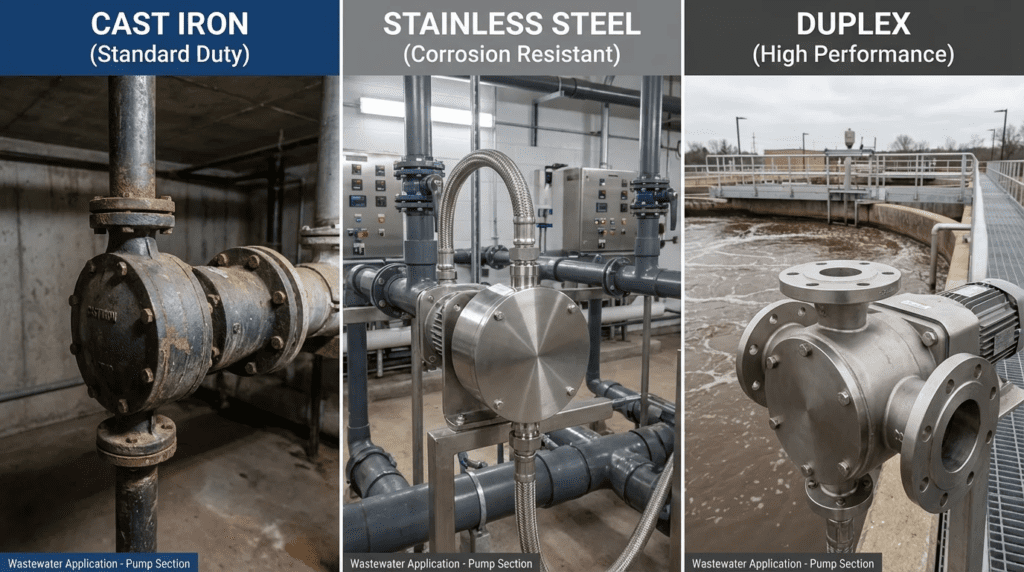
Cast Iron (ASTM A48 / A536): Historically used for pump housings and occasionally for wetted parts in non-corrosive, neutral pH applications. It is susceptible to general rusting and rapid degradation in acidic environments. In modern wastewater plants, its use in wetted parts is largely restricted to specific polymer blends or oil-based additives where corrosion is negligible.
Stainless Steel (316/316L – CF8M): The industry standard. It relies on a passive chromium-oxide layer for protection. It performs well with many polymers, alkaline solutions, and non-oxidizing acids. However, it is vulnerable to pitting and crevice corrosion in high-chloride environments (e.g., brine, ferric chloride, or certain wastewaters with high total dissolved solids).
Duplex Stainless Steel (2205 – CD3MN): A microstructure of 50% ferrite and 50% austenite provides effectively double the yield strength of 316SS and vastly superior resistance to localized corrosion. It is the preferred material for abrasive slurries (due to hardness) and high-chloride environments where 316SS would suffer from stress corrosion cracking.
When specifying alloys for chloride-rich wastewater, calculate the Pitting Resistance Equivalent Number (PREN).
PREN = %Cr + 3.3(%Mo) + 16(%N)
316SS typically has a PREN of ~24. Duplex 2205 has a PREN of ~35. A PREN > 32 is generally recommended for seawater or high-chloride brackish water service.
Hydraulics & Process Performance
Material hardness affects hydraulic efficiency over time, particularly in plunger-style metering pumps. Softer metals can wear at the packing interface, leading to “washout” and loss of volumetric efficiency.
- NPSH and Cavitation Damage: If a pump experiences cavitation, the imploding bubbles cause micro-jets that erode the pump head. Duplex stainless steel, with its higher hardness and strength, is significantly more resistant to cavitation erosion than Cast Iron or 316SS.
- Viscous Handling: For thick sludge or polymers, surface finish is critical to reduce friction losses. Stainless steels can be electropolished to Ra values < 20µin, enhancing flow characteristics for viscous fluids. Cast iron generally has a rougher surface finish, creating higher drag and potential clogging points.
Installation Environment & Constructability
The external environment is as critical as the internal fluid. Wastewater treatment plants often have atmospheres containing hydrogen sulfide ($H_2S$) or chlorine vapors.
- Atmospheric Corrosion: Unpainted Cast Iron will rust rapidly in a headworks building. While this may be cosmetic initially, it can freeze bolts and impede maintenance. Stainless steel (316) is the baseline requirement for external hardware and pump heads in these zones.
- Structural Weight: Duplex allows for thinner wall thicknesses due to higher strength, potentially reducing the weight of massive high-pressure pump heads, easing installation and maintenance access.
Reliability, Redundancy & Failure Modes
Understanding how these materials fail is crucial for risk management.
- Cast Iron: Tends to fail via general corrosion (thinning walls) or brittle fracture under impact/freeze.
- 316 Stainless: Prone to Stress Corrosion Cracking (SCC) above 60°C in chloride environments. This catastrophic failure mode occurs rapidly and often without warning.
- Duplex: Designed specifically to resist SCC. Its failure mode is more likely to be gradual wear or seal failure, providing operators with warning signs (leaks) rather than catastrophic bursts.
Lifecycle Cost Drivers
The initial purchase price (CAPEX) hierarchy is typically Cast Iron (Low) < 316SS (Medium) < Duplex (High). However, OPEX tells a different story.
If a 316SS liquid end requires replacement every 3 years due to pitting, while a Duplex head lasts 15 years, the Duplex option yields a significantly lower TCO. Furthermore, the labor cost to replace a liquid end, potential downtime penalties, and cleanup costs for leaked chemicals usually dwarf the initial material premium of Duplex alloy.
Material Comparison Tables
The following tables provide a direct comparison of the three primary metallic options for metering pump construction. Use Table 1 for technical property analysis and Table 2 to determine the best fit for specific wastewater applications.
| Feature | Cast Iron (Gray/Ductile) | Stainless Steel (316L) | Duplex (2205) |
|---|---|---|---|
| Corrosion Resistance (General) | Low (Rusts easily) | High (Passivated layer) | Very High (Resists pitting) |
| Chloride Resistance | Poor | Moderate (Risk of SCC) | Excellent (Resists SCC) |
| Abrasion Resistance | Moderate | Moderate | High (Higher hardness) |
| Yield Strength (Approx.) | 30-40 ksi | 30-35 ksi | 65-75 ksi |
| Typical Application | Non-corrosive oils, neutral slurries, housings | Polymers, dilute acids, general chemical feed | Abrasive lime, high-pressure sludge, brine/chlorides |
| Relative Cost Factor | 1.0 (Baseline) | 1.8 – 2.5x | 3.0 – 4.0x |
| Chemical / Fluid | Cast Iron Suitability | 316SS Suitability | Duplex Suitability | Engineering Notes |
|---|---|---|---|---|
| Polymer (Emulsion/Mannich) | Acceptable (if pH neutral) | Best Fit | Overkill | 316SS is standard. Cast iron can rust and contaminate polymer, reducing effectiveness. |
| Lime Slurry | Poor (Erosion risk) | Good | Best Fit | Duplex hardness resists the abrasive nature of lime grit better than 316SS. |
| Ferric Chloride | Unacceptable | Poor / Risky | Conditional | Ferric eats metals. Plastics (PVDF/Titanium) are preferred. If metal is required for pressure, Duplex or Super Duplex is mandatory. |
| Sodium Hypochlorite | Unacceptable | Unacceptable | Poor | Warning: Metals cause off-gassing in Hypo. Titanium or Hastelloy are the only safe metals. Usually PVDF is used. |
| Raw Sludge / Scum | Moderate | Good | Best Fit | High solids content and variable pH favor the hardness and corrosion resistance of Duplex. |
Engineer & Operator Field Notes
Specifying the material is only half the battle. Successful implementation requires rigorous acceptance testing and maintenance protocols tailored to the metallurgy selected.
Commissioning & Acceptance Testing
When commissioning metering pumps with metallic heads, the Factory Acceptance Test (FAT) and Site Acceptance Test (SAT) must verify material integrity.
- Hydrostatic Testing: Ensure the pump head is hydro-tested to 1.5x the design pressure. For Duplex pumps, check for any weeping at casting pores, although modern investment casting usually eliminates this.
- Passivation Verification: For 316SS and Duplex, request certificates of passivation. If the passive layer was damaged during machining or assembly and not restored, the pump will show “tea staining” or rust spots within weeks of operation in a humid wastewater plant.
- Material Traceability: For critical high-pressure applications, require Positive Material Identification (PMI) using X-ray fluorescence (XRF) to confirm the alloy composition matches the spec (e.g., confirming Mo content >2% for 316SS).
Common Specification Mistakes
Even experienced engineers make errors when dealing with Metering Pumps Materials Selection: Cast Iron vs Stainless vs Duplex in Wastewater.
Specifying “Stainless Steel” without designating the grade (304 vs 316 vs 316L) is a critical error. 304SS lacks Molybdenum and will fail rapidly in wastewater environments containing chlorides. Always specify ASTM A351 Grade CF8M (Cast 316) or Grade CD3MN (Duplex 2205) minimum.
Another error is coupling dissimilar metals. Connecting a Duplex pump head to carbon steel piping without dielectric isolation can create a galvanic cell, leading to accelerated corrosion of the carbon steel piping at the connection point.
O&M Burden & Strategy
Maintenance strategies differ by material:
- Cast Iron: Requires frequent external painting to prevent housing corrosion. Operators should monitor for thinning if used in slurry service.
- Stainless Steel (316): Requires periodic cleaning to remove deposits. Under-deposit corrosion is a major killer of stainless steel. If sludge or chemical scale builds up on the surface, oxygen is depleted, and the passive layer breaks down.
- Duplex: Lowest maintenance burden. High hardness means check valve seats (often machined into the head) last longer, reducing the frequency of head replacement or re-machining.
Troubleshooting Guide
Symptom: Reddish-brown staining on “Stainless” pump head.
Cause: Iron contamination from tools used on carbon steel, or depletion of passive layer (Rouging).
Fix: Passivation acid treatment. If pitting is deep, replacement is necessary.
Symptom: Cracks radiating from bolt holes.
Cause: Stress Corrosion Cracking (in 316SS) or Overtorquing (in Cast Iron).
Fix: Upgrade to Duplex (if SCC) or use torque wrenches strictly (if mechanical overload).
Design Details and Calculations
Precise engineering requires validating the material choice against specific design parameters.
Sizing Logic & Methodology
When selecting the material, consider the Flow Velocity through the pump head ports. High velocities with abrasive fluids accelerate erosion.
- Calculate Port Velocity: Velocity = Flow Rate / Port Area.
- Evaluate Erosion Risk: If pumping lime slurry or grit-heavy sludge, and velocities exceed 6-8 ft/s, 316SS may erode prematurely. Duplex is recommended for velocities up to 12 ft/s in abrasive service due to its higher Rockwell hardness.
- Derating for Temperature: Metals lose strength at high temperatures. While wastewater is typically ambient, exotherms in chemical feed rooms can heat pump heads. Ensure the pressure rating of the selected alloy is derated according to ASME B31.3 standards if operating above 200°F.
Specification Checklist
To ensure you receive the correct equipment, include these line items in your specification document:
- Liquid End Material: Specifically state “ASTM A351 Grade CF8M (316SS)” or “ASTM A890 Grade 4A (Duplex 2205).”
- Check Valve Seats: Specify if seats should be integral (machined into the head – feasible with Duplex) or replaceable inserts (recommended for 316SS).
- Surface Finish: Specify “Ra 32 micro-inch or better” for polymer applications to facilitate cleaning.
- Fasteners: “All external hardware shall be 316 Stainless Steel.” Do not allow zinc-plated steel fasteners on a stainless pump head.
Standards & Compliance
Adherence to standards ensures safety and interchangeability:
- API 675: The American Petroleum Institute standard for controlled-volume pumps. It defines linearity, repeatability, and construction requirements often adopted by high-spec wastewater projects.
- NACE MR0175 / ISO 15156: While originally for oil/gas, this standard regarding sulfide stress cracking is relevant for wastewater streams with high $H_2S$ concentrations (digester gas areas). It generally favors annealed 316SS or Duplex over hardened martensitic steels.
Frequently Asked Questions
What is the main difference between 316 Stainless Steel and Duplex for metering pumps?
The main differences are strength and corrosion resistance. Duplex Stainless Steel (2205) has a mixed microstructure of austenite and ferrite, giving it roughly twice the yield strength of 316 Austenitic Stainless Steel. Additionally, Duplex has superior resistance to chloride stress corrosion cracking and pitting, making it better suited for abrasive slurries and high-chloride wastewater environments, though it costs more initially.
When should I use Cast Iron for a metering pump in wastewater?
Cast Iron should only be selected for the non-wetted drive housing or for liquid ends in non-corrosive, neutral pH applications such as specific oil-based additives or neutral polymers where cost is the primary constraint. It is generally not recommended for general chemical dosing (acids, hypochlorite, coagulants) due to its poor corrosion resistance and potential to contaminate the process fluid.
Is 316L Stainless Steel compatible with Sodium Hypochlorite (Bleach)?
Generally, no. While 316L can tolerate very low concentrations of hypochlorite for short periods, the aggressive oxidizing nature of bleach usually causes pitting and crevice corrosion in stainless steel. For hypochlorite metering, engineers should specify plastics (PVDF, PVC) or high-grade exotic alloys like Titanium or Hastelloy C-276, rather than standard stainless steels.
Does Duplex Stainless Steel require special maintenance?
Duplex requires similar maintenance to 316SS but is more forgiving. It requires passivation to maintain its corrosion resistance. However, due to its hardness, it is less prone to scratches and wear during maintenance disassembly. Operators should ensure that any replacement gaskets or seals are compatible with the fluids, as the metal head will likely outlast the soft goods by many years.
How does temperature affect the choice between Stainless and Duplex?
Both alloys perform well in typical wastewater temperatures. However, 316SS has a higher coefficient of thermal expansion than Duplex. In applications with extreme thermal cycling, Duplex is more dimensionally stable. Conversely, for cryogenic or extremely low-temperature applications (rare in wastewater), 316SS retains its toughness better than Duplex, which can experience a ductile-to-brittle transition at very low temps.
Why do metering pump specs often call for “316L” instead of just “316”?
The “L” stands for “Low Carbon” (max 0.03%). Lower carbon content prevents the precipitation of chromium carbides at grain boundaries during welding or casting cooling. This prevents intergranular corrosion. For wastewater metering pumps, 316L is the preferred standard to ensure maximum corrosion longevity, particularly if the pump head is a welded assembly.
Conclusion
KEY TAKEAWAYS
- Cast Iron: Relegate to drive housings and non-corrosive, neutral oil/polymer applications only. Low cost, low life in corrosive zones.
- 316L Stainless: The industry workhorse. Suitable for 80% of metal-pump applications (Polymers, pH adjustment). Vulnerable to chlorides >1000ppm.
- Duplex (2205): The problem solver. Mandatory for high pressure, high abrasion (lime/sludge), or high chloride environments. High initial cost, lowest lifecycle cost.
- Fatigue Matters: Metering pumps create pulsating loads; select materials with high fatigue strength (Duplex > 316SS > Cast Iron).
- Specification: Always list ASTM grades (e.g., CF8M for 316) to avoid inferior generic alloys.
The decision process for Metering Pumps Materials Selection: Cast Iron vs Stainless vs Duplex in Wastewater is a balance of chemistry, mechanics, and economics. While Cast Iron represents a legacy material with limited utility in modern, corrosive treatment processes, the choice between 316L Stainless Steel and Duplex 2205 is a nuanced engineering decision.
For standard polymer and buffer solutions, 316L remains the most cost-effective and readily available solution. However, as wastewater streams become more concentrated and treatment plants push for longer maintenance intervals, Duplex Stainless Steel is increasingly becoming the standard for critical, high-load applications. By analyzing the PREN values, abrasion risks, and pressure requirements outlined in this guide, engineers can specify systems that minimize downtime and maximize public infrastructure investment.