
Retrofit vs Replace: When to Upgrade Propeller Pump in Aging Stations
INTRODUCTION
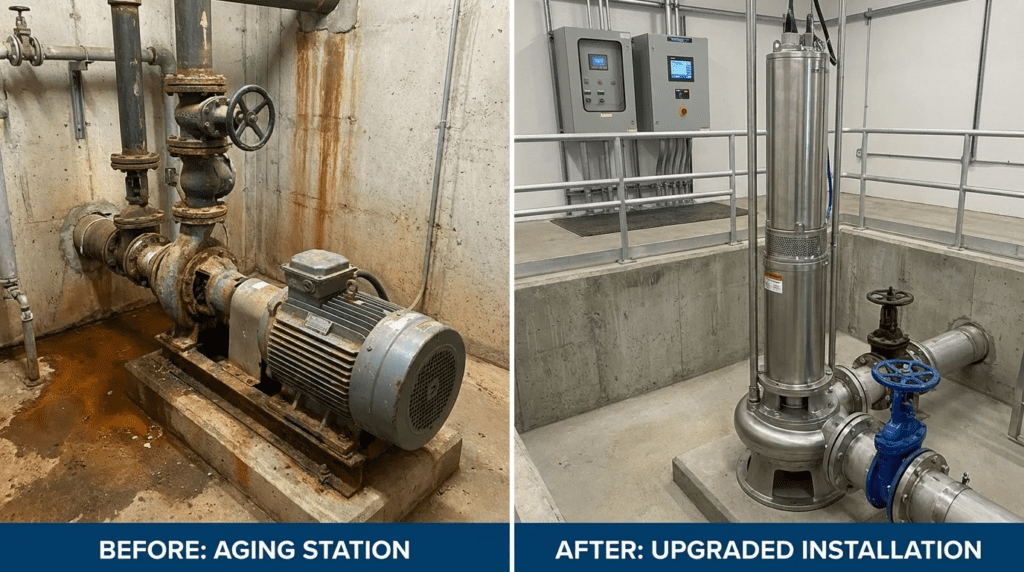
The vast majority of municipal flood control and large-scale raw water intake infrastructure in North America was constructed between the 1950s and 1980s. Today, engineers face a critical ticking clock: massive concrete volute or vertical column axial flow pumps are reaching the end of their second or third lifecycle. The challenge is rarely as simple as swapping like-for-like. Changes in hydrology, updated regulatory requirements for fish protection, and the prohibitive cost of civil reconstruction create a complex decision matrix. This is the core of the debate surrounding Retrofit vs Replace: When to Upgrade Propeller Pump in Aging Stations.
A surprising statistic from recent municipal asset management studies indicates that while mechanical wear is the primary driver for pump assessment, over 60% of replacement projects are complicated by changes in the static head requirements—often due to siltation in discharge channels or rising receiving water levels—that render the original hydraulic design obsolete. Engineers often overlook that a simple mechanical refurbishment of a 40-year-old propeller pump may restore it to “as-new” condition, but “as-new” often means “still inefficient” or “hydraulically mismatched” for current realities.
Propeller pumps (axial and mixed flow) are the workhorses of low-head, high-flow applications. They are ubiquitous in:
- Stormwater Lift Stations: Managing flash floods and levee drainage.
- Raw Water Intakes: Pulling from rivers or lakes for drinking water treatment.
- Wastewater Effluent Pumping: Final discharge into receiving waters.
- Industrial Cooling Loops: Once-through cooling for power generation and heavy industry.
The consequences of poor selection in this specific category are severe. Unlike centrifugal wastewater pumps where the operating curve is relatively forgiving, axial flow pumps have steep performance curves and a “saddle” region of instability. Miscalculating the system curve during an upgrade can lead to immediate cavitation, structural resonance, and catastrophic shaft failure. This article provides a rigorous engineering framework for navigating Retrofit vs Replace: When to Upgrade Propeller Pump in Aging Stations, focusing on the technical feasibility, hydraulic constraints, and total ownership costs that drive the final specification.
HOW TO SELECT / SPECIFY
When evaluating aging assets, the engineer must perform a gap analysis between the existing equipment’s capabilities and current requirements. The decision to retrofit (re-bowl, cartridge retrofit, or component upgrade) versus replace (full extraction, new civil works, or submersible conversion) hinges on the following engineering criteria.
Duty Conditions & Operating Envelope
The primary driver for the Retrofit vs Replace: When to Upgrade Propeller Pump in Aging Stations decision is the hydraulic suitability of the existing pump design against current needs.
- Flow Rates and Head Variations: Propeller pumps are extremely sensitive to Total Dynamic Head (TDH). A retrofit that increases capacity by increasing speed (RPM) often fails because the existing intake submergence (NPSHa) is insufficient. If the required flow has increased by >15%, a simple retrofit is often hydraulically impossible without inducing vortexing.
- The Saddle Region: Axial flow pumps exhibit a dip in the Head-Capacity curve. Operating in this unstable region causes severe vibration and noise. If the station’s static head has increased (e.g., higher river flood stages), the existing pump curve may now intersect the system curve in this unstable zone. In this scenario, a complete replacement with a mixed-flow impeller design (which has a flatter curve) is required.
- Variable Speed Operation: Older stations utilized fixed-speed synchronous motors. Converting to VFDs allows for better process control but introduces resonance risks. The critical speed analysis must be redone for the entire structural assembly, not just the pump shaft.
Materials & Compatibility
Aging stations present specific metallurgical challenges that influence the retrofit specification.
- Galvanic Corrosion: Older stations often mixed cast iron columns with bronze impellers. Over 40 years, the galvanic potential can degrade the seating surfaces. If the column pipe is pitted beyond 10% wall thickness loss, a “drop-in” retrofit is risky.
- Abrasion Resistance: For stormwater applications carrying grit, older cast iron impellers may be severely eroded. Upgrading to a duplex stainless steel (e.g., CD4MCuN) or high-chrome iron impeller is a standard retrofit upgrade. However, the heavier impeller changes the rotor dynamics, requiring shaft stiffness calculations.
- Temperature Limits: While water temperature is rarely an issue, motor ambient temperature in dry-pit propeller pump stations is critical. Retrofitting with high-efficiency motors often reduces waste heat, but VFD-rated motors may require upgraded bearing insulation to prevent EDM (Electrical Discharge Machining) fluting.
Hydraulics & Process Performance
The hydraulic efficiency of propeller pumps has improved significantly with CFD (Computational Fluid Dynamics) modeling. However, the constraint is the existing civil structure.
- Efficiency Curves: A modern propeller design can achieve hydraulic efficiencies of 85-88%. However, installing a high-efficiency bowl assembly into a poorly designed existing suction bay (common in 1960s designs) will negate these gains due to pre-swirl and uneven velocity distribution.
- NPSH Margin: This is the most common failure point in upgrades. Increasing flow through an existing footprint reduces NPSHa while increasing NPSHr (Required). If the margin drops below 1.5m (or a ratio of 1.3), cavitation is guaranteed. A replacement strategy involving a formed suction intake (FSI) device can improve flow conditioning, allowing higher flows in the same footprint.
Installation Environment & Constructability
Physical access often dictates the Retrofit vs Replace: When to Upgrade Propeller Pump in Aging Stations outcome more than hydraulics.
- Overhead Clearance: Vertical line shaft pumps require significant headroom to pull the shaft and column. If the station roof prevents crane access, a retrofit using a “canister” or submersible pump installed inside the existing column may be the only viable option.
- Civil Integrity: If the concrete volute or embedded discharge ring is cracked or eroded, a simple mechanical retrofit is throwing good money after bad. In such cases, a “tub” retrofit—grouting a new steel volute inside the old concrete void—is a hybrid replacement strategy.
- Alignment: Older stations often have settled, causing misalignment between the motor floor and the wet well. A traditional line-shaft retrofit requires precise realignment. Converting to a submersible propeller pump eliminates the long drive shaft and the alignment headaches associated with it.
Reliability, Redundancy & Failure Modes
Engineering the upgrade requires predicting future failure modes.
- MTBF (Mean Time Between Failures): Line shaft pumps suffer from guide bearing wear, particularly in sandy water. A retrofit should consider upgrading from water-lubricated rubber bearings to enclosed oil-lubricated or fresh-water flushed systems to extend MTBF.
- Redundancy: In “Replace” scenarios, engineers can sometimes replace three large pumps with four smaller, modern pumps in the same footprint (using compact submersible columns), providing N+1 redundancy that didn’t exist previously.
Controls & Automation Interfaces
Modernizing the prime mover is often the catalyst for the pump upgrade.
- SCADA Integration: Retrofits should include vibration sensors (accelerometers) on the thrust bearing and RTDs in the motor windings. These inputs are critical for predictive maintenance.
- Level Control Strategies: Stormwater stations moving from float switches to ultrasonic/radar level control can optimize pump cycling. However, short-cycling large propeller pumps overheats motors. The upgrade specification must define minimum run times and maximum starts per hour (typically 3-5 for large motors).
Maintainability, Safety & Access
Operator safety standards have evolved drastically since the original station design.
- Shaft Guarding: Open line shafts common in 1970s designs are OSHA violations today. Any retrofit must include comprehensive guarding.
- Confined Space: A “Replace” strategy utilizing submersible technology often eliminates the need for operators to enter the dry pit or wet well for routine greasing, as modern units use permanently lubricated bearings or easy-access fill ports.
Lifecycle Cost Drivers
The total cost of ownership (TCO) analysis often favors different approaches based on duty cycle.
- Stormwater (Intermittent): CAPEX dominates. High efficiency is less critical than reliability after long standstill periods. A retrofit (re-bowl) is often the most economic choice.
- Raw Water/Effluent (Continuous): Energy (OPEX) dominates. A 3% efficiency gain from a full replacement with optimized hydraulics can pay back the civil work costs in 5-7 years.
COMPARISON TABLES
The following tables provide a structured comparison to assist engineers in the decision-making process. Table 1 compares the technical methodologies of upgrading, while Table 2 serves as an application fit matrix based on station conditions.
Table 1: Comparison of Upgrade Methodologies
| Methodology | Scope of Work | Primary Strengths | Limitations / Risks | Typical Downtime |
|---|---|---|---|---|
| Re-bowl / Wet-End Kit | Replace impeller, bowl, and suction bell. Retain discharge column and motor. | Lowest CAPEX (30-50% of new). Preserves existing piping interface. | Limited by old column integrity. Does not correct intake hydraulic issues. | 1-2 Weeks per pump |
| Submersible Retrofit (In-Column) | Install submersible axial flow pump inside existing discharge column (Jacketed). | Eliminates long drive shafts and alignment issues. Flood-proof motor. | Slight diameter reduction may reduce max flow. Requires cable management engineering. | 2-3 Weeks per pump |
| Full Replacement (Dry Pit) | Demolish old pumps/piping. Install new pumps, valves, and base elbows. | Restores 100% reliability. Optimized hydraulics. N+1 redundancy possible. | Highest CAPEX. significant civil modifications. Risk of piping mismatch. | 2-4 Months |
| Pull-Out / Canister Retrofit | Install new canister containing pump into existing civil structure. | Allows easy removal for service without dewatering the entire station. | Requires sufficient overhead crane height. High initial engineering cost. | 3-5 Weeks |
Table 2: Application Fit Matrix
| Station Scenario | Civil Condition | Hydraulic Change | Best-Fit Strategy | Rationale |
|---|---|---|---|---|
| Urban Stormwater Station | Poor (Cracked Volutes) | Minimal | Tub Retrofit / Insert | Grouting a new steel volute inside the damaged concrete restores integrity without full demolition. |
| Raw Water Intake | Good | Head Increased (+20%) | Replace (New Design) | Old propeller geometry likely cannot handle head increase without cavitation. New mixed-flow design required. |
| Flood Control (Levee) | Fair | None (Like-for-Like) | Re-bowl / Re-build | For low duty-cycle pumps, extending life via re-bowling yields best ROI. |
| WWTP Effluent | Good | Variable Flow Needed | Submersible + VFD | Converting to submersible simplifies maintenance and VFD allows process control matching plant output. |
ENGINEER & OPERATOR FIELD NOTES
Real-world execution of Retrofit vs Replace: When to Upgrade Propeller Pump in Aging Stations projects often encounters unforeseen hurdles. The following notes are compiled from field experience to guide specification and planning.
Commissioning & Acceptance Testing
When commissioning upgraded propeller pumps, standard centrifugal pump procedures are insufficient.
- Vibration Baselines: Propeller pumps are structurally “tall and thin.” Commissioning must include a resonant frequency “bump test” to ensure the new operating speed (or VFD range) does not excite a natural frequency of the column/discharge head assembly. This is critical for retrofits where mass has changed.
- Blade Angle Verification: If the retrofit includes adjustable pitch blades, the Site Acceptance Test (SAT) must verify the blade angle setting matches the specified duty point. A deviation of 2 degrees can overload the motor or cause under-performance.
- Vortex Checks: During the SAT, operate the pump at minimum submergence. Look for surface vortices. If swirl is evident, the retrofit may require anti-vortex baffles or rafts, even if they weren’t in the original design.
Common Specification Mistakes
Avoiding these errors in the design phase saves significant change order costs.
- Neglecting the Discharge Flap Valve: Upgrading the pump to a higher flow often blows open the old flap valve violently or increases head loss significantly. Always include flap valve inspection and potential replacement in the scope.
- Underestimating Motor Weight: Modern high-efficiency motors can be heavier or physically larger than the 1970s equivalents. Engineers often specify a replacement without checking if the existing motor stool or floor grating can support the new static and dynamic loads.
- Material Mismatch: Specifying stainless steel fasteners on a cast iron assembly without dielectric isolation washers leads to rapid galvanic corrosion of the base metal.
O&M Burden & Strategy
The choice between retrofit and replace fundamentally shifts the O&M strategy.
- Packing vs. Mechanical Seals: Old propeller pumps used stuffing boxes (packing). Retrofits often introduce mechanical seals. While seals leak less, they fail catastrophically rather than gradually. Operators must be trained on seal monitoring (flush water pressure/flow) versus simply tightening a gland nut.
- Submersible Cable Management: In “tube” or column retrofits using submersible pumps, the power cable is the weak link. It is often battered by turbulence. Specifications must require robust cable clamping systems (e.g., Kellems grips and stainless steel stand-offs) every 3-5 feet inside the column.
Troubleshooting Guide
Recognizing symptoms early prevents catastrophic failure.
- Symptom: Low Frequency Rumbling.
Likely Cause: Sub-synchronous whirl or vortexing. The pump is likely operating too far to the right of the curve (low head/high flow) or intake submergence is insufficient. - Symptom: High Pitched Whine/Crackling.
Likely Cause: Cavitation. Check if the trash rack is blinded, increasing the suction lift requirements. - Symptom: High Motor Amps but Low Flow.
Likely Cause: In propeller pumps, power consumption increases as flow decreases (shut-off head power is highest). This indicates a blockage in the discharge line or a closed valve. Note: This is the opposite of a standard centrifugal pump.
DESIGN DETAILS / CALCULATIONS
Accurate sizing and calculation methodologies are the bedrock of a successful project regarding Retrofit vs Replace: When to Upgrade Propeller Pump in Aging Stations.
Sizing Logic & Methodology
The specific speed ($N_s$) of the pump dictates the impeller geometry. For propeller pumps, $N_s$ is typically between 9,000 and 15,000 (US units).
Step 1: Define the System Curve.
Unlike centrifugal applications where friction dominates, propeller pump applications are dominated by static head.
$$H_{total} = H_{static} + H_{friction} + H_{velocity}$$
Note: In low-head applications, velocity head ($V^2/2g$) can be 20% of the total head. Do not ignore it.
Step 2: Check Intake Velocity.
According to ANSI/HI 9.8, the approach velocity to the pump bay should be $leq 1.5 text{ ft/s}$. If the retrofit increases flow such that velocity exceeds this, you must modify the civil works or use a suction conditioning device.
Step 3: Calculate Submergence.
Required submergence ($S$) to prevent vortexing is roughly calculated (simplified) as:
$$S geq D + (2.3 times V_{bell} times sqrt{D})$$
Where $D$ is the bell diameter and $V_{bell}$ is the velocity at the bell inlet. If the existing sump cannot meet this $S$ at the new flow rate, a retrofit is not viable without anti-vortex devices.
Specification Checklist
A robust specification for upgrading propeller pumps should include:
- Performance Testing: Require HI 14.6 Grade 1U or 1B testing.
- Nondestructive Testing (NDT): For retrofits reusing shafts, require dye penetrant or ultrasonic testing of keyways and coupling areas.
- Coating Systems: Specify ceramic-epoxy coatings for the bell and bowl to improve efficiency and resist abrasion.
- Alignment Criteria: For line shafts, specify maximum runout (typically 0.002″ per foot of shaft length).
Standards & Compliance
Adherence to current standards is non-negotiable, even for retrofits.
- ANSI/HI 9.8 (Pump Intake Design): The bible for intake geometry.
- AWWA E103 (Horizontal and Vertical Line-Shaft Pumps): Governs construction standards.
- NEMA MG-1: Defines motor insulation classes and service factors. Upgrade to Class H insulation/Class B rise for VFD applications.
FAQ SECTION
What defines a “Propeller Pump” compared to a standard vertical turbine?
A propeller pump is a specific type of axial-flow or mixed-flow vertical pump designed for high flow and low head (typically under 30-40 feet). Unlike vertical turbine pumps which use centrifugal force with radial flow impellers to generate high pressures, propeller pumps use a lifting action similar to a boat propeller. This results in a very steep head-capacity curve and high power consumption at shut-off head.
When should I choose to Re-bowl instead of Replace?
Re-bowling is the preferred strategy when the existing discharge column, head, and motor support structure are in excellent condition (less than 10-15% corrosion loss), and the new hydraulic requirements are within 10-15% of the original design. It is cost-effective for life extension. However, if the station requires a flow increase greater than 20% or if the concrete substructure is failing, full replacement is necessary.
How does a Submersible Retrofit (Column Insert) work?
In a submersible retrofit, the long line shaft, motor, and bowl assembly are removed. A new submersible axial-flow pump is lowered inside the existing vertical discharge column. The pump seats on a ring at the bottom, and a “jacket” or the column itself guides the water. This eliminates the maintenance-intensive line shaft, bearings, and external motor alignment, greatly simplifying future maintenance.
What is the typical cost difference between Retrofit and Replace?
Typically, a mechanical retrofit (re-bowl and motor rehab) costs 30-50% of a full replacement price. A “Tube” retrofit (submersible conversion) typically costs 60-75% of full replacement. Full replacement costs are driven high by the need for demolition, temporary bypass pumping (which can exceed equipment costs), and civil modifications. However, full replacement offers the lowest 20-year Total Cost of Ownership for critical, high-use stations.
Why is “Shut-Off Head” dangerous for Propeller Pumps?
Unlike centrifugal pumps where power drops at zero flow, axial flow propeller pumps draw their maximum power at zero flow (shut-off). Starting a propeller pump against a closed valve can instantly trip the breaker or burn out the motor. Upgrades involving soft starters or VFDs must be programmed to ramp up quickly and open discharge valves simultaneously to avoid this high-load condition.
How long does a retrofitted propeller pump last?
A properly engineered retrofit typically extends the asset life by 15-20 years. The limiting factor is usually the reused components (column pipe, discharge head). A full replacement with modern materials (stainless steel, coated iron) is typically expected to last 25-30 years. Regular maintenance of the sacrificial anodes and bearing lubrication is essential to meeting these targets.
CONCLUSION
KEY TAKEAWAYS
- Hydraulics First: Never simply match horsepower. Propeller pumps are sensitive to system curves; verify the intersection point to avoid the “saddle” region instability.
- Civil Constraints Rule: If the intake velocity exceeds 1.5 ft/s or submergence is insufficient, a capacity increase retrofit will fail due to vortexing and cavitation.
- Check the Shaft: In line-shaft retrofits, verify shaft stiffness. Upgrading impeller materials usually adds weight, changing critical speed and resonance points.
- Power at Shut-off: Remember that axial flow pumps draw max power at zero flow. Ensure electrical gear is sized for this starting load or interlocked with discharge valves.
- Bypass Costs: In the “Replace” calculation, bypass pumping often costs more than the equipment. Retrofits that utilize the existing tube as a caisson can significantly reduce this cost.
- Lifecycle ROI: For stormwater (intermittent), minimize CAPEX via retrofit. For intake/effluent (continuous), maximize efficiency via replacement.
The decision surrounding Retrofit vs Replace: When to Upgrade Propeller Pump in Aging Stations is rarely binary. It requires a balanced assessment of hydraulic physics, structural integrity, and operational reality. While the temptation to simply “drop in a new kit” is driven by budget constraints, the engineering risk of putting new technology into obsolete civil structures is high.
Engineers must prioritize the system curve analysis and intake conditions above all else. If the water cannot get to the impeller cleanly, the most efficient pump in the world will fail. For aging stations, the “Submersible Column Retrofit” often represents the “Goldilocks” solution—eliminating the maintenance headache of line shafts while utilizing the existing civil footprint. By following the selection criteria, testing protocols, and design standards outlined in this guide, utilities can secure another 20 years of reliable service from their critical flood control and water supply assets.