
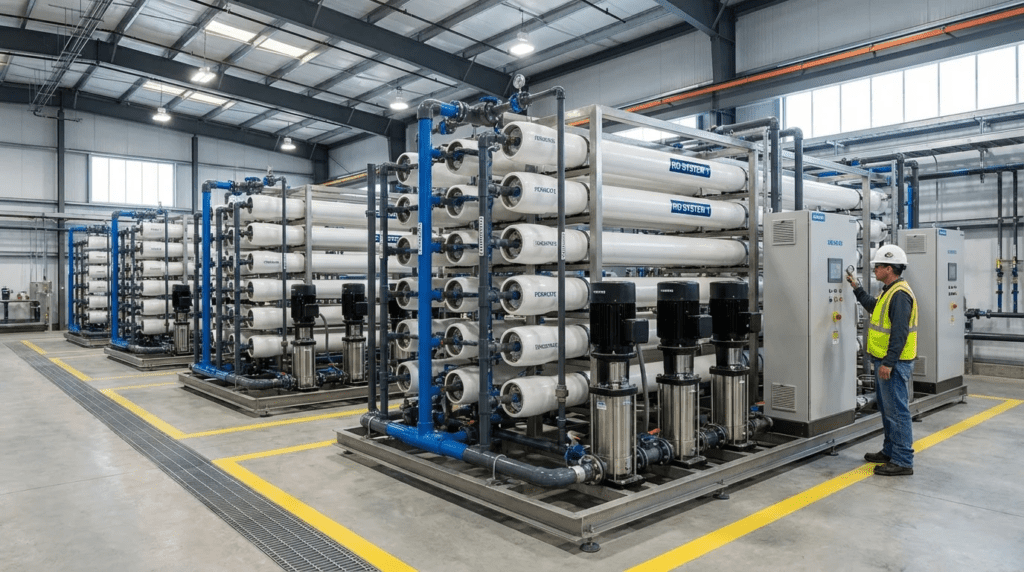
Introduction: Navigating the Complexities of Membrane Separation
A catastrophic decline in normalized permeate flux is an engineer’s worst nightmare, often resulting from improper pretreatment, aggressive recovery targets, or fundamental specification errors during the design phase. Whether you are scaling up municipal desalination or designing a zero-liquid discharge (ZLD) industrial loop, understanding the RO Water Treatment Process: Complete Guide to Reverse Osmosis is critical. Reverse osmosis is no longer a monolithic technology; it has evolved into a highly specialized matrix of configurations, membrane chemistries, and energy recovery mechanisms. Specifying an RO system requires balancing Capital Expenditure (CAPEX), long-term Operating Expenditure (OPEX), site-specific water chemistry, and operator capabilities.
This pillar page serves as the master guide to the entire reverse osmosis ecosystem. It identifies and breaks down the major subcategories, equipment variants, and process approaches that fall under modern RO design. By understanding the breadth of this landscape—from primary membrane configurations and high-pressure hydraulics to advanced pretreatment and post-treatment modules—municipal decision-makers and industrial plant directors can effectively navigate specification requirements, optimize lifecycle costs, and ensure process reliability.
Subcategory Landscape — Types, Technologies & Approaches
The RO water treatment ecosystem consists of multiple distinct subcategories that must be integrated into a cohesive process train. Engineers must select from various system types, pretreatment methodologies, and specific component technologies based on raw water quality, product water requirements, and energy constraints. The following sections outline the critical branches of reverse osmosis technology, each representing a complex sub-discipline of membrane engineering.
Brackish Water Reverse Osmosis (BWRO)
Brackish Water Reverse Osmosis (BWRO) systems are designed to treat feed waters with Total Dissolved Solids (TDS) typically ranging from 1,000 to 10,000 mg/L. These systems operate at lower feed pressures than seawater systems, generally between 150 and 400 psi (10 to 28 bar), making standard schedule PVC or standard stainless steel (304/316L) viable piping materials for the high-pressure side. BWRO is the workhorse of municipal groundwater treatment and industrial process water generation. The primary advantage of BWRO is its relatively low energy consumption and high recovery rates (often 75% to 85%), achieved through multi-stage array configurations (e.g., 2:1 or 3:2:1 arrays). The critical selection factor for BWRO is carefully modeling the concentration polarization at the final stage to prevent scaling of sparingly soluble salts like calcium carbonate, calcium sulfate, and silica.
Seawater Reverse Osmosis (SWRO)
Treating oceanic and highly saline coastal groundwater (TDS 30,000 to 45,000 mg/L) requires Seawater Reverse Osmosis (SWRO). To overcome massive osmotic pressure, SWRO operates at extreme pressures ranging from 800 to 1,200 psi (55 to 83 bar). System recovery is typically limited to 35% to 50% to prevent excessive osmotic pressure escalation and scaling in the tail elements. SWRO strictly requires high-grade metallurgy—such as Super Duplex stainless steel (e.g., SAF 2507) or high-alloy materials—to combat severe chloride-induced pitting and stress corrosion cracking. Because of the high pumping energy required, integrating advanced energy recovery is absolutely mandatory. Specification considerations heavily favor OPEX optimization over initial CAPEX, as energy constitutes the largest lifecycle cost in SWRO.
Double Pass Reverse Osmosis
When the permeate quality from a single RO array is insufficient to meet stringent industrial or regulatory limits, a Double Pass Reverse Osmosis system is employed. In this configuration, the permeate from the first pass becomes the feed water for the second pass. It is widely used when targeting very low conductivity (e.g., < 2 µS/cm) or specific ion removal (like boron or silica), and is a standard precursor to Electrodeionization (EDI). A key operational advantage is that the second pass operates on exceptionally clean water, allowing for very high recoveries (85-90%) and virtually eliminating fouling risks in the second pass. Engineers must specify intermediate tankage or specialized control logic, and often inject sodium hydroxide between passes to elevate pH and convert aqueous boron or silica into well-rejected ionic forms.
Closed Circuit Reverse Osmosis (CCRO)
Closed Circuit Reverse Osmosis (CCRO) is an innovative, disruptive batch-process approach to membrane filtration. Instead of the traditional multi-stage array where brine cascades sequentially through vessels, CCRO recirculates the concentrate back to the feed pump inlet, blending it with fresh feed. The system operates in a closed loop until a specific target recovery or volumetric concentration factor is reached, at which point a valve opens to purge the high-salinity brine while simultaneously refilling the loop. CCRO can achieve exceptionally high recoveries (up to 95-98% on certain brackish waters) using a single-stage pump and vessel configuration. It is highly advantageous for treating variable feed water qualities, as recovery is controlled by software rather than hard-piped arrays. However, it requires highly reliable automated valving and sophisticated PLC controls.
RO Pretreatment Systems
The success of any RO system is entirely dependent on its pretreatment. RO Pretreatment Systems encompass the collective processes designed to reduce Silt Density Index (SDI), mitigate fouling, and prevent scaling before the water reaches the delicate RO membranes. Without robust pretreatment, colloidal particles, organic matter, and biological growth will cause rapid differential pressure (dP) increases across the membrane feed channels. Choosing the correct pretreatment matrix depends heavily on source water—deep well water may only require simple cartridge filtration and chemical dosing, while open ocean intake or surface water requires extensive mechanical and chemical conditioning.
Ultrafiltration (UF) Pretreatment
For surface waters, tertiary wastewater, or open-intake seawater, Ultrafiltration (UF) Pretreatment has become the engineering standard. UF employs porous polymeric fibers (usually inside-out or outside-in hollow fibers) to physically block particulates, bacteria, and large colloids, consistently producing RO feed water with an SDI of less than 3.0, regardless of raw water turbidity spikes. The primary advantage of UF over conventional media filtration is its absolute barrier and smaller footprint. While CAPEX is higher, OPEX is often offset by extending the lifespan of the downstream RO membranes and reducing RO CIP frequency. Specification requires careful attention to UF flux limits and backwash regimes to prevent irreversible fouling of the UF modules themselves.
Multimedia Filtration (MMF)
A more traditional, robust, and cost-effective approach to particulate reduction is Multimedia Filtration (MMF). These pressure vessels contain layers of progressively finer media—typically anthracite, silica sand, and garnet. MMF works through depth filtration, trapping suspended solids throughout the media bed rather than just on the surface. It is best suited for feed waters with moderate and consistent turbidity (e.g., certain well waters or stabilized municipal sources). MMF is highly reliable, lacks delicate polymeric fibers, and has a lower initial CAPEX compared to UF. However, it cannot guarantee SDI reductions during extreme source water upsets and requires vast quantities of water for backwashing.
Chemical Dosing Systems (Antiscalants/Biocides)
To manipulate the chemical stability of the feed water, Chemical Dosing Systems (Antiscalants/Biocides) are deployed upstream of the RO high-pressure pumps. Antiscalants are proprietary polymers that delay the precipitation of supersaturated salts (like calcium carbonate and barium sulfate), allowing the RO system to operate at higher recoveries than natural solubility limits would permit. Biocides (either continuous or shock-dosed) are used to prevent the formation of biofilm on the membrane surface, a critical issue in wastewater and warm-surface-water applications. Engineers must precisely specify dosing pumps and chemical storage based on accurate water projections, ensuring the chosen antiscalant is compatible with the membrane chemistry and any upstream coagulants used.
RO Permeate Remineralization
Because RO permeates are stripped of almost all minerals, the water is naturally aggressive, corrosive, and lacks the buffering capacity required for municipal distribution. RO Permeate Remineralization processes inject hardness and alkalinity back into the water. This is typically achieved by passing the acidic RO permeate through calcite (calcium carbonate) contactors, often aided by the addition of carbon dioxide to enhance dissolution, or through direct dosing of calcium chloride and sodium bicarbonate. This step is critical in municipal drinking water applications to meet Langelier Saturation Index (LSI) targets and prevent the destruction of municipal piping infrastructure.
RO Degasification and Decarbonation
Reverse osmosis membranes do not reject dissolved gases. Consequently, gases like carbon dioxide ($CO_2$), hydrogen sulfide ($H_2S$), and ammonia pass freely into the permeate. RO Degasification and Decarbonation technologies—such as forced-draft aerators or membrane contactors—are utilized to strip these gases out. Removing $CO_2$ is particularly critical in industrial applications prior to mixed-bed ion exchange or EDI, as dissolved $CO_2$ contributes heavily to the anionic load, exhausting resin prematurely. Membrane contactors (hydrophobic hollow fiber devices) are increasingly favored in high-purity applications due to their compact size and prevention of airborne contamination compared to traditional packed-tower decarbonators.
High-Pressure RO Pumps
The heart of the hydraulic process is the High-Pressure RO Pumps. In BWRO systems, multi-stage centrifugal pumps (vertical or horizontal) made of 316SS or Duplex SS are typically used. For large-scale SWRO, highly efficient axial split-case or specialized single-stage volute centrifugal pumps made of Super Duplex are specified. The pump must be carefully matched to the system’s required feed pressure and flow, factoring in membrane aging and fouling, which necessitate a wider operating envelope. Utilizing Variable Frequency Drives (VFDs) is almost universally required to accommodate temperature variations, membrane compaction over time, and energy optimization.
Energy Recovery Devices (ERDs)
In SWRO and high-pressure BWRO, the brine reject leaves the system at pressures nearly as high as the feed. Energy Recovery Devices (ERDs) capture this hydraulic energy and transfer it to the incoming feed water. There are two main types: centrifugal devices (like Pelton wheels or Francis turbines) and isobaric devices (like pressure exchangers). Isobaric ERDs have become the industry standard for SWRO due to their staggering energy transfer efficiencies (up to 95-98%). Implementing ERDs can reduce total SWRO power consumption by up to 60%. Specification requires meticulous evaluation of mixing (volumetric leakage between brine and feed) and lubrication requirements, as these devices use the seawater itself as a lubricant.
RO Clean-In-Place (CIP) Systems
Fouling and scaling are inevitable, making RO Clean-In-Place (CIP) Systems a mandatory component. A CIP system typically consists of a heated chemical mixing tank, a low-pressure/high-flow CIP pump, and cartridge filters. It enables operators to circulate acidic solutions (to dissolve mineral scale like $CaCO_3$) and alkaline solutions (to remove organics, biofilms, and silica) directly through the RO vessels. Proper specification involves sizing the CIP pump to achieve the membrane manufacturer’s recommended crossflow velocity (usually 35-40 GPM per 8-inch vessel) to provide adequate shear force, and equipping the tank with sufficient heating capacity, as chemical efficacy drops drastically in cold water.
Spiral Wound RO Membranes
The vast majority of modern RO installations utilize Spiral Wound RO Membranes. These elements are constructed by sandwiching flat-sheet semi-permeable membranes around a central permeate collection tube, separated by feed and permeate spacer meshes, and rolled into a cylinder. The standard industrial size is 8 inches in diameter and 40 inches long, though 16-inch diameters are used in mega-desalination plants. Their widespread adoption is due to an excellent balance of packing density (active membrane area per volume), cost-effectiveness, and manageable susceptibility to fouling. Engineers select specific elements based on active area (e.g., 400 vs 440 sq ft) and spacer thickness (e.g., 28 vs 34 mil).
Fouling Resistant RO Membranes
For high-fouling applications—such as wastewater reuse or surface water with high organics—Fouling Resistant RO Membranes are specified. These elements feature modified surface chemistries (making the membrane surface more hydrophilic and neutrally charged to repel organics) and thicker feed spacers (e.g., 34 mil or 36 mil) to enhance turbulence and reduce particle entrapment. While they typically cost more and may have slightly lower active surface areas than standard membranes, they drastically reduce the frequency of CIP cycles and extend the element lifecycle in harsh waters, lowering overall OPEX.
Industrial Boiler Feed Water RO
Industrial Boiler Feed Water RO systems are critical components in power generation and heavy manufacturing. Boilers, especially high-pressure variants, require exceptionally pure water to prevent catastrophic scaling and corrosion on heat transfer surfaces. These RO systems generally feature double-pass configurations and feed downstream ion-exchange or EDI units. The focus in this application is extreme reliability, redundancy, and tight integration with plant DCS (Distributed Control Systems). Silica removal is a primary design driver, as volatilized silica can carry over into steam and destroy turbine blades.
Wastewater Reuse RO Systems
Driven by water scarcity and sustainability goals, Wastewater Reuse RO Systems treat secondary or tertiary municipal/industrial effluent to potable or near-potable standards. These systems face intense fouling potentials from dissolved organics (COD/BOD), emerging contaminants, and biological loading. Consequently, robust UF pretreatment, continuous chloramine dosing (to prevent biofouling without oxidizing the membrane), and fouling-resistant membranes are standard. Operating recoveries are strictly limited by organic fouling limits and sparingly soluble salts concentrated during municipal use.
Ultrapure Water (UPW) RO
Used primarily in semiconductor manufacturing and pharmaceuticals, Ultrapure Water (UPW) RO pushes the limits of water purity. These systems target the removal of trace contaminants down to parts-per-trillion (ppt). They employ multi-pass architectures, advanced degassing, and specialized low-TOC components (e.g., PVDF piping instead of PVC) to prevent leaching. The focus is not just on ionic rejection, but absolute prevention of particulate, bacterial, and organic contamination. Subcategory elements must conform to highly stringent SEMI or USP standards.
Selection & Specification Framework
Choosing the correct equipment and process configuration within the RO Water Treatment Process: Complete Guide to Reverse Osmosis framework requires a systematic approach. Engineers must weigh CAPEX against OPEX, considering the duty conditions and the operational maturity of the end-user. Below is the decision framework to differentiate and select the proper subcategories.
Decision Framework & Logic:
- Analyze Feed Water (TDS & Source): If TDS is < 10,000 mg/L, select Brackish Water Reverse Osmosis (BWRO). If TDS > 30,000 mg/L, select Seawater Reverse Osmosis (SWRO). For variable salinity or the need to minimize wastewater volume in inland brackish applications, consider Closed Circuit Reverse Osmosis (CCRO).
- Determine Pretreatment Needs (SDI & Turbidity): If the source is surface water, wastewater, or open-intake seawater, Ultrafiltration (UF) Pretreatment is heavily favored to ensure RO protection. For stable, deep-well groundwater with low particulate loads, Multimedia Filtration (MMF) is generally sufficient and offers CAPEX savings.
- Establish Purity Targets: If standard industrial or municipal limits apply, single-pass RO is adequate. If producing boiler makeup, semiconductor UPW, or needing extreme silica/boron removal, mandate Double Pass Reverse Osmosis.
- Evaluate Energy Recovery: For SWRO, high-efficiency isobaric Energy Recovery Devices (ERDs) are absolutely required. For BWRO operating above 250 psi or larger than 1 MGD, centrifugal ERDs may offer an attractive ROI.
Lifecycle Cost Tradeoffs (CAPEX vs OPEX): Specifying thicker spacers or Fouling Resistant RO Membranes increases CAPEX slightly and reduces active area, but drastically lowers OPEX by reducing RO Clean-In-Place (CIP) Systems interventions. Similarly, implementing a UF system instead of MMF will increase upfront costs by 15-30% but protects the RO assets, extending membrane life from an average of 3-5 years to 5-8 years. Plant size dictates the scalability of these choices: a 50 GPM skid may not justify the controls overhead of CCRO, but a 2 MGD plant certainly will.
Comparison Tables
The following tables provide quick-reference technical matrices for navigating the various RO subcategories. Table 1 compares the major physical subsystems, while Table 2 maps the optimal subcategories to specific industrial and municipal applications based on sizing and operator constraints.
Table 1: Subcategory Technology Comparison
| Technology / Subcategory | Key Features / Mechanism | Best-Fit Applications | Primary Limitations | Maintenance Profile |
|---|---|---|---|---|
| Brackish Water Reverse Osmosis (BWRO) | Low-med pressure (150-400 psi), multi-stage array | Groundwater, standard industrial process water | Susceptible to tail-element scaling at high recoveries | Moderate; routine chemical monitoring and occasional CIP |
| Seawater Reverse Osmosis (SWRO) | High pressure (800-1200 psi), high metallurgy requirements | Coastal desalination, marine applications | High energy demand, expensive corrosion-resistant piping | High; strict pump/ERD maintenance, biofouling mitigation |
| Closed Circuit Reverse Osmosis (CCRO) | Batch-process, single-stage recirculation | Variable feed water, high-recovery inland applications | Relies heavily on automated valving and software | Moderate-High; valve servicing is critical |
| Ultrafiltration (UF) Pretreatment | Absolute barrier < 0.1 micron, inside-out or outside-in | Surface water, wastewater reuse, open-intake RO | Higher CAPEX, modules can suffer irreversible organic fouling | High complexity; frequent automated backwashes & CEBs |
| Energy Recovery Devices (ERDs) | Isobaric or centrifugal pressure transfer | SWRO, high-pressure BWRO | Requires precise flow balancing and mixing management | Low to Moderate; depends heavily on particulate pre-filtration |
Table 2: Application Fit Matrix
| Application Scenario | Optimal Subcategory Fit | Key Engineering Constraints | Operator Skill Level Required |
|---|---|---|---|
| High-Pressure Boiler Makeup | Double Pass Reverse Osmosis + RO Degasification and Decarbonation | Stringent silica and conductivity limits; redundancy required | Advanced (complex chemical and DCS integration) |
| Municipal Groundwater (Stable, Turbidity < 0.5 NTU) | Brackish Water Reverse Osmosis (BWRO) + Multimedia Filtration (MMF) | Meeting primary drinking standards; LSI balancing post-RO | Basic to Moderate |
| Wastewater Reuse (ZLD pre-concentration) | UF Pretreatment + Wastewater Reuse RO Systems + CCRO | Extreme biofouling and organic loading potential | Advanced (frequent membrane profiling and intensive CIPs) |
| Coastal Municipal Desalination (Large Scale) | Seawater Reverse Osmosis (SWRO) + Energy Recovery Devices (ERDs) | Minimizing OPEX; stringent metallurgy for corrosion resistance | Advanced (high-pressure safety, ERD tuning) |
Engineer & Operator Field Notes
Navigating the specification and operational reality of these systems requires understanding the specific nuances that separate the subcategories in the field. What works for a simple BWRO skid will rapidly lead to failure on a SWRO or wastewater reuse platform.
Commissioning Considerations by Subcategory
Proper commissioning dictates the baseline performance for the entire lifecycle of the plant. For Spiral Wound RO Membranes, initial flushing is critical. Elements are shipped in a preservative solution (often sodium bisulfite). Flowing this preservative to the permeate tank or downstream processes can cause severe biological issues or process contamination. BWRO systems must be flushed to drain at low pressure for at least 30-60 minutes. For Seawater Reverse Osmosis (SWRO), commissioning is highly focused on validating the High-Pressure RO Pumps and ERDs; engineers must carefully vent air from the isobaric chambers to prevent catastrophic “water hammer” and destructive spinning of the rotors. For Ultrafiltration (UF) Pretreatment, validating the integrity of the fibers via a Pressure Decay Test (PDT) prior to flowing water to the RO is mandatory.
Common Specification Mistakes
A prevalent engineering error is copying specs between subcategories. Specifying the maximum flux rate allowable for a clean well-water Brackish Water Reverse Osmosis (BWRO) (e.g., 18 GFD) and applying it to a Wastewater Reuse RO Systems design will lead to rapid and irrecoverable organic fouling. Wastewater RO must be conservatively designed at 10-12 GFD. Another critical error is undersizing the RO Clean-In-Place (CIP) Systems. Designers often size the CIP tank based purely on the volume of the RO pressure vessels, failing to account for the volume of the heavily fouled piping, filter housings, and the necessary freeboard required to prevent pump cavitation during heavy foaming (which occurs when removing organics with high pH chemicals).
O&M Comparison Across Subcategories (REQUIRED)
Operations and maintenance burdens shift dramatically depending on the specified subcategory:
- Daily Operator Attention: Closed Circuit Reverse Osmosis (CCRO) and Ultrafiltration (UF) Pretreatment demand advanced operator interaction to monitor complex valve sequencing and backwash profile trending. In contrast, deep-well Brackish Water Reverse Osmosis (BWRO) with simple cartridge filtration is virtually “hands-off” once steady-state is achieved.
- Maintenance Intervals & Labor: Multimedia Filtration (MMF) requires very little direct labor (annual media inspection). Conversely, maintaining Chemical Dosing Systems (Antiscalants/Biocides) requires weekly calibration of dosing pumps, verifying draw-downs, and managing hazardous bulk chemical deliveries.
- Consumable Costs: Seawater Reverse Osmosis (SWRO) has a high consumable turnover rate for cartridge pre-filters due to oceanic blooms, and membrane replacement is vastly more expensive per element than standard BWRO.
- Operator Training: Double Pass Reverse Osmosis paired with RO Degasification and Decarbonation in power or semiconductor facilities requires highly skilled operators trained in strict plant DCS protocols and zero-tolerance contamination procedures.
- Spare Parts Inventory: SWRO systems require stocking expensive, high-alloy pump seals and specialized ERD cartridges. Fouling Resistant RO Membranes used in wastewater reuse often have longer lead times than standard elements, requiring plants to maintain a larger on-site safety stock.
Troubleshooting Overview
Troubleshooting requires differentiating between scaling and particulate/organic fouling. Scaling (precipitation of minerals) almost always occurs in the tail end of the system. If the last stage of a BWRO system shows high differential pressure and decreased permeate flow, calcium or silica scaling is the likely culprit. This indicates an issue with the Chemical Dosing Systems (Antiscalants/Biocides) or excessive recovery. Conversely, if the lead stage (the front of the system) exhibits high differential pressure, the root cause is particulate, biological, or organic fouling, pointing directly to a failure in the RO Pretreatment Systems (e.g., UF fiber breakage, exhausted MMF media, or biocide dosing failure).
Design Details & Standards
Accurate engineering specification requires strict adherence to sizing methodologies and industry codes. The RO process is mathematically modeled using proprietary projection software provided by membrane manufacturers, but engineers must establish the correct foundational boundaries.
Sizing Methodology Overview
Across all RO subcategories, sizing starts with determining the required permeate flow rate. From there, the designer defines the Average System Flux (expressed in Gallons per Square Foot per Day – GFD, or Liters per Square Meter per Hour – LMH). Flux is the fundamental determinant of CAPEX and long-term reliability. A higher flux reduces the number of required Spiral Wound RO Membranes (lowering CAPEX) but increases the rate of fouling (raising OPEX). Once flux and total active membrane area are calculated, the elements are arranged into pressure vessels (typically 6 to 8 elements per vessel) and grouped into an array that matches the desired system recovery.
Key Design Parameters by Subcategory
The operational boundaries shift radically between subcategories. For Industrial Boiler Feed Water RO, system recovery might be safely pushed to 80-85% due to high-quality city feed water and robust antiscalant dosing. The average flux can safely sit at 14-16 GFD. In stark contrast, Wastewater Reuse RO Systems must be conservatively designed with fluxes of 10-12 GFD, and recoveries are often capped at 70-75% due to the massive osmotic pressure generated by concentrated organics and phosphates. For Seawater Reverse Osmosis (SWRO), flux is extremely conservative (8-9 GFD) to handle high salinity and cold water viscosities, and recovery is strictly limited by maximum allowable vessel pressure (usually 1,000 to 1,200 psi limits on fiberglass housings).
Applicable Standards & Compliance
Engineers must draft specifications referencing appropriate standards:
- AWWA B110: Standard for evaluating and selecting RO and nanofiltration membrane systems for municipal water applications.
- NSF/ANSI 61: All components, including RO Permeate Remineralization media and membranes, must be certified for drinking water system components regarding health effects.
- ASME Boiler and Pressure Vessel Code (BPVC) Section X: Dictates the manufacturing and testing standards for fiberglass-reinforced plastic RO Pressure Vessels.
- IEC/NEMA: For the specification of motors driving the High-Pressure RO Pumps and the VFD enclosures.
Specification Checklist
When drafting an RFQ or tender document, ensure the following are explicitly detailed:
- Complete historical feed water analysis (Cations, Anions, Silica, TOC, Temperature range, Turbidity/SDI max).
- Specific module type required (e.g., standard vs. Fouling Resistant RO Membranes).
- Piping metallurgy standards (e.g., Sch 80 PVC for low pressure, 316L SS for BWRO high pressure, SAF 2507 for SWRO high pressure).
- Sizing and heating capacity for RO Clean-In-Place (CIP) Systems.
- Performance guarantees regarding power consumption (kW/m³), normalized permeate flow, and salt rejection over years 1, 2, and 3.
FAQ Section
What are the different types of RO systems?
The RO ecosystem is divided primarily by feed water and application. The main system types include Brackish Water Reverse Osmosis (BWRO) for low-salinity sources, Seawater Reverse Osmosis (SWRO) for ocean water, Double Pass Reverse Osmosis for high-purity industrial needs, and Closed Circuit Reverse Osmosis (CCRO) for highly efficient batch-process recovery. Furthermore, applications define subcategories like Wastewater Reuse RO Systems, Ultrapure Water (UPW) RO for semiconductors, and Industrial Boiler Feed Water RO.
How do you choose between BWRO and SWRO?
The choice is dictated entirely by the Total Dissolved Solids (TDS) of the source water. If the feed water has a TDS below roughly 10,000 mg/L, Brackish Water Reverse Osmosis (BWRO) is specified, operating between 150-400 psi. If the feed water is from the ocean or highly saline aquifers (30,000+ mg/L TDS), the osmotic pressure requires Seawater Reverse Osmosis (SWRO), which operates at 800-1200 psi and strictly requires specialized corrosion-resistant alloys and Energy Recovery Devices (ERDs).
What is the most cost-effective pretreatment for small plants?
For small-scale applications (< 100 GPM) on relatively stable well-water sources, Multimedia Filtration (MMF) combined with simple Chemical Dosing Systems (Antiscalants/Biocides) is the most cost-effective. MMF has a low initial CAPEX and minimal instrumentation compared to Ultrafiltration (UF) Pretreatment, making it accessible for facilities with basic operator skill levels and tight capital budgets.
What causes high differential pressure in the front stage of an RO?
High differential pressure (dP) in the lead elements usually points to failure in the RO Pretreatment Systems. It is typically caused by colloidal fouling (high Silt Density Index), organic deposition, or biological growth (biofouling). This requires immediate intervention using RO Clean-In-Place (CIP) Systems with an alkaline (high pH) cleaner, and a thorough audit of upstream Ultrafiltration (UF) Pretreatment or chemical dosing.
Why is remineralization necessary after RO?
Reverse osmosis membranes reject up to 99% of dissolved ions, leaving the permeate highly pure but aggressively corrosive with a very low pH and zero buffering capacity. In municipal applications, RO Permeate Remineralization is mandatory to reintroduce hardness (calcium) and alkalinity to stabilize the water (achieving a positive Langelier Saturation Index) and prevent the destruction of downstream concrete and metal distribution piping.
When should an engineer specify fouling-resistant membranes?
Standard Spiral Wound RO Membranes are prone to rapid fouling when treating surface waters with high Total Organic Carbon (TOC) or tertiary municipal effluent. Engineers should specify Fouling Resistant RO Membranes for Wastewater Reuse RO Systems. Their thicker feed spacers (34 mil+) and neutral surface charges dramatically reduce particle entrapment and biological adhesion, saving significant OPEX in CIP chemicals and downtime.
Conclusion
Key Takeaways: RO Treatment Specification
- Match Technology to TDS: Ensure pressure vessels, pumps, and pipe metallurgy align with osmotic demands (BWRO vs SWRO).
- Pretreatment is Paramount: Do not compromise on RO Pretreatment Systems. Heavily consider Ultrafiltration (UF) Pretreatment for surface and wastewater sources to protect RO assets.
- Control Recovery Targets: Pushing for excessive recovery will trigger catastrophic scaling in the tail elements. Use accurate modeling and reliable Chemical Dosing Systems (Antiscalants/Biocides).
- Integrate Energy Recovery: Incorporating isobaric Energy Recovery Devices (ERDs) is mandatory for SWRO and highly recommended for large-scale BWRO to mitigate lifetime OPEX.
- Design for Maintenance: Properly size RO Clean-In-Place (CIP) Systems to handle heating and foaming, ensuring operators can effectively restore membrane performance.
Mastering the RO Water Treatment Process: Complete Guide to Reverse Osmosis requires recognizing that the “system” is actually an intricate assembly of highly specialized subsystems. By accurately evaluating the feed water chemistry and operational goals, engineers can build a decision matrix that navigates between standard Brackish Water Reverse Osmosis (BWRO) and specialized approaches like Closed Circuit Reverse Osmosis (CCRO). Successful design goes beyond selecting a membrane element; it demands holistic integration of High-Pressure RO Pumps, robust RO Pretreatment Systems, and precise RO Permeate Remineralization. Balancing initial CAPEX against the long-term OPEX of chemical usage, energy consumption, and membrane replacement is the hallmark of sophisticated, reliable water treatment engineering.