
ABB vs PRIMEX for Other Autom/Ctrls: Pros/Cons & Best-Fit Applications
INTRODUCTION
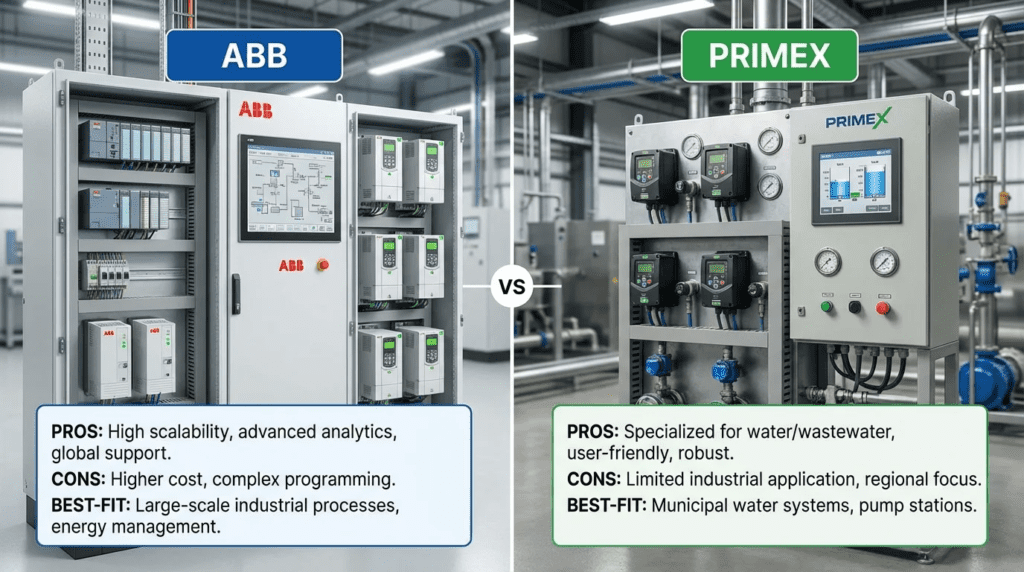
A frequent point of friction in municipal water and wastewater design lies in the disconnect between specifying distinct industrial components and specifying integrated application solutions. Engineers often grapple with a critical choice: should the control system be built around a global industrial powerhouse platform, or a specialized water-centric integration solution? This dilemma is perfectly encapsulated when analyzing ABB vs PRIMEX for Other Autom/Ctrls: Pros/Cons & Best-Fit Applications.
Statistics from post-commissioning audits suggest that nearly 30% of control system failures in the first two years are not due to hardware defects, but rather integration complexity and software configuration errors. When a consulting engineer specifies a high-end industrial drive system for a remote lift station without considering the operator’s maintenance capabilities, the Total Cost of Ownership (TCO) spikes due to service calls. Conversely, applying a standard pre-engineered panel to a complex biological treatment process can lead to inflexibility and process upset.
This article addresses the specific engineering nuances between selecting ABB—a global OEM known for VFDs, PLCs, and DCS platforms—and PRIMEX (an SJE brand), a dominant player in pre-engineered and custom water/wastewater control panels. While ABB represents the “component and heavy industry” approach, PRIMEX represents the “application-specific integration” approach. Understanding the distinction is vital for utility directors and design engineers to ensure specification compliance, operational reliability, and long-term supportability.
HOW TO SELECT / SPECIFY
When evaluating ABB vs PRIMEX for Other Autom/Ctrls: Pros/Cons & Best-Fit Applications, the decision rarely comes down to a simple “better or worse.” It is a question of architectural philosophy. ABB is typically specified when the requirement is for high-performance variable frequency drives (VFDs) or complex plant-wide automation (DCS/PLC). PRIMEX is often the standard for pump control panels, telemetry, and distributed lift station networks. The following criteria define the selection envelope.
Duty Conditions & Operating Envelope
Variable Frequency Drives (VFDs): If the application requires sophisticated motor control—such as direct torque control (DTC), active harmonic filtering, or coordinated drive systems for centrifuges—ABB’s ACS880 or ACS580 series are often the benchmark. These units are designed to handle 110% to 150% overload and provide granular control over torque and speed.
Pump Control Logic: For applications defined by standard duplex or triplex pumping logic (alternation, lag pump delays, float backup), PRIMEX control panels (like the PC-3000 series) excel. Their controllers are pre-programmed with specific water/wastewater algorithms. Specifying a custom PLC program to replicate what a PRIMEX controller does out-of-the-box is often an unnecessary engineering expense for standard lift stations.
Materials & Compatibility
Enclosure Standards: Both ecosystems can be delivered in NEMA 4X (304 or 316 Stainless Steel) or NEMA 12 enclosures. However, the engineering burden differs. When specifying ABB, the engineer or the panel shop must explicitly design the enclosure thermal management (fans, A/C) based on the drive’s heat dissipation. PRIMEX pre-engineered solutions typically come with the thermal calculations pre-validated for standard pump wattages, reducing design risk for outdoor deployments.
Corrosion Resistance: In high H2S environments (headworks, lift stations), conformal coating on circuit boards is non-negotiable. ABB industrial drives generally come with 3C2 or 3C3 conformal coating standards. PRIMEX panels, specifically designed for septic and sewer applications, utilize components and layouts inherently designed to resist moisture and corrosive ingress, often utilizing double-door enclosures to separate control logic from power wiring.
Controls & Automation Interfaces
This is the most distinct differentiator.
- ABB Approach: Rely on open industrial protocols (PROFINET, Ethernet/IP, Modbus TCP). Integration requires a systems integrator to map tags to a SCADA system (Wonderware, Ignition, VTScada). Ideal for large plants with a centralized control room.
- PRIMEX Approach: Often utilizes a “solution” approach, such as the solution-centric cloud-based monitoring (ICONTROL). For municipalities without a dedicated SCADA team, PRIMEX provides an end-to-end telemetry solution that bypasses the need for complex server infrastructure.
Reliability, Redundancy & Failure Modes
In critical wastewater applications, failure mode behavior is paramount.
ABB: Offers high-end redundancy options, such as redundant fiber optic links between drives and hot-swap control units. The failure mode is typically “Safe Stop” or “Last Known Speed.”
PRIMEX: Focuses on “Backup Control.” A hallmark of PRIMEX specifications is the separation of digital control from electromechanical backup. If the digital controller or VFD fails, simple toggle switches and relays often allow the operator to run the station in “Hand” mode on floats. This mechanical redundancy is critical for remote, unstaffed lift stations.
Lifecycle Cost Drivers
The ABB vs PRIMEX for Other Autom/Ctrls: Pros/Cons & Best-Fit Applications analysis must include OPEX.
- Software/Licensing: ABB automation suites (like 800xA) may have annual recurring software maintenance agreements (SMA). PRIMEX cloud solutions have subscription fees, but their standard panels usually have zero software licensing costs.
- Parts Availability: ABB components are available globally through massive distribution networks. However, lead times on specialized high-hp drives can be long. PRIMEX uses standard components (sometimes including ABB drives inside their panels) but simplifies the BOM (Bill of Materials) for municipal maintenance crews.
COMPARISON TABLES
The following tables provide a direct engineering comparison. Table 1 contrasts the Manufacturer/Integrator capabilities, while Table 2 provides a “Best-Fit” matrix to assist in writing specifications for different facility areas.
Table 1: Manufacturer & Solution Profile Comparison
| Feature / Criteria | ABB (Industrial OEM Focus) | PRIMEX (W/WW Integrator Focus) |
|---|---|---|
| Primary Technology Core | VFDs, PLCs, Motors, DCS, Instrumentation | Pump Control Panels, Telemetry, System Integration |
| Control Logic Approach | Open programming (IEC 61131-3); requires custom code | Configurable, pre-programmed application macros (Pump Watch, etc.) |
| VFD Technology | Manufacturer (ACS Series); ultra-low harmonic options available | Integrator (Utilizes VFDs from OEMs like ABB, Danfoss, or Eaton) |
| SCADA Integration | Heavy industrial SCADA (800xA, Zenon); high complexity | Cloud-based (ICONTROL) or standard telemetry (DNP3/Modbus) |
| Typical Support Model | Distributor/Partner network; specialized technicians | Direct support or local water-industry rep; generalist friendly |
| Documentation | Standardized global manuals; complex parameter lists | Custom submittals per project; application-specific wiring diagrams |
Table 2: Application Fit Matrix
| Application Scenario | Recommended Path | Key Engineering Rationale |
|---|---|---|
| Remote Lift Station (Duplex) | PRIMEX | Standardized control logic, integrated telemetry, and float backup reduce engineering time and simplified troubleshooting for roving operators. |
| Main Plant Raw Influent Pumps (Large HP) | ABB | High horsepower requires advanced VFD protection, harmonic mitigation (IEEE 519 compliance), and integration into central plant SCADA. |
| Aeration Blowers (DO Control) | ABB | Requires precise speed control loop (PID) integrated with dissolved oxygen sensors; benefits from ABB’s advanced drive efficiency algorithms. |
| Grinder Pump Stations | PRIMEX | Simple, rugged, repeatable panels often required in high volume for residential pressure sewer systems. |
| Plant-Wide Control System Upgrade | Hybrid / ABB | Use ABB for the heavy automation/SCADA backbone, but potentially use PRIMEX-style integration for peripheral packaged systems. |
ENGINEER & OPERATOR FIELD NOTES
Real-world experience often diverges from the datasheet. The following section outlines practical insights regarding specification, commissioning, and maintenance for both platforms.
Commissioning & Acceptance Testing
The “Finger-Pointing” Problem: When using ABB drives within a third-party panel, a common issue during commissioning is finger-pointing between the drive manufacturer and the panel builder regarding cooling or noise.
Mitigation: Specify a “System Responsibility” clause. If selecting PRIMEX, they hold the warranty for the entire enclosure, including the VFD inside. If specifying standalone ABB drives, ensure the electrical contractor is strictly held to the drive installation manual regarding grounding and cable separation.
FAT (Factory Acceptance Test) Protocols:
- For ABB systems: Focus the FAT on the communication bus. Verify that the PLC is reading the Drive Status Word correctly and that fault codes map properly to the SCADA screens.
- For PRIMEX panels: Focus the FAT on the “Backup” scenarios. Physically simulate a controller failure and ensure the float switches successfully trigger the contactors in the correct sequence.
Common Specification Mistakes
A frequent error in analyzing ABB vs PRIMEX for Other Autom/Ctrls: Pros/Cons & Best-Fit Applications is “Over-Specifying” small systems. Engineers sometimes copy-paste specifications from a 50 MGD treatment plant for a small subdivision lift station.
O&M Burden & Strategy
Maintenance Intervals:
ABB VFDs typically require cooling fan replacement every 3-5 years and DC bus capacitor replacement (or reforming) every 7-10 years. These are specialized tasks.
PRIMEX panels utilize standard contactors, relays, and controllers. The maintenance is largely visual inspection and tightening of terminal blocks. The skill gap required to maintain a PRIMEX panel is generally lower, aligning well with generalist public works staff.
Troubleshooting Guide
Scenario: Pump fails to start.
ABB Drive: The operator must look at the keypad fault code (e.g., “Overcurrent,” “Earth Fault”). Requires knowledge of electrical parameters.
PRIMEX Panel: The operator typically sees a red light labeled “Pump Fail” or “Seal Fail.” The troubleshooting steps are often printed on the inner door: “Check Breaker,” “Check Floats.” This difference in user interface is critical for late-night callouts.
DESIGN DETAILS / CALCULATIONS
To ensure the selected equipment functions within its design life, specific calculations must be performed during the design phase.
Sizing Logic & Methodology
Heat Dissipation (The Silent Killer):
Whether using an ABB drive or a PRIMEX panel containing a drive, heat is the enemy.
Rule of Thumb: VFDs generate approximately 3-4% of their rated power as heat.
Calculation: For a 100 HP pump (75 kW):
$$ Heat Loss approx 75 kW times 0.04 = 3.0 kW $$
The enclosure must be sized to dissipate 3.0 kW of heat while maintaining internal temperature below 40°C (104°F) (or 50°C if derated).
Design implication: An ABB catalog drive might be IP21 (NEMA 1). Putting it outdoors requires a custom NEMA 3R/4X cabinet with air conditioning. PRIMEX specializes in these outdoor integrated cabinet builds, whereas ABB generally sells the drive module expecting the integrator to handle the environmental protection.
Specification Checklist
When writing the CSI specifications (Division 26 or 40), ensure the following are clearly defined:
- Harmonic Mitigation: If using ABB, specify if a 6-pulse, 18-pulse, or Active Front End (AFE) drive is required to meet IEEE 519 at the PCC. PRIMEX panels will typically use standard 6-pulse drives unless line reactors or matrix filters are explicitly specified.
- Bypass Isolation: Do you require a 3-contactor bypass? This allows the motor to run across-the-line if the VFD fails. This significantly increases panel size and cost but is standard for critical municipal pumps.
- Serviceability: Require that the control panel layout allows for component replacement without removing the backplane.
Standards & Compliance
UL 508A / UL 698A:
Any control panel specified should be UL 508A listed. If the panel interfaces with a hazardous location (Class 1, Div 1/2 wet well), it must be UL 698A listed (Extensions of Industrial Control Panels to Hazardous Locations).
Both ABB (as a system builder) and PRIMEX maintain these UL listings. However, PRIMEX’s core business revolves around UL 698A intrinsically safe panels for sewage lift stations.
FAQ SECTION
What is the primary difference between ABB and PRIMEX in wastewater applications?
ABB is a global manufacturer of industrial automation components (VFDs, PLCs, Motors) and large-scale control systems. PRIMEX is a specialized system integrator and manufacturer of water/wastewater control panels. While ABB provides the core technology, PRIMEX often packages that technology (or similar) into application-specific solutions like lift station panels.
Can I use ABB drives inside a PRIMEX control panel?
Yes. PRIMEX is brand-agnostic regarding the VFDs inside their panels. Engineers can specify “PRIMEX Control Panel with ABB ACS580 Variable Frequency Drives.” This hybrid approach combines the robust enclosure and pump logic of PRIMEX with the motor control performance of ABB.
Which solution is better for harmonic mitigation?
ABB generally offers superior native harmonic mitigation. Their Ultra-Low Harmonic (ULH) drives have active front ends built-in, meeting IEEE 519 standards without external filters. PRIMEX panels typically require the addition of external line reactors or passive filters to achieve similar harmonic performance.
How do the costs compare between ABB and PRIMEX?
For standalone components, ABB drives are competitively priced but can become expensive when adding custom engineering for enclosures and cooling. PRIMEX panels often have a lower total installed cost for standard pumping applications (1-100 HP) because the engineering, telemetry, and enclosure design are bundled into a standard catalog price.
Why is “Proprietary Lock-in” a concern with automation?
Proprietary lock-in occurs when a system requires specific software or passwords only available to the manufacturer/integrator to make changes. ABB DCS systems can be proprietary, requiring service contracts. PRIMEX panels use dedicated controllers that are configurable but not “programmable” in the open sense, which avoids code-locking but limits flexibility for non-standard logic.
When should I specify a custom PLC over a dedicated pump controller?
Specify a custom PLC (like ABB AC500 or Allen-Bradley) when the process involves complex logic beyond simple pumping (e.g., chemical dosing pacing, biological process timing, or complex interlocks with other facility areas). For standard “fill and empty” tank applications, a dedicated pump controller (PRIMEX style) is preferred for simplicity and reliability.
CONCLUSION
KEY TAKEAWAYS
- Define the Scope: Use PRIMEX for distributed assets (lift stations, booster stations) where standardized logic and telemetry are key. Use ABB for complex, centralized treatment plants requiring high-end motor control and DCS integration.
- Hybrid is an Option: The most robust specification often involves a specialized panel builder (like PRIMEX) utilizing top-tier components (like ABB VFDs).
- Consider the Operator: If your maintenance team is general public works staff, the simplified interface and backup toggles of a PRIMEX panel are superior. If you have dedicated electrical technicians, the advanced diagnostics of ABB are valuable.
- Lifecycle Management: Factor in the cost of software licensing (ABB) versus subscription-based telemetry (PRIMEX) when calculating TCO.
- Standards Matter: Regardless of brand, enforce UL 508A/698A listings and IEEE 519 harmonic compliance in your specifications.
The choice between ABB vs PRIMEX for Other Autom/Ctrls: Pros/Cons & Best-Fit Applications is not a binary selection between two identical competitors. It is a selection between a Component/Industrial Platform strategy (ABB) and an Application/Solution strategy (PRIMEX).
For municipal engineers, the “Best-Fit” largely depends on the complexity of the process fluid and the capabilities of the operations staff. For raw sewage lift stations and remote water boosters, the integrated, redundant, and telemetry-ready nature of PRIMEX offers a lower risk profile and easier constructability. For complex treatment plants, centrifuges, and aeration basins where energy efficiency and precise process control are paramount, the advanced engineering capabilities of ABB’s drive and automation portfolio provide the necessary performance.
Ultimately, successful specification requires the engineer to look beyond the brand name and define the functional requirement: Is this a process that requires infinite flexibility (ABB), or a standard operation that benefits from repeatable simplicity (PRIMEX)? Answering that question is the key to long-term system reliability.