
ABB vs Thermo Fisher Adapter & Adaptation Kits Equipment
Introduction
In municipal and industrial water treatment, the reliability of process analytics — pH, conductivity, dissolved oxygen, and turbidity — often hinges not on the sensor electronics, but on the mechanical interface with the process stream. A substantial share of premature sensor failures in wastewater applications trace back to improper mounting, poor flow dynamics at the insertion point, or the inability to safely remove sensors for cleaning. For engineers retrofitting aging facilities or designing new instrumentation loops, the choice of mounting hardware is an infrastructure decision that affects operating expenditure for decades.
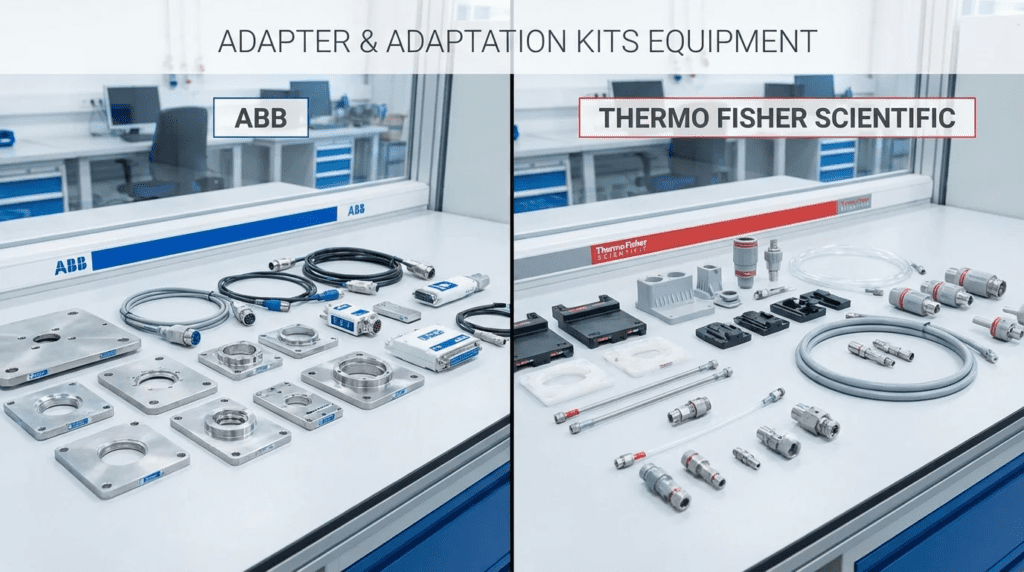
When evaluating process analytical integration, engineers frequently encounter a choice between two supplier ecosystems: ABB vs Thermo Fisher Adapter & Adaptation Kits Equipment. Both manufacturers provide extensive sensor lineups, but their approaches to mechanical adaptation — how those sensors connect to pipes, tanks, and basins — differ. These adapter kits are the physical bridge between delicate sensing elements and harsh process environments, ranging from aggressive chemical dosing lines to sludge recirculation loops.
A note on terminology, because it causes real confusion on projects. “Adapter and adaptation kit” in this context means analytical sensor mounting hardware — flow-through cells, immersion assemblies, retractable insertion assemblies, and thread or flange adapters that let a sensor reach a representative sample. It does not mean valve-actuator adaptation hardware, which is an entirely separate discipline governed by ISO 5210 and ISO 5211 mounting interfaces and, for municipal water service, AWWA C542. The two are sometimes bid in the same electrical and instrumentation package, which is how the terms get crossed, but they share no hardware and no standards.
This article provides a comparative analysis of the mechanical adaptation strategies used by ABB and Thermo Fisher Scientific for analytical instruments. It focuses on the engineering criteria required to specify the correct mounting hardware, ensuring process integrity, operator safety, and long-term maintainability.
How to Select and Specify Analytical Adaptation Hardware
Selecting the correct adaptation equipment requires analysis of the process interface. The adapter must survive the same conditions as the piping system while facilitating the delicate operation of the analytical sensor.
Duty Conditions & Operating Envelope
The primary failure mode for adaptation kits is a mismatch between the hardware ratings and the process variability. Unlike the sensors themselves, the adapters — retractable assemblies, ball valves, and packing glands — become part of the pressure boundary.
- Pressure Ratings: Verify the static and dynamic pressure ratings separately. A retractable assembly may be rated for full line pressure when static, but only a fraction of that during insertion or retraction. Different sealing mechanisms (O-ring versus compression fitting) dictate these limits.
- Temperature Cycling: Thermal expansion differences between a stainless steel adapter and a PVC piping system can lead to leaks. High-temperature applications such as anaerobic digestion or thermal hydrolysis require metallic adapters rather than CPVC or PVDF.
- Flow Velocity: High-velocity streams can induce vibration in immersion tubes or long-insertion adapters. Structural rigidity calculations or wake frequency constraints are necessary for long immersion lengths.
Materials & Compatibility
The material selection for the adapter kit is distinct from the sensor body. While a sensor might be glass and a filled polymer, the adapter kit exposes larger surface areas to the media.
- Chemical Resistance: For coagulation and flocculation service using ferric chloride or alum, 316SS adapters may suffer pitting corrosion. In these applications, PVDF or titanium adaptation kits are appropriate.
- Galvanic Corrosion: When retrofitting, avoid mixing dissimilar metals. Connecting a 316SS retractable assembly to a carbon steel pipe without dielectric isolation can seize the assembly in place over time.
- Elastomers: The O-rings within the adaptation kits are critical weak points. Ensure specifications explicitly call out EPDM, FKM, or FFKM based on the specific chemical presence; ozone, for instance, degrades standard nitrile rapidly.
Installation Environment & Constructability
The physical footprint of the adaptation hardware varies, affecting installation feasibility in crowded pipe galleries.
- Insertion Clearance: Retractable assemblies require a withdrawal zone equal to the length of the probe plus the retraction mechanism. Engineers often place a location on a drawing without accounting for the clearance needed to pull the sensor.
- Weight and Support: Heavy stainless steel ball-valve retraction assemblies exert significant moment on PVC saddles or non-metallic pipe walls. Specifications should require external pipe supports for any substantial side-stream assembly.
- Retrofit Interfaces: When adapting a new sensor to an existing nozzle, verify the thread standard. The industry is split between NPT and BSP. Bridging these without proper sealing surfaces is a common cause of leaks.
Reliability, Redundancy & Failure Modes
- Seal Integrity: Retractable assemblies rely on sliding dynamic seals. Seal life decreases sharply in abrasive fluids such as mixed liquor or grit chamber effluent.
- Locking Mechanisms: Safety locks are essential for retractable units to prevent blowout during removal. Compare the safety interlocks: does the kit mechanically prevent sensor removal while the isolation valve is open?
- Leak Detection: Advanced adaptation kits may include ports for leak detection, allowing operators to see if the primary process seal has failed before fluid reaches the exterior environment.
Maintainability, Safety & Access
The total cost of ownership for analytical loops is largely labor. The adaptation kit determines the labor hours required for routine cleaning and calibration.
- Tool-Free Access: Adaptation kits that require specialized tools or multiple wrenches to remove a sensor increase downtime. Twist-lock or bayonet-style adapters offer faster access than multi-bolt flange adapters.
- Automated Cleaning Interfaces: Some adapter kits feature integrated spray nozzles for in-situ cleaning. Specifying these for sludge applications can extend manual cleaning intervals substantially.
- Ergonomics: For immersion assemblies in open tanks, specify swing-arm adapters that allow the operator to lift the probe to the walkway deck rather than leaning over a handrail.
Lifecycle Cost Drivers
- Spare Parts Uniformity: Standardizing on one manufacturer’s adaptation ecosystem reduces the inventory of O-rings, compression nuts, and special tools.
- Sensor Lifespan Extension: Proper adaptation protects the sensor tip from direct impact using shrouds and ensures it stays wet during tank draining, significantly extending sensor life.
The Sample Line Is the Measurement
Engineers specify the sensor carefully and the mounting hardware carefully, and then run the sample through whatever pipe is convenient. That pipe determines what the instrument actually reads, and no amount of sensor accuracy recovers a sample that is not representative.
Three failures account for most of it. The first is lag. A flow-through cell at the end of a long, low-velocity sample line reports what the process was doing minutes ago. For monitoring this is tolerable; for a control loop it is destabilizing, because the controller is correcting against stale information and will hunt. Calculate the transport time explicitly — line volume divided by sample flow — and compare it to the process time constant before accepting the arrangement.
The second is the dead leg. A sensor mounted on a stub, a blind flange, or a tee with no through-flow sits in water that exchanges only by diffusion. Solids settle, biofilm grows, and chlorine residual decays in that pocket, so the reading is of the pocket rather than the process. The sensing element must extend past the branch into the active stream, and the branch itself should be as short as the geometry allows.
The third is stratification and mixing distance. Sampling immediately downstream of a chemical injection point returns whatever fraction of the stream the probe happens to sit in, which is why pH readings taken too close to a caustic injection swing wildly while the bulk stream is stable. Allow adequate pipe diameters of mixing before the sample point, and take the sample from the turbulent core rather than near the wall.
Where a sample pump is used, add a fourth consideration: the pump changes the sample. Pressure drop across a pump releases dissolved gases, which matters for dissolved oxygen and for pH in poorly buffered water. Gravity or differential-pressure-driven sample flow is preferable where the hydraulic profile allows it.
Comparison of Adaptation Ecosystems
The following tables compare the mechanical adaptation approaches of ABB and Thermo Fisher Scientific for analytical instruments. Product line names and brand ownership change; verify current offerings with the manufacturer before naming them in a specification.
| Feature / Category | ABB Adaptation Ecosystem | Thermo Fisher (Orion) Ecosystem | Engineering Considerations |
|---|---|---|---|
| Primary Connection Standard | Heavy reliance on NPT threads (3/4″ and 1″) and standard flange interfaces. | Mix of NPT threads and union or twist-lock designs. | Standard NPT offers easier generic retrofitting; union mounts offer faster tool-free removal. |
| Retractable Assemblies | Stainless steel ball-valve assemblies with emphasis on safety interlocks. | Ball valve hardware available; emphasis on compact insertion and hot-tap designs. | Heavier assemblies favor high-pressure service; compact units suit tight skids. |
| Material Options | Broad range: 316SS, PVC, PVDF, and higher alloys for specific chemical lines. | Strong CPVC and PEEK offerings; specialized for ultra-pure water and standard wastewater. | Verify chemical compatibility of the entire wetted assembly, not just the sensor body. |
| Cleaning Integration | Hydraulic and pneumatic cleaning adapters are part of the portfolio. | Cleaning heads available; design emphasis on flat-face sensor geometry to reduce fouling. | Active cleaning adapters suit sticky sludge; passive flow designs work in cleaner streams. |
| Retrofit Capability | Retrofit kits to fit their sensors into competitors’ existing hardware. | Strong path for upgrading legacy Orion installations; adaptation to generic NPT ports is standard. | Check insertion depth carefully when cross-adapting sensors to avoid dead-zone measurement. |
| Application Scenario | Preferred Adaptation Style | Key Constraints | Relative Cost Impact |
|---|---|---|---|
| Aeration Basin (Activated Sludge) | Immersion assembly with swing arm or handrail mount | Must allow retrieval without leaning over rails. Vibration from aeration can loosen fittings. | Medium — requires structural mounting hardware. |
| Pressurized Effluent Line | Retractable assembly (ball valve insertion) | Safety requires anti-blowout stops. Must allow sensor removal without process shutdown. | High — complex mechanical assembly required. |
| Chemical Dosing (Acid/Caustic) | Flow-through cell (side-stream) or flanged inline | Material compatibility. Allow adequate mixing distance downstream of injection. Avoid threaded PVC under chemical attack. | Medium/High — dependent on materials. |
| Influent / Headworks (High Solids) | Immersion with jet wash adapter | Ragging is the primary failure mode. Adapter must not have snag points. | Medium — cost of air or water cleaning utility supply. |
| Clean Water / Drinking Water | Low-volume flow cell | Minimize sample waste and transport lag. Fast response time required. | Low — simple acrylic or stainless flow cells. |
Engineer & Operator Field Notes
The following insights are derived from commissioning and operation of analytical loops involving ABB vs Thermo Fisher Adapter & Adaptation Kits Equipment.
Commissioning & Acceptance Testing
When commissioning new adaptation equipment, a water test is insufficient. Acceptance testing must verify mechanical integrity under process conditions.
- The Torque Check: For threaded NPT adapters, verify installation was performed with the correct torque. Over-tightening plastic adapters into metal pipes causes hairline cracks that only leak after thermal cycling. Use a strap wrench for plastic fittings, not a pipe wrench.
- Retraction Verification: For retractable assemblies, perform a full insertion and retraction cycle before the line is pressurized. Check for binding or misalignment of the sliding tube. Once the line is active, binding can leave a sensor stuck in the inserted position.
- Orientation Check: pH sensors generally require an installation angle of at least 15 degrees above horizontal to keep the internal electrolyte in contact with the reference junction. Ensure the adapter kit is not installed horizontal or inverted unless the sensor uses a pressurized gel or solid-state reference designed for any orientation.
Never use standard copper or nickel anti-seize on stainless steel adapter threads in potable water applications, as it can contaminate the sample. Use PTFE-based thread lubricants or sealants certified to NSF/ANSI 61.
Common Specification Mistakes
Errors in the specification phase often lead to expensive change orders during installation.
- Ignoring Pipe Schedule: Specifying an insertion length based on the outer diameter of the pipe without accounting for Schedule 80 wall thickness leaves the sensor tip in the low-flow boundary layer rather than the bulk stream.
- Material Ambiguity: Specifying a “stainless steel adapter” is ambiguous. In high-chloride environments, 304SS will corrode. Specifications must explicitly state 316L or a higher alloy.
- Missing Isolation Valves: Specifying a flow-through cell without upstream and downstream isolation valves makes it impossible to service the sensor without draining the main line. Always detail the isolation, sample, and check valves on the P&ID.
- Blind Flange Adaptation: Adapting a sensor to a blind flange creates a dead leg where solids accumulate. The adapter must ensure the sensing element extends past the flange face into the active flow.
O&M Burden & Strategy
Maintenance teams must live with the adaptation choice for the life of the plant. A strategy centered on accessibility reduces burden.
- Seal Replacement: Retractable assemblies rely on O-rings that wear out. Schedule O-ring replacement annually. Both manufacturers sell service kits for their hardware; these should be stocked as critical spares.
- Cleaning Access: If an adapter requires removing eight flange bolts to clean a pH probe in a lime softening application, the probe will not get cleaned. Select quick-release adapters for high-fouling applications.
- Standardization: Attempt to standardize on one thread size across the plant. This allows maintenance to use generic plugs if a sensor fails and a spare is unavailable, maintaining process containment.
Design Details & Sizing Logic
Proper design of the mounting interface ensures accurate measurement and mechanical safety. The following methodologies apply to both manufacturers’ equipment.
Sizing Logic: Insertion Depth
Insertion depth is critical for representative sampling. The sensor active area must be located in the turbulent core of the pipe flow.
- Identify Internal Pipe Diameter: Consult standard pipe tables (ANSI B36.10) for the specific schedule.
- Determine Nozzle Height: Measure from the pipe wall outside diameter to the top face of the mounting flange or threadolet.
- Calculate Minimum Insertion: Minimum insertion length equals the nozzle height, plus the pipe wall thickness, plus 20% of the internal pipe diameter. The 20% allowance keeps the sensing element out of the wall boundary layer.
- Verify Maximum Insertion: Ensure the probe does not reach the opposite wall or interfere with inline mixers or pumps. Keep the total insertion at least one inch short of the far wall.
Sizing Logic: Sample Transport Time
For any side-stream or flow-through arrangement, calculate the transport lag before accepting the design. Transport time in seconds equals the internal volume of the sample line divided by the sample flow rate, in consistent units. Compare this to the process time constant; for a control loop, a transport lag approaching the process time constant will make the loop unstable regardless of tuning.
Specification Checklist
When preparing bid documents for analytical adaptation hardware, include the following:
- Process Connection: Explicitly state type (NPT, BSP, ANSI flange, tri-clamp) and size.
- Wetted Materials: Define materials for body, seals, and hardware independently.
- Pressure/Temperature Rating: Must meet or exceed process design conditions, not just operating conditions, and state the rating during retraction separately.
- Retraction Safety: For retractable units, safety stop or anti-blowout mechanisms are mandatory.
- Sample Line: Line size, material, velocity, and calculated transport time.
- Certifications: NSF/ANSI 61 for potable water wetted parts; jurisdictional pressure registration where applicable.
Standards & Compliance
- ASME B31.3 (Process Piping): Adaptation kits become piping components. They must comply with the pressure-temperature ratings defined in this standard.
- NEMA 250 / IEC 60529: The junction box or head connecting to the adapter must be rated for the environment, typically NEMA 4X / IP66 for washdown areas.
- EPA Method 334.0: For online drinking water chlorine analysis, the flow cell design must maintain the hydraulic conditions the method requires.
- NSF/ANSI 61: For wetted components in potable service; certification applies to specific products, not material classes.
Frequently Asked Questions
What is the difference between an insertion assembly and a retractable assembly?
An insertion assembly is fixed in place; the process line must be depressurized and drained to remove the sensor for cleaning or calibration. A retractable assembly, often called a hot-tap or ball-valve insertion, includes a mechanism to withdraw the sensor into a chamber, close a valve, and remove the sensor while the process line remains pressurized and in operation. Retractable assemblies cost more but are necessary for critical continuous processes.
Can I use an ABB sensor in a Thermo Fisher adapter, or the reverse?
Cross-compatibility is possible if standard thread interfaces are used. Both manufacturers produce sensors with standard 3/4″ or 1″ NPT threads. Proprietary twist-lock, quick-connect, or union-style adapters are typically not interchangeable between brands. When retrofitting, check the physical thread type and the sensor insertion length to ensure the active element reaches the process stream.
When should I specify a flow-through cell instead of pipe insertion?
Flow-through cells are preferred when the main process line is large, has high vibration, or is difficult to access, and for clean water applications where precise flow regulation across the sensor is needed. The trade-off is transport lag and the additional maintenance points of sample pumps or pressure taps. Calculate the lag before committing.
How does the adapter material affect pH measurement accuracy?
The adapter material does not change the pH, but it can affect the electrical ground. For accurate pH measurement, especially with differential sensors, a solution ground is often required. If the adapter is non-conductive plastic and the pipe is also plastic, the sensor may require an integrated solution ground pin to avoid noisy signal drift. Stainless steel adapters provide this ground reference inherently.
What is the typical service life of a retractable assembly seal kit?
In typical wastewater applications the dynamic seals in a retractable assembly should be inspected every 6-12 months and replaced annually. In abrasive applications such as grit chambers or lime slurry, seal life may be reduced to 3-6 months. Failure to replace seals leads to process fluid leaking into the retraction chamber, potentially seizing the mechanism or damaging the sensor.
Why is the adapter ecosystem a critical specification decision?
The choice dictates the long-term maintenance ecosystem of the plant. Standardizing on one adapter style streamlines inventory and training. Mixing adaptation kits — some requiring wrenches, others twist-lock — increases the risk of operator error and extends the time required for routine calibration, directly affecting data availability.
Is this the same as valve-actuator adaptation hardware?
No. Valve actuator mounting is a separate discipline with its own interface standards (ISO 5210 for multi-turn, ISO 5211 for part-turn) and, for municipal water service, AWWA C542. Where an actuator interface is the actual scope in question, the relevant references are the actuator supplier comparisons — for example Rotork vs AUMA actuators and the survey of electric valve actuator OEMs — rather than analytical mounting hardware, and the broader supplier field is covered in the review of valve actuator manufacturers.
Conclusion
Key Takeaways for Engineers
- Match the Adapter to the Process, Not Just the Sensor: Ensure pressure, temperature, and chemical compatibility ratings of the mounting hardware meet the worst-case process conditions, including during retraction.
- The Sample Line Is the Measurement: Transport lag, dead legs, and inadequate mixing distance corrupt readings no sensor accuracy can recover.
- Prioritize Access: The most common cause of sensor neglect is difficult access. Specify retractable or swing-arm assemblies that allow safe, tool-free access.
- Standardize Interfaces: Where possible, use standard NPT interfaces or a single manufacturer’s system plant-wide to reduce spare parts inventory.
- Check Insertion Depth: Verify the sensor tip sits in the active flow, clear of boundary layers and dead legs.
- Material Compatibility: Do not assume stainless steel is universally safe; verify against chlorides and acids to prevent corrosion failures.
The selection of ABB vs Thermo Fisher Adapter & Adaptation Kits Equipment is more than a procurement detail; it is a design choice that affects the reliability and maintainability of the plant’s instrumentation. While both manufacturers offer high-quality sensors, their mechanical integration philosophies differ. ABB tends toward robust, heavy-duty retractable assemblies and hydraulic cleaning systems suited to difficult wastewater streams. Thermo Fisher, through its Orion line, often provides compact, operator-friendly designs suited to clean water, standard process compliance, and space-constrained skids.
For the consulting engineer and plant director, the goal is not merely to buy a sensor, but to design a measurement point that is safe, representative, and serviceable. By rigorously evaluating the mechanical attributes of these adaptation kits — pressure ratings, material options, retraction safety, and the sample path itself — engineers can ensure that their instrumentation investment delivers accurate data for the life of the facility.