
Rotork Controls vs Auma Actuators for Valve Actuators: Pros/Cons & Best-Fit Applications
Introduction
In the hierarchy of water and wastewater treatment plant assets, the electric valve actuator is often treated as a commodity, a black box expected to turn a valve stem upon command. However, incorrect specification or selection between major manufacturers can lead to process failures, unmanageable maintenance burdens, and integration difficulties. For decades, two manufacturers have dominated the global landscape for heavy-duty, intelligent electric actuation: Rotork Controls and AUMA Actuators.
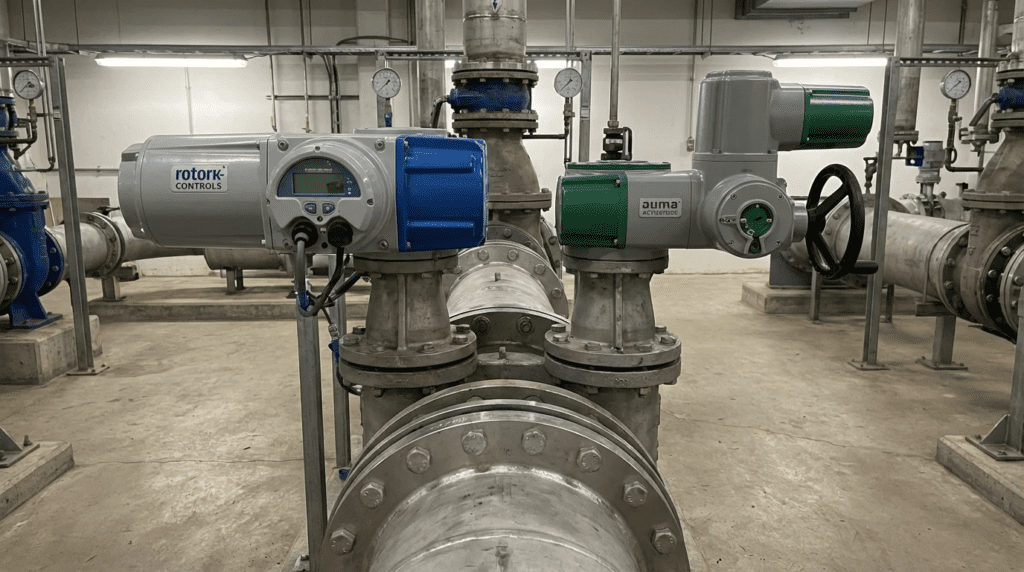
Consulting engineers and plant directors frequently face a binary choice when writing specifications for new facilities or retrofits. While both manufacturers produce high-quality equipment capable of meeting AWWA C542 and EN 15714 standards, their design philosophies differ fundamentally. Rotork is known for its integrated, non-intrusive double-sealed design, typified by the IQ series, while AUMA is known for its modular architecture, typified by the SA and SAR series, which allows for field flexibility.
The stakes of this selection are real. A misapplied actuator in a return activated sludge line or a filter backwash gallery can result in process upsets. This guide moves beyond marketing brochures to analyze the mechanical and electrical implications of these two approaches, helping engineers make data-driven decisions regarding reliability, constructability, and total cost of ownership.
This is one of the few genuinely head-to-head comparisons in the valve sector: Rotork and AUMA compete directly, across the same duty range, for the same municipal specifications, and both are routinely named as acceptable alternates in the same specification section. The distinctions drawn below are real engineering differences rather than marketing positioning.
Two statistics from the earlier version of this page — a figure for the share of valve failures attributable to actuation, and a figure for the share of actuator failures attributable to moisture — were unsourced and have been replaced with qualitative statements. Both underlying points hold: actuation and interface problems account for a large share of what gets reported as valve failure, and moisture ingress is the dominant actuator failure mode. Neither percentage should be cited from this page.
This guide sits within our coverage of top valve actuator manufacturers. See also our guides to electric valve actuator OEMs and pneumatic valve actuator OEMs, and our comparison of further actuator options.
How to Select / Specify
Engineers must evaluate the equipment against specific site constraints and process requirements. The best actuator is invariably the one that best matches the specific duty cycle and maintenance culture of the utility.
Duty Conditions & Operating Envelope
The first step in specification is defining the service class. Both manufacturers use IEC 60034-1 duty cycle ratings, but their approaches to thermal management differ.
- Isolation Service: For valves that operate infrequently, such as pump isolation valves, both product families are standard choices. Engineers must verify the short-time duty rating, typically S2-15min or S2-30min, which defines how long the motor can run at rated load before overheating.
- Modulating Service: For flow control valves requiring frequent adjustment, intermittent periodic duty or continuous duty ratings are required. AUMA’s SAR series is robust here, with high permissible starts per hour. Rotork’s modulating variant uses solid-state reversing starters to manage high switching frequencies without contactor wear.
- Throttling Precision: If the process requires tight positioning accuracy, backlash in the drive train becomes critical. Specification documents should explicitly state the required deadband and hysteresis limits.
Materials & Compatibility
Wastewater treatment plants present a highly corrosive environment through hydrogen sulfide, high humidity, and chlorine off-gassing. The enclosure material and coating system are paramount.
- Enclosure Material: Both manufacturers generally use high-quality aluminum alloy for main housings, with iron options available for larger gearboxes.
- Corrosion Protection: Specifications should mandate a minimum two-part epoxy coating suitable for C4 or C5-M environments per ISO 12944.
- Hardware: All external fasteners should be 316 stainless steel. Ensure that the interface between stainless fasteners and aluminum housings includes anti-seize or isolation to prevent galvanic corrosion, a common issue in both brands if not maintained.
Installation Environment & Constructability
- Space Constraints: Rotork IQ actuators are generally compact and integrated, with motor, controls, and gearbox contained in a unified housing. This is advantageous in tight manifolds.
- Modularity vs. Integration: AUMA’s modular design means the control head is mounted to the actuator body, which is mounted to the valve. This can result in a taller stack-up height. However, it allows the controls to be wall-mounted remotely if the valve is in a confined space or a vibration-heavy environment, a significant advantage in hard-to-reach areas.
- Orientation: Both manufacturers allow rotation of the display. Engineers should require the display to be rotatable in 90-degree increments to ensure operator visibility regardless of valve orientation.
Reliability, Redundancy & Failure Modes
The philosophy of sealing is the most distinct difference between the two.
- Rotork double seal: Rotork pioneered the double-sealed terminal compartment. The wire termination area is separated from the internal electronics by a watertight seal. If an installer leaves the conduit cap off or a cable gland leaks, water fills the terminal block but does not ruin the control board. This provides high reliability during the construction phase.
- AUMA plug and socket: AUMA typically uses a high-quality multi-pin plug and socket connector, allowing quick electrical disconnection without unscrewing individual wires. This is excellent for maintenance speed but requires disciplined installation to ensure the seals are correctly seated.
- Handwheel Engagement: During power failure, manual operation is required. Rotork normally uses a declutch lever that can be padlocked. AUMA designs vary by model. The ease of engaging manual override under load is a critical safety consideration for operators.
Controls & Automation Interfaces
- Proprietary Networks: Rotork offers Pakscan, a two-wire loop system favored for long distances and fault tolerance. AUMA offers comparable network capability and is well regarded for open-protocol implementation.
- Open Protocols: Both support Profibus, Modbus, Foundation Fieldbus, and EtherNet/IP.
- Data Granularity: Look for actuators that report not just position, but torque profiles. This allows predictive maintenance, detecting a sticky valve seat before the valve fails to close. Both manufacturers’ current control platforms offer advanced data logging.
Lifecycle Cost Drivers
- Spare Parts Strategy: AUMA’s modularity allows a plant to stock separate motors, gearboxes, and control heads. If a motor burns out, you replace just the motor. With an integrated design, major component failure often means sending the unit to a service center or swapping the entire actuator.
- Energy: While electric actuators consume negligible power compared to pumps, the standby draw of control electronics adds up over hundreds of units.
- Standardization: Mixing manufacturers increases the training burden. Operators must learn two different menu structures and setting tools. It is generally advisable to standardize on one manufacturer per facility or per process area.
Comparison Tables
Table 1: Technical & Architectural Comparison
| Feature | Rotork Controls (IQ Series) | AUMA Actuators (SA/SAR Series) | Engineering Implication |
|---|---|---|---|
| Design Philosophy | Integrated, monoblock | Modular: motor, gearing, controls | Rotork is compact; AUMA offers field flexibility for component swaps. |
| Sealing Technology | Double-sealed with separate terminal compartment | O-ring sealed; plug and socket connection typical | Rotork offers additional protection against water ingress during installation. |
| Torque Sensing | Electronic sensing of worm shaft thrust | Mechanical and electronic sensing of worm movement | Both are accurate; AUMA’s mechanical roots allow very direct calibration. |
| Position Sensing | Absolute encoder, contactless | Absolute encoder or counter gear; high precision options available | Both retain position during power loss. Battery supports display and logging during outage. |
| Manual Override | Side-mounted handwheel with declutch lever, independent of motor drive | Handwheel, typically non-rotating during motor operation | Both safe; verify rim pull requirements for large valves. |
| Control Interface | Non-intrusive Bluetooth setting tool | Display buttons or Bluetooth and software | Both allow non-intrusive setup without opening covers on current models. |
Table 2: Application Fit Matrix
| Application Scenario | Best Fit | Rationale |
|---|---|---|
| Submerged or Flood-Prone Vaults | Rotork | The double-sealed terminal compartment provides a higher safety margin if conduit seals fail or the vault floods during installation. |
| High-Precision Modulation | AUMA (SAR) | The modulating range is robust with high duty cycles and minimal backlash options. |
| Remote or Tight Space Mounting | AUMA | The ability to detach the control head and mount it on a wall bracket is a native feature of the modular design. |
| Standard Plant Isolation | Either | Both are well proven for simple isolation duty; choose on the basis of plant standardization. |
| Retrofit on Non-Standard Valves | AUMA | Modularity allows easier mixing and matching of flanges and drive nuts in the field without factory modification. |
Engineer & Operator Field Notes
Commissioning & Acceptance Testing
- Torque vs. Position Seating: For resilient seated valves such as butterfly and resilient wedge gate valves, always set the close limit based on position, with torque protection as a backup. For metal-seated valves such as knife gates and globe valves, torque seating is often required to ensure a seal. A common mistake is setting resilient valves to torque-seat, which overdrives the wedge or disc and destroys the rubber over time.
- Phase Rotation: Modern intelligent actuators usually include automatic phase correction, detecting incoming three-phase rotation and adjusting internally. Verify this feature is active to prevent damage during startup.
- End Stop Settings: Physical mechanical stops in the actuator gearbox must be set outside the electronic limits. If the electronic limit fails, the mechanical stop prevents damage, but the motor must trip on torque before hitting the hard stop.
Specifying a named model “or approved equal” without defining the criteria for equal, such as a double-sealed terminal compartment, a non-intrusive setting tool, or specific data logging capacity, allows contractors to supply lower-tier equipment that meets the torque rating but lacks the reliability features.
- Cable Entry Sealing: This is a leading cause of actuator failure. Specifications often ignore the cable glands. Engineers must specify certified IP68 cable glands. Using standard putty or non-watertight fittings negates the actuator’s enclosure rating entirely.
- Undersizing Power Cabling: Actuators draw high inrush currents during unseating. If voltage drop is excessive during that moment, the actuator may stall or reset its electronics. Long cable runs in large plants require careful voltage drop calculations.
O&M Burden & Strategy
- Battery Management: Both manufacturers use batteries to maintain position logging and display when main power is lost. If the battery dies, the actuator still works, but position data during an outage may be lost until power is restored and limits are re-checked. A preventive maintenance schedule should include battery replacement on a defined interval.
- Lubrication: Oil-bath gearing is typically sealed for life. Grease-filled units in high-temperature environments may experience separation over many years. Check the manual for inspection intervals.
Troubleshooting Guide
- Symptom: Actuator trips on torque fault in mid-travel.
Cause: Usually a tight valve, debris in the line, or lack of lubrication on the valve stem. It is rarely the actuator’s fault.
Action: Check the data log for the torque profile. If torque spikes at a specific position, the obstruction is physical. - Symptom: Thermostat trip or motor overheat.
Cause: Exceeding the duty cycle.
Action: Check the control loop. Is the PID loop hunting? Is the deadband set too tight for the mechanical slop in the valve? Widen the deadband.
Design Details & Calculations
Sizing Logic & Methodology
- Determine valve torque: Obtain the seating, running, and breakaway torque from the valve manufacturer. Breakaway torque after long periods of inactivity can be substantially higher than running torque.
- Apply a safety factor: roughly 1.25 for clean water, 1.5 to 2.0 for wastewater and sludge to account for grit and ragging.
- Calculate required actuator torque as valve torque multiplied by the safety factor.
- Select the model so that rated torque exceeds the requirement while falling within the mid-range of the actuator’s capacity. Avoid sizing at 100% of capability, which leaves no margin for wear.
- Check stem nut compatibility: the valve stem diameter and thread pitch must fit within the actuator’s drive bush.
Write the Specification to AWWA C542, Not to a Brand
Because these two manufacturers are genuine competitors, the specification is where a project either preserves competition or quietly eliminates it. AWWA C542 is the governing standard for electric motor actuators on valves and slide gates in North American water works, and it covers the requirements that actually matter: torque and thrust ratings, duty classification, enclosure protection, motor protection, position and torque limiting, manual override, and testing.
A specification written to C542 plus explicitly stated performance requirements admits both manufacturers and excludes light-duty substitutions. A specification written around one manufacturer’s proprietary feature names does the opposite, and on a publicly funded project it invites a bid protest. Where a distinctive feature genuinely is required, describe the capability:
- Not a trade name for a sealed terminal compartment, but: “the wiring termination compartment shall be sealed independently of the electronics compartment such that water entering the termination compartment cannot reach control electronics.”
- Not a named setting tool, but: “all commissioning and configuration shall be performed without removing any enclosure cover.”
- Not a named network, but the protocol, the topology, and the maximum cable run required.
State the enclosure requirement completely as well. IP68 is not a single rating — the standard requires the manufacturer to declare the depth and duration of submersion the rating covers. “IP68” alone in a specification is not enforceable; “IP68 rated for submersion at the stated depth and duration” is.
Specification Checklist
- Enclosure: IP68, with the submersion depth and duration stated explicitly.
- Temperature Range: verify against the actual site extremes.
- Motor Protection: embedded thermostats in motor windings.
- Heaters: internal space heater to prevent condensation, important for outdoor installations.
- Controls: non-intrusive setup via Bluetooth or infrared, without removing covers.
- Data Logging: capacity to store torque profiles and event logs.
Standards & Compliance
- AWWA C542: Electric Motor Actuators for Valves and Slide Gates.
- NEMA MG 1 / IEC 60034: Motor performance standards.
- ISO 5210 / MSS SP-102: Multi-turn flange attachment dimensions, ensuring the actuator fits the valve. ISO 5211 applies to part-turn attachments.
Frequently Asked Questions
What is the primary difference between the two?
The primary difference lies in architectural philosophy. The Rotork IQ series uses an integrated, monoblock design emphasizing a double-sealed enclosure to protect electronics from water ingress, making it robust for harsh environments. The AUMA SA series uses a modular design with separate motor, gearbox, and control unit, offering flexibility for field modifications, maintenance, and remote mounting of controls.
Which is better for modulating service?
Both offer capable modulating units, but they are specified differently. For Rotork, specify the modulating variant explicitly. For AUMA, the SAR series is used. AUMA is often cited as having a wide range of modulating duty options and is well regarded for control loops requiring high precision and frequent starts.
How do I calculate the stroking time for a multi-turn actuator?
Stroking time is determined by the actuator output speed and the valve stem thread pitch. Divide the total valve travel distance by the thread pitch to get the number of turns, then divide by the actuator speed in revolutions per minute. For example, a gate valve with 12 inches of travel and a quarter-inch pitch requires 48 turns; at 24 rpm it closes in two minutes. Engineers must ensure this time is slow enough to prevent water hammer but fast enough for process control.
What does non-intrusive mean in actuator specifications?
Non-intrusive means the actuator can be configured, calibrated, and interrogated without removing any electrical covers. Settings such as torque limits, position limits, and control logic are adjusted using a Bluetooth or infrared setting tool. This is critical in wastewater environments to prevent moist air, hydrogen sulfide, or rain from entering the electronic compartment.
Are the two brands interchangeable?
Mechanically, largely yes, provided both adhere to the applicable ISO flange standard. However, the electrical interfaces and control wiring differ. Replacing one with the other requires checking the bolt circle, the stem nut machining, and the SCADA communication map, since register assignments will differ.
How often should these actuators be maintained?
Under normal municipal service, these are low-maintenance devices. Major maintenance such as oil change and seal replacement is typically recommended on a multi-year interval depending on duty cycle. Routine inspections, including checking for physical damage, exercising infrequently used valves, and checking desiccant and heaters, should occur annually.
Conclusion
Key Takeaways
- Sealing is Critical: Moisture ingress is the dominant failure mode for electric actuators. Rotork’s double seal offers a distinct advantage in construction environments where conduit work is imperfect.
- Modularity Matters: AUMA’s modular design offers flexibility for retrofits, high-maintenance applications, or where remote mounting of controls is necessary.
- Duty Cycle Defines Class: Do not use isolation-class actuators for modulating duties. It will lead to motor and contactor failure.
- Voltage Drop: Calculate voltage drop based on inrush current, not running current, to prevent stalling during unseating.
- Standardize: To reduce training and spare parts inventory, standardizing on one manufacturer for the plant is often more valuable than a small saving on unit cost.
Selecting between these two is rarely a question of good versus bad, but rather integrated versus modular. For general plant isolation in wet, humid, or flood-prone galleries, the double-sealed integrity of the Rotork IQ often makes it the preferred choice for risk-averse engineers. Its set-and-forget reliability fits the lean maintenance staffing of many municipalities.
Conversely, for applications requiring complex modulation, remote control head mounting, or the ability to swap motors and gear ratios in the field, AUMA provides an engineering edge. Their modular approach allows a level of customization that can solve difficult retrofit geometry problems.
Ultimately, the specification should focus on the application’s duty cycle, the environmental constraints, and the long-term maintenance strategy of the utility.