
Airport PFAS Contamination
Airport PFAS Contamination: Navigating the Regulatory Landscape and Effective Solutions
Introduction
In recent years, the issue of per- and polyfluoroalkyl substances (PFAS) contamination at airports has emerged as a significant environmental challenge. As of July 2025, regulatory agencies and public health organizations are increasingly scrutinizing the widespread use of these chemicals, particularly due to their persistence in the environment and potential health risks. Airports, often using firefighting foams and various cleaning products containing PFAS, face unique vulnerabilities that could lead to groundwater and soil contamination. This article comprehensively reviews the scope of airport PFAS contamination, explores current regulatory frameworks, and presents effective remediation strategies, ensuring airport authorities and environmental professionals are well-equipped to tackle this pressing issue.
Airports occupy a particular place in the PFAS story, and it is worth being clear about why. Almost every other PFAS source is diffuse — a landfill, a wastewater plant, a consumer product stream. An airport fire training area is the opposite: a small, precisely located patch of ground where a concentrated fluorosurfactant product was discharged deliberately, repeatedly, for decades, under a federal requirement that the operator had no discretion to refuse. The result is among the highest groundwater concentrations recorded anywhere, in plumes that travel for miles. As part of the broader field of PFAS removal in wastewater treatment, this page serves as the category hub for PFAS sources and contamination: where these compounds enter the environment, how sources are identified and traced, what the AFFF legacy means for the sites that hold it, and how the transition away from fluorinated foam is being handled.
Understanding PFAS: What Are They?
Definition and Chemical Properties
PFAS, commonly referred to as “forever chemicals,” are a class of over 4,700 synthetic compounds known for their water- and grease-resistant properties. Common types include perfluorooctanoic acid (PFOA) and perfluorooctanesulfonic acid (PFOS), both of which have been phased out in many countries but continue to pose significant risks due to their persistence in the environment.
Sources of PFAS at Airports
Airports serve as significant sources of PFAS due to the following:
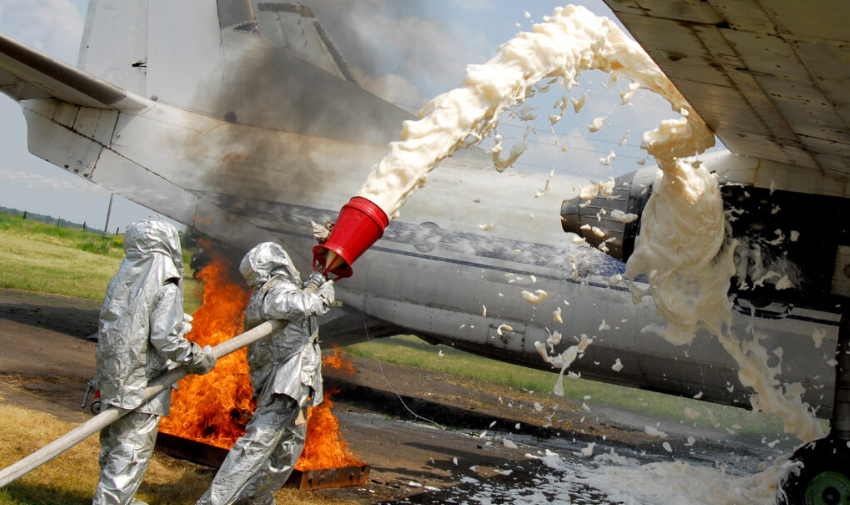
- Aqueous Film-Forming Foams (AFFF): Used extensively in fire fighting, AFFF has been implicated in numerous PFAS contamination cases.
- Maintenance Products: Various cleaning and maintenance products utilized on airport grounds may contain PFAS, leading to further contamination.
- Runoff and Leachate: Airports often have significant impervious surfaces, causing runoff that can carry PFAS into nearby water systems.
AFFF and the Scale of the Source Mass
Of those three, AFFF dominates by orders of magnitude, and understanding why requires knowing what the product is. Aqueous film-forming foam works by spreading a thin aqueous film across a burning fuel surface, and the fluorosurfactant that makes that film possible was, in legacy formulations, present at roughly one to two percent of the concentrate by mass. Older products were based on PFOS chemistry; later fluorotelomer products replaced it but still degrade in the environment to terminal perfluoroalkyl acids, so “we stopped using PFOS foam” does not mean a site has no ongoing source.
Discharge happened in four recognisable ways: fire training exercises at a dedicated pad, often on a fixed schedule for decades; emergency response to actual incidents; periodic testing and calibration of vehicle and hangar systems; and accidental releases from hangar suppression systems, which can discharge thousands of gallons of finished foam in a single event.
The masses involved are worth making concrete. A training pad consuming 500 gallons of concentrate a year over twenty years received 10,000 gallons — roughly 41,600 kilograms of product, carrying on the order of 400 kilograms of fluorosurfactant if the concentrate was one percent by mass. Set that against a drinking water limit of 4 parts per trillion, where a single kilogram of PFAS is in principle enough to push about 66 billion gallons of water above the standard. Real subsurface behaviour involves sorption, dilution, and dispersion rather than perfect mixing, so no plume behaves that way — but the ratio between source mass and regulatory limit is why these sites produce plumes measured in miles and why they do not attenuate.
The Regulatory Landscape
Current Regulations and Policies
As of 2025, the U.S. Environmental Protection Agency (EPA) has implemented stricter regulations targeting PFAS, including:
- Drinking Water Standards: The EPA has proposed a Maximum Contaminant Level (MCL) for PFOA and PFOS at 0.004 parts per trillion, significantly tightening previous guidelines.
- Hazardous Substances Designation: PFAS may be classified as hazardous substances, triggering strict monitoring and cleanup requirements.
State-level regulations also vary. Some states have established their own MCLs for PFAS compounds, compelling airports to comply with local regulations in addition to federal guidelines.
Two Corrections, and Why the Second One Matters to Airports
On the drinking water limit. The 0.004 parts per trillion figure is the 2022 interim health advisory for PFOA — non-enforceable guidance. The enforceable maximum contaminant level, finalized in April 2024 rather than proposed, is 4.0 parts per trillion each for PFOA and PFOS, with 10 parts per trillion each for PFHxS, PFNA, and HFPO-DA and a Hazard Index of 1 for mixtures. The two figures differ by a thousandfold.
On hazardous substance status. This is not a “may be.” PFOA and PFOS were designated hazardous substances under CERCLA in 2024, and for an airport with an AFFF history that designation is the single most consequential development in the entire regulatory landscape. It brings release reporting obligations, establishes federal authority to compel investigation and cleanup, creates liability that attaches to the property and can be allocated among potentially responsible parties, and — critically — opens the possibility of reopening sites previously closed under other programmes. An airport authority reading “may be classified” and deferring action is deferring against a rule that already exists.
The FAA and the Foam Transition
The regulatory history at airports is unusual and deserves stating plainly, because it shapes both the liability picture and the practical path forward. Certificated airports in the United States were, for decades, required by federal aviation regulation to hold and use firefighting foam meeting a military specification — and that specification required fluorinated foam. Operators were not choosing to use a PFAS product; they were complying with a mandate.
That changed in stages. Congressional direction in 2018 required the aviation regulator to stop mandating fluorinated foam, and the subsequent issue of a fluorine-free military specification opened the way for airports to transition to F3 products. The transition is now underway across the sector, supported by guidance on how to change over and, in some cases, funding. The legacy contamination remains regardless: stopping the source does not remediate the plume that decades of use created.
Non-Regulatory Agency Guidance
Organizations such as the Federal Aviation Administration (FAA) and the Agency for Toxic Substances and Disease Registry (ATSDR) have published guidance documents advising airports on best practices to minimize PFAS use and monitor contamination.
PFAS Sources & Contamination: Subcategory Overview
Six subject areas sit beneath this category, covering where PFAS originates, how sources are mapped and traced, the AFFF legacy specifically, and one treatment technology particularly suited to concentrated source-zone water.
PFAS Sources in Water
The general picture is covered under PFAS sources in water, which surveys the full range beyond aviation — fluoropolymer and chemical manufacturing, metal plating and finishing, textile and paper coating, landfill leachate, wastewater treatment plant effluent and biosolids, and consumer product disposal. The distinction that organises the area is between point sources, where a discrete release created a defined plume, and diffuse sources, where low concentrations arrive from many contributors at once. The two demand entirely different responses: point sources support remediation and cost recovery against an identifiable party, while diffuse contamination generally leaves treatment at the point of use as the only practical option.
PFAS Contamination Map
Where contamination has actually been found is addressed under PFAS contamination map, covering the mapping efforts that have documented known and suspected sites across the country, what the datasets behind them do and do not contain, and how to read them responsibly. Mapping resources are valuable for identifying whether a facility sits near a known source and for community communication, and they carry a consistent caveat: absence from a map reflects absence of sampling far more often than absence of contamination, and a map built from voluntary or partial datasets will always understate.
Source Tracking PFAS
Attributing contamination to a source is examined under source tracking PFAS, covering the forensic techniques used to determine where a plume came from — compound ratio patterns and fingerprinting, the distinction between PFOS-dominated legacy AFFF signatures and fluorotelomer-derived profiles, precursor analysis, and the use of monitoring well networks to establish direction and gradient. This work matters commercially as well as technically: cost allocation among potentially responsible parties, and any cost recovery action, rests on the strength of the source attribution.
AFFF Contamination Cleanup
The characterization and treatment of AFFF-impacted sites is covered under AFFF contamination cleanup, addressing what makes these sites distinctive: extremely high source-zone concentrations, substantial precursor content that converts to regulated compounds over time, contamination retained at air-water interfaces in the unsaturated zone that continues feeding the plume, and co-located contaminants from fuel and solvent use at the same locations. This area covers site characterization, source zone delineation, and the treatment trains suited to concentrations far above anything encountered in drinking water work.
Firefighting Foam Remediation
The remedial response itself is examined under firefighting foam remediation, covering the remedy selection process at foam-impacted sites — source zone excavation, in-situ stabilization and sorptive barriers, pump-and-treat with ex-situ media, and hydraulic containment — along with the equipment decontamination that the foam transition itself requires. The broader remedial framework is covered under PFAS remediation; this area concentrates on what is specific to foam sites.
Foam Fractionation for PFAS
One treatment technology suits these sites unusually well, and foam fractionation for PFAS covers it. The method exploits PFAS surface activity directly: air is sparged through contaminated water, PFAS molecules migrate to the air-water interfaces of the rising bubbles, and the resulting foam is skimmed off as a small, highly concentrated foamate. It performs best on the high-concentration, surfactant-rich water that AFFF source zones and landfill leachate produce — precisely the streams where adsorptive media would be consumed rapidly — and it produces a residual small enough to be a practical candidate for destruction rather than disposal. Note that despite sharing a word, foam fractionation is a treatment process and has no relationship to firefighting foam beyond both involving bubbles.
The Impact of PFAS Contamination
Environmental and Human Health Concerns
Research has linked PFAS exposure to various health risks, including:
- Cancer: Studies have indicated associations between PFAS exposure and increased risks of kidney and testicular cancers.
- Immunological Effects: Some research suggests that PFAS can impair antibody responses to vaccines, raising public health concerns.
- Reproductive Effects: Emerging evidence indicates potential reproductive health issues, including low birth weight and developmental delays.
Off-Site Migration and Affected Wells
The exposure pathway that turns an airport’s environmental problem into a community’s health problem is groundwater migration beyond the fence line. Because PFAS are highly water-soluble and adsorb only weakly to aquifer solids, plumes travel at close to groundwater velocity and can reach private wells and public supply wells miles from the source. Private wells are the acute concern, since no regulation requires them to be tested and no agency is obliged to act on a result — responsibility falls on the homeowner unless the responsible party or an agency intervenes. Airports facing this typically end up funding well sampling programmes, point-of-entry treatment, or connection to a public supply, and these obligations frequently exceed the cost of on-site remediation. The occurrence side is covered under PFAS in water.
Economic Implications
The cost of PFAS contamination can be staggering. Remediation efforts, potential litigation, and reputational damage can impose significant financial burdens on airport authorities. Industry analysis from 2024 approximates the remediation costs for PFAS contamination at airports could reach millions of dollars, particularly for those located near sensitive water resources.
Identifying PFAS Contamination
Monitoring and Testing
Airport authorities should implement comprehensive monitoring programs that include:
- Sampling Groundwater and Soil: Regular testing of groundwater and soil for PFAS concentrations can help identify contamination hotspots.
- Utilizing Advanced Analytical Techniques: Technologies such as mass spectrometry are being adopted for more accurate identification and quantification of PFAS levels.
What a Site Investigation Needs to Capture
Three things distinguish PFAS site investigation from the practice most consultants brought to it from solvent work. First, the monitoring well network must be sized for a contaminant that travels at close to groundwater velocity — a network laid out for a chlorinated solvent plume will very likely miss the leading edge entirely. Second, the unsaturated zone above the water table must be characterized, not just the saturated zone, because PFAS accumulates at air-water interfaces there and continues feeding the plume long after any surface source is removed. Third, precursors must be analysed alongside the regulated terminal compounds, since a site that looks manageable on PFOA and PFOS today may hold a substantial reservoir that converts to them over years.
The analytical method for these matrices is EPA Method 1633, which covers groundwater, soil, sediment, and leachate; the drinking water methods 537.1 and 533 cover a different compound list and do not apply. Sampling protocol matters unusually much, since ordinary field clothing, containers, and decontamination supplies can contaminate a sample — field and equipment blanks belong in every round, because a false positive from technique is indistinguishable in the data from a real detection.
Risk Assessment Procedures
Conducting a thorough risk assessment is crucial to determine the extent of contamination and potential pathways of exposure to humans and ecosystems. Risk assessments allow for tailored remediation plans that prioritize the most affected areas.
Remediation Strategies
Conventional Treatment Methods
While traditional remediation techniques such as soil excavation and landfill disposal may be applicable, they often lack effectiveness against PFAS due to their hydrophobic and persistent nature. However, they may be part of a more comprehensive strategy.
Three Corrections on the Remediation Picture
On mobility. PFAS are not hydrophobic in the environmental sense the sentence above implies, and the distinction inverts the transport story. Most PFAS are highly water-soluble and adsorb only weakly to soil, which is precisely why they travel so far and so fast in groundwater and why plumes measured in miles are routine at foam sites. The fluorinated tail is hydrophobic — that is why activated carbon can grip it — but the molecule as a whole is surface-active and mobile. Excavation is not ineffective against PFAS; it removes mass reliably. Its limitations are volume, cost, and narrowing landfill acceptance for PFAS-bearing soil, which is a disposal problem rather than a performance problem.
On advanced oxidation. Conventional AOPs using ozone or hydrogen peroxide do not break down PFAS. Hydroxyl radicals do not appreciably attack the carbon-fluorine bond, so fully fluorinated compounds pass through essentially unchanged. At an AFFF site the consequence is worse than merely ineffective: oxidation converts the substantial precursor content typical of foam-impacted soil and groundwater into the terminal perfluoroalkyl acids that regulations measure, so an oxidative step can make PFOA and PFOS results rise. Where oxidation is being deployed for co-located fuel or solvent contamination, its effect on the PFAS numbers needs evaluating before the first injection.
On thermal desorption. Thermal desorption volatilizes contaminants out of soil and captures them in an off-gas stream — it separates rather than destroys. For PFAS this means the technology relocates the contaminant into a concentrated gas or condensate that then requires its own treatment, and the temperatures needed are high. Genuine destruction requires high-temperature thermal treatment with verified conditions, or one of the emerging destruction routes. Describing desorption as a solution without naming what happens to the captured stream leaves out the expensive half of the problem.
Innovative Treatment Technologies
1. Granular Activated Carbon (GAC)
GAC filtration systems have been shown to effectively reduce PFAS levels in drinking water. GAC removes contaminants through adsorption, making it a viable option for treating contaminated water at airports.
2. Ion Exchange Technology
Ion exchange systems specifically designed to target PFAS can be used in conjunction with GAC. They work by exchanging PFAS ions in water for non-toxic ions, effectively removing them.
3. Advanced Oxidation Processes (AOPs)
AOPs, utilizing ozone or hydrogen peroxide, can effectively break down PFAS molecules in water, converting them into less harmful byproducts. Emerging research highlights the potential of this technology in field applications.
4. Thermal Desorption
For contaminated soils, thermal desorption is increasingly being utilized. This method involves heating soil to high temperatures to volatilize PFAS, which can then be collected and treated.
5. Residuals from All of the Above
Every technology on this list concentrates PFAS rather than eliminating it, with the exception of genuine destruction routes. Spent carbon, spent resin, foamate, thermal condensate, and excavated soil all become PFAS-bearing wastes requiring characterization, a confirmed disposal route, and — since the CERCLA designation — attention to the liability that follows material sent for disposal. Establishing and pricing those routes before selecting a remedy is covered under PFAS waste management.
Comparing Source Types and Technologies
| Source type | Concentration | Spatial extent | Responsible party identifiable | Usual response |
|---|---|---|---|---|
| Fire training area (AFFF) | Very high | Defined source zone, long plume | Yes | Source treatment plus plume containment |
| Hangar suppression discharge | Very high, episodic | Localized, can reach storm drains fast | Yes | Rapid containment, then investigation |
| Chemical or fluoropolymer manufacturing | Very high | Extensive, air deposition possible | Yes | Site remediation and cost recovery |
| Landfill leachate | High relative to ambient water | Concentrated discharge to a POTW | Partially | Pretreatment or acceptance limits |
| Biosolids land application | Low to moderate | Broad area | Diffuse | Source control and land use restriction |
| Consumer product disposal | Low | Very diffuse | No | Treatment at point of use |
| Technology | Best-fit concentration | Destroys or concentrates | Residual produced |
|---|---|---|---|
| Foam fractionation | High; surfactant-rich source water | Concentrates | Small, highly concentrated foamate |
| Granular activated carbon | Low to moderate; dilute water | Concentrates | Spent carbon, reactivable |
| Ion exchange | Low to moderate | Concentrates | Spent resin, generally single-use |
| Soil excavation | Source zone soil | Relocates | Large volume of contaminated soil |
| Thermal desorption | Source zone soil | Separates into an off-gas stream | Condensate requiring further treatment |
| Destruction technologies | Small concentrated volumes | Destroys | Greatly reduced; byproducts to verify |
Transitioning to Fluorine-Free Foam
Replacing the product is now practical, and it is not simply a matter of ordering different foam.
The first issue is residual contamination in the equipment itself. Legacy AFFF leaves fluorosurfactant adsorbed on the internal surfaces of vehicle tanks, proportioners, pumps, and piping, and it continues to leach into whatever is put in afterwards. Simply draining and refilling produces fluorine-free foam that tests positive, sometimes for years. Effective transition requires repeated rinsing to a verified endpoint, and in some cases replacement of the most affected components — a considerably larger undertaking than the foam purchase itself.
The second is that the drained legacy concentrate is a concentrated PFAS waste requiring characterization, a disposal route, and manifesting, and the rinse water is too. Both need budgeting before the transition starts rather than after the tanks are empty.
The third is performance validation. Fluorine-free products extinguish differently, and crews need training and equipment settings adjusted for the new product’s behaviour. Transition planning should treat operational readiness and environmental compliance as one project rather than two.
Field Notes
Investigation Considerations
Start from the operational history rather than from the monitoring wells: fire training area locations, hangar system discharge records, incident logs, and foam purchase and disposal records together define where to look and frequently narrow the search dramatically. Design the well network for high mobility and confirm you have found the leading edge rather than assuming it. Analyse precursors alongside terminal compounds. Sample nearby private wells early, both because it is the right thing to do and because the community relations cost of being seen to discover them late is high. Use PFAS-free field protocols with blanks in every round.
Common Mistakes
The recurring errors are treating the plume while leaving the source zone in place, sizing the investigation on solvent-plume instincts, omitting the unsaturated zone, ignoring precursors and then being surprised when concentrations rise, deploying oxidation for co-located contaminants without checking its effect on PFAS results, transitioning foam without decontaminating equipment, and deferring action on the assumption that hazardous substance designation is still pending when it was finalized in 2024.
Pro Tip
Reconstruct the foam history before drilling anything. Purchase records, training schedules, incident reports, hangar system discharge logs, and disposal manifests together tell you where concentrate went, roughly how much, and over what period — which locates source zones far more efficiently than a grid of wells and produces the mass estimate that a remedy has to be scaled against. It also builds the documentary record that any cost allocation or recovery action will eventually require, and those records get harder to assemble every year as staff turn over.
Common Mistake
Assuming that switching to fluorine-free foam ends the problem. It stops the source, which matters, but it does nothing to the plume that decades of discharge already created — and if the vehicles and piping were not properly decontaminated, it does not even fully stop the source. Legacy fluorosurfactant adsorbed on tank and pipe surfaces leaches into replacement foam and can produce positive results in a “fluorine-free” system for a long time afterwards. Budget the equipment decontamination, the disposal of drained concentrate and rinse water, and the legacy site investigation as three separate lines, because they are three separate projects.
Design Details and Standards
Applicable Frameworks and References
PFOA and PFOS were designated hazardous substances under CERCLA in 2024, establishing release reporting obligations and cleanup liability including potential allocation among responsible parties; investigation and remediation at affected sites proceeds under CERCLA or the equivalent state programme, and at defense installations under the Defense Environmental Restoration Program. Drinking water limits derive from the PFAS National Primary Drinking Water Regulation finalized in 2024 under the Safe Drinking Water Act. Analytical work follows EPA Method 1633 for groundwater, soil, sediment, and leachate, and Methods 537.1 and 533 for drinking water; the compound lists differ and the methods are not interchangeable. Firefighting foam at certificated airports is governed by federal aviation regulation, with the historical military specification requirement for fluorinated foam superseded following congressional direction and the subsequent issue of a fluorine-free specification. Soil and groundwater cleanup levels are set by state programmes and vary considerably, with many jurisdictions relying on screening levels rather than promulgated standards. Because this framework remains in active development, verify current requirements with EPA, the state agency, and the aviation regulator before relying on any of it.
Site Assessment Checklist
- Reconstruct the foam history: locations, volumes, products, and dates.
- Identify all discharge points including hangar systems and testing locations.
- Delineate source zones before designing the plume investigation.
- Size the monitoring network for high mobility and confirm the leading edge.
- Characterize the unsaturated zone as well as the saturated zone.
- Analyse precursors alongside regulated terminal compounds.
- Identify all co-located contaminants and evaluate remedy compatibility.
- Identify receptors, including private wells, and sample them early.
- Establish the applicable cleanup or screening level and its basis.
- Specify PFAS-free field protocols with field and equipment blanks.
- Budget investigation-derived waste from the first mobilization.
- Plan the foam transition with equipment decontamination and waste disposal.
- Confirm and price the residual route before selecting a remedy.
- Assemble and preserve records supporting source attribution.
Frequently Asked Questions
Why are airports such significant PFAS sources?
Because AFFF was discharged deliberately, repeatedly, and in concentrated form at fixed locations for decades, under a federal requirement. A single fire training pad can have received hundreds of kilograms of fluorosurfactant, which against a 4 parts per trillion drinking water limit is an enormous mass. Unlike diffuse sources, the result is a well-defined source zone with very high concentrations and a long plume.
Does switching to fluorine-free foam solve the problem?
It stops the ongoing source, which is necessary but not sufficient. The existing plume remains and will not attenuate naturally. And unless vehicle tanks, proportioners, and piping are properly decontaminated, legacy fluorosurfactant adsorbed on internal surfaces leaches into the replacement foam and can produce positive results for a long time. Transition, decontamination, waste disposal, and legacy site investigation are four distinct workstreams.
Are PFOA and PFOS hazardous substances yet?
Yes. They were designated hazardous substances under CERCLA in 2024. That is not the same as being listed hazardous wastes under RCRA, which has not happened. The CERCLA designation brings release reporting, federal authority to compel cleanup, liability that attaches to property and can be allocated among parties, and the possibility of reopening previously closed sites.
Why do PFAS plumes travel so much further than solvent plumes?
Because most PFAS are highly water-soluble and adsorb only weakly to aquifer solids, so they move at close to groundwater velocity rather than being retarded. There is also no meaningful biodegradation to shrink the plume as it travels. Investigation networks designed on solvent-plume instincts routinely miss the leading edge.
Can advanced oxidation be used at an AFFF site?
Not for the PFAS. Conventional AOPs do not attack the carbon-fluorine bond, and at foam sites they convert the substantial precursor content into the terminal compounds regulators measure, so PFOA and PFOS results can rise. Where oxidation is being applied to co-located fuel or solvent contamination, evaluate its effect on the PFAS numbers before proceeding.
What is foam fractionation, and is it related to firefighting foam?
Only by coincidence of vocabulary. Foam fractionation is a treatment process: air is sparged through contaminated water, PFAS migrate to the air-water interfaces of the rising bubbles, and the resulting foam is skimmed off as a concentrated foamate. It suits the high-concentration, surfactant-rich water that AFFF source zones produce, and it yields a residual small enough to be a realistic candidate for destruction rather than disposal.
Future Directions and Best Practices
Collaboration and Communication
Engaging stakeholders, including community members, regulatory agencies, and environmental groups, is crucial in managing PFAS contamination. Open communication promotes transparency and accountability, helping to foster public trust.
Ongoing Research and Development
Continuous research into the health impacts of PFAS and innovative remediation technologies is essential. The aviation industry, in particular, must remain committed to investing in sustainable practices and technologies to minimize PFAS usage.
Sustainable Alternatives to PFAS
The exploration of PFAS-free firefighting foams and maintenance products is vital. Aeronautics stakeholders must prioritize products that offer the necessary protective qualities without the lasting environmental impact.
Concentrate and Destroy
The development with the most direct relevance to foam-impacted sites is pairing a concentrating step with on-site destruction. Foam fractionation reduces a large volume of source-zone water to a small foamate, and that small volume is the scale at which supercritical water oxidation, electrochemical oxidation, and related destruction technologies become practical. A remedy that concentrates at plume scale and destroys at residual scale would remove the disposal uncertainty that currently sits behind every treatment decision at these sites.
Key Takeaways
- Airports are point sources, not diffuse ones — decades of deliberate AFFF discharge at fixed locations produced defined source zones with very high concentrations and long plumes.
- Hazardous substance designation is already in force — PFOA and PFOS were designated under CERCLA in 2024, with reporting, liability, and site-reopening consequences.
- PFAS are mobile, not hydrophobic — high solubility and weak sorption are why these plumes travel miles, and why solvent-era investigation instincts under-scope them.
- Switching foam does not end the problem — the plume remains, and undecontaminated equipment keeps leaching legacy fluorosurfactant into the replacement product.
- Advanced oxidation can make results worse — it converts the precursors abundant at foam sites into the terminal compounds regulators measure.
- Reconstruct the history before drilling — purchase, training, and incident records locate source zones faster than a grid of wells and build the record any cost allocation will need.
Conclusion
Airport PFAS contamination represents a complex challenge that requires a multifaceted response. As regulatory pressures increase and public awareness grows, airport authorities must adopt effective monitoring and remediation strategies while investing in sustainable alternatives to PFAS. By prioritizing environmental integrity and public health, the aviation sector can navigate the intricacies of PFAS cleanup, fostering a safer, more sustainable future for all.
In summary, addressing airport PFAS contamination will not only safeguard public health but also ensure the longevity of aviation infrastructure in harmony with environmental stewardship.
Reduced to a sequence, the response logic runs: reconstruct the foam history to locate the source, delineate source zone and plume with a network sized for high mobility, analyse precursors as well as regulated compounds, sample nearby private wells early, plan the foam transition as a decontamination and waste project rather than a purchase, confirm the residual route before selecting a remedy, and preserve the records that source attribution and cost recovery will rest on. In that order, the response follows the contamination rather than chasing it.