
Arizona Wastewater Treatment Plants
1. Introduction
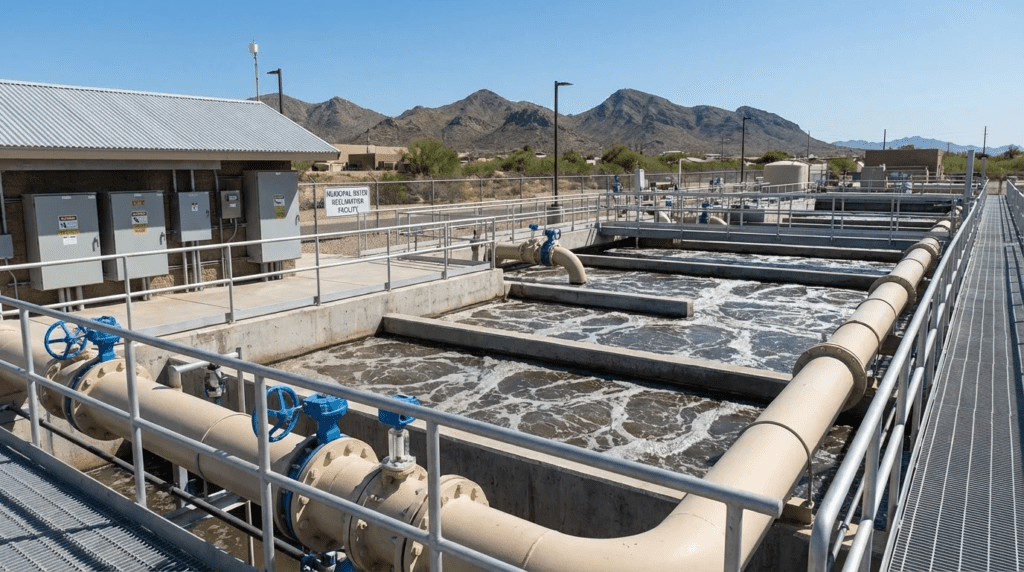
Arizona’s wastewater infrastructure is defined by its arid geography and the necessity of the “One Water” management philosophy. Unlike coastal states that discharge treated effluent into oceans, Arizona reclaims approximately 95% of its treated wastewater for agriculture, industrial cooling, turf irrigation, and underground aquifer recharge. The state’s infrastructure is overseen by the Arizona Department of Environmental Quality (ADEQ), which enforces some of the strictest Aquifer Protection Permit (APP) standards in the nation.
The sector is currently navigating a critical transition period. Rapid population growth in Maricopa and Pinal counties is driving the need for new greenfield capacity, while mature municipalities like Phoenix and Tucson are retrofitting aging bio-solids handling and secondary treatment systems. There are currently over 300 permitted wastewater treatment facilities in the state, serving a population of over 7.4 million. The regulatory environment is shifting toward Direct Potable Reuse (DPR), with ADEQ finalizing rules that will allow utilities to treat wastewater to drinking water standards without an environmental buffer.
2. Recent Developments & Projects
In the last 36 months, Arizona utilities have shifted focus from simple capacity expansion to advanced resource recovery. The Infrastructure Investment and Jobs Act (IIJA) and state-level appropriations have injected over $250 million into the Water Infrastructure Finance Authority of Arizona (WIFA) for distribution.
Notable recent trends include:
- Regionalization of Assets: Smaller municipal plants are being interconnected to larger regional facilities (like the SROG partnership) to optimize flow management and reduce per-gallon treatment costs.
- Biogas Utilization: Major facilities, including the 91st Ave WWTP, have completed massive Renewable Natural Gas (RNG) projects, turning digester gas into a revenue stream via the regional natural gas grid.
- Drought Resilience: The City of Phoenix and satellite cities are actively designing Advanced Water Purification facilities to offset reductions in Central Arizona Project (CAP) water allocations.
3. Top 20 Largest Treatment Plants
The following table ranks the largest wastewater treatment plants in Arizona by design capacity. The list is dominated by the Sub-Regional Operating Group (SROG) in Phoenix and the Pima County Regional Wastewater Reclamation Department in Tucson.
| Rank | Plant Name | Location | Design Capacity (MGD) | Operating Authority |
|---|---|---|---|---|
| 1 | 91st Ave Wastewater Treatment Plant | Phoenix | 204.5 MGD | City of Phoenix (SROG) |
| 2 | 23rd Ave Wastewater Treatment Plant | Phoenix | 63.0 MGD | City of Phoenix |
| 3 | Tres Rios Water Reclamation Facility | Tucson | 50.0 MGD | Pima County RWRD |
| 4 | Agua Nueva Water Reclamation Facility | Tucson | 32.0 MGD | Pima County RWRD |
| 5 | Greenfield Water Reclamation Plant | Gilbert | 30.0 MGD | City of Mesa (Joint Venture) |
| 6 | Scottsdale Water Campus | Scottsdale | 27.0 MGD | City of Scottsdale |
| 7 | Kyrene Water Reclamation Facility | Tempe | 25.5 MGD | City of Tempe |
| 8 | Chandler Airport Water Reclamation Facility | Chandler | 22.0 MGD | City of Chandler |
| 9 | Northwest Water Reclamation Plant | Mesa | 18.0 MGD | City of Mesa |
| 10 | West Area Water Reclamation Facility | Glendale | 16.5 MGD | City of Glendale |
| 11 | Ocotillo Water Reclamation Facility | Chandler | 15.0 MGD | City of Chandler |
| 12 | Arrowhead Ranch Water Reclamation Facility | Glendale | 13.5 MGD | City of Glendale |
| 13 | Neely Water Reclamation Facility | Gilbert | 11.0 MGD | Town of Gilbert |
| 14 | Palm Valley Water Reclamation Facility | Goodyear | 10.5 MGD | City of Goodyear |
| 15 | Avondale Aquaculture & WRF | Avondale | 9.0 MGD | City of Avondale |
| 16 | North Peoria Water Reclamation Facility | Peoria | 8.5 MGD | City of Peoria |
| 17 | Beardsley Water Reclamation Facility | Peoria | 7.5 MGD | City of Peoria |
| 18 | South Surprise Water Reclamation Facility | Surprise | 7.2 MGD | City of Surprise |
| 19 | Buckeye Water Reclamation Facility | Buckeye | 6.0 MGD | City of Buckeye |
| 20 | Flagstaff Wildcat Hill WRF | Flagstaff | 6.0 MGD | City of Flagstaff |


Detailed Profiles: Top 5 Largest Facilities
1. 91st Ave Wastewater Treatment Plant
- Location: Phoenix, Maricopa County
- Design Capacity: 204.5 MGD
- Current Average Flow: ~140 MGD
- Population Served: 2.5 million residents
- Operating Authority: City of Phoenix (Operates on behalf of SROG: Phoenix, Glendale, Mesa, Scottsdale, Tempe)
- Receiving Water: Salt River (Effluent dominated) / Tres Rios Wetlands
Treatment Process: The massive facility utilizes preliminary screening, primary clarification, and secondary treatment via Activated Sludge. It features advanced nitrification/denitrification capabilities. A significant portion of effluent flows into the Tres Rios environmental restoration project.
Infrastructure Highlights: Home to one of the nation’s largest wastewater-to-RNG facilities. The plant’s digesters produce biogas which is upgraded and injected into the commercial gas grid.
Recent Upgrades: Ongoing multi-year rehabilitation of primary digesters and replacement of aging headworks equipment ($60M+ ongoing).
2. 23rd Ave Wastewater Treatment Plant
- Location: Phoenix, Maricopa County
- Design Capacity: 63.0 MGD
- Operating Authority: City of Phoenix
- Service Area: Central Phoenix
Treatment Process: Utilizes activated sludge with nitrification/denitrification. The plant produces Class A+ reclaimed water delivered to the Roosevelt Irrigation District (RID) for agriculture and turf irrigation.
Key Feature: Located in a dense urban environment, requiring advanced odor control scrubbers and covered process units. It is a critical node in Phoenix’s reclaimed water distribution loop.
3. Tres Rios Water Reclamation Facility
- Location: Tucson, Pima County
- Design Capacity: 50.0 MGD
- Operating Authority: Pima County Regional Wastewater Reclamation Dept.
Treatment Process: This $200M+ facility (formerly the Ina Road WRF) was completely modernized in the last decade. It uses a 5-stage Bardenpho process for advanced nutrient removal, specifically targeting nitrogen and phosphorus to meet high regulatory standards for the Santa Cruz River discharge.
Infrastructure: High-efficiency turbo blowers and a sophisticated SCADA system make it one of the most energy-efficient plants in the Southwest.
4. Agua Nueva Water Reclamation Facility
- Location: Tucson, Pima County
- Design Capacity: 32.0 MGD
- Operating Authority: Pima County RWRD
Treatment Process: Replaced the aging Roger Road facility. Utilizes dissolved air flotation (DAF) for thickening and advanced Bardenpho biological treatment. It produces Class A+ water suitable for release into the Santa Cruz River, aiding in riparian restoration.
5. Greenfield Water Reclamation Plant
- Location: Gilbert, Maricopa County
- Design Capacity: 30.0 MGD (Liquid), 38 MGD (Solids)
- Operating Authority: City of Mesa (Jointly owned by Mesa, Gilbert, Queen Creek)
Treatment Process: A regional facility handling rapid suburban growth. It uses liquids and solids stream separation. Recent expansion (Phase III) added significant capacity to handle flows from Queen Creek’s rapid housing boom.
4. Plants with Approved Budgets & Expansion Projects
A. Major Projects Under Construction (2024-2026)
Northwest Water Reclamation Plant (Mesa) Expansion
- Location: Mesa, AZ
- Project Scope: Expansion of treatment capacity from 18 MGD to 24 MGD to accommodate industrial growth (near the airport) and residential expansion. Includes new aeration basins and secondary clarifiers.
- Total Budget: $165 Million
- Funding:
- 60% WIFA Loan (SRF)
- 40% Utility Revenue Bonds
- Timeline: Construction began 2023; Completion expected Q4 2025.
- Key Contractors: Garney Construction (CMAR), Carollo Engineers (Design).
- Expected Benefits: Supports the rapid industrial development in the Mesa Gateway Airport corridor.
Kyrene Water Reclamation Facility Restart & Upgrade
- Location: Tempe, AZ
- Project Scope: Rehabilitation of a facility that was idled for years. Includes upgrades to solids handling, membrane replacement, and electrical systems to bring 25.5 MGD capacity back online.
- Total Budget: $85 Million
- Project Drivers: Drought resiliency. The plant allows Tempe to reclaim water for aquifer recharge and swap credits for surface water.
- Timeline: Completion 2025.
- Technology: Membrane Bioreactors (MBR) and advanced odor control.
B. Projects in Design/Planning Phase (2025-2028)
- Advanced Water Purification (AWP) Facility – Phoenix
- Budget: Est. $400 – $600 Million
- Scope: A large-scale Direct Potable Reuse (DPR) facility located at 91st Ave. Will treat effluent to drinking water standards using Ozone-BAC or RO-UV/AOP.
- Status: Pilot testing complete; Engineering design procurement underway.
- Val Vista Water Treatment Plant Rehabilitation
- Budget: $110 Million
- Scope: Major electrical and mechanical upgrades to existing infrastructure shared by Mesa and Phoenix.
- Status: Design Phase.
- Buckeye WRF Expansion Phase 3
- Budget: $75 Million
- Scope: Doubling capacity to meet explosive housing growth in the far West Valley.
- Status: Planning/Pre-design.
Summary Statistics: Arizona Capital Investment
Total Active Capital Investment
New Capacity Being Added
Projects Driven by Water Reuse
Funding via WIFA/SRF Loans
5. Regulatory & Compliance Landscape
Arizona’s regulatory framework is uniquely tailored to aquifer protection. The Arizona Pollutant Discharge Elimination System (AZPDES) governs surface discharges, but the Aquifer Protection Permit (APP) program is the primary driver for treatment standards, as most plants discharge to the ground (recharge).
- Class A+ Reclaimed Water: The gold standard in Arizona. Requires filtration and disinfection with zero detectable fecal coliforms and turbidity below 2 NTU. This allows for unrestricted reuse (parks, schools, golf courses).
- PFAS/PFOA: ADEQ is currently conducting statewide sampling. While no enforceable state MCL exists yet, major utilities (Tucson Water, Phoenix) are proactively installing treatment or shutting down impacted wells.
- Direct Potable Reuse (DPR): Arizona is finalizing a regulatory pathway for “Advanced Water Purification,” which will remove the requirement for an environmental buffer (aquifer) before reuse water enters the drinking water distribution system.
6. Infrastructure Challenges & Opportunities
The Salt Balance Problem: As water is reused multiple times in a closed loop (One Water), Total Dissolved Solids (TDS) increase (salinity). Inland utilities cannot easily discharge brine. This presents a massive opportunity for vendors specializing in Brine Minimization and Zero Liquid Discharge (ZLD) technologies.
Growth vs. Water Supply: The Assured Water Supply rules require developers to prove 100 years of water. In areas where groundwater is restricted (Pinal County), developers are partnering with utilities to fund advanced wastewater treatment to create “recharge credits,” essentially manufacturing their own water supply to allow construction to proceed.
7. Technology Trends in Arizona
- Vadose Zone Recharge Wells: Unlike traditional injection wells, these use gravity to recharge aquifers in the unsaturated zone. Widely used due to lower O&M costs.
- Ozone-Biofiltration (Ozone-BAC): Gaining traction over Reverse Osmosis for reuse projects because it destroys contaminants without creating a brine stream that is difficult to dispose of in a landlocked state.
- Advanced Metering Infrastructure (AMI) & AI: Used extensively to detect leaks and optimize distribution networks.
8. Resources for Engineers & Operators
- AZ Water Association: The state chapter of AWWA/WEF. Hosts the annual conference in Phoenix (Spring). Link to Association
- WIFA (Water Infrastructure Finance Authority): The primary issuer of SRF loans and water supply development grants. Link to WIFA
- ADEQ Operator Certification: Manages testing and licensure for Grades 1-4 wastewater operators. Link to Certification
9. FAQ Section
How many wastewater treatment plants are in Arizona?
There are over 300 permitted wastewater treatment facilities in Arizona, ranging from massive regional plants like the 204 MGD 91st Ave plant to small package plants serving remote communities and RV parks.
What is the largest wastewater plant in Arizona?
The 91st Ave Wastewater Treatment Plant is the largest, with a capacity of 204.5 MGD. It is owned by the Sub-Regional Operating Group (SROG), which includes Phoenix, Glendale, Mesa, Scottsdale, and Tempe.
What are the primary drivers for WWTP projects in Arizona?
Unlike the East Coast (CSO/SSO compliance), Arizona projects are driven by 1) Capacity expansion for rapid housing growth, and 2) Advanced treatment for water reuse (aquifer recharge) to generate long-term water storage credits.
Is Arizona implementing Direct Potable Reuse (DPR)?
Yes. Arizona is in the advanced stages of finalizing regulations for DPR (termed Advanced Water Purification). The City of Phoenix and Scottsdale are actively planning facilities that will treat effluent to drinking water standards for direct introduction into the potable supply.