
Badger Meter vs Endress+Hauser Horizontal End Suction Pumps Equipment
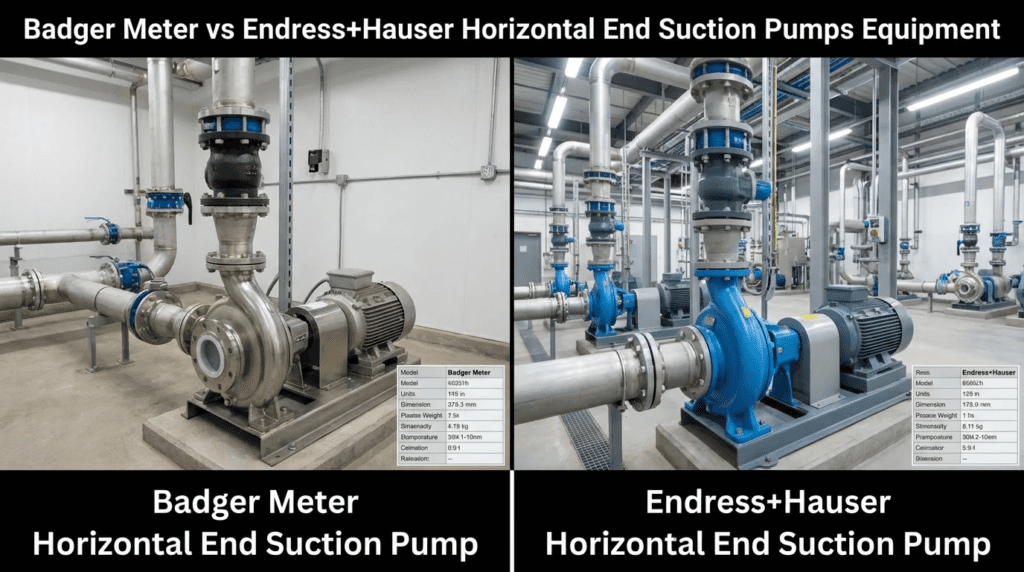
Badger Meter vs Endress+Hauser Horizontal End Suction Pumps Equipment
Introduction
In municipal and industrial fluid handling, the horizontal end suction centrifugal pump is the workhorse of the facility. But the pump is only as effective as the control loop that governs it. Engineers expend significant effort selecting the pump hydraulic curve and routinely undervalue the specification of the verification device: the flow meter.
A scope note belongs up front. Neither Badger Meter nor Endress+Hauser manufactures end suction pumps. Standard end suction centrifugal pumps built to ANSI/ASME B73.1 or ISO 2858 come from pump manufacturers — Goulds within Xylem, Grundfos, Flowserve, Sulzer, Patterson, Aurora and others. Both companies discussed here supply flow measurement instrumentation that acts as the nervous system for those mechanical assets.
That makes a Badger Meter vs Endress+Hauser Horizontal End Suction Pumps Equipment evaluation worth having on its own terms. This article focuses on flow verification and pump performance monitoring — how to know what a pump is actually delivering, and how to catch degradation before it becomes a failure. A significant share of flow meters in wastewater service read incorrectly because of poor installation or mismatched technology selection, which produces artificial pump failures where the pump is fine but the data says otherwise. That misalignment drives unnecessary maintenance, wasted energy through incorrect drive setpoints, and compliance risk.
Broader supplier positioning is covered in our overview of the top OEMs for horizontal end suction pumps.
How to Select and Specify
The selection process must move beyond matching pipe size. The interaction between pump discharge turbulence and the meter’s sensing element is the primary driver of system accuracy.
Duty Conditions & Operating Envelope
End suction pumps are frequently used in variable speed applications. The flow meter must maintain accuracy across the pump’s entire turndown range, not just the best efficiency point.
- Turndown ratio: Confirm the meter holds accuracy at the minimum drive speed. Magnetic flow meters generally offer excellent turndown, whereas older mechanical meters or differential pressure devices lose accuracy at low flow.
- Velocity constraints: Mag meters perform best in the 2 to 15 ft/s range. Engineers frequently size the meter to the line size rather than the flow velocity. It is common practice to reduce pipe diameter immediately after the discharge check valve to accommodate a smaller meter, raising velocity and improving signal-to-noise ratio.
- Pressure surges: End suction pumps generate water hammer during startup or shutdown if check valves slam. The liner material must withstand vacuum conditions if the line drains or sees a negative transient, which can collapse certain PTFE liners.
Materials & Compatibility
- Liner selection: For potable water, NSF/ANSI 61 certification is mandatory. Hard rubber or polyurethane liners are standard for general water and mild wastewater. For abrasive slurries or grit pumping, often handled by recessed impeller end suction pumps, ceramic liners or specialized soft rubber prevent erosion.
- Electrode material: 316L stainless is sufficient for water. For aggressive chemical dosing or high-chloride wastewater, Hastelloy or tantalum electrodes prevent the pitting corrosion that leads to signal drift.
- Housing and flanges: In damp pump basements or metering pits, IP68 rating is essential. Both manufacturers offer potted remote transmitters, but the specification must explicitly state continuous submergence where flooding is a real risk.
Hydraulics & Process Performance
The hydraulic profile exiting a horizontal end suction pump is inherently turbulent. Fluid leaves the volute with significant swirl.
- Straight run requirements: Most electromagnetic flow meters require several pipe diameters upstream and downstream to normalize the flow profile.
- Close-coupling constraints: In tight pump stations, achieving full straight run is often impossible. Evaluate reduced-run meters that use internal flow conditioning or multiple electrode pairs to compensate for swirl. The Endress+Hauser Promag W series with its reduced straight-run option and the Badger Meter ModMAG series with appropriate conditioning are frequent contenders.
- Head loss: Mag meters are full bore and introduce negligible head loss, but flow conditioners or reduced-bore sizing add friction head. This must be added to the pump’s total dynamic head to avoid undersizing the motor.
Installation Environment & Constructability
- Vibration: End suction pumps are tested against Hydraulic Institute vibration criteria, but they still vibrate in service. Electronics should be remote-mounted away from the sensor if the meter bolts directly to the pump discharge piping.
- Grounding: This is the most common failure mode on pump skids. Plastic or lined piping interrupts the earth ground. Grounding rings or grounding electrodes are mandatory — without them the meter measures electrical noise in the fluid, frequently producing phantom flow readings when the pump is off.
- Power supply: Determine whether the facility uses low-voltage DC, common in modern control panels, or line voltage. Mixing voltages in the pump control panel creates safety hazards and arc flash concerns.
Reliability & Failure Modes
- Diagnostic capability: Modern transmitters offer predictive maintenance. Endress+Hauser’s Heartbeat Technology provides continuous self-verification of the magnetic circuit and electrode condition without removing the meter. Badger Meter offers comparable verification tools. Specifying these features lets operators extend calibration cycles defensibly.
- Empty pipe detection: The meter must distinguish zero flow with a full pipe from an empty pipe where the pump has lost prime. This is a critical pump protection interlock — the empty pipe detection bit should be wired to the pump controller to trip the motor.
Lifecycle Cost Drivers
- Capital against operating: Badger Meter options are competitively priced for standard municipal water applications and offer strong return for distribution pumps. Endress+Hauser options carry a premium but provide deeper diagnostic data valuable for critical industrial wastewater or sludge service.
- Calibration costs: Removing a large meter from a pump discharge for off-site calibration is expensive and requires crane access. In-situ verification satisfies regulatory reporting without mechanical removal, which is where most of the operating saving sits.
Comparison Tables
| Manufacturer | Primary Strengths | Best-Fit Pump Applications | Considerations | Maintenance & Diagnostics |
|---|---|---|---|---|
| Badger Meter |
|
|
|
|
| Endress+Hauser |
|
|
|
|
| Application | Fluid Characteristics | Key Constraint | Recommended Technology | Design Priority |
|---|---|---|---|---|
| Clean water boosting | Potable, low solids, conductive | Cost efficiency, energy consumption | Standard mag meter with polyurethane or hard rubber liner | Prioritize turndown accuracy to control drive speed and save energy |
| Wastewater lift station | Solids, grease, rags, conductive | Clogging, electrode fouling | Mag meter with specialized electrode geometry or capacitive sensing | Select electrode cleaning functions or shapes that resist grease-driven signal loss |
| Chemical transfer | Corrosive, potentially non-conductive | Material compatibility, safety | Coriolis where high accuracy is needed, or mag meter with PTFE and PFA liner | Liner and electrode chemical resistance is paramount; verify minimum conductivity for mag meters |
| Tight mechanical room | Water or wastewater | No straight pipe run available | Reduced straight-run full-bore mag meter | Avoid reduced-bore vortex meters given pressure drop; use mag meters rated for swirl profiles |
Engineer & Operator Field Notes
Commissioning & Acceptance Testing
During site acceptance, the flow meter is the judge of the pump’s performance. Disputes arise between pump manufacturer and contractor over whether the pump meets its curve, and the meter is the evidence.
- Zero point calibration: Before starting the pump, ensure the pipe is full and the fluid is still, then perform a zero adjustment. Doing this with a partially empty pipe or moving fluid offsets the entire calibration curve and makes the pump appear to underperform.
- Density verification: If mass flow is being calculated, ensure the density parameter matches the actual process fluid. Sludge density varies, and using the specific gravity of water for thick sludge produces erroneous mass load calculations.
- Curve verification: Take simultaneous readings of flow, discharge pressure, suction pressure and motor power at several points. That dataset, not the flow reading alone, is what lets you place the pump on its curve and settle a performance dispute.
End suction pumps are often driven by variable frequency drives, which generate significant electrical noise. If the flow meter cable runs in the same conduit as the drive motor output cable, induced voltage creates erratic readings. Always run instrumentation signal cables in separate, grounded metal conduits from power cables.
Common Specification Mistakes
- Over-specifying accuracy: Requesting laboratory-grade accuracy for a wastewater effluent pump is wasteful. Biological process variation exceeds the meter error by a wide margin. Standard accuracy with good repeatability is the cost-effective choice.
- Ignoring conductivity: Specifying a mag meter for deionized water or oil-based fluids. Mag meters require conductive fluid. For oil or ultrapure water, ultrasonic or Coriolis technology is required.
- Flange mismatches: Standard pressure class flanges are common, but older plants have mismatched drilling. Require flange compatibility checks explicitly, especially when replacing vintage venturi meters.
O&M Burden & Strategy
- Electrode coating: In wastewater, grease coats electrodes and insulates them from the fluid, dropping the signal to zero. Modern transmitters monitor electrode impedance and alarm when it rises. Schedule cleaning based on that trend rather than a fixed calendar date.
- Remote display location: End suction pumps sit low to the ground. A display on the sensor forces the operator to kneel. Specify a remote wall-mount transmitter kit to place the display at eye level.
Troubleshooting
Flow reading fluctuates while pump speed is constant. Likely poor grounding or air entrainment. Check for loose grounding rings. If the pump is cavitating, air bubbles passing through the magnetic field cause signal noise.
Flow reads positive when the pump is off. Likely thermal convection in the pipe or electrical noise. Enable low flow cutoff to force the reading to zero at standstill, but investigate the cause rather than masking it permanently.
Design Details and Calculations
Sizing Methodology
Do not match the flow meter size to the pump flange size. End suction pumps often have a discharge flange sized for low friction loss, producing velocities too low for accurate measurement.
- Determine peak flow: Identify the pump’s runout flow on the curve.
- Calculate velocity: Velocity in ft/s equals 0.4085 multiplied by flow in gpm, divided by the square of the inside diameter in inches.
- Target range: Aim for 5 to 15 ft/s at normal operating conditions.
- Select diameter: If a 4-inch pipe yields only 2 ft/s, reduce to a 3-inch or 2-inch meter to raise velocity into the optimal range. This improves accuracy and provides scouring action that keeps electrodes clean.
- Check pressure drop: Verify that head loss through the reducer and smaller meter does not push the system curve outside the pump’s preferred operating region.
Specification Checklist
- Fluid conductivity verified above the mag meter minimum
- Liner material compatible with chemistry and temperature
- Electrode material appropriate to the media
- Ingress rating specified for the actual flooding risk
- Communication protocol matched to the plant standard
- Grounding rings included, with material matched to electrodes
- Traceable multi-point calibration certificate required
Standards
- AWWA M33: Flowmeters in water supply practice, covering selection and installation of mag meters
- NSF/ANSI 61: Drinking water system components, mandatory for potable service
- Hazardous location listings: Required where the pump sits in a classified area such as certain headworks
- Hydraulic Institute standards: Applicable pump testing and vibration acceptance criteria, which set the baseline the meter is verifying against
Frequently Asked Questions
Do Badger Meter or Endress+Hauser make end suction pumps?
No. Both are instrumentation manufacturers. Horizontal end suction centrifugal pumps come from pump manufacturers including Goulds within Xylem, Grundfos, Flowserve, Sulzer, Patterson and Aurora. This comparison covers the flow measurement instrumentation specified alongside those pumps to verify performance and protect the asset.
What is the difference between the two for pump monitoring?
Badger Meter is established in the North American municipal water market with robust, cost-effective solutions that integrate well with utility billing and distribution networks. Endress+Hauser is a global process automation supplier with a stronger footprint in industrial chemical and complex wastewater applications, offering deeper diagnostics and a wider range of exotic materials. Selection depends on whether the priority is utility metering or process control and diagnostics.
How does flow meter placement affect pump performance monitoring?
Placing a meter too close to the discharge of an end suction pump exposes the sensor to high turbulence and swirl from the impeller and volute, producing unstable readings and measurement error. Standard practice requires several pipe diameters of straight run upstream. If this is ignored, the feedback loop to the drive becomes erratic and the pump hunts, accelerating wear on the motor and mechanical seal.
Can I use a magnetic flow meter on the suction side?
It is strongly discouraged. Any restriction or instrumentation on the suction side of an end suction pump reduces available suction head and increases cavitation risk. The suction side also frequently lacks the backpressure needed to keep the meter full, producing errors. Install flow meters on the discharge side.
Do I need grounding rings?
In most cases yes. If the piping is plastic or lined metal, the fluid is electrically isolated from earth ground. Without grounding rings or a built-in grounding electrode, the meter measures stray electrical potentials in the fluid. In metal piping, grounding straps connecting the flanges may suffice, but grounding rings are the safer specification.
How often should pump skid flow meters be calibrated?
For critical billing or regulatory applications, annual verification is common. For process control, modern meters from both manufacturers offer in-situ electronic verification that checks magnetic coils and electronics without removing the meter. If those checks pass, physical wet calibration may only be needed at multi-year intervals depending on local regulations.
What is the benefit of reduced straight-run flow meters?
Space savings. End suction pumps are often installed in skids or compact mechanical rooms where obtaining full straight run is impossible. Reduced-run meters use multiple electrode paths and internal flow conditioning to measure accurately even when installed immediately after an elbow or valve, eliminating expensive piping modifications.
Conclusion
Key Takeaways
- Scope: Neither company makes end suction pumps. This is about integrating the right sensor into the pump’s hydraulic reality.
- Velocity matters: Size the meter for fluid velocity, not pipe size.
- Grounding is critical: The large majority of bad meter complaints are grounding problems, particularly in lined or plastic piping.
- Turbulence management: Respect straight-run requirements, or specify reduced-run compliant technology where space is tight.
- Diagnostics save money: Self-verification tools reduce the need for expensive removal and wet calibration.
- Material compatibility: Match liners and electrodes to the fluid chemistry, not just pressure ratings.
Selecting between these two for end suction pump instrumentation is not about which brand is better but which engineering philosophy aligns with the facility. Badger Meter often provides the optimal balance of performance and cost for municipal water distribution and standard utility applications where ease of use and durability matter most.
Endress+Hauser excels where deep diagnostic visibility, hazardous area certification or complex fluid handling justify the higher capital cost. The goal is a seamless interface where pump and meter operate as a unified system. Related evaluations appear in our comparison of Emerson and Badger Meter control integration for end suction pump systems, which addresses the drive and automation side of the same specification.