
Top OEMs for Horizontal End Suction Pumps in Water & Wastewater Applications
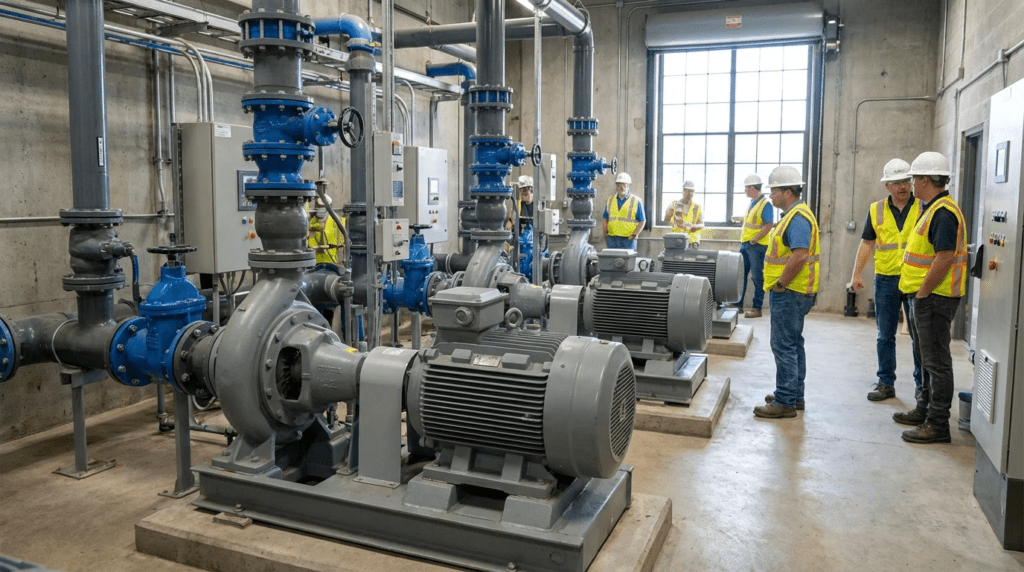
Introduction to Horizontal End Suction Pumps in Water & Wastewater
In the complex hydraulic landscape of municipal and industrial water treatment, the horizontal end suction pump remains the ubiquitous workhorse. While vertical turbine pumps may dominate deep well applications and submersible pumps handle the depths of wet wells, the horizontal end suction (HES) configuration is the standard specification for accessible, dry-pit applications where maintenance ease, hydraulic flexibility, and capital efficiency intersect.
A horizontal end suction pump is defined by its specific architectural configuration: a single impeller, a horizontal shaft, a volute casing with a suction connection on the end (axial), and a discharge connection on the top (radial). This design simplicity belies its critical role. From potable water booster stations and filtrate pumping to chemical dosing and sludge recirculation, HES pumps are integral to the process flow diagram of nearly every treatment facility.
For consulting engineers and plant operators, the ubiquity of this pump type presents a paradox. Because they are common, they are often commoditized in specifications, treated as interchangeable “off-the-shelf” components. However, in the rigorous environment of Water and Wastewater (W/WW) treatment, slight nuances in Original Equipment Manufacturer (OEM) design—bearing frame stiffness, shaft deflection ratios, sealing chamber geometry, and impeller architecture—can dictate the difference between a 20-year lifecycle and a maintenance nightmare.
This article provides a rigorous technical analysis of the top OEMs producing horizontal end suction pumps specifically for the water and wastewater sectors. Manufacturer choice is one decision within the broader end suction pumps category, where configuration, standards compliance, and materials all interact with the OEM shortlist rather than following from it. This analysis moves beyond marketing literature to examine the engineering philosophies, hydraulic envelopes, and mechanical reliabilities of the leading manufacturers.
Manufacturer Comparison Coverage
The manufacturer profiles later in this guide describe general positioning across the field. Procurement decisions, however, are almost always made between two specifically named products at submittal review, where the differences that matter are narrower and more concrete: wear part pricing, documented rebuild intervals, instrumentation and monitoring compatibility, and whether the local representative can actually support the equipment. The head-to-head comparisons below address that stage of the decision.
Badger Meter and Endress+Hauser Equipment Pairings
The comparison of Badger Meter vs Endress+Hauser horizontal end suction pumps equipment examines a pairing where the differentiator sits less in the hydraulic end than in the measurement and monitoring package wrapped around it. Modern end suction installations increasingly arrive as instrumented assemblies rather than bare pumps, with flow measurement, pressure transmitters, and condition monitoring specified as part of the same package. The choice of measurement supplier then determines signal protocols, diagnostic depth, and how cleanly the skid integrates with the plant control system.
For specifiers, the evaluation criteria shift accordingly. Accuracy class and turndown on the flow element matter for pump performance verification and energy accounting. Communication protocol compatibility—HART, Modbus, Profibus, or Ethernet-based—determines integration cost more than instrument price does. And diagnostic capability matters at a level most pump specifications never address: an instrument reporting empty pipe, partial fill, or signal degradation gives early warning of suction problems that would otherwise present as unexplained vibration.
Emerson and Badger Meter Equipment Pairings
The Emerson vs Badger Meter horizontal end suction pumps equipment comparison introduces a scale-of-portfolio dimension. Emerson’s breadth spans measurement, final control elements, and asset management software, which appeals to utilities pursuing a single-vendor control architecture across the plant. Badger Meter’s narrower focus tends to produce competitive pricing and simpler procurement for discrete applications where a full platform commitment is neither needed nor wanted.
The engineering judgment is whether the installation is a standalone pump skid or a node in a plant-wide asset management strategy. A booster station with three pumps and a local panel gains little from platform depth it will never use. A plant standardizing condition monitoring across dozens of rotating assets gains a great deal, because the value accrues in aggregated diagnostics rather than in any single instrument. Reading both comparisons together clarifies which situation the project actually is—a question specification templates rarely force anyone to answer.
How to Select This Pump Type: Engineering Criteria
Selecting the correct horizontal end suction pump requires a multidimensional analysis that goes beyond the basic duty point (Flow and Head). Engineers must evaluate the unit against the specific constraints of the fluid being pumped and the operational philosophy of the facility.
1. Hydraulic Performance and System Curves
The intersection of the pump curve and the system curve is fundamental, but in HES selection, the position of the Best Efficiency Point (BEP) is critical. Consulting engineers should specify pumps where the operating point falls close to BEP, typically between 80% and 110% of BEP. Operating too far left leads to suction recirculation and thermal instability; operating too far right leads to cavitation and excessive vibration. Interpreting where a given duty point actually sits requires fluency in pump curve reading—identifying BEP, run-out, and shutoff on the certified curve rather than trusting a selection program’s summary line.
Furthermore, the shape of the curve matters. For variable speed applications (VFD driven), a steep curve is often preferred to allow for more precise control over pressure variations. In parallel pumping configurations, often found in booster stations, stable curves (where head continuously rises to shutoff) are mandatory to prevent hunting and surging between pumps.
2. Standards: ANSI B73.1 vs. ISO 2858 vs. General Service
Not all end suction pumps are built to the same code.
- ANSI B73.1 (Chemical Duty): Originally designed for the chemical industry, these pumps feature heavy-duty bearing frames, open impellers for solids handling, and standardized dimensions. They are robust and preferred for sludge, chemicals, and harsh wastewater applications.
- ISO 2858 / 5199: The metric equivalent to ANSI, common in facilities with European design influence. They offer similar robustness and dimensional interchangeability within the ISO framework.
- General Service / Water Norm: These pumps are often cast iron, close-coupled or frame-mounted units designed specifically for clean water. They are cost-effective but generally lack the shaft stiffness and corrosion resistance required for aggressive wastewater or chemical service.
3. Impeller Architecture and Solids Handling
In W/WW, the fluid often dictates the impeller.
- Enclosed Impellers: Offer the highest efficiency. Best for clean water, final effluent, or potable water boosting. They rely on tight wear ring clearances which will degrade rapidly if grit is present.
- Semi-Open Impellers: The standard for ANSI pumps. They can handle higher solids concentrations and stringy materials. Clearance is adjustable from the bearing housing (dialing in the impeller), allowing operators to restore efficiency as wear occurs without replacing parts.
- Vortex / Recessed Impellers: Used when passing large solids is paramount and efficiency is secondary. The impeller sits back in the volute, creating a fluid coupling. Ideal for grit pumping or raw sewage with high rag content.
4. Mechanical Seals and Flushing Plans
The mechanical seal is the most common point of failure in HES pumps.
- Component vs. Cartridge: Cartridge seals are preferred for ease of installation, eliminating setting errors.
- Flush Plans: For clean water, a Plan 11 (discharge recirculation) is standard. For wastewater containing abrasives, a Plan 53 (barrier fluid) or Plan 54 (external source) may be necessary to protect the seal faces. Engineers must ensure the stuffing box design allows for adequate heat dissipation and solids evacuation.
5. Coupling Arrangements
- Close-Coupled: The pump impeller is mounted directly to the motor shaft. This eliminates alignment issues and reduces footprint. However, if the seal fails, fluid can spray into the motor bearings. It also makes seal changes difficult as the motor must be removed.
- Frame-Mounted (Flexible Coupled): The pump has its own bearing housing and shaft, connected to the motor via a coupling. This is the preferred specification for municipal/industrial applications. It isolates the motor from hydraulic loads and heat, allows for “Back Pull-Out” maintenance (removing the rotating assembly without disturbing piping or motor), and utilizes heavy-duty pump bearings (L10h greater than 50,000 hours).
Selection & Specification Framework
The criteria above are individually familiar. What separates a durable installation from a chronic problem is the order in which they are applied. Specifications built around a preferred manufacturer and back-filled with performance language cannot reject a poor substitution, and specifications built around a single duty point produce pumps that spend their working lives outside the region they were selected for.
Step 1: Classify the Service and the Fluid First
Sort the application before opening any curve. Clean water duty—potable boosting, seal water, plant utility, filtered effluent—permits enclosed impellers, tight wear ring clearances, and general service or water norm construction. Chemical and abrasive duty—ferric, alum, polymer, grit, sludge—requires ANSI B73.1 or ISO 5199 construction with semi-open impellers and adjustable clearance. This single classification eliminates roughly half the OEM field before any hydraulic work begins, and getting it wrong produces a pump that passes its factory performance test and fails within two years.
Step 2: Settle Materials Against the Actual Water Chemistry
Material selection is not a default. Cast iron with bronze fitting suits ordinary clean water; stainless becomes necessary as chlorides rise; duplex grades earn their premium in aggressive chloride and H2S service where standard austenitic stainless will pit. The trade-offs between cast iron, stainless, and duplex construction extend beyond corrosion resistance to galling behavior, thermal expansion at close clearances, and lead time—upgraded metallurgies often drive delivery schedules more than price. Decide this before shortlisting manufacturers, because foundry capability in higher alloys varies sharply across the field.
Step 3: Build the Operating Envelope, Not a Point
Plot system curves at minimum and maximum static head and at both clean and aged pipe friction factors. A booster station that sits at 95 percent of BEP on day one can migrate well outside the preferred region as demand patterns shift or as the distribution main roughens. The envelope defines what the pump must tolerate; the design point merely defines what it was sold against.
Step 4: Worked BEP and NPSH Example
Consider a plant utility water pump duty of 850 gpm at 140 feet total dynamic head, drawing from a clearwell with the water surface 6 feet below the pump centerline. A candidate with BEP at 950 gpm places the design point at roughly 89 percent of BEP—well positioned. A second candidate with BEP at 1,250 gpm places the same duty at 68 percent, outside the preferred region, where radial thrust rises and shaft deflection at the seal face increases even though the datasheet efficiency figures look comparable.
The suction side then governs the selection. With a 6-foot static lift, atmospheric pressure near 34 feet of water at low elevation, a vapor pressure allowance of roughly 0.6 feet at ambient temperature, and about 3 feet of suction piping, strainer, and entrance losses at the run-out flow, NPSH available works out near 24 feet. If the manufacturer’s NPSH required at the run-out condition is 17 feet, the margin is 7 feet, or a ratio of about 1.4 to 1—acceptable. Two cautions apply. First, evaluate NPSHr at run-out rather than at the duty point, since it rises with flow and the station will reach run-out whenever a parallel pump trips. Second, at a plant sitting at 5,000 feet elevation, atmospheric pressure drops by roughly 5 feet of water, which would cut the margin to 2 feet and make the selection untenable. Assuming sea-level conditions is one of the most common and most expensive errors in end suction specification.
Step 5: Verify Mechanical Robustness Separately from Hydraulics
Require submitted L10h bearing life at the worst point in the operating envelope rather than at BEP, and require a shaft deflection or stiffness statement at the seal face. Two pumps with near-identical curves can differ substantially in power end design, and that difference appears entirely in seal replacement frequency rather than in any figure visible at commissioning. Where the specification permits close-coupled construction, confirm that the maintenance consequence—motor removal to change a seal—has been accepted deliberately rather than inherited from a template.
Step 6: Specify the Drive and Control Strategy With the Pump
Where variable speed operation is intended, the drive is part of the pump selection, not an accessory to it. Minimum speed must keep the pump above its minimum continuous stable flow, resonance bands must be identified and locked out, and motor thermal capability at reduced speed must be verified—a standard TEFC motor loses cooling airflow as speed falls. Correct VFD setup to prevent overheating is a commissioning discipline as much as a design one, and it is where the theoretical energy savings of variable speed operation are most often lost to premature motor failure.
Step 7: Compare on Lifecycle Cost and Parts Strategy
Build the twenty-year comparison from installed capital, energy at the actual operating envelope, seal and bearing intervals, rebuild labor, and—critically for this pump class—parts interchangeability across the installed base. ANSI-dimensional pumps let one stocked power end serve many liquid ends, materially changing inventory economics for a utility running dozens of units. Proprietary designs may offer better hydraulics per unit while imposing a stocking penalty no single-project bid comparison surfaces.
Comparison Table: Horizontal End Suction OEMs
The following table analyzes the allowed OEMs based on their specific strengths within the horizontal end suction category for water and wastewater applications.
| OEM | Key Series / Lines | Typical W/WW Applications | Technical Strengths | Engineer Limitations / Considerations |
|---|---|---|---|---|
| Goulds Pumps (Xylem) | 3196 (ANSI) 3796 (Self-Priming) e-SH |
Chemical metering, sludge transfer, aggressive industrial wastewater. | The 3196 defined the ANSI standard. Unmatched parts interchangeability. “i-ALERT” monitoring integration. Robust heavy-duty bearing frames. | Overkill for simple clean water utility applications. Premium pricing for standard configurations. |
| Grundfos | NB / NBG Series NK / NKG (ISO) |
Potable water boosting, filtered effluent, RO feed, utility water. | Exceptional hydraulic efficiency. Vertical integration with motors and VFDs (MGE motors). E-coated cast iron for corrosion resistance. | Design philosophy leans toward clean water; less focus on heavy slurry or large solids handling compared to ANSI style pumps. |
| KSB | MegaCPK Etanorm |
Raw water intake, large volume transfer, district heating/cooling loops. | Hydraulic stability. The MegaCPK offers excellent NPSHr characteristics. Advanced volute geometry reduces radial loads. | Supply chain can be European-centric for specific spares. Metric flanges/fasteners may require adapters in legacy US plants. |
| Flowserve | Durco Mark 3 Worthington D-800 |
High-corrosion chemical service, abrasive slurry, polymer injection. | Durco Mark 3 is the industry benchmark for chemical processing. Reverse vane impeller offers lower seal chamber pressures. | Primarily an industrial/chemical focus. Maintenance teams need training on specific micrometer impeller adjustments. |
| Aurora Pump (Pentair) | 340 / 360 Series 3800 Series |
Municipal booster stations, fire protection, HVAC loops in plants. | Strong municipal specification presence. High flow capabilities in single-stage designs. Robust general service builds. | Not typically selected for aggressive chemical attack or high-abrasion slurry applications. |
| Peerless Pump | AE Series Process Pumps |
General plant water, circulation, non-potable water systems. | Flexible discharge configurations. Strong custom engineering capability for retrofit scenarios. Very robust casing designs. | Market presence is stronger in fire and vertical turbine sectors than in small-scale end suction chemical duty. |
| Bell & Gossett (Xylem) | Series 1510 e-1510 Series 1531 |
Digester heating loops, seal water systems, clean water circulation. | True “Back Pull-Out” design. Maintenance-free bearing frames on newer “e” series. Extremely quiet operation. | Designed strictly for clean fluids. Close tolerances in wear rings make them unsuitable for grit or solids. |
| Construction Standard | Typical Impeller | Shaft Stiffness | Solids Tolerance | Relative Cost | Best-Fit Duty |
|---|---|---|---|---|---|
| ANSI B73.1 | Semi-open, externally adjustable | High; low deflection at seal face | Good; tolerates grit and stringy material | High | Chemical feed, sludge, abrasive wastewater |
| ISO 2858 / 5199 | Semi-open or enclosed | High; comparable to ANSI | Good | High | Process duty in metric-standard facilities |
| General Service / Water Norm (frame-mounted) | Enclosed with wear rings | Moderate | Limited; clearances degrade with grit | Moderate | Clean water boosting, utility and circulation duty |
| General Service (close-coupled) | Enclosed | Motor shaft dependent | Limited | Lowest | Small clean water duty where footprint governs |
| Self-Priming End Suction | Semi-open or enclosed | Moderate to high | Moderate to good | High | Suction lift service, sump and dewatering transfer |
Top OEM Manufacturers: Detailed Analysis
The following analysis evaluates the designated manufacturers based strictly on their horizontal end suction portfolios. It avoids marketing language to focus on the engineering attributes that matter to specifiers and end-users.
Goulds Pumps (Xylem)
Engineering Heritage: Goulds Pumps is arguably the most recognizable name in the end suction market, primarily due to the Model 3196. This pump effectively established the ANSI B73.1 standard for dimension and performance. In the wastewater sector, Goulds is the go-to specification for process-critical applications where failure is not an option.
Technical Differentiators:
- Shaft Stiffness: The 3196 series is engineered with a shaft stiffness ratio (L3/D4) that minimizes deflection at the seal faces to less than 0.002 inches. This extends mechanical seal life significantly, which is the primary lifecycle cost driver.
- Impeller Options: Goulds offers a wide array of open and enclosed impellers, including the Xducer for specific duties. Their open impeller design allows for external clearance adjustment, crucial for maintaining efficiency in abrasive wastewater service without disassembling the pump.
- Material Science: Goulds has extensive foundry capabilities, offering higher alloys like CD4MCu (Duplex Stainless Steel) as standard upgrades over 316SS, providing superior resistance to the chlorides and H2S found in wastewater.
Best Fit: Chemical dosing (ferric chloride, alum), sludge transfer, and grit applications where robust ANSI construction is required.
Grundfos
Engineering Heritage: Grundfos approaches the end suction market with a philosophy deeply rooted in energy efficiency and electronic integration. While they produce robust mechanical iron, their differentiation lies in the “wire-to-water” efficiency.
Technical Differentiators:
- NB/NBG and NK/NKG Series: These are ISO 2858 compliant pumps. The “NK” indicates a long-coupled (frame-mounted) design, which is preferred for ease of maintenance.
- Electro-Coating: Grundfos applies a cationic electro-deposition coating (e-coat) to cast iron components, providing high corrosion resistance for general plant environments.
- Integrated Electronics: Grundfos excels in pairing pumps with their MGE motors (integrated VFDs). For variable demand applications, such as water booster stations, this single-source responsibility for the drive and the pump motor simplifies commissioning and compatibility issues.
Best Fit: Potable water distribution, plant water reuse systems, and clean water boosting where energy efficiency (wire-to-water) is the primary evaluation criteria.
KSB
Engineering Heritage: KSB is a German engineering giant with a massive global footprint. Their designs adhere strictly to ISO standards and are characterized by hydraulic precision. In the US market, they bridge the gap between municipal water transport and industrial process needs.
Technical Differentiators:
- MegaCPK: This is KSB’s flagship chemical/process pump. It is designed with hydraulic optimization that often yields lower Net Positive Suction Head required (NPSHr) values than competitors, making it a problem-solver for systems with poor suction conditions or high temperatures.
- Etanorm: A very widely installed standardized water pump. Its reliability stems from a stiff shaft design and confined casing gaskets that prevent blowouts under pressure surges.
- Advanced Hydraulics: KSB invests heavily in Computational Fluid Dynamics (CFD). Their volute designs are optimized to reduce radial thrust across the operating range, not just at the Best Efficiency Point (BEP).
Best Fit: Raw water intake, large-scale cooling loops, and difficult suction lift applications where NPSH margin is tight.
Flowserve
Engineering Heritage: Flowserve’s portfolio includes the heritage of Durco and Worthington. The Durco Mark 3 is a legend in the chemical processing industry and has been adopted by the wastewater industry for the most aggressive applications.
Technical Differentiators:
- Reverse Vane Impeller: Unique to the Durco line, this impeller design puts the wear surface on the rear cover rather than the casing. This reduces seal chamber pressure and requires only one setting adjustment, simplifying maintenance.
- Bearing Isolators: The bearing isolator technology used by Flowserve is superior to standard lip seals, preventing the ingress of wash-down water and contaminants into the bearing housing.
- Heavy Duty Power Ends: The Mark 3 power end is designed for severe loads, utilizing a double-row angular contact outboard bearing that handles significant axial thrust.
Best Fit: Aggressive chemical feed (acids/caustics), polymer transfer, and industrial wastewater treatment where corrosion and abrasion are the main threats.
Aurora Pump (Pentair)
Engineering Heritage: Aurora has a century-long history in municipal water and fire protection. Their designs are conservative, heavy, and built for longevity in general service applications.
Technical Differentiators:
- 3800 Series: This is a split-coupled, inline end suction pump, but their standard frame-mounted end suction (340/360 series) is the staple. They utilize a vacuum casting process that results in smoother internal waterways and higher consistent efficiencies.
- Case Rings: Aurora typically designs with replaceable case wear rings even on smaller sizes, allowing for cost-effective refurbishment rather than volute replacement.
- Diverse Metallurgies: While standardizing on cast iron/bronze fitted, Aurora supports all-iron and stainless steel fitted construction for varying water qualities.
Best Fit: Municipal water booster stations, backwash pumps, and general utility service where a rugged, uncomplicated pump is required.
Peerless Pump
Engineering Heritage: Peerless is synonymous with reliability in the stationary fire pump market, but their AE series end suction pumps share that DNA of reliability. They focus on the process capability of the pump.
Technical Differentiators:
- AE Series: The Peerless AE pump is designed to be a “drop-in” replacement for many legacy ANSI installations but with specific tweaks for water service.
- Dynamic Design: Peerless offers centerline discharge on many models, which simplifies piping stress analysis and reduces the footprint compared to tangential discharge volutes.
- Grooved Shafts: Some configurations utilize a grooved shaft design at the locking mechanism to ensure positive drive without the stress risers associated with standard keyways in high-torque starts.
Best Fit: Retrofits in existing municipal plants, non-potable water systems, and general circulation.
Bell & Gossett (Xylem)
Engineering Heritage: While Bell & Gossett (B&G) dominates the commercial HVAC market, their Series 1510 and e-1510 pumps are heavily utilized in the “clean” side of wastewater plants. They are the reference standard for base-mounted end suction pumps.
Technical Differentiators:
- True Back Pull-Out: B&G perfected the spacer coupling design that allows the entire bearing assembly and impeller to be removed while the motor and volute remain bolted to the baseplate and piping. This is a massive labor saver.
- Alignment Ease: The baseplates used by B&G are open and heavily reinforced, reducing the likelihood of “soft foot” and making laser alignment straightforward.
- Comparison to ANSI: Unlike the Goulds 3196, the B&G e-1510 is not designed for slurry. It is a tight-tolerance, high-efficiency machine for water.
Best Fit: Hot water loops for anaerobic digester heating, mechanical seal flush water pressure boosting, and HVAC systems within plant buildings.
Application Fit Guidance
Matching the OEM to the application is vital for avoiding gold-plating (overspecifying) or under-designing the system.
Municipal Wastewater (Headworks & Treatment)
For chemical dosing (ferric, alum, methanol) and sludge recirculation, Goulds Pumps and Flowserve are the preferred choices. Their ANSI designs handle the corrosivity and the solids content effectively. For supernatant return or effluent water, Aurora and Peerless offer cost-effective, durable solutions.
Industrial Wastewater
Industrial applications often involve higher temperatures and aggressive pH levels. Flowserve (Durco) excels here due to their material science heritage. KSB is also a strong contender in this space, particularly for larger flow rates found in pulp and paper or petrochemical wastewater treatment.
Clean Water & Utility Service
For potable water boosting, seal water systems, and plant utility water, Grundfos and Bell & Gossett are the top contenders. Their focus on hydraulic efficiency and clean-water tolerances provides the lowest total cost of ownership (TCO) through energy savings.
Stormwater
While stormwater is often handled by vertical axial flow or submersible pumps, end suction pumps are used for dry-pit stormwater transfer in smaller stations. KSB and Aurora provide the necessary solids-passing capability in their larger frame-mounted units to handle the grit associated with stormwater.
Engineer & Operator Considerations
Beyond the nameplate, the long-term success of a horizontal end suction pump installation depends on operational factors that must be addressed during the design and commissioning phases.
1. Maintenance Access and Back Pull-Out
Operators frequently struggle with installations where piping obstructs the pump. Engineers must specify a “spacer coupling” for frame-mounted pumps. This allows the maintenance team to utilize the Back Pull-Out feature—removing the bearing unit and impeller without unbolting the motor or the casing. Without a spacer coupling, the motor must be moved to service the pump, necessitating a realignment every time the seal is changed.
2. Baseplate Stiffness and Grouting
A common failure mode in end suction pumps is vibration caused by a flexible baseplate. Stamped steel bases are insufficient for the torque and piping loads in W/WW plants. Engineers should specify cast iron or heavy-duty fabricated steel baseplates and require them to be fully grouted. This adds mass and damping to the system, significantly extending bearing life.
3. The L10h Bearing Life Trap
Standard commercial pumps often carry an L10h bearing life rating of 20,000 hours. In a 24/7 water plant, that is less than 2.5 years. For municipal applications, engineers should explicitly specify a minimum L10h bearing life of 50,000 to 100,000 hours at the Best Efficiency Point. OEMs like Goulds and KSB offer heavy-duty power ends specifically to meet these higher reliability targets.
4. Spare Parts Strategy
Goulds and Flowserve (ANSI types) offer high interchangeability. A plant can stock one size of power end (bearing frame) that fits many different liquid end (casing/impeller) sizes. This drastically reduces inventory costs. Grundfos and KSB may utilize proprietary components that are less interchangeable between sizes, requiring a more comprehensive spare parts audit.
5. Common Specification Mistakes
- Oversizing: Adding too much safety factor to the head calculation forces the pump to run to the left of BEP, increasing radial loads and causing shaft deflection.
- Ignoring NPSHa: Assuming sea-level atmospheric pressure in high-elevation plants or neglecting the vapor pressure of warm wastewater leads to chronic cavitation.
- Wrong Seal Plan: Specifying a Plan 11 (recirculation from discharge) on a pump handling grit will sandblast the seal faces. A Plan 53 or 54 should be used for dirty services.
- Suction Piping Shortcuts: An elbow directly on the suction flange, an eccentric reducer installed flat side down, or a suction line smaller than the pump inlet all create the swirl and air pocketing that later present as unexplained vibration.
6. Commissioning and Acceptance
Field acceptance should confirm more than that the pump runs. Record the actual operating point against the certified curve at representative system conditions, verify motor amperage across the full envelope so that run-out does not overload the driver, take baseline vibration readings at both bearing housings for later trending, and document laser alignment before and after grouting. Confirm seal flush flow and pressure at the stuffing box rather than assuming the piping was built as drawn. These records cost very little at startup and become the reference against which every subsequent problem is diagnosed.
Design Details & Standards
Applicable Standards and References
Horizontal end suction pump specifications commonly reference ASME B73.1 for dimensional and design requirements of horizontal end suction centrifugal pumps for chemical process service, with ISO 2858 and ISO 5199 providing the metric equivalents. Hydraulic performance and acceptance testing follow the Hydraulic Institute standards, notably ANSI/HI 14.6 for rotodynamic pump performance acceptance tests, ANSI/HI 9.6.1 for NPSH margin, ANSI/HI 9.6.3 for allowable and preferred operating regions relative to BEP, and ANSI/HI 9.6.4 for vibration acceptance. Mechanical seal flush arrangements are described by API 682 plan numbering. Motors follow NEMA MG-1, with Part 31 applicable to inverter-duty machines on variable speed applications. Potable water wetted components require certification to NSF/ANSI/CAN 61, with lead content governed by NSF/ANSI/CAN 372.
Specification Checklist
- Duty Conditions: Design flow and head, plus the minimum and maximum system conditions defining the operating envelope, with system curves attached.
- BEP Position: Required operating point as a percentage of BEP at every condition in the envelope, not only at the design point.
- NPSH: Stated NPSH available with the calculation basis including site elevation and fluid temperature, plus the required margin over NPSHr evaluated at run-out.
- Construction Standard: ASME B73.1, ISO 5199, or general service, stated explicitly rather than implied by a model number.
- Impeller: Type (enclosed, semi-open, vortex), adjustment method, and any solids passage requirement.
- Materials: Casing, impeller, shaft, sleeve, and wear ring grades with justification where upgraded beyond cast iron and bronze.
- Mechanical: L10h bearing life at the worst envelope condition, shaft deflection at the seal face, bearing isolator type, and coupling arrangement including spacer requirement.
- Sealing: Cartridge seal requirement, face materials, flush plan by API 682 number, and barrier fluid provisions with low-level alarm where applicable.
- Baseplate: Material, stiffness requirement, grouting requirement, and drip rim or drain provisions.
- Variable Speed: Minimum continuous stable flow, minimum drive speed, motor inverter-duty rating, and resonance bands to be identified during commissioning.
- Testing: Factory performance test requirement and tolerance grade, NPSH test where margin is thin, and field acceptance criteria.
- Documentation: Certified curves, cross-sections, back pull-out dimension, spare parts list with intervals, and alignment procedures.
Frequently Asked Questions
What is the difference between a close-coupled and a frame-mounted end suction pump?
A close-coupled pump mounts the impeller directly on an extended motor shaft, eliminating the coupling, the alignment step, and a great deal of footprint. A frame-mounted pump has its own bearing housing and shaft driven through a flexible coupling. Frame-mounted is the standard municipal and industrial specification because it isolates the motor from hydraulic and thermal loads, permits heavy-duty pump bearings with long L10h life, and allows back pull-out service. Close-coupled units make sense for small clean water duties where space governs and the maintenance consequence of removing the motor to change a seal is acceptable.
What does ASME B73.1 actually get you?
Dimensional standardization and a heavier mechanical baseline. Because envelope dimensions are standardized, pumps from different manufacturers are physically interchangeable within a size designation, which matters enormously for retrofit and for competitive rebidding twenty years later. The design requirements also mandate a stiffer power end and a seal chamber geometry suited to process duty. The cost is real, and the standard is genuine overkill for a clean water booster that will never see solids or aggressive chemistry.
How close to BEP does the pump need to run?
The preferred operating region is generally 70 to 120 percent of BEP flow, with many specifiers tightening that to roughly 80 to 110 percent for continuous duty. Inside that band, radial thrust is modest and seal and bearing life meet expectations. Well to the left, suction recirculation and elevated radial load produce shaft deflection at the seal face and short seal life; well to the right, NPSH required climbs and cavitation becomes the limiting problem. The requirement must hold across the whole operating envelope, not just at the design point.
Why do mechanical seals keep failing on the same pump?
Repeat seal failure at short intervals is almost never a seal quality problem. The usual causes are operation far from BEP producing shaft deflection at the faces, the wrong flush plan for the service—most commonly a discharge recirculation plan on a gritty fluid, which drives abrasive directly across the faces—inadequate NPSH margin allowing intermittent cavitation, misalignment or piping strain distorting the casing, or a barrier fluid system nobody maintains. Treat a short seal interval as a selection or installation diagnosis rather than a maintenance routine.
How is NPSH available calculated for a suction lift application?
Start from atmospheric pressure expressed in feet of the fluid, subtract the static lift from the liquid surface to the pump centerline, subtract friction and entrance losses in the suction piping at the flow being evaluated, and subtract the fluid vapor pressure at its actual temperature. Two corrections are routinely missed. Site elevation reduces atmospheric pressure meaningfully—roughly a foot of water per thousand feet of elevation—and warm wastewater has a materially higher vapor pressure than cold potable water. Evaluate the result at run-out, not at the duty point, because NPSH required rises with flow.
Can a VFD fix a pump that was selected too large?
Partially. Reducing speed moves the pump curve down and can bring an oversized unit back toward BEP at reduced flow, and for genuinely variable duty a drive is the right tool. But the operating point traces an affinity-law path that may still leave the preferred region at some conditions, minimum speed must stay above the pump’s minimum continuous stable flow, resonance bands must be identified and locked out, and a standard motor loses cooling airflow as speed drops. A drive is a good answer to variable demand and a poor substitute for correct hydraulic selection.
Should a plant standardize on a single end suction manufacturer?
Standardization has real value in stocking, training, and rebuild economics, and a utility with a large installed base should weight it heavily. It should not override a genuine service mismatch. The workable compromise is to standardize within duty classes—one manufacturer for chemical and sludge duty, another for clean water and utility service—rather than forcing one supplier across incompatible applications or letting every project select independently. Specifying to ASME B73.1 dimensions preserves competitive rebidding without sacrificing interchangeability.
Conclusion
Key Takeaways
- Classify the fluid before opening a curve — clean water duty and chemical or abrasive duty lead to different construction standards, impeller types, and OEM shortlists, and the classification eliminates half the field before any hydraulic work begins.
- Design to the envelope, not the point — static head swings and pipe aging move the operating point over the asset’s life, and the pump must stay within the preferred region across that whole range.
- Check NPSH at run-out and correct for elevation — NPSH required rises with flow, and assuming sea-level atmospheric pressure at a high-elevation plant is one of the most expensive routine errors in this pump class.
- Shaft stiffness determines seal life — two pumps with near-identical curves can differ substantially in deflection at the seal face, and that difference is invisible in anything the owner sees at commissioning.
- Specify the spacer coupling and verify the dimension — back pull-out is the maintenance advantage of this configuration, and it is routinely lost to a coupling that is an inch too short.
- Match the flush plan to the fluid — a discharge recirculation plan on gritty service drives abrasive straight across the seal faces.
- Parts interchangeability is a lifecycle criterion — ANSI-dimensional construction lets one stocked power end serve many liquid ends, which changes inventory economics in a way no single-project bid comparison reveals.
The selection of a horizontal end suction pump manufacturer is not a choice between “good” and “bad,” but rather a pursuit of the optimal fit for the specific fluid and duty cycle.
For aggressive chemical metering and heavy sludge processing, the ANSI-heritage pumps from Goulds Pumps (Xylem) and Flowserve offer the robust mechanical design and material options required to survive. For clean water boosting and utility applications where efficiency is paramount, Grundfos and Bell & Gossett deliver superior energy performance and integrated controls. KSB, Aurora, and Peerless offer strong intermediate solutions, balancing robust hydraulics with broad application versatility across municipal infrastructure.
Engineers must move beyond verifying flow and head. By scrutinizing shaft stiffness, bearing life, seal environment capabilities, and maintenance accessibility, decision-makers can ensure that the ubiquitous end suction pump becomes a reliable asset rather than a recurring maintenance liability.