
District Of Columbia Wastewater Treatment Plants
Last Updated: October 2023
1. Introduction
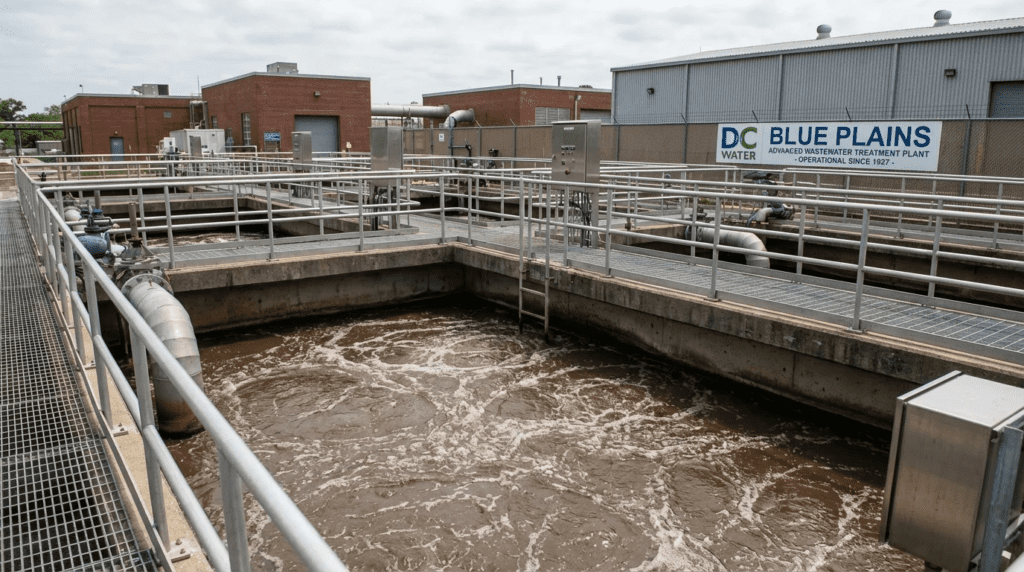
The District of Columbia operates a unique water infrastructure model compared to traditional U.S. states. The region relies entirely on the District of Columbia Water and Sewer Authority (DC Water), which operates the Blue Plains Advanced Wastewater Treatment Plant—the largest advanced wastewater treatment facility of its kind in the world. Unlike states with hundreds of distributed municipal plants, DC’s infrastructure is centralized, serving not only the District’s 700,000+ residents but also roughly 1.6 million people across Montgomery and Prince George’s counties in Maryland and Fairfax and Loudoun counties in Virginia.
The engineering landscape in DC is defined by scale and complexity. The system manages an average daily flow of nearly 300 MGD, with peak wet weather capacity exceeding 1 billion gallons per day. The current engineering focus is dominated by the massive $2.9 billion Clean Rivers Project (a consent decree-driven initiative to reduce Combined Sewer Overflows) and aggressive nutrient removal standards to protect the Chesapeake Bay. This directory focuses on the singular behemoth of Blue Plains and the massive associated pumping infrastructure that functions at a scale larger than most independent municipal plants.
Population Served
1.6 Million (Regional)
Total Treatment Capacity
384 MGD (Average)
>1 BGD (Peak)
Operating Authority
DC Water
Major Active Investment

>$3.0 Billion (CIP)
2. Recent Developments & Projects
The engineering landscape in the District of Columbia has been transformed by the Long-Term Control Plan (LTCP) known as the Clean Rivers Project. In the last three years, DC Water has commissioned the Northeast Boundary Tunnel (NEBT), a massive infrastructure feat designed to mitigate chronic flooding and reduce sewer overflows in the Anacostia River. This project alone represents one of the largest civil engineering undertakings in the Mid-Atlantic.
Currently, the focus is shifting toward the Potomac River Tunnel, the next major phase of the Clean Rivers Project. Additionally, the utility is heavily investing in climate resilience, specifically the “Blue Plains Floodwall Segment C” project, designed to protect the critical treatment assets from 500-year flood events. Funding for these initiatives is a complex mix of EPA WIFIA loans, municipal revenue bonds, and massive annual federal appropriations related to the seat of government’s infrastructure security. DC Water continues to be a pioneer in thermal hydrolysis (CAMBI process) for Class A biosolids production, a technology that has set the standard for energy neutrality in the sector.
3. The Blue Plains Advanced Wastewater Treatment Plant
Note on Regional Directory: Unlike U.S. states with dozens of facilities, the District of Columbia contains only one wastewater treatment plant within its borders. However, this single facility possesses the capacity of 20 standard municipal plants combined. The table below details the facility and the critical “Plant-Scale” pumping stations that feed it.
| Rank | Facility Name | Type | Capacity (MGD) | Operating Authority |
|---|---|---|---|---|
| 1 | Blue Plains Advanced WWTP | Treatment Plant | 384 (Avg) / 1,076 (Peak) | DC Water |
| 2 | Main Pumping Station | Headworks/Pump Station | 400+ | DC Water |
| 3 | O Street Pumping Station | Pump Station | 45 | DC Water |
| 4 | Poplar Point Pumping Station | Pump Station | 45 | DC Water |
| 5 | Potomac Pumping Station | Pump Station | 460 (Peak) | DC Water |

Profile: Blue Plains Advanced Wastewater Treatment Plant
Rank #1: Blue Plains Advanced WWTP
- Location: Southwest Washington, D.C.
- Design Capacity: 384 MGD (Average Daily), 1+ BGD (Peak Wet Weather)
- Population Served: ~1.6 million (DC, MD, VA)
- Operating Authority: DC Water
- Receiving Water: Potomac River (Chesapeake Bay Watershed)
Treatment Process:
- Preliminary: Advanced screening and grit removal facilities.
- Primary: 36 primary sedimentation tanks.
- Secondary: High-rate activated sludge for carbon removal.
- Advanced (Nutrient Removal): Biological Nitrogen Removal (BNR) and Enhanced Nitrogen Removal (ENR) processes achieving near-limit of technology results for Total Nitrogen (TN).
- Tertiary: Dual-media filtration and UV disinfection.
Infrastructure & Innovation:
- Biosolids: World’s largest Thermal Hydrolysis Process (THP) using CAMBI technology. Produces Class A “Bloom” soil amendment.
- Energy: 13 MW Combined Heat and Power (CHP) plant fueled by digester gas; constructing solar arrays.
- Compliance: Operates under one of the strictest NPDES permits in the nation regarding nutrient loading to the Chesapeake Bay.
4. Approved Budgets & Expansion Projects
DC Water’s Capital Improvement Plan (CIP) is one of the most aggressive in the nation, driven by the Clean Rivers Project consent decree and aging infrastructure replacement. Below are the major active and funded projects.
A. MAJOR PROJECTS UNDER CONSTRUCTION (2024-2026)
Potomac River Tunnel (Clean Rivers Project)
- Location: West DC (along Potomac waterfront)
- Project Scope: Construction of an 18-foot diameter, 5.5-mile long deep tunnel to control CSOs. Includes diversion facilities and drop shafts.
- Total Budget: ~$819 Million (Construction Contract)
- Funding Breakdown:
- EPA WIFIA Loan: $156 Million+
- Clean Water SRF: Utilized for planning
- Revenue Bonds: Balance of funding
- Timeline:
- Contract Awarded: October 2023
- Construction Start: 2024
- Projected Completion: 2030
- Key Contractors:
- Design-Build Team: CBNA-Halmar JV
- Expected Benefits: Will reduce combined sewer overflows to the Potomac River by 93% by volume, ensuring compliance with the Clean Water Act.
Blue Plains Floodwall Segment C
- Location: Blue Plains WWTP
- Project Scope: Construction of a floodwall to protect the plant against 500-year flood events, critical for regional resilience.
- Total Budget: ~$50 Million
- Timeline:
- Status: Active Construction
- Expected Completion: 2025
- Project Drivers: Climate resilience and asset protection.
B. PROJECTS IN DESIGN/PLANNING PHASE (2025-2027)
- Main Pumping Station Upgrades
- Estimated Budget: $80+ Million
- Scope: Rehabilitation of the aging heavy-duty pumps and screens at the primary lift station feeding Blue Plains.
- Status: Design/Pre-construction.
- Local Sewer Rehab & Replacement Program
- Annual Budget: ~$50 Million/year
- Scope: Ongoing cured-in-place pipe (CIPP) lining and replacement of small diameter mains throughout the District.
C. RECENTLY COMPLETED MAJOR PROJECTS (2022-2024)
- Northeast Boundary Tunnel (NEBT) – Completed 2023
- Investment: $580 Million
- Description: A massive 5-mile tunnel segment connecting to the Blue Plains Tunnel. It significantly reduces flooding in the bloomingdale/LeDroit Park neighborhoods and prevents Anacostia River pollution.
- Result: Adds 100 million gallons of storage capacity to the sewer system.
Summary Statistics
- Total Active Capital Investment: ~$3.5 Billion (10-year CIP)
- Primary Project Drivers: Consent Decree (CSO) Control (55%), Aging Infrastructure (30%), Resilience (15%).
- Funding Sources: DC Water is a major recipient of WIFIA loans, having closed over $400 million in low-interest federal loans to backstop the Clean Rivers Project.
5. Regulatory & Compliance Landscape
The District of Columbia operates under the direct oversight of EPA Region 3, rather than a state DEP, due to its status as a federal district. The driving regulatory force is the protection of the Chesapeake Bay.
- Chesapeake Bay Agreement: Blue Plains has successfully reduced Nitrogen and Phosphorus loads to historic lows, often operating at the “Limit of Technology” (LOT).
- Long-Term Control Plan (LTCP): A federal consent decree dictates the timeline for the Clean Rivers Project tunnels. Strict adherence to schedule is required to avoid penalties.
- Emerging Contaminants: DC Water is actively monitoring PFAS regulations. While no current MCL violations exist for wastewater effluent, the utility is participating in regional studies to determine the impact of “forever chemicals” on biosolids land application.
6. Infrastructure Challenges & Opportunities
- Climate Change & Flooding: Being situated on the banks of the Potomac, Blue Plains is vulnerable to sea-level rise and storm surges. The construction of the new seawall/floodwall is a direct response to this existential threat.
- Aging Conveyance: While the treatment plant is state-of-the-art, much of DC’s sewer stock dates back to the late 19th century (brick sewers). There is significant opportunity for trenchless rehabilitation (CIPP) contractors.
- Energy Neutrality: DC Water is a leader in energy recovery. Engineers and vendors specializing in biogas optimization, thermal hydrolysis, and renewable energy integration will find an eager partner in the authority.
7. Technology Trends in DC
- Thermal Hydrolysis: The CAMBI process at Blue Plains is a global case study for biosolids management.
- Tunneling Technology: The use of massive Tunnel Boring Machines (TBMs) for the Anacostia and Potomac tunnels highlights the region’s reliance on advanced geotechnical engineering.
- Digital Twin & AI: DC Water is progressively adopting digital twin technology to model flows within the collection system and optimize pump station operations during wet weather events.
8. Resources for Engineers & Operators
- Authority Website: DC Water (dcwater.com)
- Procurement/Bids: DC Water Vendor Portal – Essential for engineering firms seeking design or construction contracts.
- Regulatory Body: EPA Region 3 (Mid-Atlantic)
- Association: Chesapeake Water Environment Association (CWEA) – The local WEF member association.
9. FAQ Section
How many wastewater treatment plants are in Washington, D.C.?
There is only one major treatment plant within the District borders: The Blue Plains Advanced Wastewater Treatment Plant. However, it is one of the largest in the world, with a capacity roughly equivalent to 20 standard municipal plants.
What is the largest wastewater project in DC history?
The Clean Rivers Project (DC Clean Rivers) is a $2.9 billion program constructing deep tunnels to capture and treat combined sewer overflows (CSOs). It is the largest infrastructure project in the city’s history since the Metro.
Who operates the wastewater infrastructure in DC?
DC Water (District of Columbia Water and Sewer Authority) is the independent authority responsible for water and wastewater services.
What funding is available for DC wastewater projects?
DC Water relies heavily on Municipal Revenue Bonds, EPA WIFIA loans, and EPA Clean Water State Revolving Funds (SRF). They have been a pioneer in Green Bonds and Environmental Impact Bonds.
Does Blue Plains treat water only from DC?
No. Blue Plains is a regional facility. Approximately 60% of the wastewater treated at Blue Plains originates from suburban Maryland (WSSC Water) and Northern Virginia (Fairfax/Loudoun counties).