
Dual Tank Water Softeners
Understanding Dual Tank Water Softeners: A Comprehensive Guide
Introduction
Water softeners are essential appliances for homes in areas with hard water. They help mitigate the detrimental effects of hard water, which can lead to scale buildup in plumbing, reduced detergent efficacy, and damage to household appliances. Among the various models on the market, dual tank water softeners stand out for their efficiency and reliability. This article explores what dual tank water softeners are, how they work, their advantages, and things to consider before purchasing one.
Within the broader landscape of water softening equipment, dual tank softeners (also called twin tank softeners) occupy the premium tier of salt-based ion exchange systems. They are designed specifically for applications where soft water cannot be interrupted — large households, boilers, restaurants, hospitality kitchens, commercial laundries, and any process where the regeneration window of a single-tank system would create unacceptable hard-water exposure. This article covers both the operating principles of dual tank systems and the practical engineering and buyer-side questions homeowners and operators most commonly ask.
What is Hard Water?
Before diving into dual tank water softeners, it is essential to understand what hard water is and why it’s problematic. Hard water contains high levels of dissolved minerals, primarily calcium and magnesium. These minerals can cause several issues, including:
-
- Scale Buildup: Calcium and magnesium precipitate out of hard water and form scale, which accumulates in pipes, water heaters, and other appliances, reducing their efficiency and lifespan.
-
- Soap Inefficiency: Hard water reacts with soap to form soap scum, which not only wastes soap but also makes it more challenging to achieve a good lather.
-
- Skin and Hair Issues: Showering in hard water can leave skin and hair feeling dry and dull.
Given these issues, many homeowners opt for water softeners to remove calcium and magnesium from their water supply.
Basics of Water Softeners
Ion Exchange Process
Most water softeners use a process called ion exchange to remove hardness minerals from water. This process involves exchanging hardness ions (calcium and magnesium) with sodium ions. The basic components of a water softener include:
-
- Mineral Tank: This tank contains resin beads charged with sodium ions. As hard water passes through the tank, calcium and magnesium ions are attracted to the resin and replaced with sodium ions.
-
- Brine Tank: This tank holds a salt solution (brine) used to recharge the resin beads with sodium ions during the regeneration cycle. The dedicated guide to brine tanks for regeneration covers tank sizing, salt selection, and water-level adjustment in detail.
Regeneration Cycle
Over time, the resin beads become saturated with calcium and magnesium ions and need to be regenerated. The regeneration cycle flushes the resin tank with the salt-brine solution, replenishing the sodium ions and preparing the system for further ion exchange.
What is a Dual Tank Water Softener?
Definition and Components
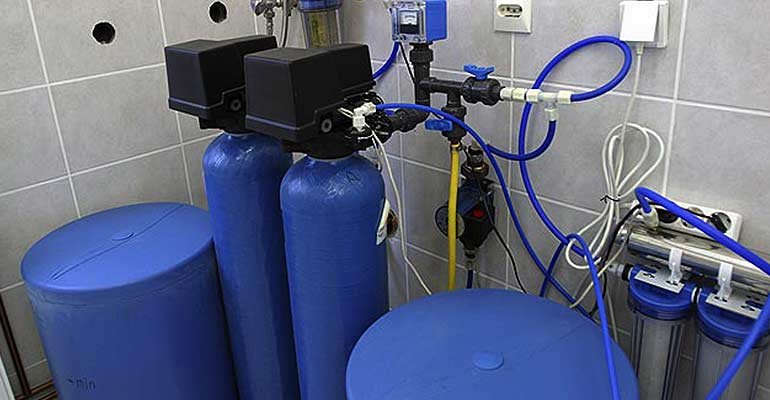
A dual tank water softener, also known as a twin tank system, consists of two separate mineral tanks instead of the single tank found in most water softeners. These two tanks alternate in the ion exchange process. When one tank is in service, the other is regenerating.
How It Works
-
- Alternating Operation: One tank is in operation while the other is in standby mode, ready to take over during regeneration.
-
- Continuous Soft Water Supply: Dual tank systems provide a continuous supply of soft water, even during regeneration.
Dual Tank Water Softener Subtopics
The “dual tank water softener” category covers two practical subtopics that homeowners and operators most commonly encounter when evaluating these systems: the systems themselves as engineered packages, and the head-to-head decision between dual tank and single tank configurations. The sections below summarize each at the level of detail needed for selection; dedicated guides cover each in greater depth.
Dual Tank Water Softener Systems
Dual tank water softener systems are sold as complete pre-engineered packages that include two resin tanks, one or two brine tanks, a control valve designed for twin-tank operation, and the interconnecting plumbing required to alternate flow between the two resin vessels. Residential dual tank systems typically pair two 0.75 to 2 cubic foot resin tanks under a single Fleck or Clack twin-tank control valve. Light-commercial systems scale to 3–10 cubic feet per resin tank, while commercial and industrial systems use 10+ cubic feet per tank with progressive or alternating valve configurations. The defining design feature is that the control valve switches the active resin tank automatically when the lead tank reaches its regeneration trigger — typically a gallons-throughput counter — and starts regeneration on the just-exhausted tank in the background while the standby tank delivers soft water without interruption.
Dual Tank vs Single Tank Water Softener
The direct dual tank vs single tank water softener comparison is the most common question prospective buyers ask, and the answer depends on whether soft water can be interrupted. Single tank systems are simpler and less expensive but regenerate the only resin tank in the system on a fixed schedule (typically overnight) or on a demand trigger, during which the unit either delivers hard water or supplies stored water from a brine tank. Dual tank systems carry roughly 1.5–2× the capital cost but eliminate any regeneration-window hard-water exposure, regenerate on actual usage rather than a fixed schedule, and typically deliver longer resin life because each tank works at a known and controlled exhaustion level. For typical 3–4 person households a single tank system is the cost-effective choice; for large households, hot tubs, second homes with intermittent occupancy, or any commercial application where continuous soft water is part of the duty, a dual tank system is the right answer.
Benefits of Dual Tank Water Softeners
Continuous Operation
Perhaps the most significant advantage of a dual tank water softener is its ability to provide uninterrupted soft water. With a single-tank system, water softening stops during the regeneration process. However, in a dual-tank system, the second tank takes over, ensuring a consistent flow of soft water.
High Efficiency
Dual tank systems are generally more efficient than single-tank units. They regenerate as needed based on actual soft water usage rather than a preset schedule. This demand-initiated regeneration leads to less salt and water being used, making these systems more environmentally friendly.
Extended Resin Life
Since the resin beads in a dual tank system regularly alternate between tanks, they experience less wear and tear, contributing to a longer lifespan. This can result in less frequent maintenance and replacement costs.
Adaptability for Large and Growing Households
Dual tank systems are ideal for large households or those with high water demands. They can handle significant fluctuations in water usage while maintaining efficient operation. This adaptability makes them a good investment for homes with many residents or changing water needs.
Considerations Before Purchasing a Dual Tank Water Softener
Cost
Dual tank systems tend to be more expensive than their single-tank counterparts. The initial investment is higher due to the added complexity and technology. Homeowners should consider their budget, alongside potential savings in salt, water, and extended system life when evaluating cost.
Space Requirements
Dual tank water softeners require more space than single-tank systems. Homeowners need to ensure adequate space in their utility or plumbing area to accommodate the additional tank.
Installation and Maintenance
Although dual tank systems can be more complex to install due to their additional components, many manufacturers provide detailed instructions and support. Regular maintenance is essential to ensure the system’s longevity and continue enjoying the benefits of soft water.
Selection and Specification Framework
Selecting a dual tank water softener begins with verifying that continuous soft water is actually required for the application. Many households assume they need dual tank service when a properly sized single tank with an overnight regeneration schedule would meet their needs adequately. Honest demand analysis — household size, daily water consumption, hardness in grains per gallon, presence of boilers or steam systems, hospitality or food service operations — determines whether the dual-tank premium is justified. For applications where intermittent service or compact form factor matter more than continuous capacity, portable water softeners may be a better fit, particularly for RVs, boats, and small commercial vehicles.
Once dual tank service is established as the right architecture, sizing follows a defined chain. Total daily hardness load is calculated as gallons per day × hardness in grains per gallon. Each resin tank is sized to deliver at least 24 hours of capacity at peak design conditions, with the second tank providing the regeneration buffer. Typical residential dual tank systems carry 32,000–96,000 grains of capacity per tank; commercial systems scale to several hundred thousand grains per tank. Salt dose per regeneration is set by efficiency target — 6 lb salt per cubic foot delivers about 18,000 grains per cubic foot of capacity, while 15 lb per cubic foot delivers about 30,000 grains, with diminishing salt efficiency at higher dose.
Control valve selection is the next decision. Fleck (twin-tank 9000 and 9500 series), Clack (WS1TC twin), and Kinetico (proprietary non-electric twin-tank valves) dominate the market. Electric controls (Fleck, Clack) cost less and offer programmable demand initiation; non-electric meters (Kinetico) cost more but operate without power and may run longer between failures. The right choice depends on local power reliability, repair-parts availability, and preference for digital interfaces vs. mechanical robustness.
Materials of construction follow standard ion-exchange softener practice: polyethylene-lined fiberglass resin tanks, polyethylene brine tanks, and FDA-grade resin in food-and-beverage applications. Wetted components must meet NSF/ANSI 61 for drinking water service. Plumbing connections, bypass valves, and bypass piping should be sized to match the system’s design flow rate without excessive pressure drop.
Resin type is the final consideration most buyers skip. Standard 8% cross-linked polystyrene cation resin is the workhorse for typical residential and light commercial duty. Higher cross-link percentages (10% or 12%) tolerate chlorine attack better and are commonly specified where municipal water carries significant free chlorine residual. Specialty resins — high-capacity macroporous, fine-mesh for trace contaminants, or food-grade — apply in narrower applications. Buyers should verify resin type and warranty length in any quote; “lifetime resin warranty” claims that exclude chlorine damage are functionally limited to a few years in chlorinated municipal water.
A worked sizing example illustrates the chain. For a six-person household with 80 gallons per person per day water use and 20 grains per gallon hardness, daily hardness load is 480 × 20 = 9,600 grains per day. With a 1.5× safety factor, each resin tank should deliver at least 14,400 grains between regenerations. A 1.5 cubic foot resin tank at 6 lb salt per cubic foot delivers about 27,000 grains, which is ample for 1–2 day intervals between regens per tank — a conservative match. Tighter sizing (1 cubic foot tanks) would force more frequent regeneration and shorter resin life; oversizing further (2 cubic foot tanks) would waste capital with little operating benefit at this household scale.
Dual Tank vs. Alternative Softening Approaches
| Configuration | Continuous Soft Water? | Hardness Removal | Capital Profile | Operating Cost Driver | Best-Fit Applications |
|---|---|---|---|---|---|
| Dual Tank Salt-Based | Yes (one tank serves while other regenerates) | Full removal to <1 gpg | High ($1,500–$4,000 residential) | Salt + water/sewer (demand-initiated) | Large households, boilers, commercial, continuous duty |
| Single Tank Salt-Based | No (regeneration window interrupts service) | Full removal to <1 gpg | Moderate ($800–$2,000 residential) | Salt + water/sewer | Typical 3–4 person households, intermittent demand |
| Portable Softener | No (manual regeneration) | Full removal | Low ($200–$600) | Salt | RV, boat, vacation home, small commercial vehicle |
| Salt-Free (TAC) | Yes (continuous) | None (scale prevention only) | Moderate ($1,200–$2,500) | Media replacement 5–8 years | Whole-house scale prevention without true softening |
| Magnetic / Electronic | Yes (continuous) | None | Low ($100–$700) | Minimal | Low-cost scale-control trials, supplemental |
Field Notes
Commissioning and Startup
Commissioning a new dual tank installation follows a defined sequence: confirm both resin tanks are level and stable on their platforms, connect both to the twin-tank control valve per the OEM piping diagram, fill the brine tank with 3–8 gallons of water before adding salt, charge both resin tanks with the specified resin volume, program the control valve for the household’s hardness and flow rate, manually trigger a regeneration on each tank to verify brine draw and rinse, and finally run the system in normal service for at least one switchover cycle to confirm the alternating logic works. The first switchover after commissioning is the most informative test — it confirms both that the control valve correctly identifies tank exhaustion and that the standby tank is fully regenerated and ready for service.
Common Specification Mistakes
Three specification errors recur in dual tank softener projects. The first is paying for dual tank service when a properly sized single tank would meet the actual duty — many residential installations don’t actually need uninterrupted soft water, and the premium for dual tank capability is essentially wasted in those cases. The second is undersizing both tanks to fit a tight budget, then operating them in continuous regeneration mode that defeats the purpose of dual tank service. The third is mismatching brine tank capacity to the dual resin tank load — each regeneration cycle draws roughly twice the brine of a single tank system over time, so the brine tank should be sized for the combined service interval, not for a single regen.
Operations and Maintenance
Day-to-day O&M for dual tank systems is similar to single tank but with twice the brine tank to manage. Salt level should be checked monthly and topped off when below the halfway mark. The twin-tank control valve typically requires no routine intervention but should be inspected annually for visible leaks at fittings, electrical connections, and the bypass valve. Resin life in dual tank service typically extends to 12–15 years versus 8–12 for single tank because each bed sees more uniform exhaustion cycles. Listen for unusual switchover behavior — repeated short cycles, switchovers that don’t complete, or both tanks running simultaneously — as early indicators of control valve issues that should prompt a service call before the system reverts to hard water output.
Logging operating parameters over time is one of the highest-value O&M practices for dual tank systems. Track gallons softened per regeneration, salt consumption per month, and effluent hardness as measured by a simple test kit every few months. Steady metrics indicate the system is performing to design; gradual drift in any direction signals a developing issue — resin fouling if capacity drops slowly, control valve drift if salt consumption rises without a hardness change, or upstream water quality change if both metrics shift together. A simple notebook log next to the brine tank or a spreadsheet template captures the data with minimal labor and pays back many times over in early issue detection.
Design Details and Standards
Sizing Methodology
Dual tank sizing follows the same fundamental chain as single tank but with an explicit redundancy requirement. Calculate daily hardness load (gpd × gpg = grains/day), multiply by a safety factor of 1.25–1.5× to size the active tank’s daily capacity, then size each resin tank to deliver at least the daily capacity between regenerations (typically 1–3 day intervals for residential, often daily for commercial). Brine tank capacity should hold at least 30 days of design salt consumption to avoid frequent refills. Plumbing connections, bypass piping, and the control valve port size should match the system’s design flow rate to keep pressure drop below 15 psi at peak demand.
Applicable Standards
NSF/ANSI 44 covers performance certification for cation exchange water softeners including dual tank variants — certification verifies both hardness removal and salt efficiency claims. NSF/ANSI 372 governs low-lead content for any wetted components in drinking water service. NSF/ANSI 61 certifies wetted materials for drinking water contact. WQA Gold Seal certification provides additional consumer-facing assurance and is offered by reputable softener manufacturers. Local plumbing codes typically require backflow prevention on the water inlet and a properly air-gapped drain on the brine and regeneration discharge.
Specification Checklist
- Verified design hardness load (gpd × gpg) with safety factor
- Required resin volume per tank to meet daily capacity
- Salt dose per regeneration vs. efficiency target
- Control valve selection (Fleck twin, Clack twin, Kinetico non-electric, or equivalent)
- Brine tank sized for 30-day refill interval at design dose
- NSF/ANSI 44 certification of installed system
- NSF/ANSI 61 / 372 certification of wetted components
- Bypass piping for service and maintenance
- Drain routing with air gap per local plumbing code
- Backflow prevention on water inlet
- Floor drain or sump for incidental brine spills
- Power supply for electric control valves (if not non-electric)
- Local service support and spares inventory
Choosing the Right Dual Tank Water Softener
Calculating Water Hardness and Usage
Before purchasing a water softener, it’s crucial to understand your home’s water hardness levels and usage patterns. You can use a hard water test kit or contact a local water utility company for information. Knowing your water hardness will help you choose a system with the appropriate capacity.
Researching Brands and Models
Several reputable manufacturers offer dual tank water softeners, including Fleck, Kinetico, and Culligan. Each brand has its unique features, benefits, and price ranges. Potential buyers should research reviews, compare features, and consult professionals if necessary.
Evaluating Features and Technologies
Modern dual tank water softeners come with various advanced features, including:
-
- Efficient Regeneration Controls: Systems that offer demand-initiated regeneration optimize salt and water use compared to time-initiated ones.
-
- Digital Displays and Programming: User-friendly interfaces provide more accessible monitoring and adjustments.
-
- Warranties and Customer Support: Extended warranties and robust customer service offer peace of mind regarding the investment.
Installation Process
Professional vs. DIY Installation
While dual tank water softeners can be installed by a knowledgeable homeowner, professional installation is often recommended. Professionals ensure proper setup, which can prevent long-term issues. DIY installation might be more cost-effective but could lead to complications if not performed correctly.
Key Steps in Installation
-
- Location Selection: Ensure that the chosen location is near the water main and has access to a drain and electrical outlet.
-
- System Setup: Set up both tanks, connecting them to the water supply and drain lines.
-
- Control Valve Programming: Program the control valve according to the manufacturer’s instructions, adjusting for water hardness and usage expectations.
-
- Testing: After installation, test the system to ensure it functions correctly, checking for leaks and correct water softening operation.
Maintenance Tips
Regular Salt Checks
Ensure the brine tank has adequate salt levels. Replenish the salt supply as needed, avoiding overfilling to prevent bridging.
Inspecting the Control Valve and Resin Tanks
Periodically check for leaks or malfunctions. It’s crucial to maintain the control valve clean and functional, as it regulates the softening cycle.
Annual Professional Inspection
Schedule an annual inspection with a professional to ensure the system operates at peak efficiency. A professional can identify potential issues and perform necessary maintenance.
Environmental Considerations
Salt Usage
While dual tank systems optimize salt use through demand-initiated regeneration, they still use salt during the softening process. Some regions have restrictions on salt-based softeners due to environmental concerns. Alternatives, like salt-free water conditioners, may be considered in areas with strict regulations.
Water Consumption
Dual tank systems are more efficient regarding water use compared to single tank versions, as they regenerate only when needed. This efficiency reduces environmental impact and water waste.
Frequently Asked Questions
How much more does a dual tank softener cost compared to a single tank?
Capital cost for a dual tank residential system typically runs $1,500–$4,000 installed, compared to $800–$2,000 for an equivalent single tank system — roughly 1.5–2× the price. The premium pays for the second resin tank, the twin-tank control valve, the additional plumbing, and typically a larger brine tank. Operating cost is similar to a single tank in salt and water consumption (sometimes lower due to demand-initiated regeneration), so the breakeven question is whether continuous soft water service justifies the capital premium for the specific household.
Do dual tank softeners use more salt than single tank?
Not necessarily. While a dual tank system has more total resin to regenerate, demand-initiated regeneration on each tank means salt is consumed only when actual exhaustion triggers it. Many dual tank installations actually use less salt per year than equivalent single tank systems on a fixed regeneration schedule, because the fixed schedule regenerates even when the resin isn’t fully exhausted. Total salt cost depends on hardness, water consumption, and salt dose per regeneration — not on tank count.
What’s the difference between a dual tank and a parallel-flow softener?
A dual tank system operates one resin tank at a time, with the second tank in standby. The standby tank takes over only when the lead tank exhausts. A parallel-flow system operates both resin tanks simultaneously, splitting the total flow between them — typically used in commercial applications where peak flow exceeds what a single tank can handle. Parallel-flow does not provide continuous service during regeneration unless additional redundancy is built in (3 or 4 tanks total). Most residential “twin tank” systems are dual tank alternating-flow, not parallel-flow.
How long does the resin last in a dual tank system?
Resin in dual tank service typically lasts 12–15 years, longer than the 8–12 years typical for single tank service. The reason is that each resin bed alternates between full regeneration and full exhaustion, with no extended periods of partial exhaustion that accelerate physical breakdown. Chlorine in municipal water is the primary chemical attack on standard cation resin; carbon pre-filtration to remove chlorine extends resin life across both tank types. End-of-life is signaled by reduced capacity (more frequent regeneration without higher hardness) rather than mechanical failure.
Can I retrofit a single tank softener to dual tank?
In principle yes, but in practice the economics rarely justify it. Retrofitting requires adding a second resin tank, replacing the control valve with a twin-tank valve, and modifying the plumbing — costs that often approach or exceed installing a new dual tank system. Most homeowners considering an upgrade find it more practical to wait until the existing single tank system reaches end of life, then replace with a new dual tank system at that point. The conversion makes more sense in commercial applications with large existing resin tanks that can be reused.
Are dual tank systems certified to NSF standards?
Major dual tank softener brands (Fleck-based systems, Kinetico, Culligan, and others) typically carry NSF/ANSI 44 certification for performance, NSF/ANSI 61 for material safety, and NSF/ANSI 372 for low-lead content. Certification covers both the components and the system as a whole, and reputable manufacturers publish their certification on product literature. Buyers should verify certification on any specific model rather than assuming brand-level certification applies to all variants — entry-level twin tank systems sometimes ship without full certification to hit a lower price point.
Conclusion
Key Takeaways
- Dual tank softeners eliminate the regeneration-window hard-water gap — one resin tank serves while the other regenerates, delivering continuous soft water output.
- The dual tank premium is worth it only when continuous service is the duty — typical 3–4 person households are usually well-served by a properly sized single tank with overnight regeneration.
- Match the system to the application, not just the household size — boilers, hospitality kitchens, commercial laundries, and any process where soft water interruption is unacceptable demand dual tank service.
- Demand-initiated regeneration is the efficiency lever — modern dual tank control valves regenerate only when actual usage triggers it, often reducing salt and water consumption versus fixed-schedule single tank systems.
- Resin life is extended in dual tank service — typically 12–15 years vs. 8–12 for single tank, because each bed alternates between full regeneration and full exhaustion in controlled cycles.
- NSF/ANSI 44, 61, and 372 certifications matter — verify certifications at the model level rather than the brand level, since entry-level products sometimes ship without full certification.
Dual tank water softeners are a robust solution for managing hard water, offering continuous soft water supply, increased efficiency, and adaptability for various household sizes and needs. While they may require a higher initial investment, their benefits often outweigh the costs, especially for homes with high water usage.
Prospective buyers should thoroughly evaluate their water needs, research options, and consider professional installation to ensure optimal performance and longevity. In doing so, homeowners can enjoy the myriad benefits of soft water while mitigating the detrimental effects of hard water on their homes.