
DuPont – Memcor vs WesTech for Filtration: Pros/Cons & Best-Fit Applications
INTRODUCTION
One of the most persistent debates in municipal water treatment and tertiary wastewater polishing centers on the choice between proprietary membrane technologies and versatile packaged filtration systems. Engineers are frequently caught between the absolute barrier protection of ultrafiltration (UF) and the robust, forgiving nature of adsorption clarifiers or conventional multimedia filtration. This decision affects everything from civil footprint and hydraulic profiles to operator licensing requirements and 20-year lifecycle costs.
A staggering statistic in the industry suggests that over 30% of filtration retrofits fail to meet their projected operational expenditure (OPEX) targets, often due to a misalignment between the source water variability and the selected technology’s tolerance. For engineers evaluating DuPont – Memcor vs WesTech for Filtration: Pros/Cons & Best-Fit Applications, the stakes are high. A misapplication can lead to irreversible membrane fouling, excessive backwash waste volumes, or the inability to meet Giardia/Cryptosporidium log removal requirements during storm events.
This article moves beyond the brochure-level features to dissect the engineering realities. We are comparing two heavyweights that represent different philosophies: DuPont (formerly Siemens/Memcor), which champions high-tech PVDF hollow-fiber membrane systems, and WesTech, which serves as a premier integrator of both open-platform membrane systems and traditional high-rate media filtration (such as the Trident family). This guide assists design engineers, plant superintendents, and utility directors in navigating the complex selection process, focusing on hydraulic performance, constructability, and long-term maintainability.
HOW TO SELECT / SPECIFY
When specifying filtration systems, engineers must look past capital cost and evaluate the fundamental process mechanics. The choice between a DuPont Memcor system and a WesTech solution often comes down to the source water matrix and the utility’s operational philosophy. The following criteria provide a framework for navigating DuPont – Memcor vs WesTech for Filtration: Pros/Cons & Best-Fit Applications.
Duty Conditions & Operating Envelope
The operating envelope is the first critical differentiator. DuPont Memcor systems, utilizing pressurized or submerged hollow fiber membranes, operate on a principle of exclusion based on pore size (typically 0.04 to 0.1 microns). This provides a physical barrier independent of feed turbidity, up to a point. However, membranes are flux-limited. Engineers must specify design flux rates (gallons per square foot per day, gfd) carefully based on the coldest water temperature.
- Flow Turndown: Membrane systems (DuPont) offer excellent turndown capabilities but suffer efficiency losses at low flows due to the fixed volume required for backwashing and Clean-in-Place (CIP) processes.
- Turbidity Spikes: WesTech’s media-based systems (like the Trident) generally handle high-solids loading events (spikes >50 NTU) more robustly than membranes, which may require aggressive backpulsing or temporary shutdown to prevent irreversible fouling.
- Variable Loads: If the facility faces rapid changes in organic loading (TOC), WesTech’s adsorption clarification processes can be advantageous as they chemically condition solids prior to filtration, whereas membranes may require enhanced upstream coagulation to prevent pore blocking.
Materials & Compatibility
Material science drives the longevity of the asset. DuPont Memcor modules typically utilize Polyvinylidene Fluoride (PVDF) chemistry. PVDF is renowned for high oxidant tolerance, allowing for aggressive chlorine cleans. However, engineers must verify compatibility with coagulants used upstream; certain cationic polymers can irreversibly foul membrane surfaces.
WesTech equipment, particularly in their steel-tank packaged plants or open-basin designs, relies heavily on epoxy-coated carbon steel or stainless steel internals.
- Corrosion: In high-chloride environments (e.g., desalination pretreatment), the material specification for WesTech internals must be upgraded to 316L or Duplex stainless steel.
- Abrasion: For media filtration, the selection of anthracite, sand, and garnet is standard, but the underdrain system is the weak link. WesTech’s nozzle-based or folded-plate underdrains must be specified to withstand the abrasive forces of air scour over 20 years.
Hydraulics & Process Performance
The hydraulic profile differs significantly. DuPont Memcor pressurized systems (like the XP or CP series) require feed pumps capable of overcoming Transmembrane Pressure (TMP) that builds over the filtration cycle, typically varying from 3 to 15 psi, plus static head. This often necessitates VFD-driven pumps to maintain constant flux as permeability declines.
Conversely, WesTech gravity filtration systems operate on available static head.
- Head Loss: A gravity filter might operate with 4-8 feet of terminal head loss. A pressurized membrane system might operate at 20-30 psi feed pressure.
- Recovery Rate: This is a major differentiator. Media filters typically achieve 95-98% recovery. Membrane systems can range from 90-97%, but pushing recovery high on membranes requires sophisticated backwash recovery systems, which adds complexity.
- Process Constraints: Engineers must calculate the “waste stream management.” Membrane backwash is often chemically enhanced (EFM), creating a neutralized waste stream that may be difficult to return to the headworks without upsetting biological processes.
Installation Environment & Constructability
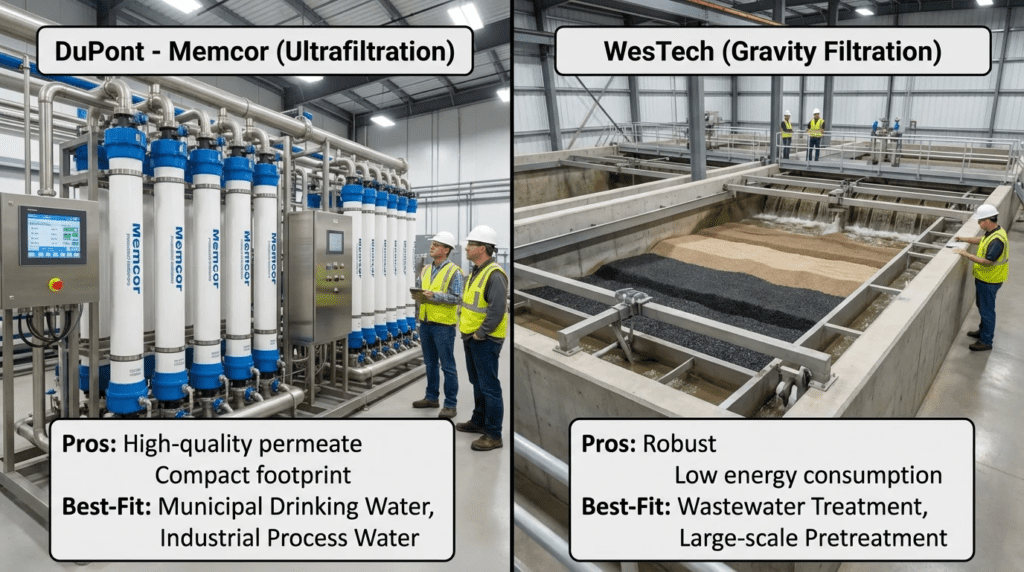
Space constraints often dictate the technology choice. DuPont Memcor racks are vertical and modular. A 10 MGD membrane plant usually occupies significantly less footprint than a comparable granular media filtration plant. This makes membranes the “Best-Fit” for retrofits in existing buildings.
- Height Requirements: While footprint is small, membrane racks are tall. Engineers must verify overhead clearance for crane access to lift modules out of the racks.
- Structural Load: WesTech packaged steel units are heavy point loads. Foundation design must account for the fully flooded weight of steel tanks plus media. Membrane racks have a lower distributed load but require extensive trenching for permeate and filtrate piping.
Reliability, Redundancy & Failure Modes
Failure modes in DuPont – Memcor vs WesTech for Filtration: Pros/Cons & Best-Fit Applications are distinct.
- Memcor Failure: A fiber break compromises the absolute barrier. Systems rely on automated integrity testing (Pressure Decay Test) to detect a breach. If a rack fails a test, it must be isolated. Redundancy is typically N+1 racks.
- WesTech (Media) Failure: Failure is usually “breakthrough,” where turbidity slowly rises. This is rarely catastrophic but can lead to regulatory violations. Redundancy is usually N+1 filter cells.
- Critical Spares: For DuPont, spare modules and rack valves are critical. For WesTech, spare actuators, air scour blowers, and chemical feed pumps are the primary concerns.
Maintainability, Safety & Access
Operator feedback often diverges here. Media filters are viewed as “passive” and “forgiving.” Operators can visually inspect the filter bed. Membrane systems are “black boxes”—you cannot see the filtration happening inside the fiber.
- Chemical Handling: Membrane systems require bulk storage of Acid (Citric/Sulfuric), Base (Caustic), and Oxidant (Hypo) for CIPs. This introduces significant safety hazards and containment requirements. WesTech media filters generally only require backwash water and occasional chlorine.
- Ergonomics: Pinning a membrane module (repairing a broken fiber) is a tedious, manual task requiring dexterity and patience. Replacing media in a WesTech filter is a heavy construction event but happens only once every 10-15 years.
Lifecycle Cost Drivers
The Total Cost of Ownership (TCO) analysis is where the battle is won or lost.
- CAPEX: Membranes have historically been more expensive, but the gap has closed. However, the civil work for gravity filters (concrete basins) is high.
- OPEX – Energy: Membranes generally consume more energy due to higher feed pressures and air scour requirements.
- OPEX – Replacement: Membrane modules have a 7-10 year life. This is a massive recurring capital cost. Media lasts 15-20 years.
- Labor: Membrane plants require higher-skilled operators (often higher licensure levels) due to the complexity of the automated sequences and chemical systems.
COMPARISON TABLES
The following tables provide a direct side-by-side analysis to assist engineers in quick evaluations. Table 1 compares the technological attributes of the flagship offerings. Table 2 provides a matrix to identify the best-fit application based on plant constraints.
| Feature | DuPont Memcor (UF/MF) | WesTech (Trident/Gravity Media) | WesTech (Membrane Integration) |
|---|---|---|---|
| Primary Technology | PVDF Hollow Fiber Membrane (0.04 – 0.1 µm) | Adsorption Clarifier + Multi-Media Filtration | Open Platform Integration (Toray, Scinor, etc.) |
| Pathogen Barrier | Absolute (Log 4+ Giardia/Crypto) | Dependent on Coagulation/Ripening | Absolute (Dependent on selected module) |
| Footprint | Very Compact (Vertical Racks) | Moderate to Large | Compact |
| Chemical Usage | High (Daily Maintenance Cleans + CIP) | Low (Coagulant + Polymer) | High (Module dependent) |
| Energy Intensity | Moderate/High (Pumping + Air Scour) | Low (Gravity flow options available) | Moderate/High |
| Effluent Quality | < 0.1 NTU consistently | < 0.3 NTU typical | < 0.1 NTU consistently |
| Module/Media Life | 7-10 Years (Replacement Cost High) | 15-20 Years (Media Top-off) | 7-10 Years |
| Scenario / Constraint | DuPont Memcor Best Fit? | WesTech Media Best Fit? | Engineering Rationale |
|---|---|---|---|
| Strict Pathogen Limits (Crypto) | YES | No | Membranes provide direct physical removal credits without relying solely on chemical inactivation. |
| High Variable Turbidity (>50 NTU) | No | YES | Media filters with adsorption clarification handle solids loading better without fouling; membranes would require extensive pretreatment. |
| Remote/Unmanned Facility | No | YES | Membranes require complex automation and chemical handling not suitable for low-oversight sites. |
| Space/Footprint Constrained | YES | No | Vertical racking allows expansion of capacity within existing building footprints. |
| Cold Water Applications (<5°C) | Conditional | YES | Membrane flux drops significantly in cold water (viscosity), requiring oversizing. Media filtration is less sensitive to viscosity. |
| Wastewater Reuse (Title 22) | YES | Conditional | Membranes are the industry standard for producing high-quality reuse water for irrigation or aquifer recharge. |
ENGINEER & OPERATOR FIELD NOTES
Real-world experience often diverges from the Operation & Maintenance (O&M) manual. The following insights regarding DuPont – Memcor vs WesTech for Filtration: Pros/Cons & Best-Fit Applications come from field commissioning and long-term operation.
Commissioning & Acceptance Testing
For DuPont Memcor systems, the Integrity Test is the “go/no-go” metric. During commissioning, engineers must witness the Pressure Decay Test (PDT). A common issue is failing PDT not because of a broken fiber, but due to leaking O-rings on the module headers or incompletely vented air.
For WesTech Trident or gravity filters, commissioning focuses on the Backwash Profile. Engineers must verify that the media expands sufficiently (typically 20-30%) to release trapped solids without washing the media out of the trough. The “performability” test usually involves spiking the feed turbidity and verifying the filter run time before breakthrough.
Common Specification Mistakes
A frequent error in specifying WesTech/media systems is under-specifying the Air Scour System. Effective cleaning of media requires vigorous air/water backwash. If the blower is undersized, mudballs will form in the media bed, creating channeling and ruining filtration performance within a few years.
For DuPont Memcor, a critical mistake is ignoring the Cold Water Derating. PVDF membrane performance is governed by viscosity. A system designed for 15 MGD at 20°C might only produce 8 MGD at 5°C. Engineers often rely on the “design average” temperature, leading to capacity shortfalls in winter.
O&M Burden & Strategy
DuPont Memcor: The primary burden is chemical management. Operators act as chemical technicians, managing CIP schedules. The “Pinning” process—identifying and plugging a broken fiber—requires isolating a module, pressurizing it, finding the bubbles, and inserting a pin. This takes time and dexterity.
WesTech: The burden is mechanical. It involves maintaining pneumatic valves, actuators, and blower motors. The media itself requires periodic core sampling to check for effective size and uniformity coefficient changes. If an Adsorption Clarifier is used, the buoyant media must be monitored for loss.
Troubleshooting Guide
- Symptom: High TMP (Membrane).
- Cause: Organic fouling or pore plugging.
- Fix: Run an enhanced chemical clean (Recovery Clean). Check upstream coagulation dose; overdosing polymer is a membrane killer.
- Symptom: Short Filter Runs (Media).
- Cause: Surface blinding or “mudball” formation deep in the bed.
- Fix: Inspect backwash expansion. You may need to increase backwash rate or extend the air scour duration.
DESIGN DETAILS / CALCULATIONS
Precise engineering requires validating the manufacturer’s sizing logic. Below are the key parameters for DuPont – Memcor vs WesTech for Filtration: Pros/Cons & Best-Fit Applications.
Sizing Logic & Methodology
Membrane Sizing (DuPont Memcor)
The governing equation for membrane surface area is based on Flux (J).
Required Area (ft²) = Q (gpd) / (Flux (gfd) × Temperature Correction Factor)
- Flux Rates: Typical design flux for PVDF UF on surface water is 25-45 gfd. For wastewater reuse, it is typically 15-25 gfd.
- Temperature Correction: Since viscosity increases as temperature decreases, flux decreases.
TCF ≈ 1.03^(T_design – 20) (Approximation, consult vendor curves).
Media Filter Sizing (WesTech)
Media filters are sized based on Loading Rate (Hydraulic Loading Rate, HLR).
Required Area (ft²) = Q (gpm) / Loading Rate (gpm/ft²)
- Loading Rates:
- Rapid Sand: 2-3 gpm/ft²
- High Rate Multimedia: 4-6 gpm/ft²
- Trident (Adsorption Clarifier): Up to 8-10 gpm/ft² (aggressive rating).
Specification Checklist
When drafting the RFP or technical specs, ensure these specific items are included to protect the utility:
- Membrane Specs: Define the “Net Production” (Feed flow minus backwash volume). Vendors often quote “Gross Production.” Specify a minimum required recovery rate (e.g., >92%).
- Media Specs: Require AWWA B100 compliance for filtering material. Specify the Uniformity Coefficient (UC) strictly (typically < 1.5) to ensure proper stratification.
- Vessel Construction: For WesTech packaged units, specify ASME Section VIII if pressurized, or appropriate API/AWWA standards for atmospheric tanks. Require 3-coat epoxy systems for carbon steel.
- Warranty: For membranes, demand a prorated module warranty of at least 5-7 years. For media, the warranty is usually on the mechanical equipment (1-2 years).
Standards & Compliance
- AWWA B110: Membrane Systems.
- AWWA B100: Granular Filter Material.
- NSF/ANSI 61: Drinking Water System Components (Mandatory for both).
- Ten State Standards: Governs redundancy and loading rates for municipal works in the US.
FAQ SECTION
What is the difference between DuPont Memcor and WesTech Trident systems?
The fundamental difference is the separation mechanism. DuPont Memcor uses Ultrafiltration (UF) or Microfiltration (MF) membranes to create a physical barrier based on pore size (excluding particles >0.1 micron). WesTech Trident systems use an Adsorption Clarifier followed by Mixed Media filtration, relying on depth filtration and chemical adhesion to remove particles. Memcor offers better pathogen removal; Trident offers simpler operation and handles higher solids loading.
How do you select between membranes and gravity filtration for wastewater reuse?
For Title 22 or Class A reuse water, membranes (DuPont Memcor) are generally preferred because they provide a verifiable barrier to pathogens and consistently achieve low turbidity (<0.1 NTU) regardless of feed quality. While gravity filtration (WesTech) can meet reuse standards with proper coagulation, it requires more intensive monitoring and may struggle with the variable quality of secondary effluent compared to membranes.
What is the typical lifecycle cost difference?
Membrane systems typically have a lower initial civil construction cost (smaller footprint, no deep basins) but higher long-term OPEX. The OPEX driver is module replacement (every 7-10 years), higher energy costs (pumping + air scour), and chemical consumption. WesTech media filters have higher upfront civil costs but lower OPEX, as media lasts 15-20 years and energy demands are lower.
Why does membrane flux rate matter in specification?
Flux rate (gallons per square foot per day) determines how hard the membranes are worked. Specifying a flux rate that is too high saves capital cost (fewer modules needed) but leads to rapid fouling, frequent cleaning, and shorter module life. A conservative flux rate increases upfront cost but ensures reliability and longevity.
Can WesTech systems use membrane technology?
Yes. WesTech is a systems integrator and offers “Open Platform” membrane systems. They can design racks and skids that utilize membranes from various manufacturers (like Toray, Scinor, or Hydranautics). This allows engineers to get WesTech’s system engineering and support while utilizing a specific membrane geometry, offering an alternative to the proprietary DuPont Memcor ecosystem.
How often is maintenance required for these systems?
DuPont Memcor systems require daily automated Maintenance Washes and typically a Clean-In-Place (CIP) every 30-90 days, depending on water quality. WesTech media filters require backwashing every 24-72 hours but generally do not require chemical cleaning. Mechanical maintenance (valves/pumps) is similar for both.
CONCLUSION
KEY TAKEAWAYS
- Pathogen Barrier: Choose DuPont Memcor if absolute barrier protection (Giardia/Crypto log credits) is the primary driver.
- Water Quality: Choose WesTech (Media/Trident) if the source water has high or highly variable solids/turbidity that would rapidly foul membranes.
- Footprint: Membranes offer significant space savings, making them ideal for capacity expansion in existing buildings.
- Operations: Media filtration requires less specialized operator skill; membranes require understanding of chemical cleaning and integrity testing.
- Cost Structure: Membranes = Lower Civil Cost, Higher Recurring Cost. Media = Higher Civil Cost, Lower Recurring Cost.
The decision between DuPont – Memcor vs WesTech for Filtration: Pros/Cons & Best-Fit Applications is not simply a choice between brands, but a choice between filtration philosophies. DuPont Memcor represents the precision of modern membrane science—offering unmatched effluent quality and pathogen safety at the cost of operational complexity and chemical dependence. WesTech represents the robustness of system integration—whether through their legendary Trident media systems or their open-platform membrane designs—prioritizing operational flexibility and forgiveness.
For engineers, the “Best-Fit” is determined by the constraints of the specific project. If the site is a remote municipality with limited operator presence and variable river water, a WesTech media solution is likely the safer engineering choice. If the project is a high-profile water reuse facility requiring Title 22 compliance within a tight urban footprint, the DuPont Memcor system provides the necessary performance density.
Successful specification requires a holistic view of the 20-year horizon. By accurately modeling the lifecycle costs of membrane replacement versus civil construction, and realistically assessing the capabilities of the operations staff, engineers can select the technology that delivers not just clean water, but peace of mind.