
DuPont – Memcor vs WesTech for Filtration: Pros/Cons & Best-Fit Applications
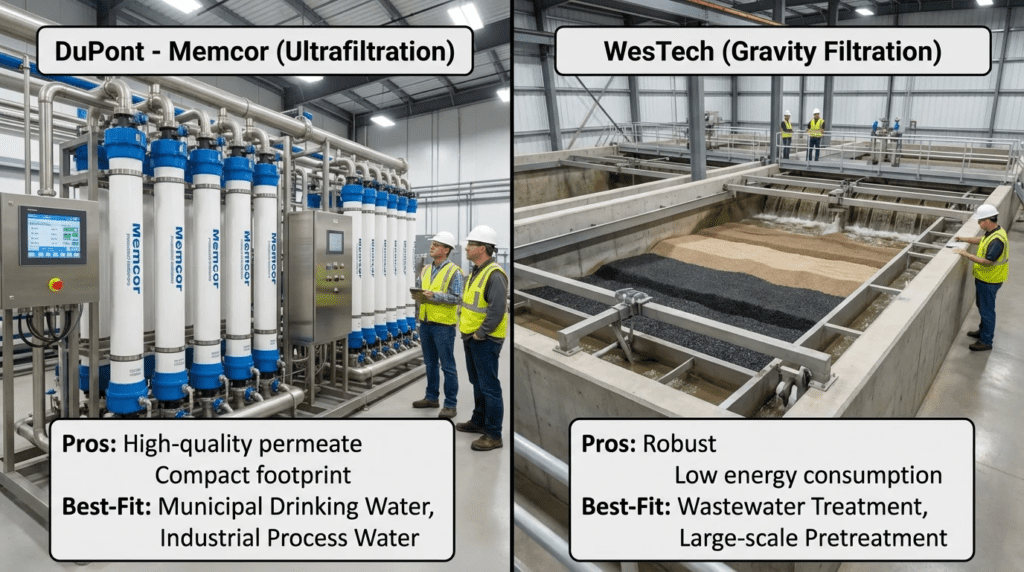
DuPont – Memcor vs WesTech for Filtration: Pros/Cons & Best-Fit Applications
INTRODUCTION
One of the most persistent debates in municipal water treatment and tertiary polishing centers on the choice between proprietary membrane technology and versatile packaged filtration systems. Engineers are caught between the absolute barrier protection of ultrafiltration and the robust, forgiving nature of clarification and conventional media filtration. The decision affects civil footprint, hydraulic profile, operator licensing requirements and twenty-year lifecycle cost.
Filtration retrofits frequently miss their projected operating cost targets, and the usual cause is a mismatch between source water variability and the selected technology’s tolerance. For engineers evaluating DuPont – Memcor vs WesTech for Filtration: Pros/Cons & Best-Fit Applications, the stakes include irreversible membrane fouling, excessive backwash waste volume, and inability to meet pathogen log removal requirements during storm events.
These are two heavyweights representing different philosophies. DuPont — through the Memcor line that passed from Siemens through Evoqua — champions PVDF hollow-fiber membrane systems. WesTech Engineering is a systems supplier across clarification, thickening and filtration, offering cloth media through the SuperDisc line, conventional granular media filtration, and open-platform membrane integration using modules from multiple suppliers.
Comparable evaluations appear in our analysis of Xylem and WesTech filtration equipment.
HOW TO SELECT / SPECIFY
Duty Conditions & Operating Envelope
The operating envelope is the first differentiator. Memcor systems operate on exclusion by pore size, providing a barrier largely independent of feed turbidity — up to a point. But membranes are flux-limited, and design flux must be set against the coldest water temperature the plant will see.
- Flow turndown: Membrane systems offer good turndown but lose efficiency at low flows because backwash and cleaning volumes are fixed.
- Turbidity spikes: Media-based systems generally handle high solids loading events more robustly than membranes, which may require aggressive backpulsing or temporary shutdown to avoid irreversible fouling.
- Variable organic loading: Clarification processes ahead of media filtration chemically condition solids before filtration, whereas membranes may need enhanced upstream coagulation to prevent pore blocking.
Materials & Compatibility
Memcor modules use PVDF, valued for oxidant tolerance that permits aggressive chlorine cleaning. Verify compatibility with upstream coagulants — certain cationic polymers irreversibly foul membrane surfaces, and that damage is not recoverable.
WesTech equipment, in steel-tank packaged plants or open-basin designs, relies on coated carbon steel or stainless internals.
- Corrosion: In high-chloride service such as desalination pre-treatment, internals must be upgraded to 316L or duplex stainless.
- Abrasion: For media filtration the media selection is standard, but the underdrain is the weak link. Specify underdrain systems able to withstand air scour forces over the asset life.
Hydraulics & Process Performance
Memcor pressurized systems require feed pumps overcoming transmembrane pressure that builds over the filtration cycle plus static head, typically necessitating variable-speed pumps to hold constant flux as permeability declines.
Gravity filtration systems operate on available static head.
- Head loss: A gravity filter operates on several feet of terminal head loss; a pressurized membrane system operates at substantially higher feed pressure.
- Recovery rate: Media filters typically achieve high recovery. Membrane systems recover well but pushing recovery higher requires backwash recovery systems that add complexity.
- Waste stream management: Membrane backwash is often chemically enhanced, creating a neutralized waste stream that may be difficult to return to the headworks without upsetting biological processes.
Installation Environment & Constructability
Memcor racks are vertical and modular. A membrane plant generally occupies significantly less footprint than comparable granular media filtration, making membranes the better fit for retrofits inside existing buildings.
- Height: Footprint is small but racks are tall. Verify overhead clearance for crane access to lift modules.
- Structural load: Packaged steel units are heavy point loads; foundation design must account for flooded weight plus media. Membrane racks impose lower distributed load but require extensive trenching for permeate and filtrate piping.
Reliability & Failure Modes
- Membrane failure: A fiber break compromises the absolute barrier, detected through automated integrity testing. A failed rack must be isolated. Redundancy is typically N+1 racks.
- Media failure: Usually breakthrough, where turbidity rises gradually. Rarely catastrophic but capable of producing a regulatory violation. Redundancy is N+1 filter cells.
- Critical spares: For membranes, spare modules and rack valves. For media systems, spare actuators, air scour blowers and chemical feed pumps.
Maintainability, Safety & Access
Operator perspective diverges sharply here. Media filters are viewed as passive and forgiving, and operators can visually inspect the bed. Membrane systems are closed — the filtration cannot be observed.
- Chemical handling: Membrane systems require bulk storage of acid, caustic and oxidant for cleaning, introducing safety hazards and containment requirements. Media filters generally need only backwash water and occasional chlorine.
- Ergonomics: Pinning a membrane module to repair a broken fiber is tedious manual work. Replacing filter media is a heavy construction event but happens once in many years.
Lifecycle Cost Drivers
- Capital: Membranes were historically more expensive, but the gap has narrowed. Civil work for gravity filters is substantial.
- Energy: Membranes consume more through higher feed pressures and air scour.
- Replacement: Membrane modules have a finite service life measured in years — a significant recurring capital cost. Media lasts far longer.
- Labor: Membrane plants require higher-skilled operators owing to automation complexity and chemical systems.
COMPARISON TABLES
| Feature | DuPont Memcor | WesTech (media and clarification) | WesTech (membrane integration) |
|---|---|---|---|
| Primary technology | PVDF hollow fiber membrane | Clarification with granular or cloth media filtration | Open platform integration using third-party modules |
| Pathogen barrier | Absolute, with log removal credit | Dependent on coagulation and filter ripening | Absolute, depending on selected module |
| Footprint | Very compact, vertical racks | Moderate to large | Compact |
| Chemical usage | High — maintenance cleans plus CIP | Low — coagulant and polymer | High, module dependent |
| Energy intensity | Moderate to high — pumping and air scour | Low, with gravity flow options | Moderate to high |
| Effluent quality | Consistently very low turbidity | Low turbidity with proper coagulation | Consistently very low turbidity |
| Media or module life | Measured in years, high replacement cost | Media lasts far longer with periodic top-off | Measured in years |
| Scenario | Memcor Best Fit? | WesTech Media Best Fit? | Engineering Rationale |
|---|---|---|---|
| Strict protozoan limits | Yes | No | Membranes provide direct physical removal credit without relying on chemical inactivation |
| High variable turbidity | No | Yes | Media filters with clarification handle solids loading without fouling; membranes would need extensive pre-treatment |
| Remote or unmanned facility | No | Yes | Membranes require complex automation and chemical handling unsuited to low-oversight sites |
| Footprint constrained | Yes | No | Vertical racking expands capacity within existing building footprints |
| Cold water applications | Conditional | Yes | Membrane flux drops significantly in cold water, requiring oversizing. Media filtration is less viscosity-sensitive |
| Wastewater reuse | Yes | Conditional | Membranes are the reference standard for high-quality reuse water |
ENGINEER & OPERATOR FIELD NOTES
Commissioning & Acceptance Testing
For Memcor systems the integrity test is the go/no-go metric. Witness the pressure decay test during commissioning. A common issue is failing the test not because of a broken fiber but because of leaking O-rings on module headers or incompletely vented air.
For gravity and packaged media filters, commissioning focuses on the backwash profile. Verify the media expands sufficiently to release trapped solids without washing media out of the trough. Performance testing usually involves spiking feed turbidity and verifying filter run time before breakthrough.
Common Specification Mistakes
A frequent error with media systems is under-specifying the air scour system. Effective cleaning requires vigorous air and water backwash. An undersized blower produces mudballs in the bed, creating channeling that ruins filtration performance within a few years.
For Memcor, the critical mistake is ignoring cold water derating. PVDF performance is governed by viscosity, and a system sized at summer temperature can fall well short of rated capacity in winter. Engineers who design to the average temperature discover the shortfall in January.
O&M Burden & Strategy
Memcor: The primary burden is chemical management. Operators function partly as chemical technicians, managing CIP schedules. Pinning a broken fiber — isolating a module, pressurizing it, locating bubbles and inserting a pin — takes time and dexterity.
WesTech: The burden is mechanical — pneumatic valves, actuators and blower motors. Media requires periodic core sampling to check effective size and uniformity coefficient. Where buoyant media is used in clarification, loss must be monitored.
Troubleshooting
- High transmembrane pressure: Organic fouling or pore plugging. Run an enhanced chemical clean and check upstream coagulation dose — polymer overdose is a membrane killer.
- Short filter runs on media: Surface blinding or mudball formation deep in the bed. Inspect backwash expansion; increase backwash rate or extend air scour duration.
DESIGN DETAILS / CALCULATIONS
Membrane Sizing
Required area equals design flow divided by the product of flux and the temperature correction factor.
- Flux rates: Design flux differs substantially between surface water and wastewater reuse duty. Consult vendor curves rather than assuming a single value.
- Temperature correction: Viscosity rises as temperature falls, and flux falls with it. Apply the correction at minimum site temperature.
Media Filter Sizing
Required area equals flow divided by loading rate. Loading rates differ considerably between rapid sand, high-rate multimedia, and clarification-plus-filtration packages. Confirm the rate proposed is supported by the regulatory authority for the application.
Specification Checklist
- Membrane specs: Define net production — feed flow minus backwash volume. Vendors often quote gross production. Specify a minimum required recovery rate.
- Media specs: Require AWWA B100 compliance for filtering material and specify the uniformity coefficient strictly to ensure proper stratification.
- Vessel construction: Specify the applicable pressure vessel or atmospheric tank standard, and require a multi-coat epoxy system for carbon steel.
- Warranty: For membranes, demand a prorated module warranty of meaningful duration. For media, warranty applies to mechanical equipment.
Standards
- AWWA B110: Membrane systems
- AWWA B100: Granular filter material
- NSF/ANSI 61: Drinking water system components, mandatory for both
- Ten States Standards: Redundancy and loading rates
FAQ SECTION
What is the fundamental difference between these approaches?
The separation mechanism. Memcor uses ultrafiltration or microfiltration membranes creating a physical barrier based on pore size. WesTech media systems use clarification followed by depth filtration, relying on chemical conditioning and physical capture within the bed. Membranes deliver better pathogen removal; media systems offer simpler operation and handle higher solids loading.
How do you select between membranes and gravity filtration for reuse?
For high-grade reuse water, membranes are generally preferred because they provide a verifiable pathogen barrier and consistently low turbidity regardless of feed quality. Gravity filtration can meet reuse standards with proper coagulation but requires more intensive monitoring and may struggle with the variability of secondary effluent.
What is the typical lifecycle cost difference?
Membrane systems typically have lower civil construction cost through smaller footprint and no deep basins, but higher long-term operating cost driven by module replacement, energy and chemicals. Media filters carry higher upfront civil cost with lower operating cost, since media lasts far longer and energy demand is lower.
Why does flux rate matter in specification?
Flux determines how hard the membranes work. Specifying too high a flux saves capital by requiring fewer modules but leads to rapid fouling, frequent cleaning and shorter module life. Conservative flux raises upfront cost while delivering reliability and longevity.
Can WesTech supply membrane systems?
Yes. As a systems integrator, WesTech offers open-platform membrane systems, designing racks and skids using modules from various manufacturers. This lets engineers obtain system engineering and support while selecting a particular membrane geometry, as an alternative to a single-supplier ecosystem.
How often is maintenance required?
Memcor systems require automated maintenance washes on a frequent cycle and clean-in-place at intervals driven by water quality. Media filters require backwashing on a regular cycle but generally no chemical cleaning. Mechanical maintenance on valves and pumps is broadly similar for both.
CONCLUSION
KEY TAKEAWAYS
- Pathogen barrier: Choose Memcor where absolute barrier protection and log removal credit are the primary drivers.
- Water quality: Choose media and clarification where source water carries high or highly variable solids that would rapidly foul membranes.
- Footprint: Membranes offer significant space savings for capacity expansion within existing buildings.
- Operations: Media filtration requires less specialized operator skill; membranes require understanding of chemical cleaning and integrity testing.
- Cost structure: Membranes mean lower civil cost and higher recurring cost. Media means the reverse.
The decision in DuPont – Memcor vs WesTech for Filtration: Pros/Cons & Best-Fit Applications is a choice between filtration philosophies. Memcor represents membrane precision — high effluent quality and pathogen safety at the cost of operational complexity and chemical dependence. WesTech represents systems integration, whether through media filtration or open-platform membrane design, prioritizing operational flexibility.
If the site is a remote municipality with limited operator presence and variable source water, a media solution is likely the safer engineering choice. For a reuse facility requiring strict compliance within a tight urban footprint, the membrane system provides the necessary performance density. Related evaluations appear in our comparisons of DuPont Memcor and Aqua-Aerobic and of Aqua-Aerobic and WesTech.