
Top OEMs for Emergency Bypass & Temporary Pumping Systems
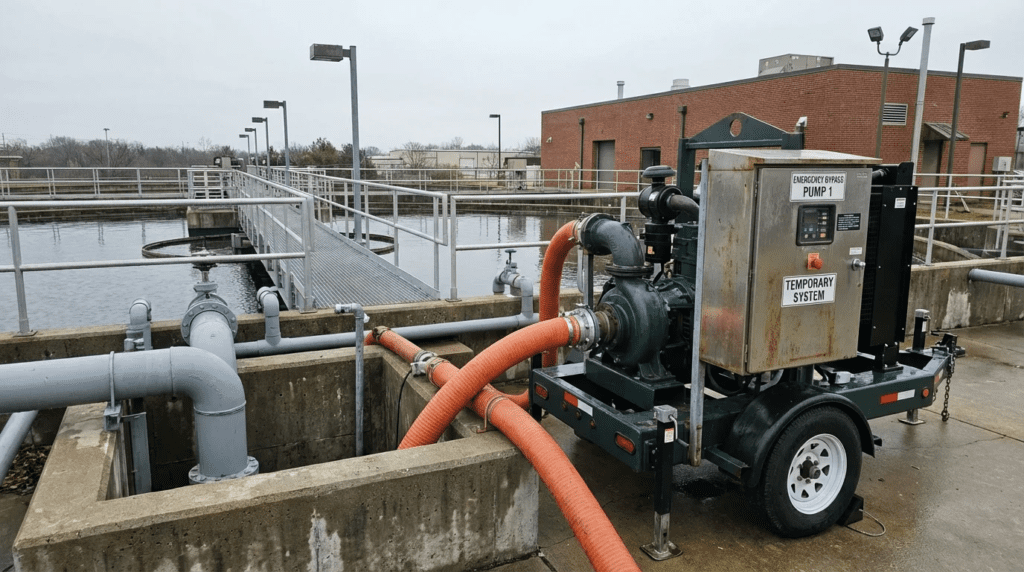
Top OEMs for Emergency Bypass & Temporary Pumping Systems
1. Introduction
In the hydraulic architecture of municipal and industrial wastewater systems, continuity of service is the paramount directive. Permanent infrastructure forms the backbone, but the ability to bypass it during failure, maintenance or rehabilitation is a critical engineering requirement. Emergency bypass and temporary pumping systems are the safety valve of the utility sector, conveying flow without environmental release, regulatory violation or public health compromise when primary systems go offline.
Selecting manufacturers for these systems differs fundamentally from selecting permanent process pumps. Permanent pumps are optimized for a narrow operating point on a system curve. Temporary and bypass pumps must be engineered for versatility — widely varying flow rates, fluctuating static head, erratic solids loading, and adverse suction conditions that would cavitate standard process equipment. The bypass pump is not a commodity rental item; it is a critical asset that must perform under the worst conditions, often unattended and near residential or sensitive environmental areas.
Regulatory context drives the engineering rigor. Sanitary sewer overflows carry strict penalties, and a bypass failure — failure to prime, clogging, or mechanical breakdown — results in immediate illicit discharge. Specifications therefore prioritize reliability, solids handling and autonomous operation over pure hydraulic efficiency.
Broader supplier positioning for permanently installed equipment is covered in our overview of the top OEMs for dry pit pumps.
2. How to Select This System or Equipment
Selecting a temporary pumping system requires a shift from efficiency at the design point to reliability across the envelope. Equipment must operate intermittently, handle significant air entrainment, and manage variable solids content.
Functional Role and Operating Conditions
- Suction lift versus positive suction head: Most surface-mounted bypass pumps operate in suction lift, often substantial. This requires robust priming capable of evacuating air from the suction line and holding prime during low-flow snore conditions.
- Variable flow rates: Unlike a station designed for peak flow, a bypass pump may see flows from near zero to peak wet weather. The pump and driver must turn down significantly without overheating or damaging seals.
- Solids handling: Raw sewage in bypass applications includes large solids, rags and fibrous material. Impeller geometry — open, enclosed, recessed or chopper — must be selected against the specific clogging risk.
Reliability and Redundancy
In bypass operations, redundancy is a statistical necessity rather than an option. The standard approach is N+1, where primary pumps handle peak design flow and a standby unit is fully piped and automated to take over on failure.
- Priming systems: Failure to prime is the leading cause of bypass failure. Evaluate whether the manufacturer uses a venturi-based system, a vacuum pump or a compressor. Vacuum and compressor-assisted systems generally prime faster with higher air handling capacity, at the cost of added mechanical complexity.
- Seal integrity: Bypass pumps frequently run dry or in snore mode. The mechanical seal — typically silicon or tungsten carbide faces with oil bath lubrication — must survive extended dry running without thermal cracking.
Materials and Construction
- Volute and impeller: Standard municipal sewage pumps use ductile or cast iron. For abrasive stormwater or industrial effluent, high-chrome iron or duplex stainless provides the necessary wear and corrosion resistance.
- Chassis and enclosure: For portable diesel units the skid or trailer is structural. Sound-attenuated enclosures are critical for urban deployment, and the enclosure must provide fluid containment to prevent fuel or oil reaching the site.
Common Failure Modes and Mitigation
- Air entrainment: An imperfectly sealed suction line, or vortexing as the water level drops, causes loss of prime. Manufacturers with superior air handling capacity are preferred where levels fluctuate.
- Ragging: Traditional non-clog impellers still foul with modern non-dispersible wipes. Chopper pumps or serrated wear plates with open impellers mitigate this at some cost to hydraulic efficiency.
- Fuel logistics: For diesel units, fuel is a major operational burden. Extended run tanks and telematics alerting operators to low fuel are standard specification requirements.
Lifecycle Cost and Maintenance
Tier 4 Final diesel engines require exhaust fluid and maintenance of particulate filters. Engine loading matters — running a Tier 4 engine at light load for extended periods causes wet stacking and filter clogging. Electric drive units eliminate this complexity but require reliable site power or a generator.
3. Comparison Table
The table contrasts key manufacturers in the emergency bypass and temporary pumping sector by technological approach, strengths and limitations. It assumes a municipal wastewater or stormwater context unless noted.
| OEM | Core Technology Focus | Typical Applications | Strengths | Limitations |
|---|---|---|---|---|
| Thompson Pump | Compressor-assisted priming and rotary wellpoint | Sewer bypass, wellpoint dewatering, construction drainage | High air-handling capacity through compressor priming; heavy-duty construction; strong dry-run capability | Large physical footprint on some high-head models; compressor systems require maintenance intervals separate from the pump end |
| Godwin (Xylem) | Automatic self-priming diesel pumps and submersible integration | Municipal bypass, flood control, industrial dewatering | Widely held in rental fleets; telemetry integration; self-cleaning impeller technology available for clog resistance | Priming approach requires supporting components; strong brand position often carries a premium price |
| Tsurumi | Electric submersible pumps | Deep wet wells, sump dewatering, sand and silt-laden water | No priming required; anti-wicking cable entry prevents water ingress; durable in abrasive service; compact | Requires electrical infrastructure or generator; not suitable for suction lift; fewer large diesel options |
| Gorman-Rupp | Self-priming centrifugal | Lift station backup, permanent bypass, sludge transfer | Serviceability through removable cover plate for unclogging; fewer moving parts than vacuum-assisted units; strong solids handling | Relies on fluid retention for priming, slower than vacuum assist on long suction lines; limited dry-run capability without external assist |
| BJM Pumps | Severe duty and shredder submersibles | Industrial wastewater, high-temperature effluent, abrasive slurries | Specialized metallurgy for corrosion and abrasion; integrated shredders for heavy solids; high-temperature options | Niche focus on submersibles; less emphasis on large diesel surface pumps for general municipal bypass |
4. Manufacturer Profiles
Thompson Pump
Thompson Pump is a cornerstone manufacturer in the North American dewatering and bypass market, with an engineering philosophy oriented toward heavy-duty construction for the rigors of construction and rental service.
Technical analysis: The differentiator is compressor-assisted priming designed to handle large volumes of air rapidly, which makes these units effective for wellpoint dewatering and long suction lines where air entrainment is constant. Their pumps use an air-water separation arrangement preventing pumped fluid from discharging onto the ground — a meaningful environmental compliance feature.
Engineering merit: Noted for high-head capability and heavy cast iron construction, with a range of solids-handling impellers. Sound-attenuated enclosures make them suitable for residential sewer bypass projects where noise complaints are a real project risk.
Godwin (Xylem)
Godwin, part of the Xylem portfolio, is among the most widely deployed names in temporary pumping. The Dri-Prime series effectively defined the automatic self-priming diesel pump category, and the brand benefits from access to Xylem impeller and motor technology.
Technical analysis: The priming system allows the pump to prime from dry at substantial static suction lift. A significant advantage is the availability of self-cleaning impeller technology, which uses a backswept leading edge and a relief groove in the volute to push solids away from the center, markedly reducing ragging in raw sewage.
Engineering merit: Godwin units are highly integrated with telemetry, allowing remote monitoring of speed, fuel level, engine temperature and pressures. For critical municipal bypasses, that transparency supports predictive fuel dispatch and maintenance, reducing unexpected downtime. Fleet depth means most flow and head combinations can be met.
Tsurumi
Tsurumi takes a fundamentally different approach. While engine-driven pumps exist in their range, their strength lies in electric submersibles — the primary specification where suction lift physics make surface pumps impractical.
Technical analysis: The defining feature is the anti-wicking cable entry. In submersible pumps, water can enter the motor housing through the power cable by capillary action if the jacket is damaged or the tip submerged. A sealed section at the cable entry prevents this intrusion and significantly extends stator life. Their pumps typically feature dual silicon carbide seals in an oil chamber rather than in the pumped medium, offering better thermal protection.
Engineering merit: Frequently specified for abrasion resistance, using high-chrome components suited to stormwater bypass with heavy sand and grit. Being submersible eliminates the priming variable entirely — if the pump is in water, it works — which simplifies control logic and removes a failure point, provided electrical power is reliable.
Gorman-Rupp
Gorman-Rupp is a leading American manufacturer of self-priming centrifugal pumps. Unlike vacuum-assisted units, their classic series rely on a large volute reservoir retaining fluid, allowing re-prime after initial fill. The technology is most often seen in permanent lift stations, though mobile units are widely used for bypass.
Technical analysis: The philosophy is maintainability. A removable cover plate lets an operator access the impeller and wear plate to clear a clog in minutes without disconnecting piping or using special tools. Without a vacuum pump there are fewer moving parts, but the physics of standard self-priming limits air handling capacity — they prime more slowly on long, empty lines.
Engineering merit: For bypass involving heavy sludge, or where simplicity outweighs priming speed, Gorman-Rupp is hard to beat. Their solids management systems create a self-cleaning function without sharp blades that dull over time. Engineers specify them when maintenance staff need equipment serviceable in the field with basic hand tools.
BJM Pumps
BJM Pumps, now part of Industrial Flow Solutions, occupies a specialized niche in severe duty and industrial submersibles. Not the first choice for clean water bypass, but the standard for industrial wastewater, chemical plant bypasses and municipal applications with extreme challenges.
Technical analysis: BJM specializes in metallurgy, with pumps available in 316 stainless, cast iron and hard-metal alloys, plus high-temperature series. Their shredder pumps use carbide cutting tips against a suction plate to macerate solids before they enter the volute — distinct from a grinder pump, designed for higher flows and tougher solids.
Engineering merit: Specified when fluid properties would destroy a standard iron pump — acidic wastewater bypasses, or digester cleanouts where temperature exceeds what standard submersible windings and seals tolerate. Oil-filled motors and high-temperature seal elastomers are engineered for those environments.
5. Application Fit Guidance
Municipal Sewer Bypass
Preferred: Godwin, Thompson Pump
Reasoning: These projects involve suction lift from manholes with variable flows. Vacuum and compressor-assisted priming handles snore conditions — a mix of air and water — without losing prime. Indefinite dry running is a key requirement.
Deep Lift Station Rehabilitation
Preferred: Tsurumi, submersible options from other suppliers
Reasoning: Beyond a certain lift, surface-mounted suction pumps are physically incapable of lifting fluid because of vapor pressure limits. Submersibles are the only viable option, and rugged designs tolerate sitting on grit at the bottom of a wet well.
Industrial and Chemical Wastewater
Preferred: BJM Pumps, stainless options from surface pump suppliers
Reasoning: Standard cast iron corrodes rapidly at low or high pH. Stainless construction is the standard specification for chemical resistance.
Sludge Transfer and Digester Cleaning
Preferred: Gorman-Rupp, Godwin
Reasoning: These fluids are viscous and solids-laden. Large volute designs with easy unclogging access suit sludge that would plug a standard pump.
Mission-Critical and Unmanned Sites
Preferred: Godwin, Thompson Pump
Reasoning: Without continuous operator presence, telemetry is non-negotiable. Remote visibility and alarming for low fuel, failure to start and high water are required to manage the risk.
6. Engineer & Operator Considerations
Installation Best Practices
Suction piping integrity: The single most common cause of bypass failure is a vacuum leak on the suction side. Even a pinhole prevents priming or significantly reduces capacity. Specify fused HDPE for suction lines where possible, or high-quality fittings with inspected seals.
Air release valves: In long discharge runs, air accumulates at high points, restricting flow and causing water hammer. Automatic air release valves must be installed at all high points.
Thrust restraint: Temporary piping, particularly lay-flat hose, moves dynamically under pressure surges. Proper thrust blocking or staking prevents the line from whipping and causing injury or property damage.
Commissioning Risks
NPSH calculations: A common error is failing to calculate available net positive suction head for the specific temporary setup. That a pump can lift a given height does not mean it delivers full flow at that lift. As lift increases, capacity falls and cavitation risk rises. Verify the pump curve against actual site elevation.
Transducer placement: For automated systems, the level transducer must sit in a stilling well or calm section. Turbulence from the influent line causes erratic readings and rapid pump cycling, which burns out starters and drains batteries.
Maintenance Access and Support
Spare parts: For long-term rentals or purchases, consumable availability is vital — fuel and oil filters, seal kits, vacuum pump vanes and oil. The major suppliers maintain distributor networks that typically stock these locally.
Fuel logistics: A diesel pump under full load consumes several gallons per hour, and a standard tank may last a day. Over a weekend this requires scheduled fuel drops. Plan for truck access — if the pump sits down a muddy easement, how does the fuel truck reach it?
7. Conclusion
Selecting emergency bypass and temporary pumping systems is an exercise in risk management. It demands equipment balancing hydraulic versatility with mechanical ruggedness. The market is defined by distinct engineering philosophies: the priming capability of Godwin and Thompson Pump for general municipal bypass; the electric submersible durability of Tsurumi for deep and abrasive applications; the service-friendly self-priming designs of Gorman-Rupp for accessible, sludge-heavy work; and the severe-duty metallurgy of BJM Pumps for industrial challenges.
Look beyond the rental rate or purchase price. The true cost of these systems is measured in reliability — a single sanitary sewer overflow caused by a pump failing to prime can cost more in fines and cleanup than the entire capital cost of the equipment. Specifications must detail priming capability, solids handling, material construction and automation requirements so that when permanent infrastructure goes offline, the temporary system performs.
Related equipment evaluations appear in our reviews of the top conventional dry pit manufacturers and the top impeller manufacturers.