
Emerson vs Badger Meter Horizontal End Suction Pumps Equipment
Introduction
In municipal and industrial fluid handling, the integrity of a pump station relies not just on the hydraulic mover, but on the monitoring and control loop that governs it. A surprising statistic in water utility management reveals that up to 30% of pump efficiency loss is masked by inaccurate discharge monitoring, leading to undetected wear and premature asset failure. Engineers often obsess over the pump curve but overlook the specification of the critical control and measurement equipment attached to the discharge. This oversight frequently leads to integration headaches, poor turndown ratios, and data blind spots in SCADA systems.
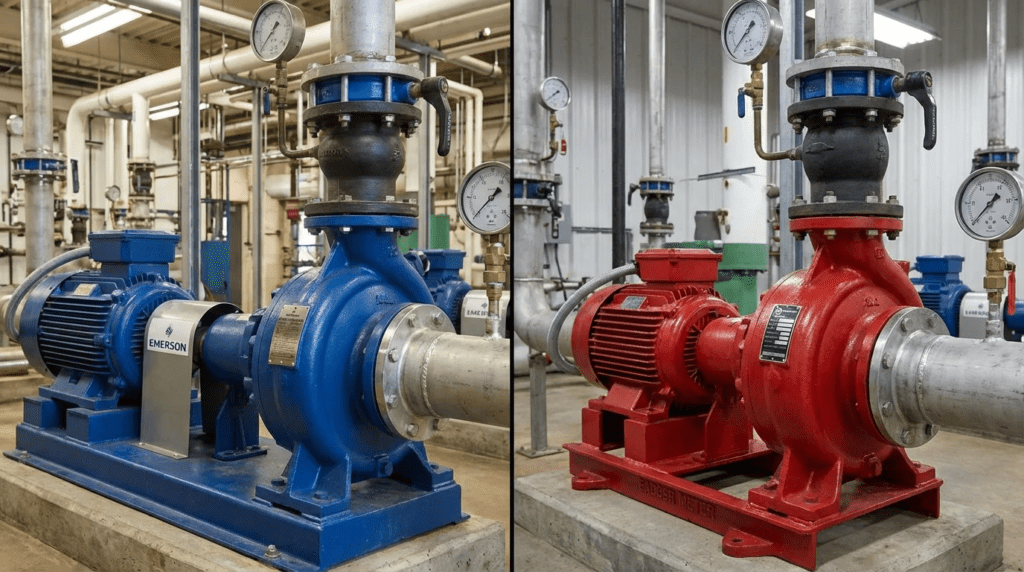
When specifying Emerson vs Badger Meter Horizontal End Suction Pumps Equipment, engineers are largely comparing two distinct philosophies of process control and flow measurement integration. Horizontal end suction pumps are the workhorses of the industry, used extensively in potable water distribution, HVAC cooling loops, and light-to-medium industrial wastewater applications. These pumps generally operate in tight mechanical rooms or packaged skids where straight-run piping is limited, and vibration can be a significant factor.
Proper selection of the equipment surrounding the pump—specifically the flow instrumentation (magnetic meters, Coriolis), control valves, and actuation—determines the operational visibility of the system. A poor choice here can result in signal noise caused by hydraulic turbulence, incompatibility with modern Ethernet-based control architectures, or material failure due to chemical attack. This article provides a comprehensive engineering analysis to help you navigate the nuances of equipping horizontal end suction pump systems with components from these two industry giants, focusing on performance, reliability, and lifecycle engineering.
How to Select and Specify Equipment
Selecting the correct ancillary equipment for horizontal end suction pumps requires a holistic view of the hydraulic system. The interaction between the pump’s discharge characteristics and the downstream instrumentation is critical. When evaluating Emerson vs Badger Meter Horizontal End Suction Pumps Equipment, the following criteria must drive the specification process.
Duty Conditions & Operating Envelope
The operating envelope of a horizontal end suction pump is defined by its Head-Capacity (H-Q) curve. The monitoring equipment must be capable of accurate performance across the entire range, including minimum flow conditions.
- Flow Velocities: Most magnetic flow meters (the standard for conductive fluids) require a minimum velocity (typically 1-2 fps) to maintain accuracy (±0.5% or better). However, end suction pumps often operate on VFDs (Variable Frequency Drives). You must verify that the meter maintains accuracy at the pump’s minimum speed (turndown). Emerson and Badger Meter offer different electrode designs that impact low-flow signal stability.
- Pressure Ratings: Horizontal end suction pumps can generate significant discharge pressures, particularly in staged configurations or high-speed applications. Ensure the equipment flanges (ANSI 150 vs. ANSI 300) match the pump discharge rating.
- Temperature Transients: In HVAC applications, the equipment must handle rapid temperature cycling. Differential thermal expansion between the pump casing, piping, and the flow meter liner (e.g., PTFE vs. Hard Rubber) can lead to sealing failures if not specified correctly.
Materials & Compatibility
Material compatibility is the first line of defense against premature failure. Both manufacturers offer a range of wetted materials, but their standard offerings differ.
- Liner Selection: For wastewater applications involving grit or sludge, abrasion resistance is paramount. Polyurethane or Neoprene liners are common. For potable water, NSF-61 certification is mandatory. Emerson’s Rosemount series often utilizes PFA/PTFE liners which offer broad chemical resistance but can be susceptible to vacuum collapse if the pump cavitates or experiences water hammer. Badger’s ModMAG series frequently utilizes hard rubber or PTFE, with specific options for abrasive slurries.
- Electrode Material: Standard 316L Stainless Steel is sufficient for water, but Hastelloy C or Platinum may be required for aggressive industrial wastewater. Engineers must review the chemical compatibility charts for the specific process fluid, especially if coagulants like Ferric Chloride are injected upstream of the pump.
Hydraulics & Process Performance
The introduction of any equipment into the pump discharge piping creates head loss. While full-bore magnetic meters generally have negligible pressure drop, control valves or reduced-bore meters can significantly impact the System Head Curve.
NPSH and Suction Side: While this article focuses on discharge equipment, be cautious if specifying monitoring equipment on the suction side. Any restriction here reduces Net Positive Suction Head Available (NPSHa). Generally, non-intrusive monitoring is preferred on the suction side of horizontal end suction pumps to prevent cavitation.
Installation Environment & Constructability
Horizontal end suction pumps are frequently installed in “packaged” systems where space is at a premium. This creates a conflict with standard hydraulic requirements.
- Straight Run Requirements: Traditional flow measurement requires 5 to 10 pipe diameters (5D-10D) of straight pipe upstream and 2D-5D downstream to ensure a laminar flow profile. Placing a meter directly after a pump discharge elbow or check valve causes swirl, leading to inaccurate readings.
- Emerson: Offers conditioning orifice plates or specific “high-noise” frequency drive options in their transmitters to compensate for hydraulic noise in short runs.
- Badger Meter: Often markets models with aggressive sampling rates or specific bore designs intended to mitigate short-run inaccuracies, though physical conditioning is always superior.
- Vibration: End suction pumps, due to their overhung impeller design, can generate vibration at the bearing frame which transmits to the piping. Equipment electronics (transmitters) should ideally be remote-mounted (wall or panel) rather than integral to the sensor tube to prevent vibration-induced PCB failure.
Reliability, Redundancy & Failure Modes
In critical municipal applications, data loss is as problematic as flow loss. The failure modes of the Emerson vs Badger Meter Horizontal End Suction Pumps Equipment packages differ based on their design philosophy.
- Coil Failure: In magnetic meters, moisture ingress is the primary killer. Look for potted terminal blocks and welded sensor housings.
- Electrode Coating: In wastewater, grease and non-conductive solids can coat electrodes, causing signal loss. Emerson offers advanced diagnostic suites (DA) that detect electrode coating and signal the SCADA system before measurement is lost. Badger Meter also provides electrode verification features in their higher-tier transmitters.
- MTBF: Mean Time Between Failures for the electronics is typically 10+ years, but the sensor lining life depends heavily on velocity and abrasion.
Controls & Automation Interfaces
The modern pump station is an intelligent node in a connected network. The interface between the equipment and the PLC is a key differentiator.
- Protocol Support: Both manufacturers support standard protocols (4-20mA HART, Modbus, EtherNet/IP). However, Emerson’s ecosystem is heavily integrated with DeltaV and AMS Device Manager, making it a strong candidate for plants using those DCS platforms. Badger Meter’s Beacon/AquaCUE systems are more cloud-focused, often appealing to distributed utility networks rather than complex plant automation.
- Smart Diagnostics: Advanced transmitters can report more than just flow; they can report conductivity changes, empty pipe detection, and internal temperature, acting as a secondary process health monitor.
Maintainability, Safety & Access
Operator safety and ease of access reduce long-term O&M costs. Horizontal end suction pumps are low to the ground; equipment should be oriented so displays are readable without ladders or crouching.
- Grounding: Proper grounding is non-negotiable for magnetic flow meters. If the pump piping is PVC or lined pipe, grounding rings or electrodes are required. Improper grounding leads to stray voltage affecting the reading and potentially accelerating electrolytic corrosion of the pump volute or flanges.
- Calibration Verification: Pulling a meter for calibration is costly. Look for “in-situ” verification tools—simulators that plug into the transmitter to verify the electronics are within spec without stopping the flow.
Lifecycle Cost Drivers
The initial purchase price (CAPEX) is often dwarfed by the lifecycle (OPEX) costs. A cheaper meter that requires 10 diameters of straight pipe may force a larger pump room footprint, increasing civil costs significantly. Conversely, a high-end meter with advanced diagnostics may prevent a catastrophic pump failure by detecting flow anomalies early, paying for itself instantly.
Comparison Tables: Emerson vs Badger Meter
The following tables provide a direct technical comparison of the equipment typically specified for horizontal end suction pump applications. Table 1 focuses on the flagship magnetic flow meter technologies often paired with these pumps, while Table 2 outlines the application fit based on facility constraints.
| Feature / Characteristic | Emerson (Rosemount 8700 Series) | Badger Meter (ModMAG M-Series) |
|---|---|---|
| Primary Technology Focus | High-spec process automation; heavy industrial integration. | Municipal water/wastewater utility metering; diverse industrial use. |
| Signal Stability | High: Advanced filtering options (High-Signal Mag) specifically designed for high-noise applications (slurries/pulp). | Standard/High: Excellent for conductive fluids; specialized noise reduction in newer M-Series transmitters. |
| Liner Options | Extensive: PTFE, ETFE, PFA, Polyurethane, Linatex, Adiprene. Optimized for chemical/temp extremes. | Standard: PTFE, Hard Rubber, Soft Rubber. Optimized for water, wastewater, and standard chemical duty. |
| Diagnostics capability | Smart Meter Verification: Continuous health checks of sensor coils, electrodes, and transmitter without process interruption. | Process/Device Health: Empty pipe detection, electrode status, and verification tools available on M2000/M5000. |
| Straight Run Sensitivity | Standard 5D/2D; Signal processing can compensate for some hydraulic noise, but proper piping is preferred. | Standard 5D/2D; aggressive sampling rates assist in turbulent flow profiles common in compact pump skids. |
| Control Integration | Native integration with DeltaV/AMS; HART 7, Foundation Fieldbus, Modbus. Strong for DCS environments. | Strong compatibility with SCADA; Modbus RTU, BACnet (HVAC), EtherNet/IP. Cloud connectivity via BEACON. |
| Typical Application | Critical process control, aggressive chemicals, high-vibration industrial pump skids. | Municipal distribution, lift stations, HVAC cooling loops, commercial water. |
| Application Scenario | Key Constraint | Emerson Fit | Badger Meter Fit | Selection Logic |
|---|---|---|---|---|
| Municipal Lift Station (Wastewater) | Clogging / Coating | High (8750W) | High (M2000) | Both perform well. Badger is often preferred for cost-effectiveness in standard municipal bids; Emerson for critical, large-diameter mains. |
| Industrial Chemical Dosing | Corrosion / Accuracy | Excellent | Good | Emerson’s wider range of exotic liners/electrodes makes it superior for aggressive chemical compatibility. |
| HVAC / Cooling Tower | Budget / BMS Integration | Moderate | Excellent | Badger Meter’s native support for BACnet and lower price point makes it the standard for HVAC end suction pump packages. |
| Remote Booster Station | Power / Connectivity | Good | Excellent | Badger offers battery-powered options (M5000) ideal for remote stations lacking reliable line power. |
| High-Solids Sludge Pumping | Signal Noise | Excellent | Moderate | Emerson’s “High Signal” options drive higher current to coils to overcome slurry noise, stabilizing the pump control loop. |
Engineer & Operator Field Notes
Real-world performance often deviates from the datasheet. The following insights are gathered from commissioning and operating Emerson vs Badger Meter Horizontal End Suction Pumps Equipment in municipal and industrial environments.
Commissioning & Acceptance Testing
During the Factory Acceptance Test (FAT) or Site Acceptance Test (SAT), specific verification steps must be taken:
- Zero Calibration: Never perform a zero adjustment while fluid is moving. The pump must be off, and the pipe must be full. Horizontal end suction pumps often drain if check valves fail, creating partially empty pipes which ruin calibration.
- Configuration Check: Verify the “Pulse Output” scaling matches the PLC input. A common mismatch (e.g., 1 pulse = 10 gallons vs 1 pulse = 100 gallons) creates massive totalization errors.
- Flange Torque: Over-torquing flange bolts on PTFE-lined meters causes “cold flow,” where the liner deforms into the flow path, creating turbulence and potential leakage. Use torque wrenches and follow the manufacturer’s star pattern strictly.
O&M Burden & Strategy
Operational maintenance for magnetic flow meters and control valves is relatively low, but not zero.
- Electrode Cleaning: In wastewater applications, grease buildup insulates electrodes. If the pump VFD starts hunting or the flow signal drops to zero intermittently, the electrodes likely need cleaning. Some transmitters offer high-frequency cleaning cycles, but manual cleaning ports (mechanical scrapers) or Bullet-nose electrodes are physical solutions for severe services.
- Desiccant Packs: For electronics mounted on the pump skid in humid wet wells, check the desiccant packs inside the transmitter housing annually. Moisture is the enemy of accurate electronics.
Troubleshooting Guide
Symptom: Flow Reading Fluctuates Wildly
- Potential Cause 1: Air in the line. Horizontal end suction pumps can cavitate or draw air if the suction submergence is low. Mag meters read air bubbles as noise.
- Potential Cause 2: Improper Grounding. Plastic piping requires grounding rings to reference the fluid potential to the meter. If these are loose or corroded, the signal floats.
- Potential Cause 3: Pump Vibration. If the meter is rigidly coupled to a vibrating pump discharge, the piezoelectric noise can interfere. Support the piping independently of the pump.
Design Details and Calculations
Correctly integrating this equipment requires verifying hydraulic constraints. Simply matching the pipe size is a recipe for poor performance.
Sizing Logic & Methodology
Do not automatically size the flow meter or control valve to match the pump discharge flange size.
- Determine Flow Velocity: Calculate fluid velocity at Min, Avg, and Max flow rates.
Velocity (ft/s) = (0.4085 × Q (gpm)) / (d (inches))² - Check Constraints:
- Minimum: Velocity should be > 2 ft/s for self-cleaning and stable accuracy.
- Maximum: Velocity should generally be < 20-30 ft/s to prevent liner abrasion and excessive head loss.
- Reducer Selection: It is common to reduce the line size immediately after the pump discharge expansion to accommodate a smaller meter (increasing velocity for accuracy), then expand back to the main header size.
Specification Checklist
When writing the spec for Emerson vs Badger Meter Horizontal End Suction Pumps Equipment, ensure these items are defined:
- Accuracy Requirement: Typically ±0.5% of rate (standard) or ±0.25% (high accuracy).
- Turndown Ratio: Ensure the meter meets accuracy specs at the lowest VFD speed (e.g., 30 Hz).
- Power Supply: 24VDC (common for PLC panels) or 120VAC (common for older plants).
- Certifications: NSF-61 (Potable), Class 1 Div 2 (Explosion Proof for hazardous locations), IP68 (Submersible for flooded pits).
Standards & Compliance
- AWWA M33: Manual of Water Supply Practices for Flowmeters.
- ANSI/ASME B16.5: Pipe Flanges and Flanged Fittings.
- NEC Article 250: Grounding and Bonding (critical for instrument signals).
Frequently Asked Questions
Do Emerson or Badger Meter manufacture the actual Horizontal End Suction Pump?
Generally, no. While both are massive industrial conglomerates that have owned various niche equipment lines over time, in the context of municipal and standard industrial water systems, they are the manufacturers of the instrumentation, control valves, and metering equipment. They are specified alongside pump brands like Goulds, Grundfos, or Flowserve to provide the “eyes and ears” of the pumping system.
Which brand is better for high-vibration pump skids?
Horizontal end suction pumps can generate significant vibration. Emerson’s Rosemount series generally offers more robust “Remote Mount” options with heavy-duty industrial interconnect cables, and their sensor construction is often rated for higher vibration tiers typical of oil & gas standards. However, properly installed Badger Meter units with remote transmitters and independent pipe supports perform reliably in standard water applications.
How does straight pipe run affect Emerson vs Badger Meter selection?
Both technologies (electromagnetic) follow the physics of flow profiles. Both typically request 5 diameters upstream and 2 downstream. However, if space is extremely tight (e.g., < 3 diameters), Emerson offers conditioning orifice plates and specialized signal processing in their high-tier transmitters that can mathematically compensate for some profile distortion, albeit at a higher cost.
What is the cost difference between these equipment packages?
Typically, Badger Meter solutions (e.g., M2000) are positioned as cost-effective, utility-grade solutions, often 20-40% lower in CAPEX than high-spec Emerson Rosemount industrial packages. For a simple water booster station, Badger is often the value choice. For a critical chemical injection or sludge return pump where failure means environmental fines, the premium for Emerson’s advanced diagnostics is justifiable.
Can I use these meters on the suction side of the pump?
It is generally not recommended to place flow restriction devices (like meters or control valves) on the suction side of a horizontal end suction pump. Doing so increases friction loss, reduces NPSHa, and dramatically increases the risk of cavitation. Always install this equipment on the discharge side.
How often does this equipment require calibration?
Modern magnetic flow meters do not drift mechanically like old turbine meters. “Calibration” is usually an electronic verification. Both Emerson and Badger offer verification tools that simulate flow signals to check the transmitter. Actual wet-calibration (removing the meter) is typically done every 5-10 years depending on regulatory requirements, or if the electronic verification fails.
Conclusion
Key Takeaways for Engineers
- Define the Scope: When discussing “Emerson vs Badger Meter Horizontal End Suction Pumps Equipment,” you are specifying the critical control loop assets (meters, valves), not the pump iron itself.
- Velocity is King: Size the meter based on velocity (2-20 ft/s), not line size. Pump discharge piping is often oversized for friction reduction, which is bad for meter accuracy.
- Match the Application: Use Badger Meter (ModMAG) for standard municipal water/wastewater and HVAC applications where value and BACnet/Modbus integration are key.
- Criticality Justifies Cost: Use Emerson (Rosemount) for harsh chemical, high-slurry, or critical process applications where advanced diagnostics (coating detection, noise reduction) prevent unplanned downtime.
- Watch the Grounding: 80% of “bad meter” issues are actually grounding issues, especially on plastic-piped skid packages.
The successful deployment of horizontal end suction pumps depends heavily on the fidelity of the data they generate. Whether you select Emerson for its heavy-industrial pedigree and deep diagnostic capabilities, or Badger Meter for its utility-focused design and ease of integration, the decision should be driven by the specific constraints of the fluid, the physical installation environment, and the required data integration.
Engineers should approach this specification not merely as buying a sensor, but as designing the pump’s nervous system. By carefully calculating flow velocities, respecting straight-run requirements, and selecting materials compatible with the process fluid, you ensure that the equipment provides reliable, actionable data for the life of the pump station.