
Franklin Miller vs Hydro International Grit Equipment: Comparison & Best Fit
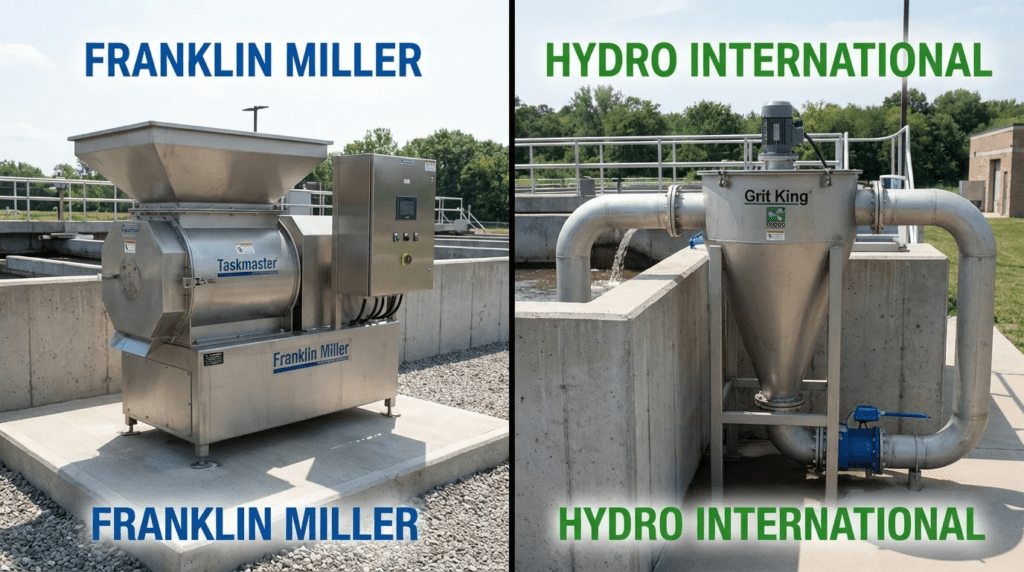
Franklin Miller vs Hydro International Grit Equipment: Comparison & Best Fit
Introduction
Inorganic solids accumulating in downstream processes is among the most persistent operating burdens in wastewater treatment. Grit settles in aeration basins, consumes digester volume, and abrades pumps and dewatering equipment. Headworks design is the first line of defense, and two names that frequently appear together in specifications are Franklin Miller and Hydro International.
A product-line distinction is worth establishing at the outset, because it shapes the entire comparison. Hydro International is a grit removal specialist — their HeadCell, Grit King and TeaCup systems are advanced hydraulic separation devices built specifically to capture and wash grit. Franklin Miller builds solids reduction and screening equipment — TASKMASTER grinders, SCREENMASTER bar and drum screens, and the SPIRALIFT series of screw screens that screen, wash, convey and dewater screenings. Grit removal is not in their published product range.
That does not make the comparison pointless. These two manufacturers’ equipment routinely occupies the same headworks, in sequence, and specifying one without understanding the other produces predictable failures. Understanding Franklin Miller vs Hydro International Grit Equipment: Comparison & Best Fit means understanding where screening ends and grit separation begins.
Broader supplier positioning is covered in our overview of the top OEMs for grit removal systems.
How to Select and Specify Headworks Equipment
Duty Conditions & Operating Envelope
Grit removal efficiency is inextricably linked to hydraulic loading. Unlike screening, where a physical barrier defines capture, grit removal relies on differential settling velocity and specific gravity.
- Flow turndown: Grit chambers are sized for peak wet weather flow, but at average dry weather flow velocities drop and organics settle with the grit. Advanced vortex systems generally hold removal efficiency across a wider hydraulic range than conventional aerated or detritus tank designs.
- Particle characterization: Specifications must define the target particle — a common requirement is 95 percent removal of 106-micron particles at specific gravity 2.65. Note that native grit often has a lower effective specific gravity because of grease coating, which is why real-world capture frequently falls short of specified performance.
- Headloss: Hydraulically driven separation requires available head to generate vortex action. On a flat hydraulic profile this may force intermediate pumping, which changes the economics considerably.
Materials & Compatibility
- Abrasion resistance: For vortex internals and grit pump volutes, specify Ni-Hard or high-chrome iron. For screw conveyors and screw screens, abrasion-resistant steel or stainless with replaceable wear shoes is appropriate.
- Corrosion: Headworks are high hydrogen sulfide environments. 304L or 316L stainless is the baseline for structural components. Carbon steel should be avoided unless galvanized or coated with high-performance epoxy, and those coatings eventually fail under abrasion.
- Liner replacement: Review how wear liners are accessed. Systems requiring complete disassembly to reach wear plates carry significantly higher lifecycle cost.
Hydraulics & Process Performance
- Surface overflow rate: The critical design parameter for gravity separation. Stacked tray vortex designs achieve far higher effective loading per square foot of footprint than conventional settling arrangements.
- Short-circuiting: Baffles and flow straighteners matter. Poor inlet hydraulics reduce effective detention time. Computational modeling of inlet channels is worthwhile on larger installations.
- Organics capture: The goal is clean grit. A system capturing grit along with a large organic fraction produces odor complaints and high disposal costs. Washing capability should be specified explicitly, not assumed.
Installation Environment & Constructability
- Footprint: Stacked tray vortex designs are engineered for small footprints and fit into spaces a fraction of the size an aerated grit chamber would require. Screw screens are linear — they need length rather than depth.
- Retrofit: For existing concrete channels, channel-mounted screens and mechanical traps install more easily than casting new vortex chambers, though self-contained pad-mounted vortex units are available.
Reliability & Failure Modes
- Hydraulic separation: Vortex systems have no moving parts in the submerged separation zone, eliminating underwater failure points. The vulnerability shifts to ancillary equipment — grit pumps, underflow lines, and the concentrator.
- Mechanical screening: Screw screens rely on brushes, augers and drives. These have finite service lives, and jams from rocks or lumber still occur. Reversing capability on screw drives is a critical specification feature.
Lifecycle Cost Drivers
- Energy: Hydraulic separation uses gravity for the separation step but may require higher-horsepower pumps for slurry transport. Mechanical screens draw continuous motor power.
- Disposal: The hidden cost. Wet, organic-laden material costs considerably more to haul than dry, washed material. The difference between a system producing high dry solids and one producing wet cake accumulates into real annual money.
Comparison Matrices
The tables below distinguish the two manufacturers by their actual technological roles in the headworks.
| Manufacturer | Primary Technology Focus | Key Strengths | Typical Limitations | Maintenance Profile |
|---|---|---|---|---|
| Hydro International HeadCell, Grit King, TeaCup |
Advanced hydraulic and vortex grit separation |
|
|
Low mechanical maintenance; wear concentrates on pump liners and grit piping. Intervals are long but parts can be proprietary. |
| Franklin Miller TASKMASTER grinders, SCREENMASTER screens, SPIRALIFT screw screens |
Solids reduction, screening, washing and conveyance |
|
|
Moderate mechanical maintenance. Routine greasing, brush and wear shoe replacement, flight inspection. |
| Application | Requirement | Appropriate Equipment | Engineer’s Note |
|---|---|---|---|
| Fine grit capture, large plant | High efficiency on fine particles | Hydro International vortex separation | Prioritize capture efficiency to protect downstream membranes and digesters |
| Rag and debris removal | Capture and remove screenings | Franklin Miller screens or screw screens | Grit systems do not remove rags; screening is a separate duty |
| Pump station protection | Condition solids to prevent clogging | Franklin Miller grinders | Grinding conditions solids; it does not remove them from the stream |
| Combined sewer headworks | High variability, large debris, heavy grit | Both, in sequence | Screening and grinding upstream protect vortex ports from clogging |
| Screenings volume reduction | Wash and compact captured material | Franklin Miller washer compactor | Washing organics back into the flow reduces disposal weight substantially |
Engineer & Operator Field Notes
Commissioning & Acceptance Testing
Verifying grit removal performance is notoriously difficult, because grit is not evenly distributed in the flow.
- Cross-channel sampling: Do not accept single-point grab samples for performance verification. Use a cross-channel sampling grid or a recognized grit profiling method.
- Seeding: Introducing a known quantity of graded sand upstream is far more reliable than depending on native grit, which varies hour to hour.
- Documentation: Ensure the O&M manual identifies zero points for classifier weirs and vortex paddle heights. These settings drive process performance.
Common Specification Mistakes
- Ambiguous grit definition: “95 percent removal of grit” is unenforceable. Define grit by particle size and specific gravity, or a manufacturer can claim success while light organics pass through.
- Ignoring organics: Specifying capture without specifying washed volatile solids content produces odorous dumpsters. Evaluate washing capability on the ability to produce clean grit, not merely captured grit.
- Confusing screening with grit removal: A screw screen captures rags and debris; it does not remove settled sand. Specifying one where the other is required leaves a genuine gap in the treatment train.
- Material mismatch: Carbon steel troughs in grit service perforate within a few years. Specify stainless or hardened alloy liners.
O&M Burden & Strategy
- Vortex grit systems: Maintenance concentrates on grit pumps and the concentrator underflow. Monitor for clogging in underflow lines, particularly where upstream screening is coarse. There are few greasing points on the main vessel.
- Screw screens and grinders: Traditional mechanical schedule — weekly gearbox oil checks, monthly greasing where accessible, annual inspection of brush and flight wear.
Troubleshooting
- High water content in the dumpster: Classifier speed too high, or underflow pumping rate too high. Slow the screw drive or adjust pump cycles to allow concentration.
- Excessive odor: High organic capture. Increase wash water flow or agitation; on vortex systems adjust the fluidized bed water setting to liberate lighter organics.
Design Details and Sizing Logic
Sizing Methodology
- Determine peak hydraulic loading. The system must pass peak wet weather flow without backing up the headworks channel.
- Determine surface overflow rate. Conventional gravity systems operate in a modest range; advanced stacked tray vortex systems achieve substantially higher effective rates through tray surface area. Validate manufacturer claims against independent data where available.
- Check detention time. Ensure adequate detention at peak flow to prevent washout, recognizing that vortex systems rely more on induced rotational force than on pure detention.
Specification Checklist
- Motors: TEFC, premium efficiency, 1.15 service factor. Specify inverter duty for grit applications regardless of current VFD intent.
- Bearings: Defined minimum B-10 life
- Anchor bolts: 316 stainless, never galvanized
- Controls: NEMA 4X stainless enclosures with SCADA integration for torque and run status monitoring
Frequently Asked Questions
Does Franklin Miller make grit removal equipment?
Franklin Miller’s published product range covers grinders, crushers, shredders, screens, mills and septage receiving systems. The SPIRALIFT series is a screw screen that screens, washes, conveys and dewaters screenings — it is not a grit separation device. Hydro International is the grit removal specialist in this pairing. Engineers comparing the two are generally comparing equipment that performs different, complementary functions in the same headworks.
What is the main difference in what these companies do?
Hydro International separates and washes grit using hydraulic and vortex forces. Franklin Miller reduces and removes rags, plastics and debris using grinders and screens. A complete headworks typically needs both: screening to remove trash, and grit separation to remove abrasive inorganics.
How do you select grit equipment for a small plant?
Simplicity matters most. A complex vortex system with multiple pumps and automated valves may be excessive. A simple channel trap or compact packaged vortex unit often offers a better balance of capital and operating cost. Where space is extremely limited, a small-footprint vortex unit is a strong contender.
Why is specific gravity important in grit specifications?
Specific gravity determines settling rate. Silica sand sits at 2.65, but wastewater grit coated in grease has a materially lower effective value. Equipment specified only against clean sand will underperform on the lighter, grease-coated grit actually present. Specify performance across a realistic range.
How does headloss affect the comparison?
Vortex separation requires a hydraulic grade line drop to drive the process without added energy. On a hydraulically limited site this may require intermediate pumping. Screening equipment introduces its own headloss but a different profile, and consumes electrical energy for the drives instead.
What is the typical service life of this equipment?
Well-maintained headworks equipment lasts on the order of two decades, but wetted wear parts are far shorter. Grit pump volutes and impellers are sacrificial items. Screw and brush components wear according to load and abrasiveness. Stainless structures generally last the life of the plant.
Conclusion
KEY TAKEAWAYS
- Different roles, not competing products: Hydro International separates grit; Franklin Miller reduces and screens solids. A complete headworks uses both.
- Define grit precisely: Never specify removal without particle size and specific gravity.
- Grit removal is two stages: separation and classification. Ensure both are addressed.
- Hydraulics matter: Verify available head early. Vortex separation needs hydraulic potential; mechanical equipment needs electrical power.
- Organics drive disposal cost: High capture efficiency is worth little if the captured material is half organics.
The Franklin Miller vs Hydro International Grit Equipment: Comparison & Best Fit question resolves into a sequencing decision rather than a head-to-head selection. Hydro International’s hydraulic separation delivers fine particle capture and clean grit in a compact footprint, making it the standard where downstream processes are sensitive to carryover. Franklin Miller’s grinders and screens handle the rags, plastics and debris that would otherwise clog a vortex chamber’s ports and foul its pumps.
Engineers should conduct a lifecycle analysis weighing capital cost against grit disposal and downstream equipment wear. Related evaluations appear in our comparisons of Hydro International and Egger Turbo, Franklin Miller and Smith & Loveless, and JWC Environmental and HUBER.