
JWC Environmental vs HUBER Grit Equipment: Comparison & Best Fit
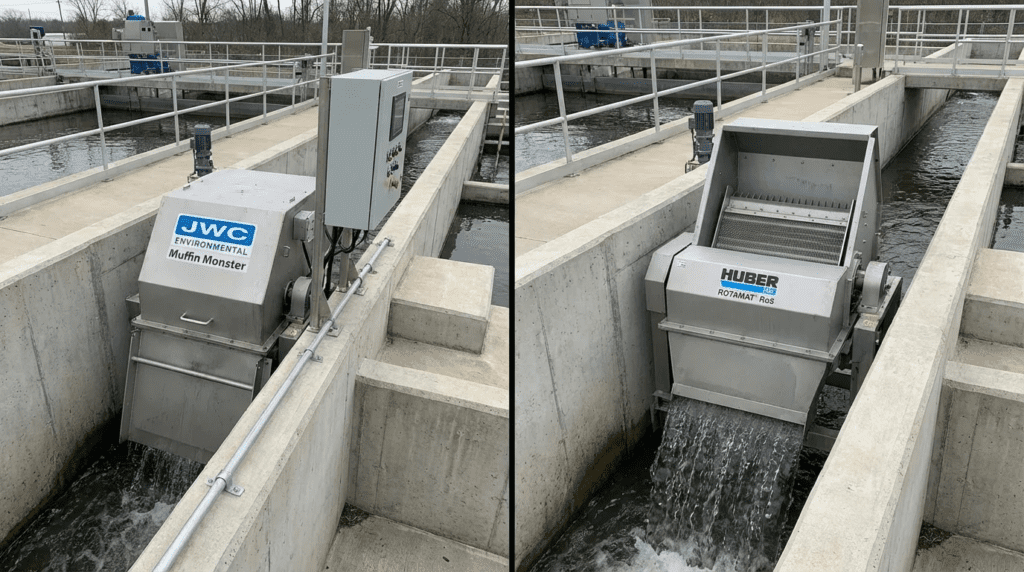
JWC Environmental vs HUBER Grit Equipment: Comparison & Best Fit
INTRODUCTION
Grit accumulation remains one of the most pervasive silent failures in municipal wastewater treatment. Headworks screens provide visible capture, but grit often bypasses preliminary treatment, settling in aeration basins, consuming digester capacity and causing premature abrasion failure in downstream pumps. Selecting grit removal technology is a calculation of lifecycle protection for the entire plant, and a frequent evaluation point in modern headworks design involves analyzing JWC Environmental vs HUBER Grit Equipment: Comparison & Best Fit.
The two manufacturers approach the headworks from different starting points, which is worth stating plainly. HUBER Technology is a grit removal specialist with a dedicated portfolio of grit traps, washers and classifiers alongside their screening range. JWC Environmental, now part of Sulzer, built its reputation on solids reduction and screening — Muffin Monster and Channel Monster grinders, Monster screening systems, Auger Monster and washer presses — and offers grit removal principally as a component of its combined Monster Separation System, which can incorporate vortex grit removal alongside screening.
This shapes the comparison: HUBER is generally evaluated as a grit technology choice, JWC as an integrated headworks package where grit handling is one function among several. Broader supplier positioning is covered in our overview of the top OEMs for grit removal systems.
HOW TO SELECT / SPECIFY
Duty Conditions & Operating Envelope
The primary driver is the definition of grit. Standard design targets sand at specific gravity 2.65, but real influent contains eggshells, coffee grounds, seeds and road material with markedly different settling behavior. Specify target removal efficiency against a defined particle size, or the specification is unenforceable.
Flow variability matters equally. Vortex systems and aerated chambers rely on hydraulic retention time. Where turndown is high, channel velocity may drop below critical settling velocity, depositing grit before it reaches the removal equipment. Conversely, peak wet weather events can wash out captured grit when surface overflow rate exceeds design.
Materials & Compatibility
Material selection often reflects manufacturer philosophy. HUBER is known for extensive use of stainless steel — typically 304L or 316L, acid pickled and passivated — which delivers corrosion resistance in the aggressive hydrogen sulfide environment of a headworks without coating maintenance.
JWC equipment is available in stainless configurations, with material selection varying across product lines. Specify passivation requirements for all stainless to prevent rouging and pitting. For components in direct grit contact — screw flights, pump volutes — abrasion resistance governs. Specify abrasion-resistant liners or hardened wear elements in high-velocity zones.
Hydraulics & Process Performance
Process performance turns on separating organics from mineral grit. High organic content in the grit dumpster means higher disposal fees and significant odor problems. Advanced grit washing systems use fluidizing water and updraft action to wash organics back into the flow stream — HUBER’s washers are built around this principle, and JWC’s separation systems incorporate washing within the packaged unit.
Hydraulic grade line must be calculated so the headworks does not back up the influent sewer. Vortex chambers induce headloss to generate separation force. Evaluate manufacturer headloss curves against upstream hydraulics before committing.
Installation Environment & Constructability
Space constraints often dictate technology choice. HUBER equipment is frequently characterized by a compact enclosed machine footprint, and their complete plant configurations combine screening and grit removal in a single unit — advantageous for retrofits in tight buildings.
JWC’s separation systems follow a similar integrated logic, combining screening with grit removal in a packaged arrangement, with footprint geometry varying by configuration. Headworks are typically classified electrical environments because of methane and hydrogen sulfide, so motors and instrumentation must carry appropriate approvals.
Reliability, Redundancy & Failure Modes
Grit service is abrasive by definition. Common failure modes include wear on screw auger flights, failure of submerged bottom bearings, and clogging of airlift pumps. Prioritize shaftless screw designs for grit transport — eliminating the bottom bearing removes a notorious failure point in submerged service.
Redundancy is critical. A single grit train failure during a storm can deliver tons of sand into the plant. Specify N+1 redundancy for pumps and consider parallel grit channels. Request mean time between failure data for drive assemblies and wear liners.
Controls & Automation
Continuous operation is rarely efficient; intermittent operation on timers or flow pacing is standard. Integration with plant SCADA is mandatory, with torque monitoring to detect jamming, run status and fault alarms as key data points. Some advanced washing units use torque feedback to adjust washing cycle intensity.
Maintainability, Safety & Access
Enclosed systems reduce aerosol exposure but need accessible hatches for inspection. Consider the weight of replacement parts — lifting davits or crane rails should appear in the design where components are heavy. Lockout points must be within line of sight. Systems requiring daily manual washdown because of poor self-cleaning will be neglected, and neglect leads to failure.
Lifecycle Cost Drivers
Capital is the initial hurdle, but operating cost drives the twenty-year picture. Energy consumption for grit motors is modest; disposal cost is not. A system producing clean grit at low volatile solids versus one producing dirty grit at high volatile solids saves substantial money annually in tipping fees and hauling. The total cost analysis must account for disposal volume reduction.
COMPARISON TABLES
| Feature | JWC Environmental | HUBER Technology | Engineering Considerations |
|---|---|---|---|
| Core focus | Solids reduction and screening, with grit removal offered within integrated separation systems | Dedicated grit removal, washing and classification alongside screening | JWC is generally evaluated as a packaged headworks solution; HUBER as a grit technology selection |
| Signature technologies | Muffin Monster and Channel Monster grinders; Monster screening and separation systems; washer presses | Grit traps, grit washers and classifiers; ROTAMAT screening range; complete plant units | Match the product to the actual duty rather than the brand |
| Primary materials | Stainless steel configurations available; verify by product line | Extensive stainless steel construction, pickled and passivated | Stainless offers lower lifecycle maintenance at higher initial material cost |
| Grit washing | Washing integrated within separation and wash press systems | Dedicated washing and classification technologies | Washing technology determines organic content of the final output |
| Combination units | Monster Separation System combining screening with grit removal | Complete plant units combining screening, grit and grease removal | Combination units save footprint but couple the failure modes of screening and grit systems |
| Wear mitigation | Heavy-duty construction with replaceable elements | Shaftless spirals and wear bars in stainless troughs | Check liner thickness and material hardness specifications |
| Typical fit | Retrofits, pump station protection, headworks with heavy ragging | New builds, plants with strict odor and disposal limits, membrane protection | Depends on whether clean grit or solids protection is the priority |
| Scenario | Best Fit Characteristics | Key Decision Factor | Relative Complexity |
|---|---|---|---|
| Small plant | Packaged headworks combination unit | Footprint and single-source responsibility | Low |
| High organic loading | Advanced grit washing with fluidized bed | Reducing volatile solids to lower disposal cost | High |
| Combined sewer | Robust removal sized for hydraulic swings | Handling large fluctuations in flow and solids loading | Medium to high |
| Aggressive corrosive environment | Full stainless steel construction | Eliminating coating failures and rust | Low |
| Heavy ragging | Grinding and screening upstream of grit separation | Protecting grit equipment from fibrous material | Medium |
| Limited operator staffing | Automated washing and dewatering | Self-cleaning cycles with minimal manual intervention | Medium |
ENGINEER & OPERATOR FIELD NOTES
Commissioning & Acceptance Testing
Commissioning grit equipment is difficult because clean water testing does not replicate grit settling behavior. During factory testing, verify screw run-out and clearance. For shaftless spirals, the spiral should sit flat on the wear liner.
Site acceptance requires attention to seeding. Contractors often hesitate to introduce sand into a new basin, but verifying torque response under load is essential before handover. Confirm motor current draw aligns with the manufacturer’s curve when processing solids, not merely spinning in water.
Operators commonly bump motors to check rotation. On grit screws, confirm the unit is not packed with settled grit first. Starting a buried screw against a compacted load is a leading cause of shaft shearing and gearbox failure during startup. Perform a manual torque check after long shutdowns.
Common Specification Mistakes
The most frequent error is undefined grit. “95 percent removal of grit” is legally insufficient. Define particle size and specific gravity, or a manufacturer can claim compliance by removing large stones while passing the fine sand that destroys pumps.
Another is neglecting wash water requirements. Grit washers need non-potable water at specific pressure and flow to fluidize the bed. An undersized plant water system leaves the washer unable to separate organics, producing a soupy, odorous discharge regardless of the equipment’s capability.
A third is assuming a grinder or screen removes grit. Grinders condition solids and screens capture screenings; neither removes settled sand. Where the specification needs grit separation, it must say so.
O&M Burden & Strategy
Classifiers separate by gravity and generally require less operator attention while producing dirtier grit. Washers separate hydrodynamically and require tuning of wash water and organic return valves.
- Weekly: Inspect discharge chutes for bridging; check gearbox oil levels
- Monthly: Check drive belt and chain tension; grease bearings where not sealed
- Annually: Measure wear liner thickness; on shaftless screws, measure spiral diameter for outer edge wear
Troubleshooting
Wet, sloppy output: Usually high organic content holding water, or worn screw flights allowing water to slip back. Check wash water settings first, then screw clearance.
Excessive odor: Putrescible material settling with the grit. Increase aeration in the chamber to float organics, or increase fluidization rate in the classifier.
DESIGN DETAILS / CALCULATIONS
Sizing Logic
The fundamental parameter for any gravity settling device is surface overflow rate, representing upward water velocity against particle settling velocity.
SOR = Q / A, where Q is flow rate and A is surface area.
Manufacturers use proprietary enhancements — lamella plates, stacked trays, shaped chambers — to increase effective surface area and allow higher hydraulic loading in a smaller footprint. Validate those claims against test data rather than accepting catalog figures.
Specification Checklist
- Design peak flow: the absolute hydraulic maximum
- Grit loading rate: expected volume per unit flow. Older specifications routinely underestimate this, particularly for combined systems during flush events.
- Capture efficiency: tied explicitly to particle size and specific gravity
- Organic content limit: state a maximum volatile solids percentage for discharged grit
- Material: specify stainless grade and require full passivation
Standards
Equipment should follow Ten States Standards for redundancy and channel velocity control. Electrical components must meet NFPA 820 for fire protection in wastewater facilities. For stainless fabrication, reference the applicable structural welding code.
FREQUENTLY ASKED QUESTIONS
Does JWC Environmental make grit removal equipment?
JWC’s core products are grinders and screening systems. Grit removal is offered principally as a function within their integrated Monster Separation System, which can incorporate vortex grit removal alongside screening. HUBER has a broader dedicated grit portfolio. Engineers should confirm which specific configuration is being quoted rather than assuming equivalence between a dedicated grit system and an integrated headworks package.
What is the difference between a grit classifier and a grit washer?
A classifier separates solids from water using gravity and a slow-moving screw, producing grit with substantial organic content. A washer adds fluidization and agitation to separate light organics from heavy mineral grit before dewatering, producing much cleaner grit and reducing odor and disposal cost.
Why is specific gravity important?
Specific gravity defines particle density relative to water. Sand settles predictably. But grit also includes shells, coffee grounds and seeds at much lower density. A system designed only for 2.65 will wash out lighter particles, which then settle in the digester. Specifying removal at lower specific gravity requires larger basins or more advanced separation.
Can these systems retrofit into existing concrete channels?
Yes. Both manufacturers offer channel-mounted and packaged configurations. The usual challenge in retrofits is hydraulic profile matching — ensuring new equipment does not create headloss that floods upstream sewers.
What is the typical lifespan of grit equipment?
Structural components in stainless systems last a couple of decades or more with proper maintenance. Wetted moving parts — screws, liners, pumps — typically require major refurbishment considerably sooner. Carbon steel components in corrosive headworks may need recoating every few years to maintain integrity.
Does 95 percent removal mean all grit is captured?
No. It refers to a specific particle size. A system can meet that specification and still pass essentially all particles below the stated size. Because fine grit is highly abrasive to membranes and high-speed pump seals, decide deliberately whether a finer cut point is needed — which requires larger or more specialized equipment.
CONCLUSION
KEY TAKEAWAYS
- Define grit precisely: particle size and specific gravity. “95 percent removal” alone means nothing.
- Know what you are buying: HUBER offers dedicated grit technology; JWC offers grit within integrated separation systems.
- Organics drive disposal cost: where tipping fees are high, prioritize washing over simple classification.
- Hydraulics are critical: confirm system headloss fits the plant’s hydraulic profile.
- Maintenance access: ensure liners, screws and bearings are reachable without confined space entry where possible.
The decision in JWC Environmental vs HUBER Grit Equipment: Comparison & Best Fit is less about which manufacturer is better than about which engineering approach matches the facility’s constraints. HUBER represents a dedicated, high-efficiency, stainless-steel approach well suited to new plants with strict disposal requirements. JWC offers robust integrated headworks systems that are highly adaptable for retrofits and for facilities where grinding and screening are equally pressing needs.
Define the problem grit — size and composition — and the disposal constraint before evaluating equipment. Related comparisons appear in our analyses of JWC Environmental and Franklin Miller, Franklin Miller and Hydro International, and Smith & Loveless and Egger Turbo.