
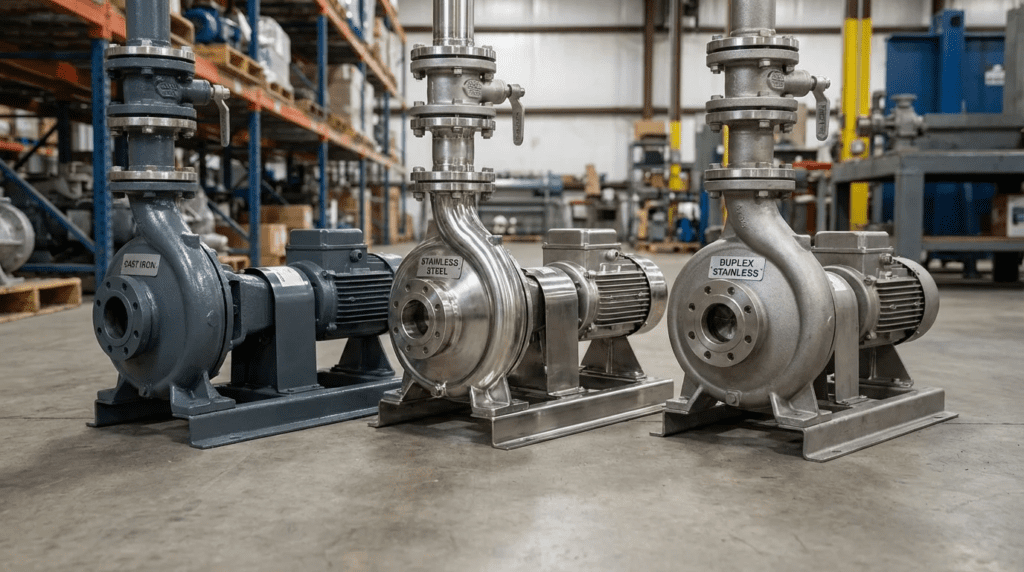
Horizontal End Suction Pumps: Cast Iron vs Stainless vs Duplex
Introduction
One of the most persistent failure modes in municipal and industrial fluid handling isn’t mechanical overload—it is the mismatch between pump metallurgy and fluid chemistry. Engineers often rely on legacy specifications, copying and pasting “Cast Iron Construction” for applications that have evolved in acidity or abrasiveness, or conversely, over-specifying exotic alloys for benign services, bloating capital budgets unnecessarily. The decision matrix for Horizontal End Suction Pumps: Cast Iron vs Stainless vs Duplex is often reduced to initial purchase price, ignoring the catastrophic impact of corrosion-erosion cycles on pump hydraulic efficiency and seal life.
According to hydraulic institute data and field reliability studies, material-related failures account for approximately 30% of premature pump retirements in wastewater treatment plants (WWTPs). This is particularly acute in horizontal end suction pumps, which are the workhorses for everything from potable water booster systems to abrasive sludge recirculation and aggressive chemical dosing. When the wrong material is selected, the pump doesn’t just fail; it loses efficiency rapidly as volute clearances open up due to corrosion, increasing energy consumption long before the casing actually breaches.
This article provides a rigorous technical comparison for consulting engineers and plant directors. We will dissect the metallurgical properties, hydraulic implications, and total lifecycle costs of the three primary material contenders: Grey/Ductile Iron, Austenitic Stainless Steel (316/CF8M), and Duplex Stainless Steel (CD4MCu/2205). The goal is to move beyond generic selection guides and provide actionable data for specifying Horizontal End Suction Pumps: Cast Iron vs Stainless vs Duplex in critical water and wastewater infrastructure.
How to Select and Specify Pump Materials
Selecting the correct metallurgy for horizontal end suction pumps requires a multi-dimensional analysis that goes beyond simple chemical compatibility charts. Engineers must evaluate the interplay between chemical attack, mechanical stress, and hydraulic erosion.
Duty Conditions & Operating Envelope
The operating envelope defines the baseline stress the pump material must endure. While cast iron is exceptionally rigid and handles vibration well, it lacks the tensile strength required for high-pressure applications compared to steel alloys.
- Pressure Considerations: Standard Class 30 Grey Iron has a tensile strength of approximately 30,000 psi. In contrast, CD4MCu (Duplex) typically exceeds 100,000 psi. For high-head applications or systems subject to water hammer, the ductility of stainless and duplex steels provides a critical safety factor against catastrophic casing rupture.
- Temperature Constraints: Cast iron loses significant strength at elevated temperatures, but typical water/wastewater applications (0°C to 40°C) rarely challenge thermal limits. However, thermal shock can crack cast iron, whereas stainless steel and duplex grades are more resilient to rapid temperature changes often found in industrial clean-in-place (CIP) cycles.
- Fluid Velocity: High internal fluid velocities accelerate erosion. If the pump is operating far to the right of the Best Efficiency Point (BEP), internal turbulence increases. In these scenarios, the hardness of Duplex stainless steel (approx. 260+ Brinell) significantly outperforms Cast Iron (approx. 180-200 Brinell) and 316 Stainless (approx. 160-190 Brinell) in resisting erosion-corrosion.
Materials & Compatibility
This section is the core of the decision-making process for Horizontal End Suction Pumps: Cast Iron vs Stainless vs Duplex.
Cast Iron (ASTM A48 Class 30 / Ductile Iron A536):
Cast iron relies on material thickness for longevity. In aerated water or wastewater, it forms an oxide layer (rust). If the fluid is neutral (pH 6-9) and non-abrasive, this oxidation is slow and manageable. However, cast iron has poor resistance to cavitation damage. When cavitation bubbles collapse, they blast away the oxide layer, exposing fresh metal to corrosion, creating a rapid failure cycle.
Stainless Steel (316/CF8M):
The industry standard upgrade. The chromium oxide passive layer provides excellent resistance to general corrosion. However, 316SS is susceptible to pitting and crevice corrosion in high-chloride environments (e.g., brackish water or certain industrial effluents) and creates galling issues if wear rings are made of the same material with the same hardness.
Duplex Stainless Steel (CD4MCu / 2205):
Duplex microstructure combines austenite and ferrite. This results in yield strengths roughly double that of 316SS and superior resistance to chloride stress corrosion cracking. For wastewater applications containing grit, sand, or sludge, Duplex is the superior choice due to its hardness, which resists the scouring action that removes protective oxide layers on softer 316SS.
Hydraulics & Process Performance
Material selection impacts hydraulic efficiency. Cast iron volutes are typically sand-cast with relatively rough internal surfaces (Roughness Average Ra ~12.5-25 µm). Investment cast stainless steel components can achieve much smoother finishes (Ra ~3.2-6.3 µm).
Efficiency Implications:
A smoother volute and impeller surface reduces friction losses. Consequently, an investment cast stainless steel pump may demonstrate 1-3% higher efficiency than an equivalent cast iron model purely due to surface finish. Over a 20-year lifecycle, this energy saving can offset the material premium.
NPSH and Cavitation Resistance:
While material choice does not change the Net Positive Suction Head Required (NPSHr) significantly, it drastically changes the pump’s tolerance to temporary cavitation. Duplex stainless steel is far more resistant to the pitting damage caused by cavitation than both cast iron and 316SS.
Installation Environment & Constructability
The physical environment often dictates material choice regarding external corrosion.
- Damp/Flooded Vaults: Cast iron pumps in damp dry-wells require robust external epoxy coating systems to prevent exterior degradation. Stainless steel pumps require no painting and maintain legibility of casting data and tags indefinitely.
- Baseplates: A common specification error is pairing a high-grade Duplex pump with a standard painted carbon steel baseplate. In corrosive environments, the baseplate fails before the pump. Engineers should specify 304/316SS baseplates or polymer concrete bases when upgrading the pump metallurgy.
- Piping Loads: Cast iron flanges are brittle. Excessive nozzle loading from misaligned piping can crack a cast iron casing flange. Ductile iron, Stainless, and Duplex offer higher elongation, allowing for slight deformation without immediate fracture, though nozzle loads should always be minimized.
Reliability, Redundancy & Failure Modes
Understanding failure modes helps in calculating Mean Time Between Failures (MTBF).
- Cast Iron Failure: Typically gradual wall thinning or catastrophic cracking due to impact/freeze. “Graphitization” can occur in certain waters where iron leaches out, leaving a brittle graphite matrix that looks intact but fails under pressure.
- Stainless Steel (316) Failure: Often related to chloride pitting or “galling” at tight-clearance areas like wear rings. If the pump runs dry, 316SS wear rings can seize almost instantly.
- Duplex Failure: Extremely rare in municipal water applications unless chemical limits (pH < 1 or > 13) are exceeded. The primary failure mode is typically seal or bearing failure, not the pump wet end itself.
Lifecycle Cost Drivers
The initial purchase price (CAPEX) hierarchy is generally: Cast Iron (1x) < 316 SS (1.5x - 2.0x) < Duplex (2.0x - 2.5x). However, OPEX tells a different story.
In abrasive grit applications, a cast iron impeller may require replacement every 2 years. A Duplex impeller might last 8-10 years. Including the labor cost of teardowns, crane mobilization, and downtime, Duplex often achieves ROI within the first 4 years. Furthermore, because Duplex maintains its hydraulic profile (wear ring clearances) longer, the pump operates near its design efficiency for a longer duration, saving energy.
Material Comparison Tables
The following tables provide a direct technical comparison to assist regarding Horizontal End Suction Pumps: Cast Iron vs Stainless vs Duplex selection. Table 1 focuses on material properties and chemical suitability, while Table 2 outlines the application fit based on typical plant scenarios.
| Attribute | Cast Iron / Ductile Iron (ASTM A48 / A536) | Stainless Steel 316 (ASTM A743 CF8M) | Duplex Stainless (ASTM A890 CD4MCu) |
|---|---|---|---|
| Corrosion Resistance | Low. Requires coating/lining. Susceptible to graphitization and general oxidation. | High. Excellent for general chemicals. Susceptible to pitting in high chlorides (>1000 ppm). | Superior. Excellent resistance to pitting, crevice corrosion, and stress corrosion cracking. |
| Abrasion Resistance (Hardness) | Moderate (180-220 Brinell). Good for clean water, poor for grit/sand. | Low/Moderate (160-190 Brinell). Soft; erodes quickly in slurry applications. | High (240-280+ Brinell). Excellent resistance to grit, sand, and abrasive slurries. |
| Mechanical Strength (Yield) | 30-45 ksi. Rigid but brittle (Grey Iron) or moderately ductile (Ductile Iron). | 30-40 ksi. Ductile, tough, handles thermal shock well. | 60-70 ksi. High strength permits higher pressure ratings and resists fatigue. |
| Typical pH Range | 6.0 – 9.0 | 2.0 – 12.0 | 1.0 – 13.0 |
| Chloride Tolerance | Low | Moderate (Up to ~1,000 ppm) | High (Up to ~15,000+ ppm) |
| Repairability | Difficult to weld. Generally considered throw-away components. | Ideally weldable. Easy to build up worn areas and machine. | Weldable with specific procedures (heat input control). |
| Application | Primary Constraint | Best Fit Material | Engineering Rationale |
|---|---|---|---|
| Potable Water Booster | NSF-61 Compliance, Efficiency | 316 Stainless or Ductile Iron | Clean water causes minimal wear. SS prevents “red water” issues; coated Ductile Iron is cost-effective if coating integrity is monitored. |
| Raw Sewage (Grit heavy) | Abrasion & Corrosion | Duplex (CD4MCu) | The combination of H2S (corrosion) and grit (abrasion) destroys Cast Iron and 316SS rapidly. Duplex offers the lowest 10-year ownership cost. |
| Activated Sludge (RAS/WAS) | Continuous Duty, Efficiency | Duplex or Hardened Iron | RAS is less abrasive than raw sewage but operates 24/7. Duplex maintains wear ring clearances longer, preserving hydraulic efficiency. |
| Digester Circulation | High Temp, Solids | Hardened Iron or Duplex | Often high temperature. High chrome iron (hard) is good, but Duplex offers better chemical resistance to varying sludge chemistry. |
| Ferric Chloride / Alum Dosing | Extreme Corrosion | Non-Metallic or High-Alloy | Even Duplex may struggle with concentrated Ferric. Often lined pumps or specialty non-metallics are preferred, but if metal is required, Super Duplex or Hastelloy is needed. |
Engineer & Operator Field Notes
Real-world experience often diverges from catalog curves. The following notes are derived from commissioning and maintaining horizontal end suction pumps in varied municipal environments.
Commissioning & Acceptance Testing
During the Factory Acceptance Test (FAT) or Site Acceptance Test (SAT), the material choice impacts the vibration baseline. Cast iron is a dense material with excellent damping characteristics. When switching to fabricated stainless steel (lighter weight) or even cast stainless, the natural frequency of the pump changes.
Vibration Signatures: Do not be alarmed if a stainless steel pump exhibits slightly different vibration spectral characteristics than a cast iron predecessor, provided the overall amplitude is within Hydraulic Institute (HI) 9.6.4 limits. However, because stainless and duplex are tougher, they often mask bearing issues that would cause a cast iron housing to ring loudly.
Common Specification Mistakes
One of the most frequent errors in bid documents is the ambiguous term “Stainless Steel Construction.” This allows vendors to supply lower-grade 304SS or stamped/fabricated casings instead of cast 316SS or Duplex.
- Ambiguity: Always specify the ASTM grade (e.g., “ASTM A743 Grade CF8M” for 316SS or “ASTM A890 Grade 1B” for CD4MCu).
- Wear Ring Compatibility: Specifying a 316SS impeller with a 316SS case wear ring is a recipe for galling (seizing). A hardness differential of at least 50 Brinell is recommended. Typically, engineers should specify a Nitronic 60 or Duplex stationary ring against a 316SS impeller to prevent seizure during startup or transient conditions.
O&M Burden & Strategy
Maintenance strategies differ by material:
- Cast Iron: Requires vigilant monitoring of coating integrity. Once the epoxy paint is breached, external corrosion accelerates. Internal wear rings usually require replacement every 3-5 years in grit service.
- Stainless/Duplex: These are “install and forget” regarding external corrosion. However, because they are electrically conductive and often connected to dissimilar metals (piping), isolation kits are critical to prevent galvanic corrosion where the pump flanges meet carbon steel piping.
- Impeller Trimming: If operations require trimming an impeller in the field, note that Duplex stainless steel work-hardens rapidly. It is extremely difficult to machine without specialized tooling and cooling. It is usually more cost-effective to order a new, properly sized impeller from the factory than to attempt a local machine shop trim on CD4MCu.
Design Details and Specification Logic
Sizing Logic & Methodology
When selecting Horizontal End Suction Pumps: Cast Iron vs Stainless vs Duplex, the sizing logic must account for the specific gravity (SG) and viscosity, which usually remain constant for water/wastewater, but the corrosion allowance changes.
For Cast Iron pumps, engineers often apply a “corrosion allowance” to wall thickness, accepting that the material will degrade. With Duplex stainless, the corrosion rate in typical wastewater is negligible (< 0.001 mm/year). This allows for thinner wall sections (if casting molds allow) or, more importantly, ensures that the pressure rating remains constant throughout the pump's 20-year life. In Cast Iron, the Maximum Allowable Working Pressure (MAWP) effectively decreases as the walls thin over time.
Specification Checklist
To ensure you receive the specific metallurgy intended, include these requirements in Section 11300/43200 of the specification:
- Casing Material: ASTM A890 Grade 1B (CD4MCu) or ASTM A743 Grade CF8M (316SS).
- Impeller Material: Shall match casing or be of superior grade (e.g., CD4MCu impeller in a CF8M casing).
- Shaft Material: Shall be 316SS or 17-4PH Stainless Steel. Carbon steel shafts with sleeves are acceptable but less reliable in corrosive atmospheres.
- Surface Finish: Specify “Investment Cast” for stainless components to ensure hydraulic efficiency benefits are realized.
- Passivation: All stainless steel components must be passivated (acid cleaned) after machining to remove free iron and restore the oxide layer.
Standards & Compliance
Adherence to standards ensures interchangeability and safety:
- ANSI / ASME B73.1: Defines dimensions for chemical process pumps. If you specify a B73.1 pump in Duplex, it will be dimensionally interchangeable with a Cast Iron B73.1 pump, allowing for easy upgrades without repiping.
- NSF/ANSI 61: Mandatory for all pumps in potable water contact. While Cast Iron can be NSF 61 certified with proper coatings, Stainless and Duplex are inherently compliant materials (though they still require certification to ensure no lead contamination in the alloy).
Frequently Asked Questions
Is Duplex Stainless Steel (CD4MCu) always better than 316 Stainless Steel?
For abrasion and stress corrosion, yes. Duplex is harder and twice as strong as 316SS. However, for general clean water applications or simple chemical transfer where chlorides are low, 316SS is perfectly adequate and less expensive. Duplex is the specific solution for abrasive slurries, high chlorides, or high-pressure applications.
Can I replace a Cast Iron pump with a Stainless Steel pump on the same baseplate?
Generally, yes, if both are built to ANSI B73.1 or ISO 2858 dimensional standards. However, verify the weight difference and ensuring the motor coupling alignment is re-checked. Also, ensure the piping flanges (often flat face for cast iron, raised face for stainless) are compatible, using proper gaskets.
Why do Cast Iron pumps in wastewater lose efficiency faster than Stainless ones?
Cast iron corrodes and creates “tuberculation” (rough rust nodules) on the interior volute surface. This increases friction losses significantly. Additionally, erosion at the cut-water and wear rings opens internal clearances, allowing high-pressure fluid to recirculate back to suction. Stainless/Duplex resists this surface degradation, maintaining the “as-new” efficiency curve for years.
What is the typical cost premium for Duplex over Cast Iron?
Expect a Duplex CD4MCu pump to cost approximately 2.0 to 2.5 times the price of a standard Cast Iron/Bronze fitted pump. While this CAPEX is higher, the elimination of one impeller replacement and the energy savings from sustained efficiency often result in a lower 5-year Total Cost of Ownership.
Do Stainless Steel pumps require painting?
No. Stainless steel and Duplex pumps are typically left unpainted. This is a maintenance advantage, as there is no coating to chip, peel, or require touch-up. It allows operators to easily inspect the casing for any signs of leakage or stress cracks without paint masking the metal.
Conclusion
Key Takeaways
- Cast Iron: Best for budget-constrained, clean water, or non-critical intermittent applications. Requires monitoring for corrosion and cavitation damage.
- 316 Stainless Steel: The standard for chemical resistance and potable water. Vulnerable to abrasive wear and high-chloride pitting.
- Duplex (CD4MCu): The premier choice for wastewater, grit, and sludge. High hardness resists erosion; high strength resists fatigue. Lowest lifecycle cost for difficult services.
- Efficiency: Investment cast stainless/duplex pumps offer 1-3% better hydraulic efficiency due to smoother internal surfaces and maintain that efficiency longer than iron.
- Wear Rings: Never match 316SS static and rotating wear rings of the same hardness; galling will occur. Use differential hardness materials.
The selection of Horizontal End Suction Pumps: Cast Iron vs Stainless vs Duplex is a strategic engineering decision that impacts plant reliability for decades. While Cast Iron remains the baseline for benign, low-budget applications, the industry is shifting toward Duplex Stainless Steel for wastewater and industrial services.
The resilience of Duplex against the dual threats of chemical attack (H2S, chlorides) and physical erosion (grit, sand) creates a compelling Return on Investment case despite the higher initial capital expenditure. For municipal engineers, the recommendation is clear: stick to Ductile/Cast Iron for clean water distribution where costs must be minimized, but specify CD4MCu/Duplex for any raw sewage, sludge, or chemically aggressive application to safeguard operational continuity and minimize maintenance labor.