
Los Angeles County Sanitation Districts Whittier Narrows Water Reclamation Plant
The authoritative technical resource for the historic 15-MGD tertiary treatment facility serving the San Gabriel Valley.
1. INTRODUCTION
The Whittier Narrows Water Reclamation Plant (WNWRP) holds a distinct position in the history of wastewater engineering as the first water reclamation plant constructed by the Los Angeles County Sanitation Districts (LACSD). Commissioned in 1962, this facility was designed specifically to demonstrate the viability of large-scale water reuse for groundwater replenishment. Located within the Whittier Narrows Recreation Area, the plant operates as a “skimming” facility, treating approximately 15 million gallons per day (MGD) of wastewater diverted from a major trunk sewer to tertiary standards.

Unlike conventional wastewater treatment plants that must process all incoming flow, WNWRP extracts a consistent flow rate to maximize hydraulic efficiency and produce high-quality recycled water (Title 22 compliant). The treated effluent is discharged into the San Gabriel River and Rio Hondo channels, where it percolates into the Montebello Forebay, replenishing the Central Basin Aquifer—a primary drinking water source for Los Angeles County. Following a significant transition from chlorination to UV disinfection, WNWRP continues to serve as a model for decentralized, sustainable water resource management.
2. FACILITY OVERVIEW
A. Service Area & Configuration
The WNWRP is situated in the San Gabriel Valley, serving communities including South El Monte and surrounding unincorporated areas. As a hydraulic “scalping” or “skimming” plant, it does not have a traditional fixed service area in terms of collection system isolation. Instead, it draws flow from the Joint Outfall “B” Trunk Sewer. This configuration allows operators to maintain steady-state flow conditions regardless of diurnal variations in the collection system, optimizing biological treatment stability.
B. Operational Capacity
The facility has a design capacity of 15.0 MGD. Historically, the plant has operated near this capacity; however, recent regional water conservation efforts have reduced available flows in the trunk sewer, resulting in current average daily flows ranging between 7 and 9 MGD. The plant is designed for continuous baseload operation rather than managing wet-weather peak flows; excess flow remains in the trunk sewer and bypasses the plant, traveling to the Joint Water Pollution Control Plant (JWPCP) in Carson.
C. Discharge & Reuse
WNWRP is a zero-discharge facility in terms of waste to the ocean. 100% of the treated effluent is beneficially reused. The primary discharge points are the Rio Hondo and San Gabriel River spreading grounds. The facility operates under strict requirements set by the Los Angeles Regional Water Quality Control Board, ensuring that the effluent meets California Title 22 standards for unrestricted recreational impoundment and groundwater recharge.
3. TREATMENT PROCESS
The Whittier Narrows WRP utilizes a three-stage treatment train designed to produce high-quality recycled water. A unique operational characteristic of this facility is its solids handling strategy: all primary sludge and waste activated sludge (WAS) are returned to the trunk sewer for downstream processing, eliminating the need for on-site digesters or dewatering equipment.
A. Preliminary Treatment
Raw sewage is diverted from the Joint Outfall “B” Trunk Sewer via a gate structure. The influent passes through mechanically cleaned bar screens to remove large debris, rags, and plastics. Unlike terminal treatment plants, aggressive grit removal is less critical at the headworks due to the skimming nature of the intake, though protection of downstream pumps remains a priority. Odor control at the headworks is achieved using chemical scrubbers to minimize impact on the surrounding recreational area.
B. Primary Treatment
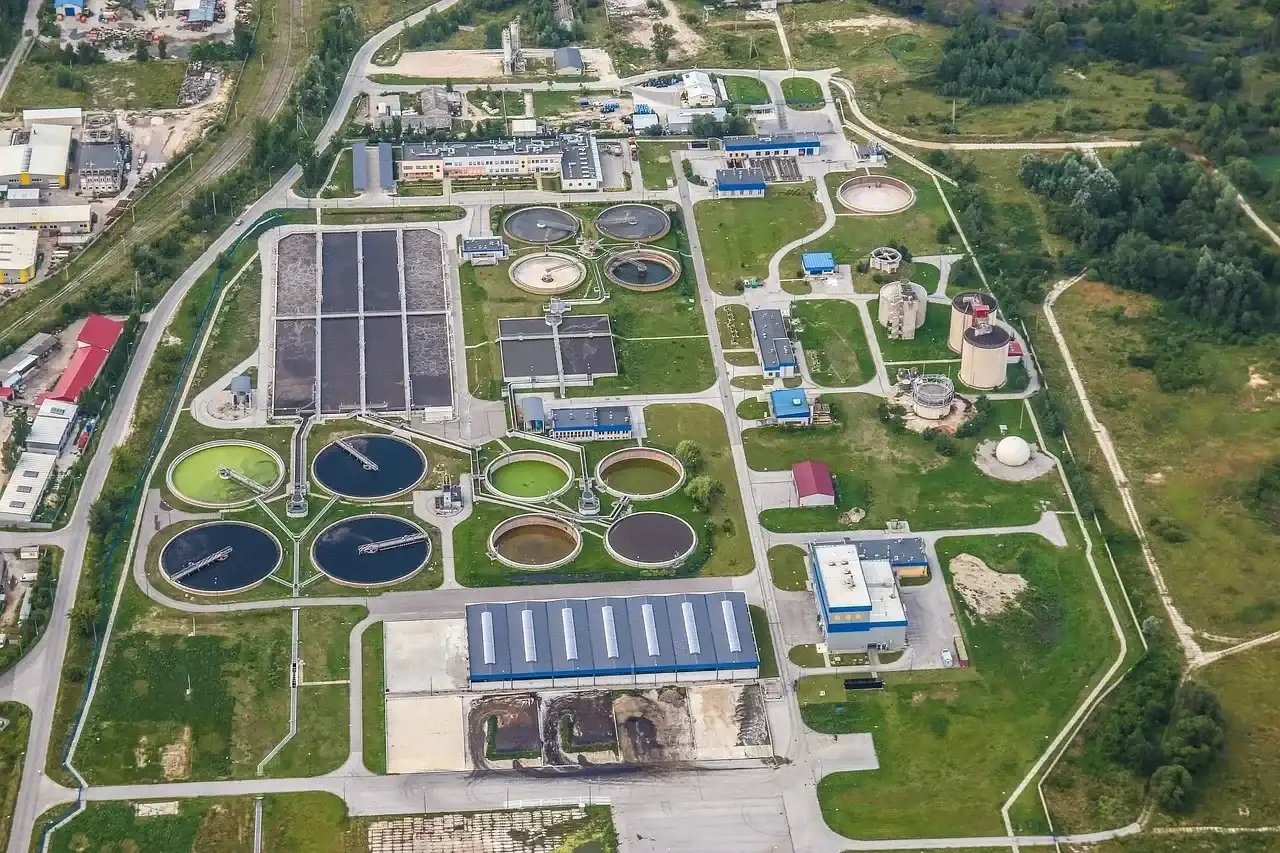
The screened wastewater flows into rectangular primary sedimentation tanks. Here, the hydraulic velocity is reduced to allow settleable solids to drop to the bottom and fats, oils, and grease (FOG) to float to the surface.
- Configuration: Rectangular tanks with chain-and-flight collectors.
- Efficiency: Typically removes 60-70% of Total Suspended Solids (TSS) and 30-40% of Biochemical Oxygen Demand (BOD).
- Solids Return: The settled sludge and surface skimmings are pumped back into the outfall sewer, bypassing the rest of the plant.
C. Secondary Treatment (Activated Sludge)
The effluent from primary treatment undergoes aerobic biological treatment using a conventional Activated Sludge Process.
- Aeration Basins: The plant utilizes deep tanks equipped with fine-bubble diffusers to maximize oxygen transfer efficiency. The biological community consumes dissolved organic matter and converts ammonia to nitrate (nitrification).
- Secondary Clarifiers: Mixed liquor flows to secondary clarifiers where the biomass flocculates and settles.
- Process Control: Return Activated Sludge (RAS) is recycled to the aeration tanks to maintain Mean Cell Residence Time (MCRT). Waste Activated Sludge (WAS) is returned to the trunk sewer.
D. Tertiary Treatment
To meet Title 22 requirements for unrestricted reuse, the secondary effluent undergoes filtration.
- Media Filtration: Deep-bed dual-media gravity filters (anthracite coal and sand) remove remaining suspended solids and turbidity.
- Coagulant Addition: Polymer or alum may be added upstream of filters to enhance flocculation and filtration performance.
E. Disinfection (UV System)
In a major modernization effort, the plant transitioned from chlorination to Ultraviolet (UV) Disinfection.
- Technology: Closed-vessel UV reactors.
- Target: Inactivation of pathogens, bacteria, and viruses to meet < 2.2 MPN/100mL coliform standards.
- Dechlorination: Not required for the main UV process, though some chlorine may be used for process control (filament control) or system maintenance.
4. INFRASTRUCTURE & FACILITIES
A. Physical Plant
The site occupies approximately 27 acres within the federal flood control basin managed by the U.S. Army Corps of Engineers. Because it is located within a popular public park (Whittier Narrows Recreation Area), the facility maintains a low architectural profile and extensive landscaping to blend with the environment. The plant also houses an educational center used for public outreach and school tours.
B. Energy & Sustainability
WNWRP is a net consumer of energy as it does not generate biogas (due to the lack of anaerobic digesters). However, it contributes significantly to regional sustainability by offsetting the energy intensity required to import water from Northern California or the Colorado River. The “embodied energy” of the recycled water produced here is significantly lower than imported water sources.
C. Odor Control
Given the proximity to picnic areas, trails, and a shooting range, odor control is paramount. All primary treatment tanks are covered. Foul air is extracted and treated through multistage chemical scrubbers and/or activated carbon filters before release. The lack of solids processing on-site significantly reduces the potential for offensive odors compared to conventional plants.
5. RECENT UPGRADES & MAJOR PROJECTS
UV Disinfection System Project (Completed 2019/2020)
- Project Scope: Replacement of the existing gaseous chlorine disinfection system and sulfur dioxide dechlorination system with a UV light disinfection system.
- Budget: ~$10 – $15 Million (part of district-wide initiatives).
- Drivers:
- Safety: Elimination of hazardous chlorine gas storage near public recreation areas.
- Compliance: Reduction of disinfection byproducts (DBPs) such as NDMA (N-Nitrosodimethylamine) and Trihalomethanes (THMs) in the groundwater recharge basin.
- Technology: Installation of TrojanUV or similar high-efficiency UV reactor trains.
- Result: The facility now meets stringent bacterial limits without adding chemical residuals to the receiving waters.
Process Air Compressor Upgrades (2022-2023)
- Scope: Replacement of aging centrifugal blowers with high-efficiency turbo blowers.
- Benefit: Significant reduction in electrical consumption for the aeration process, which is the single largest energy load at the plant.
Future Planning: Advanced Water Treatment (Potential)
While WNWRP produces tertiary water, regional planning by LACSD and the Metropolitan Water District of Southern California (MWD) is exploring the “Pure Water Southern California” program. While centered at the Joint Water Pollution Control Plant, satellite facilities like WNWRP are being evaluated for potential process intensification to reduce Total Dissolved Solids (TDS) or contribute to direct potable reuse (DPR) networks in the future.
6. REGULATORY COMPLIANCE
A. Permit Requirements
WNWRP operates under an NPDES permit issued by the Los Angeles Regional Water Quality Control Board (Order No. R4-2014-0213-A01 or subsequent renewals). Key parameters include:
- Turbidity: Must not exceed 2 NTU on average (Title 22).
- Total Coliform: 7-day median of 2.2 MPN/100 mL.
- Nitrogen: Strict limits on Nitrate + Nitrite as N (typically < 10 mg/L) to protect underlying groundwater aquifers used for drinking water.
B. Compliance History
The facility maintains an exemplary compliance record, frequently receiving the National Association of Clean Water Agencies (NACWA) Platinum Peak Performance Award, recognizing facilities with 100% compliance over a period of five consecutive years or more.
7. OPERATIONAL EXCELLENCE
The plant is staffed by California State Water Resources Control Board (SWRCB) certified wastewater treatment plant operators. Because WNWRP is part of the larger LACSD Joint Outfall System, it benefits from centralized laboratory services, engineering support, and SCADA monitoring from the Joint Administration Office in Whittier and the JWPCP control center.
Operations Strategy: The “skimming” configuration allows operators to run the plant at a constant set-point. If biological upset occurs, the influent gate can be throttled or closed, diverting flow back to the sewer. This capability makes WNWRP one of the most stable and reliable biological treatment processes in the county system.
8. CHALLENGES & FUTURE PLANNING
A. PFAS/PFOA Management
As with all facilities discharging to groundwater basins, the emergence of PFAS (Per- and Polyfluoroalkyl Substances) as a regulatory concern is a primary challenge. While wastewater plants are passive receivers of these chemicals, future regulations may require source control or advanced treatment (RO/GAC) to mitigate PFAS in recycled water.
B. Flow Reduction
California’s aggressive water conservation mandates have reduced the volume of wastewater in the collection system. While WNWRP can skim what it needs, the higher concentration of pollutants (ammonia/BOD) in the reduced flow volume requires careful adjustment of the aeration process to maintain nitrification efficiency.
C. Aging Infrastructure
Commissioned in 1962, the concrete structures and conveyance piping are over 60 years old. Asset management programs focus on concrete rehabilitation and electrical gear replacement to ensure continued reliability.
9. COMMUNITY & REGIONAL IMPACT
The WNWRP is a cornerstone of the Montebello Forebay Groundwater Recharge Project. By returning treated water to the aquifer, the plant effectively “creates” new water for the region. Since 1962, the plant has produced over 250 billion gallons of recycled water. The facility also features a Water Education Center, providing free tours to schools and community groups to educate the public on the water cycle and the importance of reclamation in arid climates.
10. TECHNICAL SPECIFICATIONS SUMMARY
| Parameter | Specification |
|---|---|
| Facility Type | Tertiary Water Reclamation Plant (“Skimming” Plant) |
| Design Capacity | 15.0 MGD |
| Average Daily Flow | ~7 – 9 MGD |
| Treatment Process | Primary Sedimentation, Activated Sludge, Media Filtration |
| Disinfection | UV (Ultraviolet) Light |
| Solids Handling | Returned to trunk sewer (Processed at JWPCP) |
| Service Area | San Gabriel Valley (Joint Outfall District 2) |
| Receiving Water | San Gabriel River / Rio Hondo (Groundwater Recharge) |
| Beneficial Reuse | 100% (Groundwater Replenishment) |
| Operating Authority | Los Angeles County Sanitation Districts (LACSD) |
| Year Commissioned | 1962 |
| Site Area | ~27 Acres |
11. RELATED FACILITIES
- Joint Water Pollution Control Plant (JWPCP): The 400-MGD facility in Carson that treats the solids returned from WNWRP.
- San Jose Creek WRP: A larger (100 MGD) sister plant located upstream in Whittier, also discharging to the San Gabriel River watershed.
- Rio Hondo/San Gabriel Spreading Grounds: The physical infrastructure operated by LA County Public Works where WNWRP effluent percolates into the aquifer.
12. FAQ SECTION
1. Why doesn’t the Whittier Narrows WRP have digesters?
WNWRP is designed as a satellite “skimming” plant. To minimize odors in the recreational area and reduce capital costs, all solids (sludge) are returned to the sewer trunk line and conveyed to the JWPCP in Carson for centralized processing.
2. Is the water from WNWRP safe to drink?
The water meets Title 22 standards for incidental contact and groundwater recharge. It is not piped directly to tap. Instead, it percolates into the ground, is naturally filtered by the soil, mixes with groundwater, and is eventually pumped out by municipal wells and treated again before becoming drinking water.
3. What happened to the chlorine tanks?
The facility recently upgraded to UV disinfection. This eliminated the need to store hazardous chlorine gas on-site, significantly improving safety for plant operators and the visitors to the surrounding Whittier Narrows Recreation Area.
4. Does the plant treat all the sewage from the area?
No. The plant diverts a specific amount of flow (up to 15 MGD) from the main sewer line. Any excess flow, or flow during heavy rains, bypasses the plant and continues down the sewer system to the coast for treatment.
5. Can the public tour the facility?
Yes, LACSD offers tours of the Whittier Narrows WRP for schools and community groups. It is a popular educational destination due to its location within a park.