
Metropolitan Water Reclamation District Calumet Water Reclamation Plant Chicago
FACILITY BASIC INFORMATION
1. INTRODUCTION
The Calumet Water Reclamation Plant (CWRP) stands as the oldest of the seven wastewater treatment facilities operated by the Metropolitan Water Reclamation District of Greater Chicago (MWRD). Commissioned in 1922, this critical infrastructure asset serves the southern portion of Chicago and 48 suburban communities, encompassing a massive 300-square-mile service area. With a design capacity of 354 million gallons per day (MGD), the CWRP is a linchpin in the protection of the Little Calumet River and the downstream Illinois Waterway system.
Distinguished by its integration with the Tunnel and Reservoir Plan (TARP)—specifically the colossal Thornton Composite Reservoir—the Calumet plant represents a hybrid of historic engineering resilience and modern environmental adaptation. Recent capital investments exceeding $50 million have modernized the facility with disinfection capabilities to meet new recreational water quality standards. As the primary treatment hub for over one million residents and a heavy industrial corridor, the CWRP continues to set benchmarks for wet-weather flow management and biological treatment efficiency in the Midwest.
2. FACILITY OVERVIEW
A. Service Area & Coverage

The CWRP serves a distinct and heavily urbanized region known as the Calumet Area. This 300-square-mile sewershed includes the southern neighborhoods of the City of Chicago and the southern suburbs of Cook County. The demographic profile of the service area is mixed, featuring dense residential zones, significant commercial corridors, and historic industrial sectors that contribute to a complex influent profile. The collection system feeding the plant is a combination of older combined sewers (stormwater and sanitary) and newer separate sanitary systems, necessitating robust wet-weather management strategies.
B. Operational Capacity
The facility is designed for an average hydraulic capacity of 354 MGD, with a design peak flow capability significantly higher to handle storm surges. Currently, the plant treats an average daily flow of approximately 230 MGD. Historical trends indicate high variability in flow due to the combined sewer system; during heavy precipitation events, flows can surge rapidly. The plant works in tandem with the TARP system; excess flow is diverted to the deep tunnel system and the Thornton Composite Reservoir (7.9 billion gallon capacity) to prevent overwhelming the treatment train, allowing the plant to treat stored water once the storm subsides.
C. Discharge & Compliance
Treated effluent is discharged into the Little Calumet River. The facility operates under NPDES Permit No. IL0028061, issued by the Illinois Environmental Protection Agency (IEPA). Recent regulatory shifts have reclassified the receiving waters for general use (recreation), triggering stricter requirements for bacterial limits and nutrient reduction. The plant has maintained a strong compliance record, consistently achieving high removal rates for Carbonaceous Biochemical Oxygen Demand (CBOD) and Suspended Solids (SS), typically exceeding 95% removal efficiency.
3. TREATMENT PROCESS
The Calumet WRP utilizes a conventional activated sludge process supplemented by newly installed disinfection systems and advanced solids handling. The treatment train is designed to handle high-strength industrial waste alongside domestic sewage.
A. PRELIMINARY TREATMENT
Influent wastewater enters the plant through the intercepting sewer system.
- Coarse Screening: Large debris (rags, wood, plastic) is removed via mechanically cleaned bar screens to protect downstream pumps.
- Grit Removal: The flow passes through aerated grit chambers where heavier inorganic materials (sand, gravel, coffee grounds) settle out. The velocity is controlled to allow organics to remain in suspension while grit is captured, dewatered, and hauled off-site to landfills.
B. PRIMARY TREATMENT
Flow enters the primary settling tanks where physical separation occurs.
- Clarifiers: The facility utilizes a battery of rectangular primary settling tanks.
- Process: Gravity settles approximately 60-70% of suspended solids and 30-40% of BOD. Primary sludge is scraped from the bottom, while fats, oils, and grease (FOG) are skimmed from the surface.
- Enhancements: Ferric chloride may be added at this stage or prior to enhance settling and assist with phosphorus precipitation.
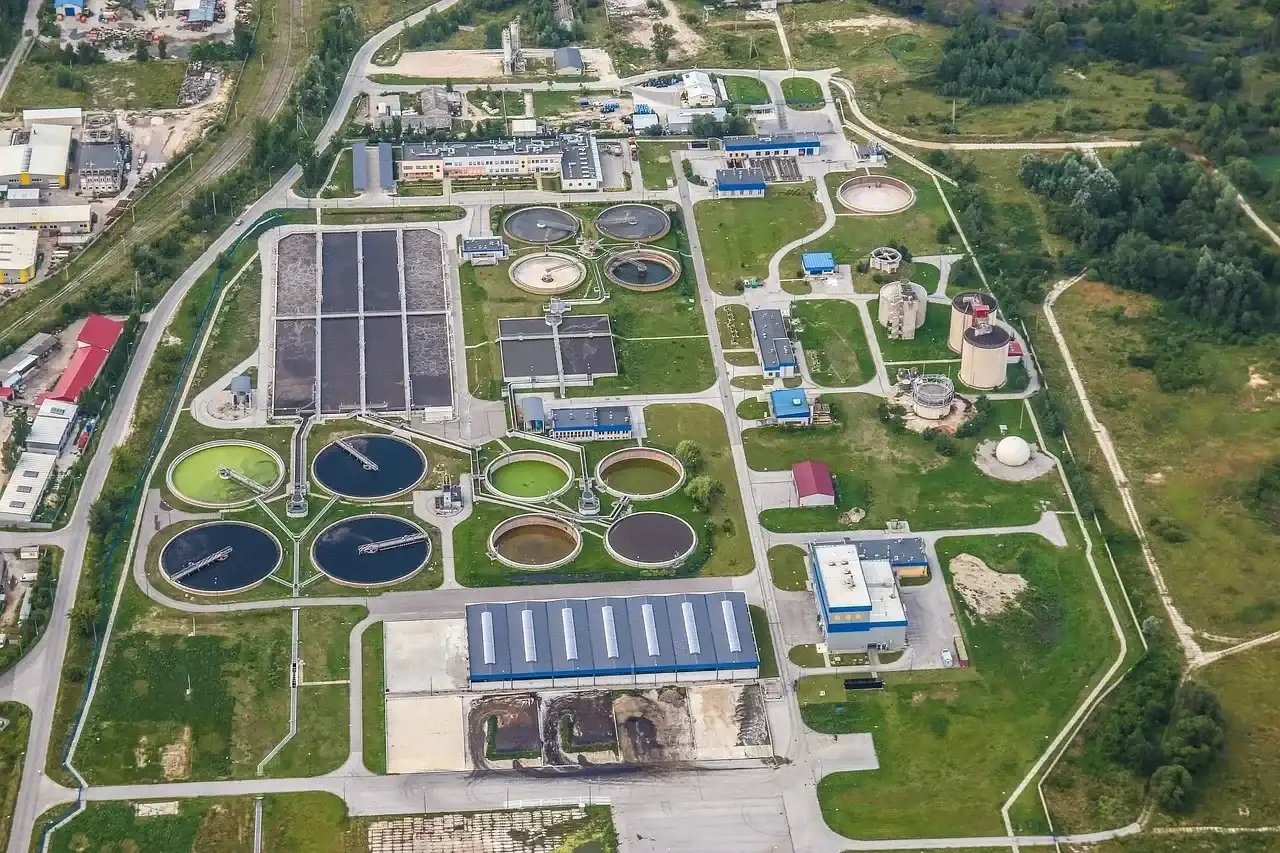
C. SECONDARY TREATMENT
The biological heart of the plant employs a single-stage activated sludge process.
- Aeration Batteries: The plant operates multiple aeration batteries containing varied tank configurations. Mixed liquor suspended solids (MLSS) are aerated using fine-bubble diffusion to support aerobic bacteria that consume dissolved organic matter and ammonia.
- Nitrification: The solids retention time (SRT) is managed to support nitrifying bacteria, converting ammonia-nitrogen to nitrate-nitrogen to meet toxicity limits for the receiving water.
- Secondary Clarifiers: The mixed liquor flows to secondary clarifiers where the biological floc settles. The clear supernatant flows over weirs to disinfection.
- RAS/WAS: Settled sludge is returned to the aeration tanks (RAS) to maintain the biological population. Excess growth is removed as Waste Activated Sludge (WAS) and sent to solids processing.
D. DISINFECTION (Tertiary Stage)
Commissioned around 2016 to meet new recreational water standards, the disinfection facility is a critical final step.
- Chlorination: The plant utilizes liquid sodium hypochlorite (bleach) in contact tanks to inactivate pathogens (fecal coliform/E. coli).
- Dechlorination: Before discharge, sodium bisulfite is added to remove residual chlorine, preventing toxicity to aquatic life in the Little Calumet River.
- Seasonal Operation: Disinfection typically operates during the recreational season (March/May through November), though permits are increasingly pushing for year-round compliance considerations.
E. SOLIDS HANDLING
Calumet features a robust solids processing complex:
- Concentration: Primary sludge and WAS are thickened using gravity concentration and centrifuges.
- Anaerobic Digestion: Thickened sludge is sent to 12 heated anaerobic digesters. This mesophilic process stabilizes the sludge, reduces volatile solids, and generates biogas (methane).
- Dewatering/Drying: Unlike many modern plants that rely solely on mechanical dewatering, Calumet utilizes extensive sludge drying lagoons and drying beds. The digested biosolids are aged and dried to produce a Class B (and in some processes Class A) biosolid.
- Beneficial Reuse: The final product is utilized for land application, often as daily cover at landfills or as a soil amendment for farmland/reclamation projects.
4. INFRASTRUCTURE & FACILITIES
A. Physical Plant
The site spans approximately 150 acres near 126th Street and Doty Avenue. The architecture reflects its 1920s origins with industrial brick facades on older structures, blended with modern concrete processing tanks. The site houses extensive maintenance shops, a process control laboratory, and administrative offices.
B. Tunnel and Reservoir Plan (TARP) Integration
A unique feature of CWRP is its direct connection to the “Deep Tunnel” system. The Calumet System of TARP captures combined sewer overflows (CSOs) from a 91-square-mile area. The associated Thornton Composite Reservoir, located nearby in a former limestone quarry, provides 7.9 billion gallons of storage. This infrastructure prevents untreated sewage from entering the waterways during storms and allows the CWRP to treat this volume at a controlled rate once peak flows subside.
C. Energy & Odor Control
Biogas produced in the anaerobic digesters is captured and utilized in on-site boilers to heat the digesters and facility buildings, offsetting natural gas consumption. Odor control is a priority due to the plant’s proximity to residential areas and the Bishop Ford Freeway. Technologies include chemical scrubbers and biofilters located at the headworks and sludge concentration facilities.
5. RECENT UPGRADES & MAJOR PROJECTS
Disinfection Facility Project – ~$34 Million (2014-2016)
- Project Scope: Construction of a new chlorination and dechlorination facility to treat plant effluent.
- Project Drivers: Compliance with IEPA requirements to designate the Chicago Area Waterway System (CAWS) for primary contact recreation.
- Technical Highlights: Installation of chemical storage tanks, dosing pumps, and contact basins capable of handling peak flows while ensuring pathogen inactivation.
- Results: The plant now consistently meets fecal coliform limits during the recreational season, significantly improving water quality in the Little Calumet River.
Phosphorus Removal Retrofits (Ongoing)
- Project Scope: Modifications to the secondary treatment aeration batteries to facilitate Enhanced Biological Phosphorus Removal (EBPR).
- Drivers: New NPDES permit limits for total phosphorus to reduce hypoxia risks in the Gulf of Mexico (nutrient reduction strategy).
- Technical Highlights: Creation of anaerobic zones within existing aeration tanks and installation of baffle walls and mixers to select for Phosphorus Accumulating Organisms (PAOs).
Upcoming: Calumet Interceptor Rehabilitation (2024-2027 Planning)
- Scope: Rehabilitation of aging interceptor sewers feeding the plant.
- Funding: Mix of local funds and potential State Revolving Fund (SRF) loans.
- Expected Benefits: Reduction in inflow/infiltration (I/I) and structural preservation of the collection system.
6. REGULATORY COMPLIANCE & ENVIRONMENTAL PERFORMANCE
A. Permit Requirements
The CWRP operates under a strict NPDES permit. Key parameters include:
- CBOD5: Monthly average limit typically < 25 mg/L (often achieving < 5 mg/L).
- TSS: Monthly average limit typically < 30 mg/L.
- Ammonia-Nitrogen: Seasonally variable, with tight limits (< 1.5 mg/L) in summer.
- Phosphorus: Moving toward a target of 0.5 mg/L annual geometric mean.
- Bacteria: Fecal Coliform limits applicable May through October.
B. Compliance History
The Calumet plant maintains an exemplary compliance record with the IEPA. In recent years, the facility has received Platinum and Gold Peak Performance Awards from the National Association of Clean Water Agencies (NACWA), recognizing consecutive years of 100% permit compliance. The integration of the Thornton Reservoir has virtually eliminated untreated CSOs in the Calumet system, a massive environmental victory for the region.
7. OPERATIONAL EXCELLENCE
A. Staffing & Safety
The facility is staffed 24/7 by a team of Illinois Class 1 certified operators, stationary engineers, skilled tradespeople, and laboratory analysts. The MWRD maintains rigorous safety programs, particularly regarding confined space entry and chemical handling (chlorine/bisulfite).
B. Technology & Innovation
MWRD uses a robust SCADA system for real-time monitoring of all unit processes. The Calumet plant serves as a testing ground for nutrient removal strategies. The District has also implemented an Artificial Intelligence (AI) initiative across its plants to optimize aeration usage, reducing energy costs while maintaining effluent quality.
8. CHALLENGES & FUTURE PLANNING
Nutrient Management: The primary challenge for CWRP is meeting increasingly stringent phosphorus limits. While biological removal is being implemented, chemical polishing may be required to consistently meet future limits of 0.1 mg/L or lower, necessitating further capital investment.
Aging Infrastructure: As a centenarian facility, Calumet faces the constant challenge of maintaining physical structures. Concrete degradation in original tanks and the obsolescence of mechanical equipment require a continuous cycle of rehabilitation.
Climate Resilience: Intense rainfall events driven by climate change test the hydraulic limits of the plant. While TARP provides a buffer, optimizing the “pump back” strategy from the reservoir to the plant to maximize treatment without upsetting biological processes remains a complex operational balancing act.
9. COMMUNITY & REGIONAL IMPACT
The Calumet WRP is an economic anchor in the Southland, protecting the waterways that support both recreation and commercial navigation. The MWRD actively engages the community through open houses and tours, educating the public on the value of water reclamation. The transformation of the Calumet river system from an industrial drainage canal to a recreational asset used for rowing and fishing is a direct result of the improved effluent quality from this facility.
10. TECHNICAL SPECIFICATIONS SUMMARY
| Parameter | Specification |
|---|---|
| Facility Type | Advanced Secondary Treatment with Disinfection |
| Design Capacity | 354 MGD |
| Current Average Flow | ~230 MGD |
| Primary Treatment | Coarse screens, aerated grit chambers, 37 primary tanks |
| Secondary Treatment | Conventional Activated Sludge (Fine Bubble Aeration) |
| Disinfection | Chlorination / Dechlorination (Sodium Hypochlorite/Bisulfite) |
| Nutrient Removal | Nitrification (Ammonia), Biological Phosphorus Removal (In progress) |
| Biosolids Processing | Anaerobic Digestion (12 tanks), Lagoon Aging, Drying Beds |
| Energy Recovery | Biogas utilization for process heating |
| Population Served | > 1,000,000 |
| Service Area | 300 square miles |
| Receiving Water | Little Calumet River |
| NPDES Permit | IL0028061 |
| Operating Authority | Metropolitan Water Reclamation District of Greater Chicago |
| Year Commissioned | 1922 |
| Associated Storage | Thornton Composite Reservoir (7.9 Billion Gallons) |
11. RELATED FACILITIES
Thornton Composite Reservoir: Located north of the Tri-State Tollway, this is the world’s largest combined sewer reservoir. It is operationally tethered to the Calumet WRP via the Deep Tunnel system.
Stickney Water Reclamation Plant: The largest wastewater treatment plant in the world, located to the north, serves the central Chicago area and shares operational strategies and engineering resources with Calumet.
12. FAQ SECTION
Technical Questions
1. What is the peak hydraulic capacity of the Calumet WRP?
While the design capacity is 354 MGD, the plant can sustain higher peak flows for short durations. However, excess wet weather flow is primarily diverted to the TARP tunnels and Thornton Reservoir to prevent plant washout.
2. Does Calumet WRP use UV disinfection?
No. Unlike the MWRD’s O’Brien plant which uses UV, Calumet utilizes chlorination and dechlorination technologies due to site-specific constraints and economic analysis at the time of design.
3. How is phosphorus handled at the plant?
The plant is currently retrofitting aeration batteries to perform Enhanced Biological Phosphorus Removal (EBPR) to meet lower effluent limits without sole reliance on chemical precipitation.
4. What class of biosolids does Calumet produce?
Calumet generally produces Class B biosolids suitable for restricted land application, utilizing a process of anaerobic digestion followed by long-term aging in lagoons and drying beds.
Public Interest Questions
5. Is the water discharged into the river safe?
Yes. The treated water meets strict IEPA standards. The addition of disinfection in 2016 significantly reduced bacteria levels, making the river safer for secondary contact recreation like canoeing and kayaking.
6. Does the plant smell?
Wastewater treatment inherently generates odors, but MWRD employs extensive odor control technologies (scrubbers and biofilters) to minimize impact on neighboring communities.
7. How old is the plant?
The Calumet WRP is the oldest in the MWRD system, commissioned in 1922, though nearly every component has been upgraded or replaced since then.