
Reverse Electrodialysis for Energy Production
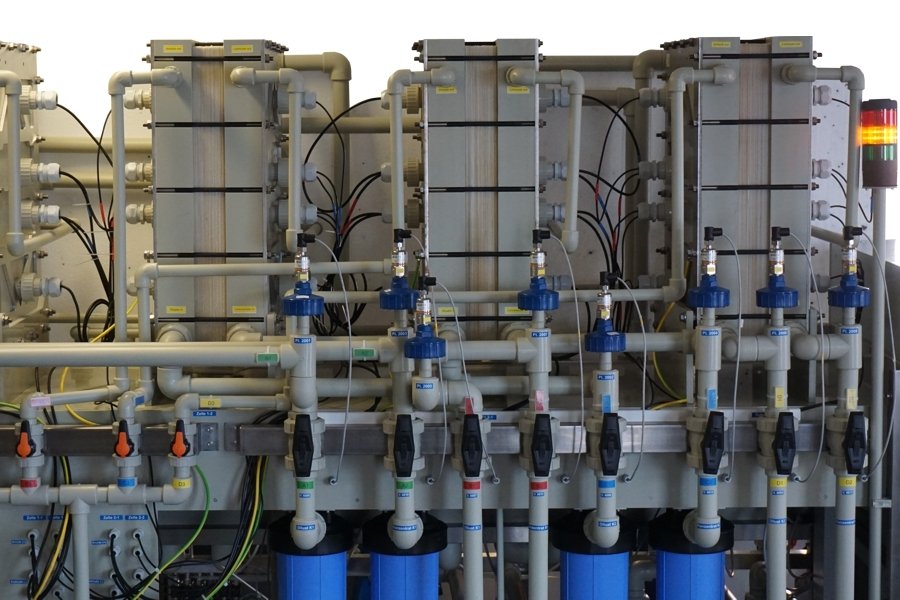
Reverse electrodialysis (RED) is a promising technology for generating clean and sustainable energy from salinity gradients. Salinity gradients, such as those found between seawater and river water or brackish water, can be a rich source of renewable energy that can be harnessed for power generation using RED.
In this article, we will delve into the principles of reverse electrodialysis, its applications, benefits, challenges, and the progress being made in this field. Although RED produces energy rather than fresh water, it is usually grouped with emerging desalination technologies because it uses the same ion exchange membrane hardware as electrodialysis and is increasingly paired with desalination plants to recover energy from their brine.
1. Introduction to Reverse Electrodialysis (RED)
Reverse electrodialysis is a process that generates electricity using the salinity difference between two solutions of different concentrations. This process is based on the principle of ion migration through selective ion exchange membranes, driven by the concentration difference between the two solutions rather than by an externally applied electric field.
In a RED system, alternating ion exchange membranes and spacers are used to create compartments for the freshwater and seawater or brackish water solutions. No external voltage is applied; instead, ions diffuse from the concentrated solution toward the dilute solution through the membranes, and because each membrane passes only one charge type, this selective movement produces a potential difference that can be harnessed as electrical energy.
2. Working Principle of Reverse Electrodialysis (RED)
The working principle of reverse electrodialysis is based on the selective permeability of ion exchange membranes to specific ions. A RED system typically consists of alternating cation exchange membranes (CEM) and anion exchange membranes (AEM) separated by spacers. These membranes allow only cations or anions to pass through, creating a voltage (membrane potential) across each membrane.
When a freshwater and a seawater solution are introduced into the compartments, cations in the seawater (mainly sodium) migrate through the CEM towards the freshwater compartment, while anions (mainly chloride) migrate through the AEM, also moving from the seawater side towards the freshwater side. This ion migration creates a potential difference that can be converted into electrical energy.
At each end of the membrane stack, electrodes immersed in an electrode rinse solution, typically containing a reversible redox couple, convert the ionic current inside the stack into an electronic current that flows through an external load. Despite the similar name, RED should not be confused with electrodialysis reversal, which uses a comparable stack but consumes electrical power to remove salt from water and periodically reverses electrode polarity to control scaling.
Voltage and Power Output
The ideal voltage across one membrane can be estimated from the Nernst equation, E = α (RT/F) ln(a_c/a_d), where α is membrane permselectivity, R is the gas constant, T is absolute temperature, F is the Faraday constant, and a_c and a_d are the salt activities in the concentrated and dilute streams.
Worked example: for seawater (about 0.5 M NaCl) against river water (about 0.017 M NaCl) at 25°C, the concentration ratio is roughly 30. With an ideal membrane (α = 1), E ≈ 0.0257 V × ln(30) ≈ 0.0257 × 3.4 ≈ 0.087 V per membrane. A cell pair contains one CEM and one AEM, so its ideal open-circuit voltage is about 0.17 V. Real stacks deliver less because membranes are not perfectly selective and activity coefficients are below 1, which is why practical stacks use hundreds of cell pairs in series to reach useful voltages.
The theoretical energy available from mixing river water with a large excess of seawater is roughly 0.7–0.8 kWh per cubic meter of river water. Reported gross power densities with natural seawater and river water are typically on the order of 1 W per square meter of membrane or lower, and much higher values have been achieved in laboratory tests using concentrated brines as the high-salinity feed.
3. Applications of Reverse Electrodialysis (RED)
Reverse electrodialysis has a wide range of applications in energy production, desalination, and wastewater treatment. Some of the key applications of RED include:
- Power generation: RED can be used to generate clean and sustainable electricity from salinity gradients, such as those found in estuaries, rivers, and coastal areas.
- Desalination: RED can be integrated with desalination systems to improve the efficiency of salt removal processes and reduce energy consumption. A common concept uses concentrated reverse osmosis brine as the high-salinity feed, recovering part of the plant’s energy while diluting the brine before discharge.
- Wastewater treatment: RED can be used to recover energy from wastewater streams, reducing the overall energy footprint of treatment plants. In microbial reverse-electrodialysis cells, a short RED stack is combined with a bioelectrochemical cell so that bacteria oxidizing organic matter and the salinity gradient both contribute to power output, an approach closely related to microbial desalination cells.
- Industrial processes: RED can be integrated into various industrial processes to generate electricity from salinity gradients present in different solutions.
4. Benefits of Reverse Electrodialysis (RED)
Reverse electrodialysis offers several benefits as a renewable energy technology, including:
- Clean and sustainable energy generation: RED produces electricity without emitting greenhouse gases or other harmful pollutants, making it an environmentally friendly option for power generation.
- Abundant energy source: Salinity gradients are abundant in natural water bodies, providing a readily available source of renewable energy for RED systems. Unlike wave energy for desalination or solar power, salinity gradient power does not depend on weather or daylight, so a site with steady river inflow can produce relatively constant output.
- Scalability: RED systems can be scaled up or down depending on the energy requirements, making them suitable for a wide range of applications.
- Compatibility with other technologies: RED can be integrated with other renewable energy technologies, such as solar or wind power, to create hybrid energy systems.
5. Challenges of Reverse Electrodialysis (RED)
Despite its many benefits, reverse electrodialysis also faces several challenges that need to be addressed for wider commercialization and adoption. Some of the key challenges include:
- Energy efficiency: The efficiency of RED systems is currently lower compared to other renewable energy technologies, such as solar or wind power. Improving the efficiency of ion exchange membranes and reducing energy losses are key challenges for RED.
- Membrane fouling: Membrane fouling can occur due to the accumulation of organic or inorganic deposits on the surfaces of ion exchange membranes, reducing their performance and lifespan. Effective fouling control strategies are needed to mitigate this problem.
- Cost: The cost of ion exchange membranes and other components of RED systems can be a barrier to widespread adoption. Research and development efforts are focused on reducing the cost of materials and improving the economics of RED technology.
- Scale-up: Scaling up RED systems from lab-scale to commercial-scale can be challenging due to technical and economic factors. Technological innovations and demonstration projects are needed to overcome this challenge.
6. Recent Advances in Reverse Electrodialysis (RED)
In recent years, significant progress has been made in the development of reverse electrodialysis technology, leading to improved performance and efficiency. Some of the key recent advances in RED include:
- Novel membrane materials: Researchers are exploring new materials and membrane designs to improve the selectivity, permeability, and durability of ion exchange membranes used in RED systems. Graphene-based membranes, nanocomposite membranes, and thin-film membranes are some of the promising developments in this area.
- System optimization: Researchers are optimizing the design and operation of RED systems to maximize energy conversion efficiency and minimize energy losses. Parameters such as flow rates, current density, and membrane configuration are being optimized to enhance system performance.
- Integration with other technologies: RED is being integrated with other renewable energy technologies, such as solar and wind power, to create hybrid energy systems with enhanced performance and reliability. These integrated systems offer the potential for greater energy generation and grid stability.
- Demonstration projects: Several demonstration projects have been launched to test and validate the performance of RED technology in real-world conditions. One widely cited example is the pilot plant at the Afsluitdijk in the Netherlands, which began operating in 2014 using fresh water from the IJsselmeer and salt water from the Wadden Sea. These projects help to showcase the feasibility and benefits of RED for power generation and other applications.
7. Future Prospects of Reverse Electrodialysis (RED)
Reverse electrodialysis holds great promise as a clean and sustainable energy technology with wide-ranging applications in power generation, desalination, and wastewater treatment. With ongoing research and development efforts, the future prospects of RED look bright, with potential advancements in the following areas:
- Improved efficiency: Researchers are working on enhancing the energy conversion efficiency of RED systems through the development of advanced materials, membranes, and system designs. These improvements will make RED more competitive with other renewable energy technologies.
- Cost reduction: Efforts are underway to reduce the cost of RED technology through the use of low-cost materials, streamlined manufacturing processes, and economies of scale. Lowering the overall cost of RED systems will help accelerate their commercialization and deployment.
- Commercialization: As the performance and reliability of RED technology improve, more commercial opportunities are expected to emerge in sectors such as power generation, desalination, and industrial applications. Market growth and investment in RED are likely to increase in the coming years.
- Policy support: Governments and policymakers are recognizing the potential of RED as a renewable energy technology and providing support through incentives, grants, and regulatory frameworks. Favorable policies can accelerate the adoption of RED and facilitate its integration into existing energy systems.
8. Conclusion
Reverse electrodialysis (RED) is a promising technology for generating clean and sustainable energy from salinity gradients. With the potential to harness the energy stored in natural water bodies, such as estuaries, rivers, and coastal areas, RED offers a renewable energy solution that is compatible with a wide range of applications.
Despite facing challenges such as energy efficiency, membrane fouling, and cost, RED has made significant strides in recent years through advances in membrane materials, system optimization, integration with other technologies, and demonstration projects. The future prospects of RED look promising, with ongoing research and development efforts focused on improving efficiency, reducing costs, accelerating commercialization, and gaining policy support.
As the global demand for clean energy continues to grow, reverse electrodialysis is poised to play a significant role in the transition to a sustainable energy future. By harnessing the power of salinity gradients, RED offers a renewable energy source that is abundant, reliable, and environmentally friendly. With continued innovation and investment, RED has the potential to become a key player in the renewable energy landscape, contributing to a cleaner and greener world for future generations.