
Rotork vs AUMA Automatic Valves Equipment: Comparison & Best Fit
Introduction
In the municipal water and wastewater sector, the electric actuator is often the single most critical interface between the control room (SCADA) and the physical process. Yet, despite their importance, actuators are frequently treated as commodity items or last-minute additions to valve specifications. This oversight often leads to a staggering statistic: industry analysis suggests that nearly 60% of actuator “failures” in the first five years are actually failures of specification—selecting the wrong equipment for the environment, duty cycle, or maintenance philosophy of the facility.
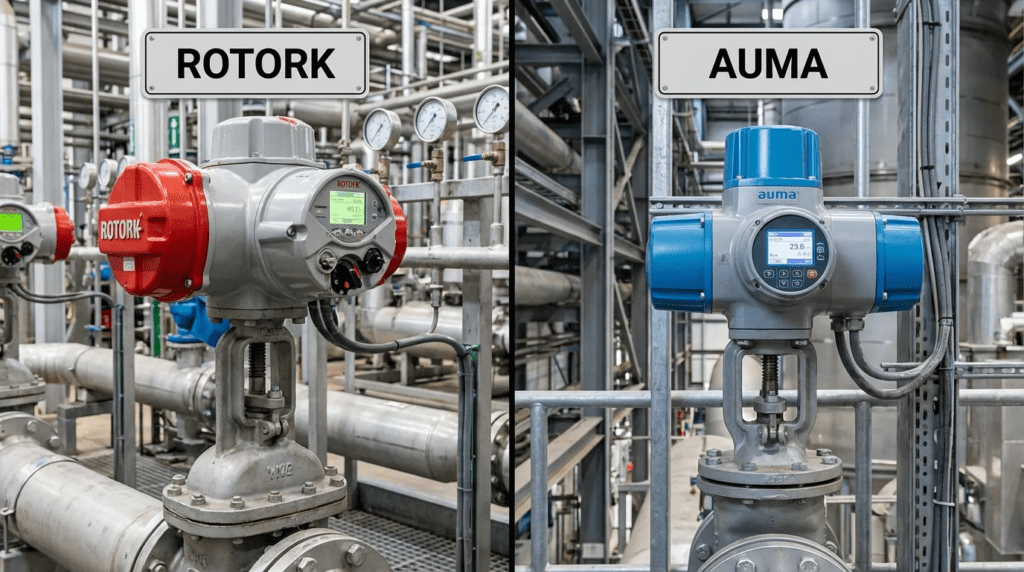
For decades, two manufacturers have dominated the global specification landscape for heavy-duty electric actuation: Rotork (UK) and AUMA (Germany). For consulting engineers and plant directors, the decision often boils down to a choice between these two giants. However, treating them as interchangeable “or equal” options ignores fundamental differences in design philosophy, modularity, and enclosure protection. This article provides a deep technical analysis of Rotork vs AUMA Automatic Valves Equipment: Comparison & Best Fit, moving beyond catalog features to examine real-world performance.
These actuators are the workhorses of the industry, found on everything from 96-inch influent gate valves and modulating butterfly valves in aeration basins to high-pressure discharge valves in distribution pump stations. The operating environments are arguably the harshest in civil engineering: high humidity, hydrogen sulfide (H2S) exposure, submersion risks, and extreme vibration. A poor choice here results in unplanned downtime, manual operation requirements during storm events, and inflated OpEx budgets.
The goal of this guide is not to declare a “winner,” as both manufacturers produce world-class equipment capable of meeting AWWA and ISO standards. Instead, we aim to equip engineers with the nuanced understanding required to determine which design philosophy aligns best with their specific plant architecture, maintenance capabilities, and automation goals.
How to Select / Specify
Proper specification of electric actuators requires a holistic view of the valve assembly and the process environment. When evaluating Rotork vs AUMA Automatic Valves Equipment: Comparison & Best Fit, engineers must look beyond torque ratings and focus on the interaction between mechanical design and operational reality.
Duty Conditions & Operating Envelope
The first step in selection is defining the duty classification accurately. The standard designations (Open/Close vs. Modulating) are often insufficient for modern process control.
- Isolation/Inching (Class A/B): For valves operated infrequently (e.g., filter isolation), thermal capacity is rarely an issue. However, “stiction” (static friction) after long periods of inactivity requires actuators with “hammerblow” mechanisms to unseat the valve. Both Rotork (IQ series) and AUMA (SA series) excel here, but their torque sensing mechanisms differ.
- Modulating (Class C/D): For flow control valves, the number of starts per hour is critical. Standard motors may overheat if cycled more than 60 times per hour. Engineers must specify continuous modulating duty (S4 or S9 duty cycles) where the motor is rated for up to 1,200 starts per hour or continuous operation.
- Torque & Thrust: The actuator must be sized not just for the running torque, but for the seating/unseating torque, which typically requires a safety factor of 1.25 to 1.5 above the valve manufacturer’s maximum requirement.
Materials & Compatibility
Wastewater treatment plants present a corrosive atmosphere dominated by Hydrogen Sulfide (H2S) and high humidity.
- Enclosure Materials: Standard aluminum housings are generally sufficient if the coating spec is robust. However, for coastal facilities or aggressive industrial wastewater, ductile iron or even stainless steel housings may be necessary.
- Coating Systems: Engineers should specify a C5-M (Marine) or C5-I (Industrial) corrosion protection category according to ISO 12944. AUMA typically uses a powder coating process that is highly resistant to impact, while Rotork often utilizes a liquid wet-paint system that offers excellent bonding.
- Internal Gearing: Look for the materials used in the worm gear and drive train. Bronze worm wheels paired with hardened steel worms are standard for longevity and wear resistance.
Hydraulics & Process Performance
The speed of operation is a critical hydraulic parameter often overlooked until the surge analysis is performed.
- Variable Speed Needs: Standard AC motors run at fixed speeds. If water hammer is a concern, or if precise flow control is needed at low opening percentages, variable speed actuators (using VFDs integrated into the actuator head) are superior. Rotork’s IQT and AUMA’s SAV models allow for “soft starts” and “soft stops,” and can run at different speeds for opening (fast) and closing (slow) to mitigate surge.
- Fail-Safe Requirements: In power loss scenarios, does the valve need to fail open, close, or stay put? While spring-return electric actuators exist, they are complex. Many engineers nowadays prefer actuators with integrated supercapacitors or battery backups that can drive the valve to a safe position upon power loss.
Installation Environment & Constructability
Physical constraints often dictate the winning technology.
- Orientation: Both manufacturers allow mounting in various orientations, but the visibility of the local display is key. Rotork’s display can be rotated electronically or mechanically (depending on generation). AUMA’s modular design allows the controls to be mounted remotely on a wall bracket while the motor remains on the valve—a massive advantage in confined spaces or high-vibration environments.
- Cabling: Daisy-chain (loop) topologies for bus networks (Profibus/Foundation Fieldbus) save conduit costs but increase commissioning complexity. Star topologies are more robust but expensive.
Reliability, Redundancy & Failure Modes
Reliability in actuation is often defined by the “Double Seal” concept.
- Sealing Philosophy: This is a major differentiator. Rotork is famous for its “Double-Sealed” enclosure (IP68), where the terminal compartment is sealed separately from the electronics. If an electrician leaves the cable gland loose, moisture enters the terminal block but cannot reach the control board. AUMA relies on high-quality O-ring sealing but emphasizes modularity; their design allows components to be swapped easily, but care must be taken during field wiring to ensure environmental integrity.
- Handwheel Engagement: During power failure, manual operation is required. The engagement mechanism must be safe (declutchable) so that if power returns while an operator is turning the wheel, the wheel doesn’t spin and injure the operator.
Controls & Automation Interfaces
The interface between the actuator and the PLC/SCADA system drives the functionality.
- Non-Intrusive Setting: Both Rotork (Bluetooth/Infrared) and AUMA (Bluetooth/Magnetic) allow parameters (torque limits, position limits) to be set without removing the cover. This preserves the factory seal and warranty.
- Data Logging: Modern actuators are data loggers. They record torque profiles over time. A deviation in the torque curve can predict a valve seat failure or an obstruction weeks before it becomes critical. Specifying “Advanced Diagnostics” allows engineers to utilize this predictive maintenance data.
Maintainability, Safety & Access
Consider who will be maintaining the equipment.
- Modular vs. Integrated: AUMA’s design is highly modular. If a control board fails, you can replace just the logic unit. If a motor fails, you can unbolt the motor while keeping the gearbox on the valve. Rotork’s design is more integrated; often, a failure requires swapping the actuator head or more specialized service. For plants with skilled electrical teams, modularity (AUMA) is often preferred. For plants that prefer a “swap-out” model, integrated units (Rotork) are attractive.
Lifecycle Cost Drivers
The purchase price is roughly 20% of the lifecycle cost.
- Standardization: Mixing brands increases spare parts inventory costs significantly.
- Retrofit Capability: Can the new actuator fit on the old valve stem/yoke? Adaptability to existing ISO 5210/5211 flanges reduces mechanical fabrication costs during upgrades.
Comparison Tables
The following tables provide a direct technical comparison to assist in the Rotork vs AUMA Automatic Valves Equipment: Comparison & Best Fit analysis. Table 1 focuses on the flagship product lines (Rotork IQ3 vs. AUMA SA/AC), while Table 2 outlines the “Best Fit” scenarios based on common engineering constraints.
Table 1: Technical Comparison – Flagship Multi-Turn Actuators
| Feature / Criteria | Rotork (IQ3 Series) | AUMA (SA Series + AC Controls) |
|---|---|---|
| Design Philosophy | Integrated/Monoblock: Highly integrated electronic and mechanical package. Focus on sealing integrity and compact footprint. | Modular: Separate motor, gearbox, and control unit modules. Focus on flexibility and component interchangeability. |
| Environmental Sealing | Double-Sealed: Terminal compartment is separated from internal electronics by a watertight barrier. Protection maintained even during wiring. | Standard IP68: High-quality O-ring sealing. Requires strict adherence to closure procedures during wiring to maintain integrity. |
| Local Controls | Non-intrusive via Bluetooth setting tool. Large display with extensive data visualization on-screen. | Non-intrusive via magnetic switches or Bluetooth. Controls can be easily remote mounted away from the valve (up to 100m). |
| Maintenance Approach | Unit Replacement/Service: Designed for high reliability with minimal field intervention. Repair often involves swapping the actuator head. | Field Repairable: Components (motor, logic board, power board) can be individually replaced in the field by trained technicians. |
| Vibration Resistance | Good, but electronics are integral to the main housing, meaning they experience the same vibration as the valve. | Excellent, specifically because the control unit (sensitive electronics) can be mounted on a wall bracket, isolating it from pipe vibration. |
| Power Failure Mode | Optional battery backup or capacitor options available for fail-to-position. | Mechanical redundancy options and widely used with external UPS or integrated battery solutions. |
Table 2: Application Fit Matrix
| Application Scenario | Primary Constraint | Recommended Fit & Rationale |
|---|---|---|
| High Humidity / Outdoor / Coastal | Corrosion of internal electronics due to moisture ingress during installation or maintenance. | Rotork IQ3: The “Double-Sealed” terminal compartment offers superior insurance against moisture damage if conduit sealing is imperfect or covers are left off in rain. |
| High Vibration (Pump Discharge) | Vibration causing solder fatigue on PCBs or relay chatter. | AUMA SA + Remote Mount: The ability to separate the sensitive AC controls from the vibrating valve body is a definitive engineering advantage here. |
| Tight Space / Confined Access | Operator cannot see the screen or reach the handwheel safely. | AUMA: Remote mounting capability allows the HMI to be placed at eye level while the actuator is in a pit or overhead. |
| Plant Standardization (Mixed Vintage) | Need to retrofit onto variety of old valves (gates, globes, butterflies). | Both/Tie: Both manufacturers offer extensive machine shop capabilities to machine custom stem nuts and adaptor plates. Selection should depend on the existing installed base to minimize spares. |
| Remote Unmanned Station | Reliability is paramount; no maintenance staff nearby. | Rotork: The integrated “black box” approach generally yields higher MTBF (Mean Time Between Failures) in “set and forget” applications due to fewer external interconnects. |
Engineer & Operator Field Notes
Theory often diverges from practice. The following insights are gathered from field commissioning and long-term operation of both Rotork and AUMA systems.
Commissioning & Acceptance Testing
The Factory Acceptance Test (FAT) is standard, but the Site Acceptance Test (SAT) is where problems surface. A critical checkpoint for Rotork vs AUMA Automatic Valves Equipment: Comparison & Best Fit involves the “Seating Action” setting.
- Torque vs. Position Seating: For gate valves and wedge valves, engineers must specify “Torque Seating” for the closed position to ensure a tight seal. For butterfly and ball valves, “Position Seating” is mandatory to prevent jamming the disc into the liner. Both actuators allow this configuration, but the default factory settings often differ. Verify this before the first stroke.
- Phase Rotation: Modern actuators (Rotork IQ and AUMA AC) usually feature automatic phase correction. They will run correctly regardless of how L1, L2, and L3 are connected. However, older models or basic specification actuators may not. Always verify phase rotation to prevent the valve from being driven into the seat when the “Open” command is given.
- Deadband Settings: In modulating service, setting the deadband (hysteresis) too tight (e.g., < 1%) causes the actuator to "hunt," constantly adjusting position. This overheats the motor and wears the gear train. A practical starting point for wastewater modulation is 2% to 3%.
The most common delay in installation isn’t the electronics—it’s the stem nut (drive bush). These must be machined to match the specific thread of the valve stem.
Rotork: The drive bush is typically removable from the bottom but requires retaining rings.
AUMA: The output drive type (Type A, B, etc.) is highly modular and can often be swapped without removing the actuator from the valve. This is a significant advantage during retrofits where stem data might be inaccurate.
Common Specification Mistakes
- Ignoring Wire Sizing: Engineers often size power cables based on running current. However, “Locked Rotor Current” (inrush) can be 5-8 times higher. If the voltage drop during inrush exceeds 10-15%, the actuator’s contactors may chatter or drop out, preventing the valve from unseating.
- Vague Corrosion Specs: Simply stating “epoxy coated” is insufficient. Specify “C4 or C5-M per ISO 12944” to ensure a multi-layer system capable of withstanding H2S and UV exposure.
- Over-Specifying Bus Networks: While Profibus and Modbus provide rich data, they introduce latency. For emergency shutdown valves (ESD), hardwired signals are often safer and faster than bus commands that must wait for polling cycles.
O&M Burden & Strategy
Maintenance strategies differ significantly between the two brands.
- Oil vs. Grease: Rotork IQ actuators are oil-filled and sealed for life. They generally do not require oil changes unless a leak occurs. AUMA actuators often use grease lubrication for the gearing, which may require replenishment or inspection after a set number of operations or years.
- Battery Management: Both brands use batteries to power the position encoder and display when main power is off. A common failure mode is a dead battery leading to loss of position data after a power outage. AUMA’s battery is easily accessible; Rotork’s is also accessible but requires removing the hazardous area certified cover (in older models) or a separate compartment (in newer IQ3).
Troubleshooting Guide
Symptom: Actuator displays “Torque Fault” in mid-travel.
- Root Cause 1: The valve is physically tight or there is debris in the line.
- Root Cause 2: The torque settings are too low. (Note: Only increase settings if the valve manufacturer confirms the stem can handle the load).
- Root Cause 3: Voltage dip. Check the voltage at the actuator terminals while the motor is trying to start.
Design Details / Calculations
When engineering the integration of Rotork vs AUMA Automatic Valves Equipment: Comparison & Best Fit, specific calculations ensure the system works physically and electrically.
Sizing Logic & Methodology
Sizing must be based on the “worst-case” scenario.
- Determine Valve Torque ($T_v$): Obtain the Maximum Allowable Stem Torque (MAST) and the required seating torque from the valve manufacturer.
- Apply Safety Factor ($SF$):
- Clean water / lubricating fluids: 1.25
- Wastewater / Sludge / Grit: 1.35 – 1.5
- Calculate Required Actuator Torque ($T_a$): $$T_a = T_v times SF$$
- Select Actuator Model: Choose a model where the rated seating torque exceeds $T_a$, but the maximum output torque does not exceed the valve’s MAST. This prevents the actuator from shearing the valve stem if a limit switch fails.
Specification Checklist
Ensure these items appear in your Division 40 or Division 43 specifications:
- Enclosure Rating: IP68 (Specify depth and duration, e.g., 7 meters for 72 hours).
- Motor Duty Rating: S2-15min (Short time duty) for isolation; S4-25% or S4-50% for modulation.
- Heaters: “Space heater to prevent condensation” must be wired to a constant power source or derived internally from the mains.
- Handwheel: “Declutchable handwheel with padlock provision.”
- Flange Standard: ISO 5210 (Multi-turn) or ISO 5211 (Part-turn).
Standards & Compliance
- AWWA C542: Standard for Electric Motor Actuators for Valves and Slide Gates.
- NEMA MG 1: Motors and Generators standards.
- NFPA 70 (NEC): Wiring methods in hazardous locations (Class I, Div 1/2) if applicable.
Frequently Asked Questions
What is the primary difference between Rotork IQ and AUMA SA actuators?
The primary difference lies in their design philosophy. Rotork IQ actuators utilize a highly integrated, “double-sealed” monoblock design that prioritizes protecting electronics from the environment, making them ideal for high-humidity or corrosive areas. AUMA SA actuators utilize a modular design where the motor, gearbox, and controls are separate units, prioritizing repairability, component interchangeability, and the ability to mount controls remotely from the valve.
How do you select between Rotork vs AUMA Automatic Valves Equipment for modulating service?
For modulating service (Class C or D), look at the duty cycle rating. Rotork offers the IQM and CVA ranges specifically for modulation. AUMA offers the SAR (modulating) series. The selection often depends on the resolution required and the vibration environment. If the valve vibrates heavily during modulation, AUMA’s ability to remote-mount the control unit is a significant advantage. Both are capable of precision control, but thermal management in the motor (S4 duty cycle) is the limiting factor for both.
Can Rotork and AUMA actuators be interchanged on the same valve?
Yes, provided the mounting flange (ISO 5210/5211) and the drive bushing (stem nut) match. However, the electrical pinouts for control signals will differ, and the SCADA addressing (if using bus communications) will need updating. Mechanical retrofits often require a custom adaptor plate if the original mounting was non-standard.
What is the typical lifespan of these electric actuators?
In municipal water/wastewater applications, a high-quality electric actuator typically lasts 20 to 30 years. The electronic components (capacitors, displays) may require refreshment after 15 years, and seals/o-rings should be inspected during major overhauls. Mechanical gearing, if properly lubricated, often outlasts the valve itself.
What does “Non-Intrusive” mean in actuator specifications?
Non-intrusive means the actuator can be configured, calibrated, and interrogated without removing any electrical covers. This is done via Bluetooth, Infrared, or magnetic switches. This feature is critical because it prevents operators from opening the unit in the field, which introduces moisture, dust, and potential for wiring errors.
Are these actuators suitable for hazardous (explosive) environments?
Yes, both manufacturers offer explosion-proof versions certified to ATEX, IECEx, and FM/CSA standards (e.g., Class I, Div 1, Groups C&D). When specifying for digester gas applications or enclosed headworks, explicitly require “Explosion Proof” certification in the data sheet.
Conclusion
KEY TAKEAWAYS
- Specification is Key: 60% of failures are due to wrong duty selection (Isolation vs. Modulation).
- Rotork Advantage: The double-sealed, integrated design provides superior protection in high-moisture environments or where installation crews may be less disciplined with conduit sealing.
- AUMA Advantage: The modular design excels in high-vibration applications (remote mount controls) and facilities that prioritize component-level repair over unit replacement.
- Safety Factors: Always size the actuator with a 1.25 to 1.5 safety factor above the valve’s unseating torque.
- Don’t Ignore Inrush: Size power cables for Locked Rotor Current, not just running current, to prevent contactor dropout.
In the final analysis of Rotork vs AUMA Automatic Valves Equipment: Comparison & Best Fit, the “best” choice is dictated by the specific constraints of the project site and the operational philosophy of the utility.
For facilities located in coastal areas, flood-prone zones, or where minimal maintenance is the goal, Rotork’s sealed-for-life, double-barrier design offers a layer of insurance that is hard to beat. The “black box” reliability ensures that as long as the housing remains intact, the electronics are safe.
Conversely, for facilities with strong in-house electrical maintenance teams, high-vibration pump stations, or complex retrofits requiring flexible geometries, AUMA’s modular approach provides unmatched versatility. The ability to replace a motor without scrapping the controls, or to move the HMI to a safe viewing angle, solves practical site problems that an integrated unit cannot.
Engineers should avoid copying and pasting specifications from previous projects. Instead, engage with the local application engineers from both manufacturers early in the design phase, specifically regarding the bus communication topology and the mechanical adaptation to the valves. By aligning the actuator’s strengths with the plant’s environment, engineers can ensure decades of reliable process control.