
Singer Valve vs AVK Ball Valves Equipment: Comparison & Best Fit
Introduction
In municipal water distribution and industrial fluid handling, the “valve selection paradox” is a frequent challenge for consulting engineers: the most expensive valve upfront is often the cheapest over 20 years, yet the wrong hydraulic application can destroy even the highest-quality equipment in weeks. A surprising statistic from hydraulic efficiency studies suggests that up to 30% of pump energy in older distribution systems is wasted solely due to friction losses across incorrectly specified valves. Furthermore, catastrophic surge events—often costing utilities hundreds of thousands in pipe repairs—are frequently traced back to the improper selection of check and control valves.
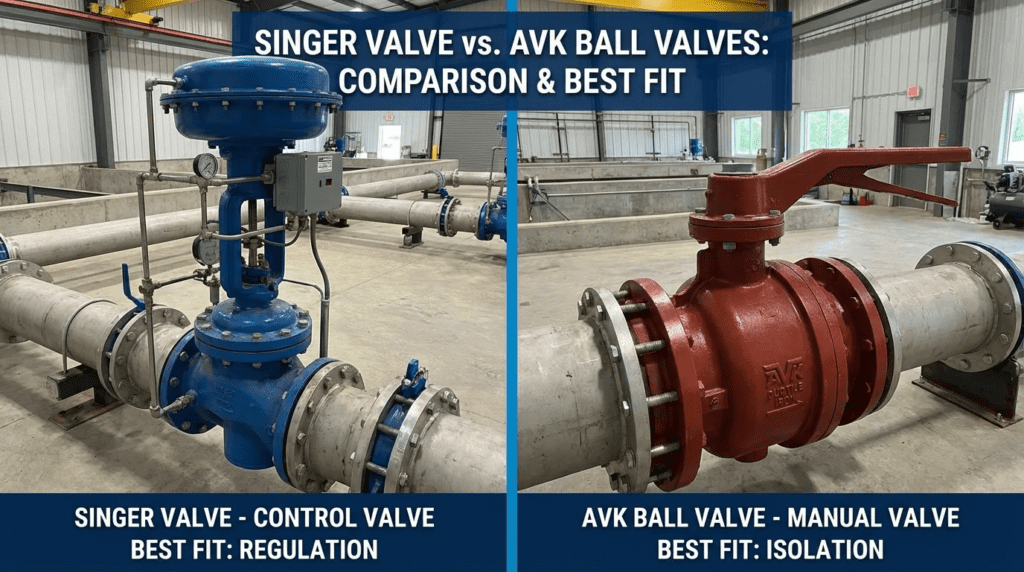
The debate often centers on two distinct technologies represented by industry leaders: the hydraulic diaphragm-actuated control valve (exemplified by Singer Valve, a Mueller brand) versus the mechanical rotary ball valve (exemplified by AVK). Understanding the Singer Valve vs AVK Ball Valves Equipment: Comparison & Best Fit is not merely a brand preference exercise; it is a fundamental choice between two different hydraulic philosophies. Singer valves utilize line pressure and complex pilot systems to achieve precise modulation, pressure reduction, and flow control. In contrast, AVK ball valves utilize mechanical gearboxes or actuators to provide full-bore isolation or low-head-loss pump control.
Typical applications for these technologies overlap in pump stations (pump control valves) and reservoir management, but diverge significantly in distribution networks. This article provides a rigorous, engineer-focused analysis to help you specify the correct equipment, minimize cavitation risks, and optimize lifecycle costs (LCC) for your specific hydraulic conditions.
How to Select / Specify
When evaluating Singer Valve vs AVK Ball Valves Equipment: Comparison & Best Fit, the engineer must move beyond simple pipe diameter matching. The selection process requires a granular analysis of hydraulic behavior, energy considerations, and the physical constraints of the facility. The following criteria define the engineering boundary between selecting a diaphragm-style Automatic Control Valve (ACV) and a rotary Ball Valve.
Duty Conditions & Operating Envelope
The primary differentiator between these technologies is how they handle pressure and flow energy.
- Head Loss Constraints: If the primary design constraint is minimizing head loss to reduce pumping costs, the AVK ball valve is generally superior. A full-port ball valve offers a flow coefficient ($C_v$) significantly higher than a globe-pattern ACV. For example, in a 12-inch line, a ball valve acts virtually as a straight pipe when open, whereas a globe-style Singer valve forces flow through a tortuous path, inducing permanent pressure drop even at 100% open.
- Modulation vs. Isolation: If the application requires precise pressure regulation (e.g., holding downstream pressure to exactly 50 psi despite fluctuating inlet pressure), a Singer ACV with a pressure-reducing pilot is the correct choice. Ball valves generally have a high “recovery factor” and non-linear characteristics that make them difficult to use for precise pressure throttling without specialized V-port trims and high-resolution actuators.
- Flow Velocities: Ball valves can typically handle higher velocities (up to 20-25 ft/s intermittently) because the flow path is streamlined. ACVs are generally sized for velocities below 15 ft/s to prevent excessive noise, vibration, and pilot instability.
Materials & Compatibility
The material build affects longevity, particularly in wastewater or aggressive water applications.
- Singer (ACV): Typically constructed of Ductile Iron (ASTM A536) with an epoxy coating. The critical internal components involve stainless steel seats, stems, and elastomeric diaphragms (EPDM/Buna-N). The limitation here is the diaphragm life and the susceptibility of the pilot tubing system to clogging if solids are present.
- AVK (Ball): Also Ductile Iron with heavy epoxy or PU coatings. The ball itself is often stainless steel or encapsulated. The critical wear points are the trunnion bearings and the seat rings. For wastewater containing grit, the ball valve (specifically designed for wastewater) is often more robust as it lacks the small pilot passages that define the ACV.
Hydraulics & Process Performance
Understanding the hydraulic curve is essential.
- Cavitation ($ sigma $): Singer valves offer specialized anti-cavitation trim (cages) that break down pressure differentials in stages. This makes them the definitive choice for high-pressure-drop applications (e.g., filling an empty reservoir from a high-pressure zone). Standard ball valves in throttling service are highly susceptible to cavitation damage on the trailing edge of the ball and seat.
- Surge Control: Singer offers dedicated surge anticipation valves that open proactively on pump trip. AVK ball valves, used as pump control valves, rely on slow closure speeds (via battery backup or hydraulic accumulation on the actuator) to mitigate surge. The selection depends on the surge analysis: do you need to relieve a pressure spike (Singer) or prevent column separation through controlled closure (AVK/Singer)?
Installation Environment & Constructability
Space and orientation can dictate the selection.
- Footprint: ACVs (Singer) usually have a globe body which may have a wider face-to-face dimension or a different centerline offset compared to ball valves. However, ACVs are self-contained; they do not require external power for modulation (using line pressure).
- Power Requirements: To automate an AVK ball valve for control, you need a substantial electric or pneumatic actuator. This adds to the electrical design burden (cabling, UPS for fail-safe). Singer valves generally require no power unless solenoid override is specified, which is low voltage/low wattage.
- Orientation: Large ball valves often require horizontal installation to manage bearing loads. ACVs are more flexible regarding vertical flow, though support for the heavy bonnet assembly is required on large sizes.
Reliability, Redundancy & Failure Modes
How the valve fails is a critical safety consideration.
- Fail-Safe State: Singer valves can be configured to fail open, fail closed, or hold position upon loss of pilot pressure or diaphragm failure, depending on the pilot schematic.
- Complexity: The pilot system on a Singer valve is complex, resembling a hydraulic circuit board. A failure in a small sensing line affects the whole valve. An AVK ball valve is mechanically simpler but relies on the reliability of the external actuator and gearbox.
- MTBF: Diaphragms are wear items with a lifespan of 5-10 years depending on cycling. Ball valve seats can last 20+ years in clean water service but are expensive to replace (often requiring valve removal).
Lifecycle Cost Drivers
The Total Cost of Ownership (TCO) analysis often flips the initial price comparison.
- Energy: In high-flow pump stations, the head loss across a globe-style pump control valve (Singer) can amount to thousands of dollars in wasted electricity annually compared to a full-port ball valve (AVK).
- Maintenance: ACVs require skilled technicians to troubleshoot pilot systems. Rubber kits are cheap, but labor is high. Ball valves require little routine maintenance, but catastrophic failure (seized trunnion) is a capital replacement event.
Comparison Tables
The following tables provide a direct side-by-side analysis to assist engineers in determining the appropriate technology for specific facility types. These tables contrast the fundamental technologies represented by Singer (Diaphragm ACV) and AVK (Ball Valve).
| Feature / Criteria | Singer (Diaphragm ACV) | AVK (Ball Valve) |
|---|---|---|
| Primary Mechanism | Hydraulic pilot-operated globe/angle body with flexible diaphragm. | Rotary action (quarter-turn) with trunnion-mounted or floating ball. |
| Flow Regulation (Throttling) | Excellent. Linear or equal percentage capabilities; specialized cages for high $Delta P$. | Poor to Fair. Non-linear; high gain near closure. Requires V-port trim for decent control. |
| Head Loss (Wide Open) | Moderate/High. Tortuous flow path through the seat and bridge. | Negligible. Full bore designs offer essentially zero restriction. |
| Energy Efficiency | Lower efficiency (parasitic pressure drop). | Highest efficiency (minimal friction loss). |
| Power Requirement | None (operates on line pressure). Solenoids optional for SCADA. | Requires electric, pneumatic, or hydraulic actuator for automation. |
| Wastewater Suitability | Limited. Requires clean water supply for pilots or separation diaphragms. | High. Full port designs allow solids passage without clogging. |
| Maintenance Profile | Higher frequency (pilot strainers, diaphragm fatigue). Low parts cost. | Low frequency (exercising). High repair cost if seats/bearings fail. |
| Pressure Management | Primary function (PRV, PSV, Altitude). | Not applicable (used only for isolation or flow rate control). |
| Application Scenario | Best Fit Tech | Why? | Engineer’s Note |
|---|---|---|---|
| Pressure Reducing Station (District) | Singer ACV | Requires constant downstream pressure regardless of flow demand. | Use dual-stage or low-flow bypass for varying demands. |
| Pump Discharge Control (Raw Water) | AVK Ball | Minimize head loss; handle raw water solids; slow open/close for surge. | Specify battery backup on actuator for power-failure closure. |
| Pump Discharge Control (Clean Water – High Head) | Singer ACV | Precise check function; modulation capability; lower CAPEX than actuated ball. | Ensure pump head can overcome valve’s inherent pressure drop. |
| Transmission Main Isolation | AVK Ball | Tight shutoff; negligible pressure drop; reliable infrequent operation. | ACVs are not rated for positive isolation safety (Lockout/Tagout). |
| Surge Relief / Anticipation | Singer ACV | Fast reaction time (<1s) driven by hydraulic pilots to dump pressure. | Ball valves are too slow to react to water hammer waves. |
| Reservoir Altitude Control | Singer ACV | Hydraulic level sensing without external power or complex wiring. | One-way flow altitude valves prevent tank overflow efficiently. |
Engineer & Operator Field Notes
Real-world experience often diverges from the catalog data. The following notes are compiled from field service reports, commissioning logs, and operator feedback regarding the Singer Valve vs AVK Ball Valves Equipment: Comparison & Best Fit conversation.
Commissioning & Acceptance Testing
Singer Valves: The most critical step in commissioning a Singer valve is bleeding air from the bonnet cover. Trapped air is compressible and leads to “hunting” (rapid oscillation) or sluggish response. During the Site Acceptance Test (SAT), engineers must verify the pilot setpoints. A common issue is the speed of control controls (needle valves) being set too fast, causing the valve to slam shut.
AVK Ball Valves: Commissioning focuses heavily on the actuator limits. The “open” and “closed” limit switches must be set precisely. If an electric actuator overdrives a ball valve into the mechanical stop, it can shear the stem or damage the gearbox. For pump control applications, the opening/closing times must be timed with a stopwatch to match the surge analysis recommendations (typically 60-180 seconds).
Common Specification Mistakes
One of the most frequent errors in specifying ACVs (Singer) is oversizing. Engineers often match the valve size to the line size. However, ACVs operate best when they have significant lift. An oversized valve will operate near the seat (cracked open), leading to “wire drawing” (erosion of the seat) and instability. Pro Tip: It is common and correct to spec a Singer valve one size smaller than the main line.
Conversely, for AVK ball valves, undersizing the actuator is a common pitfall. The “break-away torque” required to open a ball valve after it has sat stationary for months is significantly higher than the running torque. Specifications should require a safety factor of at least 1.5x to 2.0x on the actuator torque rating relative to the valve’s maximum break torque.
O&M Burden & Strategy
Singer O&M:
- Monthly: Inspect for external leaks at pilot fittings.
- Quarterly: Clean the wye strainer on the pilot line. This is the #1 cause of failure.
- 5-7 Years: Replace the main diaphragm and seat disc. This is a confined space task if the valve is in a vault.
AVK O&M:
- Semi-Annually: Cycle the valve (partial stroke) to prevent seal adhesion and verify actuator function.
- Annually: Check gearbox oil levels and grease trunnion bearings if accessible.
- 20+ Years: Major overhaul. Note that replacing the seats on large diameter ball valves often requires removing the valve from the line and sending it to a shop.
Troubleshooting Guide
Singer: Usually indicates a clogged pilot supply line (no pressure getting to the bonnet to push the diaphragm down) or a ruptured diaphragm.
AVK: Usually an actuator fault (power loss, thermal overload) or debris stuck between the ball and seat preventing full rotation.
Design Details / Calculations
Sizing Logic & Methodology
Proper sizing validates the choice between Singer Valve vs AVK Ball Valves Equipment.
Sizing a Singer ACV
The sizing is based on the flow coefficient ($C_v$) and the allowable pressure drop.
Formula: $Delta P = SG times (Q / C_v)^2$
Where $Q$ is flow in GPM and $SG$ is specific gravity (1.0 for water).
Engineers must calculate the valve position at minimum, average, and peak flows.
- Ideally, the valve should be 20-30% open at minimum flow and no more than 80-90% open at peak flow.
- Check the Cavitation Index ($sigma = (P_{down} – P_{vapor}) / (P_{up} – P_{down})$). If $sigma < 0.5$ (approx), standard trims will cavitate. Singer offers anti-cavitation cages for these zones.
Sizing an AVK Ball Valve
Sizing is simpler but focused on velocity and torque.
- Ensure line velocity does not exceed manufacturer ratings (typically 15-20 ft/s).
- Calculate dynamic torque: $T_d = N times D^3 times Delta P$. (Simplified; consult manufacturer torque charts).
- Verify that the actuator speed can meet the $T_{closure}$ required by the surge analysis. Rapid closure of a ball valve can cause massive water hammer ($ Delta H = a times Delta V / g $).
Standards & Compliance
Ensure your specifications reference the correct standards to ensure quality.
- AWWA C530: Pilot-Operated Control Valves (The governing standard for Singer valves). Covers testing, materials, and pressure ratings.
- AWWA C507: Ball Valves, 6 In. Through 60 In. (The governing standard for AVK ball valves in municipal service).
- NSF 61/372: Mandatory for all potable water applications (lead-free and toxicology).
- NEMA 4X / IP68: Essential ratings for electric actuators or solenoids in damp valve vaults.
Frequently Asked Questions
What is the main difference between a Singer control valve and an AVK ball valve?
The main difference lies in the actuation method and hydraulic profile. A Singer valve is a diaphragm-actuated globe valve that uses the water’s own line pressure to modulate position, making it ideal for pressure and flow regulation. An AVK ball valve is a rotary valve requiring external mechanical force (actuator) to move, offering a full-bore opening ideal for isolation and low-head-loss pumping applications.
Can I use an AVK ball valve for pressure reducing service?
Technically yes, but it is generally not recommended for precise control. Ball valves have a high recovery factor and non-linear flow characteristics. To use one for pressure reducing, you would need a specialized V-port ball and a high-resolution actuator. Even then, they are prone to cavitation in high-pressure-drop scenarios where a Singer valve with anti-cavitation trim would be the standard engineering choice.
Which valve type has a lower lifecycle cost?
It depends on the application. For a pump isolation or pump control valve where the valve spends 99% of its life fully open, the AVK ball valve has a lower lifecycle cost due to significant energy savings (near-zero head loss). For a pressure reducing station, the Singer valve has a lower lifecycle cost because it performs the complex hydraulic duty reliably without the need for expensive power infrastructure and complex automation programming.
How often does a Singer valve diaphragm need replacement?
In typical municipal water applications, a Singer diaphragm lasts between 5 to 10 years. However, in applications with extreme cycling (continuous modulation) or high pressures, this may reduce to 3-5 years. Regular inspection of the pilot strainers extends the system’s overall reliability significantly.
Why is there a wye strainer installed before my Singer valve?
The pilot system of a Singer valve uses small tubing and orifices to control the main valve. Debris, rust, or grit in the water can clog these small passages, causing the valve to fail (either sticking open or closed). The wye strainer acts as the primary protection for this sensitive hydraulic control circuit.
When should I specify a ball valve over a control valve for pump control?
Specify a ball valve (AVK) for pump control when: 1) Energy efficiency is a critical driver (high flows, long operating hours), 2) The fluid contains solids or wastewater, or 3) You have reliable onsite power and require the valve to be integrated into a complex digital control system (SCADA) via an electric actuator.
Conclusion
Key Takeaways
- Energy vs. Control: Choose AVK Ball Valves for pump discharge to save energy (low head loss). Choose Singer ACVs for pressure regulation and surge relief where hydraulic precision is paramount.
- Actuation Logic: Singer valves use line pressure (hydraulically efficient, no external power). AVK control valves require electric/pneumatic actuators (easier SCADA integration but higher infrastructure cost).
- Sizing Matters: Never line-size a Singer valve for control; typically size down to ensure authority. AVK ball valves should typically match line size to maximize flow efficiency.
- Solids Handling: Avoid pilot-operated valves (Singer) in raw sewage applications unless strictly necessary and equipped with separation diaphragms. Ball valves are superior for wastewater.
- Maintenance Strategy: Singer requires technician-level skill for pilot troubleshooting. AVK requires mechanical maintenance for actuators and gearboxes.
The “Singer Valve vs AVK Ball Valves Equipment: Comparison & Best Fit” decision ultimately relies on defining the primary hydraulic objective. If the goal is dissipating energy (reducing pressure, relieving surge), the friction-inducing design of the Singer globe style valve is a feature, not a bug. It is the industry standard for hydraulic regulation. Conversely, if the goal is conserving energy (pump isolation, flow transmission), the unobstructed bore of the AVK ball valve provides the most efficient solution.
Successful facility design often employs both: AVK ball valves for isolation and pump control on the main line, with Singer valves handling bypass pressure relief, surge anticipation, or downstream pressure management. By matching the valve’s mechanical attributes to the system’s hydraulic needs, engineers can ensure reliability, safety, and optimized lifecycle costs.