
SPX Lightnin vs Philadelphia Mixing for Mixers: Pros/Cons & Best-Fit Applications
Introduction
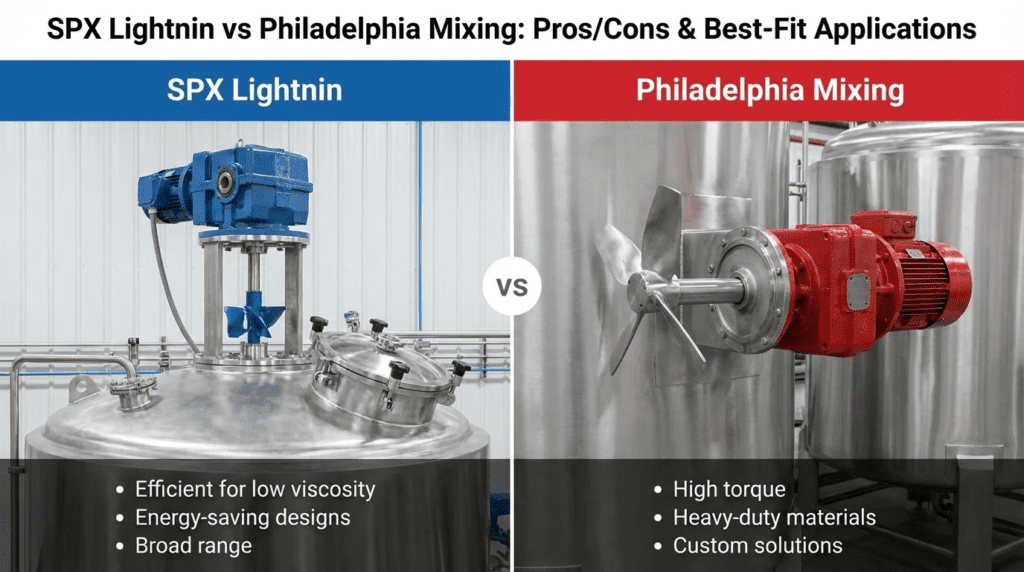
In the realm of fluid dynamics and mechanical processing, the mixing unit is often the heartbeat of a treatment train. For decades, engineers have faced a binary choice when specifying heavy-duty agitation equipment for critical municipal and industrial infrastructure. A comparative analysis of SPX Lightnin vs Philadelphia Mixing for Mixers: Pros/Cons & Best-Fit Applications reveals more than just a brand preference; it highlights two distinct engineering philosophies regarding torque transmission, impeller hydrodynamics, and service longevity. While SPX FLOW acquired Philadelphia Mixing Solutions (PMSL) in 2021, the legacy product lines, installed base, and design approaches remain distinct entities in the field. Understanding these differences is critical for retrofits, new capital projects, and standardization strategies.
Mixing equipment is ubiquitous in water and wastewater treatment, found in applications ranging from rapid flash mixing and flocculation to biological nutrient removal (BNR) zones and anaerobic digestion. In industrial settings, these units handle complex chemical blending and solids suspension. However, a mixer is more than a motor on a stick. It is a complex assembly of forces where shaft deflection, critical speed, and gearbox service factors dictate reliability.
The consequences of poor selection are severe. An undersized gearbox in a digester can lead to catastrophic failure requiring crane extraction and months of downtime. Conversely, specifying a custom, heavy-duty unit for a simple chemical make-down tank wastes capital budget. This article provides a rigorous, engineer-to-engineer breakdown of how to navigate the technical specifications, separating marketing claims from hydraulic reality to ensure process compliance and mechanical integrity.
How to Select and Specify
When analyzing SPX Lightnin vs Philadelphia Mixing for Mixers: Pros/Cons & Best-Fit Applications, the selection process must move beyond horsepower ratings. Horsepower is a measure of energy consumption, but torque is the measure of process capability. The following criteria outline the engineering workflow for specifying the correct equipment regardless of the manufacturer.
Duty Conditions & Operating Envelope
The operating envelope defines the mechanical stresses the mixer will endure. Engineers must define the “process torque” required to achieve the desired mixing result and compare it against the “mechanical capacity” of the gearbox and shaft.
- Torque Requirements: Calculate the specific torque (inch-pounds) based on the impeller diameter, power number (Np), and fluid density. Philadelphia Mixing largely built its reputation on high-torque, low-speed applications (like digesters), whereas Lightnin has historically dominated high-speed to medium-speed standard applications.
- Fluid Rheology: Non-newtonian fluids (sludge) behave differently under shear than water. Viscosity changes with shear rate must be modeled to prevent motor overload during startup.
- Variable Frequency Operation: If using VFDs, verify the mixer’s critical speed. Operating near a natural frequency (critical speed) leads to destructive resonance. Specifications should require the first critical speed to be at least 125% of the maximum operating speed.
Materials & Compatibility
Material selection drives the CAPEX significantly but prevents premature failure due to corrosion or abrasion.

- Wetted Parts: Standard specification is 316SS. However, for high-chloride industrial wastewater or ferric chloride handling, Hastelloy or rubber-lined carbon steel may be required.
- Abrasion Resistance: In grit chambers or lime slurry applications, standard stainless steel impellers will erode. Hard-facing or specialized alloys are necessary.
- Gearbox Housing: Look for cast iron construction with high-grade epoxy coatings. In highly corrosive headspaces (like anaerobic digesters with high H2S), the paint specification is as critical as the metal itself.
Hydraulics & Process Performance
The core function of the mixer is to generate flow and shear. The balance between these two depends entirely on the impeller design.
- Flow vs. Shear: Flocculation requires high flow but very low shear to prevent floc breakup. Flash mixing requires high shear. Lightnin’s A310 impeller is a benchmark for high-flow efficiency, while Philadelphia’s Raven hydrofoils are often cited for their deep-tank pumping efficiency.
- G-Value (Velocity Gradient): For water treatment, the G-value ($s^{-1}$) is the governing process parameter. Ensure the manufacturer provides calculations validating the G-value at the specified water temperature and viscosity.
- Impeller Positioning: The distance from the tank bottom (off-bottom clearance) affects solids suspension. Incorrect positioning creates dead zones (fillets) where solids settle and become septic.
Installation Environment & Constructability
A mixer that performs well on paper must still be installable and maintainable in the field.
- Headroom: Top-entry mixers require significant vertical clearance for shaft installation. If headroom is limited, a split-shaft design or a side-entry configuration might be necessary.
- Support Structure: The bridge or flange must withstand not just the static weight, but the dynamic bending moment and torque reaction. Pro Tip: Never rely solely on the mixer OEM’s weight data; apply a safety factor for dynamic loads caused by fluid forces (ragging on impellers).
- Electrical Classification: Digesters and certain industrial zones are Class 1, Div 1 environments. Motors and instrumentation must be explosion-proof.
Reliability, Redundancy & Failure Modes
Reliability in mixing is dictated by the gearbox and the seal.
- Gearbox Service Factor: Adhere to AGMA (American Gear Manufacturers Association) standards. A minimum service factor of 1.5 or 2.0 is recommended for continuous wastewater duty. This accounts for shock loads from rags or power surges.
- L10 Bearing Life: Specify an L10 life (the number of hours 90% of bearings will survive) of at least 100,000 hours.
- Seals: For tanks emitting hazardous gases (digesters), double mechanical gas seals are required. For open basins, simple vapor seals or lip seals may suffice, but they leak eventually.
Lifecycle Cost Drivers
The purchase price is often 10-15% of the 20-year total cost of ownership (TCO). The primary drivers are energy and maintenance.
- Energy Efficiency: A hydrofoil impeller (like the Lightnin A310 or PMSL Raven) can draw 30-40% less power than a pitch-blade turbine for the same flow. Over 20 years, this energy savings dwarfs the initial equipment cost.
- Oil Changes: Large gearboxes require significant volumes of synthetic oil. Check the required oil change intervals. Some modern units offer “lubed for life” bearings, but main gearboxes always require fluid management.
Comparison Tables: SPX Lightnin vs Philadelphia Mixing
The following tables provide a structured comparison to assist in decision-making. Table 1 compares the technical pedigree and typical market positioning of the two brands (acknowledging their corporate integration while respecting their product line history). Table 2 provides an application fit matrix to guide specification.
Table 1: Technical & Product Line Comparison
| Feature / Criteria | SPX Lightnin (Legacy & Current) | Philadelphia Mixing (Legacy & PMSL Line) |
|---|---|---|
| Primary Design Philosophy | Standardization, modularity, and catalog-based engineering. High emphasis on impeller efficiency (A310). | Custom, heavy-duty engineering. Emphasis on massive torque transmission and rugged gearbox construction. |
| Gearbox Architecture | Often utilizes commercial drives or proprietary light-to-medium duty boxes (Series 10, 70/80). | Known for proprietary, heavy-duty helical and spiral bevel gear drives designed specifically for mixing loads (UniFirst, Raven). |
| Impeller Technology | A310 (Hydrofoil) is the industry standard for flow-controlled applications. Excellent efficiency. | Raven and PVE hydrofoils. Known for high pumping capacity and handling ragged flows well. |
| Typical Torque Range | Dominant in low to medium torque (0.5 HP to 100 HP typical standard range). | Dominant in high to extreme torque (Digesters, massive blending tanks, 100 HP+ high-viscosity). |
| Maintenance Profile | Designed for ease of replacement. Parts are often stocked globally. Dry-well construction common on larger units. | Designed for longevity (overhaul intervals). Parts may have longer lead times due to custom nature. |
| Best-Fit Scenario | Open basins, flocculation, flash mix, chemical storage, general industrial blending. | Anaerobic digesters, large biological reactors, high-viscosity industrial applications. |
Table 2: Application Fit Matrix
| Application | Critical Parameter | Lightnin Fit | Philadelphia Fit | Selection Notes |
|---|---|---|---|---|
| Flash Mixing | High Shear / Short Residence | Excellent | Good | Lightnin’s standard high-speed units are cost-effective and perfectly sized for rapid mix chambers. |
| Flocculation | Low Shear / High Flow | Excellent | Good | The A310 impeller allows for large diameters with low shear, critical for floc formation. |
| Anaerobic Digestion | Pumping / Ragging / Sealing | Good | Excellent | PMSL’s legacy in digesters is strong due to robust draft tube designs and heavy gearboxes handling sludge crusts. |
| Anoxic/Anaerobic Selectors | Suspension / Efficiency | Very Good | Very Good | Both offer submersible and top-entry options. Selection often comes down to lifecycle cost analysis. |
| Chemical Makeup | Solids Suspension | Excellent | Overkill | For polymer or lime, Lightnin portable or small top-entry units are the industry standard. |
| Aeration (Surface) | Oxygen Transfer | Good | Good | Low-speed surface aerators are a niche; usually, specific aeration companies are preferred, but both brands supply them. |
Engineer & Operator Field Notes
Real-world performance often deviates from the datasheet. The following insights are gathered from commissioning reports, maintenance logs, and root cause failure analyses (RCFA) involving both equipment lines.
Commissioning & Acceptance Testing
The Site Acceptance Test (SAT) is the final gate before the equipment becomes the plant’s responsibility. Do not sign off until these criteria are met:
- Vibration Baseline: Establish a vibration baseline (velocity in in/s or mm/s) immediately upon startup. Both SPX Lightnin and Philadelphia units should run smoothly. High vibration at startup usually indicates shaft misalignment, critical speed issues, or structural weakness in the support bridge—not necessarily a bad gearbox.
- Amperage Draw: Verify that the motor amperage under load (water or process fluid) matches the calculated design point. If a Lightnin A310 impeller is drawing 15% more power than predicted, check for baffling issues or vortexing.
- Seal Integrity: For digester mixers, perform a pressure hold test on the gas seal if possible, or use a gas sniffer during initial operation to verify zero leakage.
Common Specification Mistakes
Engineers often specify a Lightnin model “or equal” but fail to define the G-value. A competitor might supply a mixer with the same horsepower but a smaller impeller running faster. This meets the HP spec but generates high shear instead of flow, shearing floc particles and ruining the process. Always specify Impeller Diameter and Pumping Capacity (GPM), not just HP.
- Ignoring Tank Geometry: A mixer specified for a round tank will perform poorly in a square tank without baffles. The fluid will simply swirl (solid body rotation) rather than mix top-to-bottom. Baffling requirements must be part of the mixer submittal.
- Undersizing for Ragging: In wastewater, rags accumulate on impellers, effectively changing their shape and increasing drag. Specifications for raw sewage mixers must include a “Ragging Service Factor” or require self-clearing impeller designs.
O&M Burden & Strategy
Maintenance teams generally report different experiences with these brands based on the size of the equipment.
- Oil Analysis: Implement a quarterly oil analysis program for large gearboxes. Look for spikes in iron (gear wear) or bronze (bearing cage/worm gear wear). This predictive step can save a $50,000 gearbox from catastrophic seizure.
- Shaft Runout: Check shaft runout at the seal annually. Excessive runout is the primary killer of mechanical seals. Lightnin shafts, often being longer and thinner on standard units, require careful handling during installation to prevent bending.
- Spare Parts: Lightnin parts are often available through widespread distribution networks. Philadelphia Mixing parts, especially for older custom units, may require longer lead times or custom machining. Keep critical spares (seals, bearings) on the shelf.
Design Details and Calculations
To rigorously evaluate SPX Lightnin vs Philadelphia Mixing for Mixers: Pros/Cons & Best-Fit Applications, engineers must verify the core sizing logic used by the vendors.
Sizing Logic & Methodology
The fundamental equation governing mixer selection is the Power Equation:
$$ P = N_p times rho times N^3 times D^5 $$
Where:
- P = Power (Watts or HP)
- Np = Power Number (Impeller constant, e.g., ~0.3 for A310, ~1.3 for Pitch Blade)
- ρ (rho) = Fluid Density
- N = Rotational Speed (RPS)
- D = Impeller Diameter
Analysis: Note that Power is proportional to Diameter to the 5th power ($D^5$). A small increase in impeller diameter allows for a significant reduction in speed ($N$) to achieve the same power. Lower speed generally means longer gearbox life and less shear. Philadelphia Mixing designs often favor maximizing $D$ and minimizing $N$ for heavy sludge.
Specification Checklist
Ensure your RFP or bid package includes the following mandatory data points:
- Torque Rating: Continuous and peak torque ratings of the gearbox.
- AGMA Service Factor: Minimum 1.5 for electric motors; higher for diesel drives.
- L10 Bearing Life: Minimum 100,000 hours.
- Critical Speed Analysis: First lateral critical speed must be >125% of operating speed.
- Impeller Type: Define hydrofoil vs. pitch blade explicitly.
- Shaft Material: Solid bar stock vs. pipe shaft (pipe is stiffer but harder to seal if submerged).
Standards & Compliance
- AGMA 6013: Standard for Industrial Enclosed Gear Drives. Ensure the gearbox meets this.
- OSHA: Guarding requirements for rotating shafts are non-negotiable.
- AWWA: While AWWA doesn’t have a specific “mixer” standard like C-series for pumps, the general equipment guidelines for coating and materials apply.
Frequently Asked Questions
What is the relationship between SPX Lightnin and Philadelphia Mixing Solutions?
SPX FLOW acquired Philadelphia Mixing Solutions Ltd. (PMSL) in 2021. While they are now under the same corporate umbrella, the product brands, engineering archives, and specific technologies (like the Philadelphia Raven impeller or Lightnin A310) often remain distinct in the market. Engineers can still specify specific product lines based on the legacy strengths of each brand, though support channels have merged.
How do I choose between a hydrofoil and a pitched-blade turbine?
Select a hydrofoil (like Lightnin A310 or PMSL Raven) for flow-controlled applications such as flocculation, blending, and solids suspension. They provide high flow with low shear and low energy consumption. Select a pitched-blade turbine (PBT) if you need higher shear for dispersion or if the viscosity is moderately high, though PBTs are generally less energy-efficient for simple pumping tasks.
Why is torque more important than horsepower in mixer selection?
Horsepower determines the rate of work, but torque determines the turning force available to move the fluid. In high-viscosity applications (like wastewater digesters), a mixer might run at very low RPM. A 10 HP motor running at 10 RPM generates massive torque compared to a 10 HP motor at 100 RPM. Sizing based on HP alone often leads to gearbox failure in thick sludge applications.
What is the typical lifespan of a mixer gearbox?
A properly specified mixer gearbox with an AGMA service factor of 1.5 or higher should last 15-20 years. However, seals and bearings are wear parts. Mechanical seals typically last 3-5 years depending on the abrasiveness of the fluid and shaft runout. Bearings generally follow the L10 rating (e.g., 100,000 hours), provided lubrication maintenance is performed strictly.
How does shaft length affect mixer selection?
Longer shafts increase the bending moment on the gearbox bearings and lower the shaft’s critical speed. For very deep tanks (>20 ft), engineers must carefully evaluate shaft diameter to ensure stiffness. If the shaft is too long/thin, it will whip, destroying the seal. In deep applications, steady bearings (bottom bearings) are an option but are maintenance nightmares; increasing shaft diameter or using a bump ring is preferred.
Can I use a VFD with any mixer?
Most modern mixers can run on VFDs, but you must verify the Critical Speed. Running a mixer at a reduced speed that coincides with its natural frequency will cause resonance and catastrophic failure. Always program “skip frequencies” in the VFD to avoid these resonant bands, and ensure the motor is inverter-duty rated.
Conclusion
Key Takeaways for Engineers
- Torque is King: Specify torque capacity and AGMA service factors (>1.5), not just horsepower.
- Know the Application: Use SPX Lightnin standard series for efficient, high-flow applications like flocculation and flash mix. Consider Philadelphia Mixing heritage designs for heavy-duty, high-torque digesters and anoxic zones.
- Impeller Efficiency: Hydrofoils (A310/Raven) save 30-40% on energy bills compared to older pitch-blade designs. This OPEX saving justifies higher CAPEX.
- Structural Integrity: The support bridge must handle dynamic loads, not just static weight. Neglecting this leads to vibration issues that no gearbox can withstand.
- Corporate Context: While now one company, the engineering pedigrees remain relevant for matching replacement parts and understanding design intent in existing plants.
Selecting between SPX Lightnin vs Philadelphia Mixing for Mixers: Pros/Cons & Best-Fit Applications ultimately comes down to matching the machine to the process intensity. Lightnin’s legacy of optimization and standardization makes it the go-to for general water and wastewater treatment processes where efficiency and speed of delivery are paramount. Philadelphia Mixing’s heritage of brute-force engineering and custom hydraulics remains the benchmark for the most punishing environments in the plant, such as anaerobic digestion and thick sludge handling.
For the consulting engineer or plant director, the goal is to write a specification that defines the performance (G-value, pumping capacity, service factor) rather than simply listing a model number. By focusing on hydraulic physics and mechanical robustness, you ensure that whichever brand plate ends up on the gearbox, the equipment will survive the 20-year lifecycle demanded by public infrastructure.