SSI vs Sanitaire Aeration Equipment: Comparison & Best Fit
Introduction
Aeration systems consume a large share of a typical activated sludge wastewater treatment plant’s total energy budget — commonly cited at 50 to 60 percent of process energy, and higher at plants with deep tanks or high nitrogen loads. Consequently, the selection of aeration hardware is one of the most consequential decisions a consulting engineer or plant director can make. A difference of merely 1-2% in Standard Oxygen Transfer Efficiency (SOTE) or a marginal increase in dynamic wet pressure (DWP) due to fouling can translate to hundreds of thousands of dollars in excess operational expenditure over a 20-year lifecycle. Yet specifications often default to “or equal” clauses that treat distinct technologies as commodities.
When evaluating the market leaders, engineers frequently encounter the SSI versus Sanitaire decision matrix. Both Xylem’s Sanitaire brand and SSI Aeration (Stamford Scientific International) are established manufacturers in the municipal and industrial sectors. Sanitaire is often viewed as the industry standard-bearer with a large installed base dating back to the early development of the fine bubble disc, while SSI has built market share through material science, particularly in PTFE-coated membranes. However, selecting between them requires looking beyond brand recognition to the physics of bubble formation, membrane chemistry, and mechanical integrity.
This article provides a rigorous technical analysis for engineering professionals. It moves beyond marketing claims to examine the hydraulic performance, material limitations, and long-term reliability of these systems. By understanding the nuanced differences in diffuser geometry, membrane composition, and piping support systems, engineers can optimize their specifications for specific wastewater characteristics, ultimately ensuring process stability and minimized lifecycle costs.
A note on scope, because the title is imprecise. Neither Sanitaire nor SSI is a blower manufacturer. Both make diffused aeration equipment — membranes, discs, tubes, and the air distribution piping that carries air from the blower to the basin floor. That is what this article compares, and it is a real and frequent specification decision. Blower selection is a separate exercise against a different set of manufacturers; see our comparison of Atlas Copco and Sulzer blowers, which covers actual air generation equipment.
This guide sits within our coverage of aeration equipment manufacturers. See also our comparison of Kaeser and Gardner Denver for aeration.
Editorial note: two formulas on this page previously published as unrendered markup and have been rewritten in plain language. A companion article on this site, “Sanitaire vs SSI Blowers,” covers the same two companies with the word order reversed; the two pages are consolidation candidates.
How to Select / Specify
Properly navigating the SSI versus Sanitaire landscape requires a multidimensional analysis. The “best” system is invariably the one that matches the specific biological and physical constraints of the influent while maintaining mechanical integrity under stress. The following criteria should form the basis of the design and selection process.
Duty Conditions & Operating Envelope
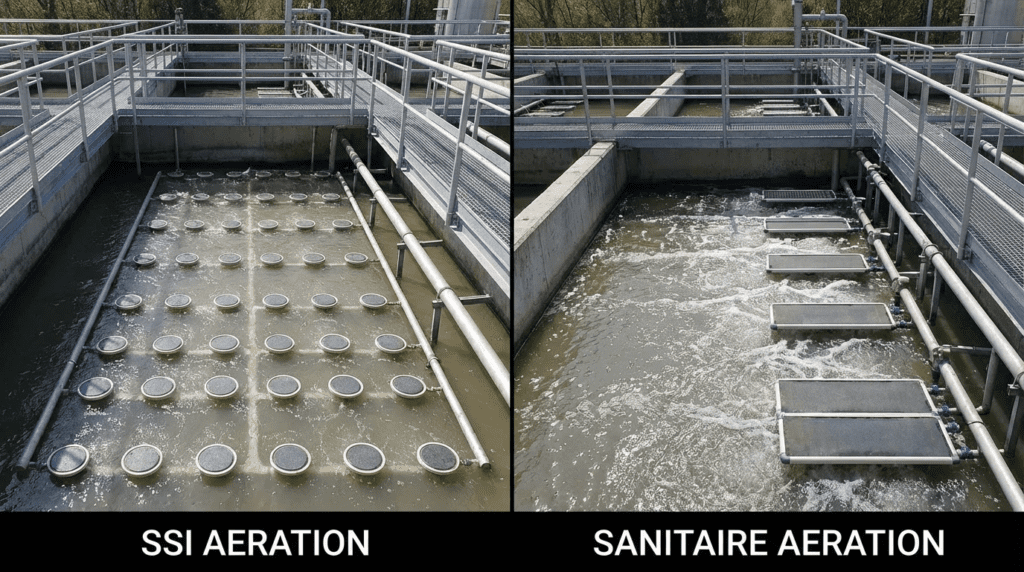
The operating envelope of a fine bubble aeration system is defined by the flux rate (scfm per diffuser) and the floor coverage. Both SSI and Sanitaire offer disc and tube diffusers, but their optimal operating points differ based on slit patterns and membrane elasticity.
- Airflow Range: Engineers must evaluate the turndown capability. A typical 9-inch disc diffuser operates best between 0.5 and 2.5 scfm. However, during diurnal low flows, the system must not weep (leak water back into the piping). Sanitaire’s varying slit patterns and SSI’s slit geometries react differently to low pressure.
- Pressure & Temperature: The blower discharge pressure is a function of static water depth plus system headloss. Headloss increases as membranes foul or age. Specifications must account for the maximum discharge pressure the blowers can handle before surge, usually calculating a fouled-diffuser safety factor of 10 to 15 inches water column.
- Intermittent vs. Continuous: For SBRs or aerobic digesters where air is turned off, the check valve function is critical. Backflow can foul the piping manifold. Both manufacturers utilize integral check valves, but their mechanisms differ in long-term reliability.
Materials & Compatibility
The single greatest differentiator in the comparison is membrane material science. The interaction between the wastewater constituents and the membrane surface determines the rate of fouling and plasticizer extraction.
- Standard EPDM: Both manufacturers offer standard compression-molded EPDM. This is suitable for typical municipal sewage. However, EPDM is susceptible to attack by fats, oils, and grease and certain solvents, which leach plasticizers, causing the membrane to shrink and become brittle.
- Coated Membranes (PTFE): SSI is widely recognized for popularizing PTFE-coated EPDM. The oleophobic nature of PTFE reduces the surface energy, making it difficult for biological slime and calcium scale to adhere. This is critical in high-solids or industrial applications. Sanitaire offers advanced membrane materials as well, often focusing on distinct EPDM blends or polyurethane in specific applications to combat similar issues.
- Silicone & Polyurethane: For high-temperature industrial wastes or streams with aggressive solvents that degrade EPDM, silicone or urethane membranes are required. Engineers must specify the chemical resistance profile based on the influent characterization.
Hydraulics & Process Performance
The core purpose of the equipment is mass transfer. SOTE is not a static number; it is a curve dependent on airflow per diffuser and diffuser density.
- SOTE Curves: Generally, SOTE decreases as airflow per diffuser increases due to bubble coalescence. Specifications should require SOTE curves derived from full-scale ASCE-compliant testing, not theoretical extrapolations.
- Alpha Factor: The ratio of oxygen transfer in wastewater to clean water. High-surfactant wastewater depresses alpha. Fine bubble diffusers typically have lower alpha values than coarse bubble, but higher overall transfer. The diffuser density impacts the spiral roll and mixing, which in turn affects the alpha factor.
- Headloss (DWP): Lower initial DWP means lower blower energy. However, the rate of DWP increase is more important. A diffuser starting at 10 inches water column that stays at 12 for five years is superior to one starting at 6 that jumps to 20 within two years due to fouling.
Installation Environment & Constructability
The mechanical interface between the aeration grid and the basin floor is a common failure point.
- Floor Levelness: Fixed grid systems require level floors, typically within 0.375 inches. If the floor slopes, adjustable pipe supports are mandatory. Both manufacturers provide adjustable stands, but the ease of adjustment in the field varies.
- Piping Systems: The choice between PVC and stainless steel is driven by thermal expansion. Aeration air is hot, often above 140°F at the drop leg. PVC requires expansion joints and proper anchoring to prevent snaking, which can snap diffuser saddles. Stainless steel is more robust but significantly more expensive.
- Floating vs. Fixed: In lagoons, retrievable or floating lateral systems are often preferred to avoid draining the basin. The ballast requirements and tensile strength of the retrieval chains or cables must be engineered to withstand mixing forces.
Reliability, Redundancy & Failure Modes
- Membrane Failure: Tearing at the slit or separation from the backing plate. Ring failures can occur if over-torqued or if the plastic creeps due to thermal cycling.
- Piping Blowout: Joint failure in PVC systems due to solvent weld errors or thermal stress.
- O-Ring Leaks: The seal between the diffuser and the pipe saddle. If this leaks, coarse bubbles emerge, killing transfer efficiency and potentially eroding the pipe saddle.
Maintainability, Safety & Access
- In-Situ Cleaning: Acid gas cleaning, with formic acid or HCl injected into the air stream, is a common method to remove scaling. The compatibility of the piping and diffuser materials with acid gas must be verified.
- Draining & Cleaning: Manual pressure washing is the most effective cleaning method. The diffusers must be robust enough to withstand high-pressure water jets without damaging the membrane surface.
- Retrievability: For plants that cannot take basins offline, liftable grids are necessary. The hoist mechanisms and guide rails must be 316 stainless steel to prevent corrosion.
Lifecycle Cost Drivers
The low-bid mentality is particularly dangerous in aeration. A 10% savings in capital cost can be erased in 18 months of energy premiums.
- Energy Consumption: Blower power rises with both airflow and discharge pressure and falls with package efficiency. High transfer efficiency reduces the airflow required; low backpressure reduces the pressure the blower must generate. Both drive the same electrical bill.
- Replacement Frequency: Standard EPDM membranes typically last 5 to 7 years. PTFE-coated or advanced polymers may last 7 to 10 years or more. The labor cost to replace thousands of membranes often exceeds the material cost.
- Cleaning Costs: Frequency of acid dosing or tank draining. Systems that foul less frequently reduce this burden.
Comparison Tables
The following tables provide a direct side-by-side analysis. Table 1 focuses on the manufacturer capabilities and technology philosophies. Table 2 provides an application fit matrix to guide selection based on plant parameters.
| Feature / Attribute | Sanitaire (Xylem Brand) | SSI Aeration (Stamford Scientific Int.) |
|---|---|---|
| Primary Market Position | Legacy brand with a large global install base. Often the basis of design in municipal specifications. | Challenger position, with growth driven by material science and competitive retrofitting of existing grids. |
| Core Diffuser Technologies | Silver Series II membrane disc, Gold Series, ceramic discs (legacy), tubular membranes. | Standard disc series, PTFE-coated EPDM, panel products, tube diffusers, quick-mount saddles. |
| Membrane Material Philosophy | Focus on high-quality proprietary EPDM blends. Polyurethane options for specific industrial needs. Emphasis on slit pattern geometry for efficiency. | Heavy focus on surface coatings to extend life and reduce fouling. Molding processes aimed at uniform membrane thickness and stress distribution. |
| Piping & Grid Systems | Extensive options in PVC and stainless steel. Retrofit options available for legacy grids. | Grommet connections and quick-install saddles. Strong focus on retrofit kits that fit competitors’ piping. |
| Best-Fit Strengths | Large municipal projects requiring proven longevity. Projects where adherence to legacy specifications is required. Integrated process guarantees. | Projects with difficult water and high fouling potential. Industrial applications. Retrofits where budget is tight but a performance upgrade is needed. |
| Limitations / Considerations | Can command a price premium. Standard EPDM may foul faster than coated options in high-scaling environments. | May face resistance in municipalities standardized on the legacy brand due to procurement policies. |
| Application Scenario | Preferred Technology Type | Considerations | Key Engineering Constraint |
|---|---|---|---|
| Standard Municipal Sewage (Low FOG) | 9-inch disc diffusers (EPDM) | Both are excellent. Decision often comes down to price and local support. | SOTE & wire-to-water efficiency |
| High Calcium / High Scaling Influent | 9- or 12-inch disc, coated or special blend | SSI lean. PTFE coating is designed to resist scale adhesion, potentially reducing acid cleaning frequency versus standard EPDM. | Backpressure (DWP) stability |
| Industrial (Dairy/Food/Pulp) | Coarse bubble or specialty fine bubble | Application dependent. If fine bubble is viable, coated membranes or polyurethane are mandatory to resist chemical attack and rapid fouling. | Membrane chemical compatibility |
| SBR / Intermittent Operation | Disc diffusers with robust check valves | Both qualified. Scrutinize the check valve design. Solids entering the header during off cycles is a major failure mode. | Backflow prevention |
| Deep Tanks (>25 ft) | Tube diffusers or panel diffusers | Tube or panel. Tubes often offer better structural integrity at depth compared to large diameter discs. Both offer robust tube options. | Structural integrity / buoyancy |
| Retrofit of Existing Grid (Budget Constrained) | Replacement diffuser heads | SSI lean. SSI markets universal replacement heads that fit several competitors’ piping systems, often with upgraded membrane materials. | Interface compatibility |
Engineer & Operator Field Notes
The difference between a successful installation and a maintenance nightmare often lies in the field execution and operational strategy, not just the hardware selection.
Commissioning & Acceptance Testing
Commissioning is the first line of defense against premature failure. For both systems, the following protocols are mandatory:
- Leveling Verification: Before filling the tank, use a laser level or water level to verify that all diffusers are within the specified tolerance of a common datum. A 1-inch variance can result in significant airflow maldistribution, with shallow diffusers taking air and deep diffusers weeping.
- Leak Testing: Fill the basin with clean water until diffusers are submerged by 2 to 4 inches. Apply airflow. Look for large coarse bubbles indicating loose retainers, missing O-rings, or cracked pipes. This must be done before the contractor leaves the site.
- DWP Baseline: Record the system pressure at the design airflow with clean water. This establishes the baseline condition. Without this number, it is impossible to track fouling rates later.
Common Specification Mistakes
- “Fine Bubble Diffuser” without material spec: Specifying simply “EPDM” allows for low-grade rubber with high plasticizer content. Specify low-plasticizer, compression-molded EPDM or PTFE-coated EPDM to ensure longevity.
- Ignoring Pipe Wall Thickness: In PVC systems, specifying Schedule 40 for drop legs in deep tanks is risky due to temperature de-rating. Schedule 80 or stainless steel is often required for the top section where air temperature is highest.
- Over-Sizing Blowers: If blowers are sized only for the maximum design condition, they may surge at the minimum mixing airflow required by the diffuser density. Ensure the diffuser minimum airflow matches the blower’s turndown limit.
O&M Burden & Strategy
- The Bump Cycle: Operators should flex the diffusers daily or weekly by ramping airflow to maximum for 5 to 10 minutes to stretch the membrane and dislodge incipient slime or scale.
- Acid Cleaning: Monitor the pressure delta. When discharge pressure rises 0.5 to 1.0 psi above baseline, initiate cleaning. Waiting too long allows scale to bridge across the membrane pores, becoming unremovable.
- Moisture Purging: Regularly open the purge lines at the end of the manifolds. Accumulated water increases static head and causes surging airflow and potential membrane tearing.
Design Details / Calculations
Sizing Logic & Methodology
The sizing process generally follows these steps:
- Determine Actual Oxygen Requirement: Based on BOD/COD load, TKN load, and respiration rates.
- Calculate Standard Oxygen Requirement: Convert to standard conditions (20°C, zero dissolved oxygen, sea level) by dividing the actual requirement by the product of the alpha factor, the driving-force ratio between field and standard saturation conditions, and the temperature correction term raised to the power of the temperature difference from 20°C. This is where the alpha factor is critical. A conservative alpha, typically 0.5 to 0.6 for municipal service, should be used unless pilot data exists.
- Select Diffuser Density: Decide on floor coverage. Higher density usually yields higher SOTE but higher capital cost. Grid density typically ranges from 10% to 25% floor coverage.
- Calculate Airflow per Diffuser: Divide total airflow by the number of diffusers and check against the manufacturer’s SOTE curve. Target range: 1.0 to 1.5 scfm per 9-inch disc for optimal efficiency.
Why Bids Are Not Comparable Until You Normalize the Assumptions
The most consequential decision in a diffused aeration procurement is not which manufacturer wins — it is whether the bids were computed on the same assumptions in the first place. They usually are not, and the engineer who does not force the issue ends up comparing arithmetic rather than equipment.
Three inputs move the answer far more than any difference between the manufacturers:
- The alpha factor. A vendor assuming 0.65 will propose fewer diffusers and a smaller blower than one assuming 0.50, and will appear cheaper on both counts. Neither number is wrong in the abstract; only one of them matches the plant. Mandate a single alpha value in the specification and require every bidder to use it.
- The fouling allowance. A design that assumes clean-water DWP for the life of the system will select a blower that cannot deliver design airflow in year four. Specify the DWP the blower must accommodate at end of membrane life, not at startup.
- Site conditions. Elevation, maximum inlet air temperature, and design wastewater temperature all change the air mass required. State them in the specification rather than leaving each bidder to assume.
Once those three are fixed, the remaining differences between proposals reflect real equipment differences — diffuser density, membrane material, and grid layout — which is what the evaluation was supposed to be about.
Specification Checklist
- Material Certification: Require independent lab analysis of the membrane rubber compound for ash content, specific gravity, and tensile strength.
- SOTE Testing: Require shop testing reports per ASCE 2-06, Measurement of Oxygen Transfer in Clean Water.
- Structural Analysis: For piping systems, require analysis demonstrating that thermal expansion and buoyancy forces will not fracture the supports.
- Warranty: A standard material warranty is one to two years. A performance warranty covering SOTE degradation is rare but valuable if negotiable.
Standards & Compliance
- ASCE 2-06: The governing standard for oxygen transfer testing.
- ASTM Standards: Specifically for PVC piping (ASTM D1785) and stainless steel (ASTM A774/A778).
- ISO 9001: Quality management systems for manufacturing consistency.
Frequently Asked Questions
What is the difference between SSI and Sanitaire membrane materials?
While both offer standard EPDM, the key differentiator is in the advanced options. Sanitaire typically utilizes proprietary EPDM blends and polyurethane for specific high-strength applications. SSI is best known for popularizing PTFE-coated EPDM membranes. The PTFE coating reduces surface energy, making the membrane oleophobic and hydrophobic, which helps prevent fouling from calcium scale and biological slime, potentially extending cleaning intervals.
How do I calculate the payback period for PTFE coated membranes?
Compare the premium cost of coated membranes against operational savings. Savings come from two sources: energy savings due to maintained lower backpressure over time, and reduced maintenance labor and replacement costs. If the coated membrane extends life from five years to eight and maintains DWP lower on average, the return is often realized within a few years at medium-to-large plants. Run the calculation with your own energy rate and labor cost rather than relying on a generic payback figure.
Can I retrofit Sanitaire discs with SSI membranes or vice versa?
Yes, in most cases. Both manufacturers utilize standard geometry discs. However, the retaining ring mechanism and the sealing bead of the membrane must be compatible with the base plate. SSI specifically markets universal replacement membranes designed to fit several competitor holders. Always request a sample for a fit test before ordering bulk replacements.
When should I choose tube diffusers over disc diffusers?
Tube diffusers are often preferred in narrow tanks, deep tanks, or channels such as oxidation ditches where floor coverage with discs is difficult. They also offer higher physical strength. However, discs generally offer slightly higher SOTE per unit of airflow. In retrievable systems, tubes are often preferred for their streamlined shape which is less prone to snagging during retrieval.
How often should aeration diffusers be replaced?
Standard EPDM membranes typically have a service life of 5 to 7 years in municipal wastewater. PTFE-coated or advanced polymer membranes can last 7 to 10 years or more. Replacement is indicated when DWP increases beyond the blower’s capacity, SOTE drops significantly, or physical brittleness leads to tearing. Proactive replacement is cheaper than emergency repairs.
Why does the alpha factor matter in manufacturer selection?
The alpha factor is primarily a function of the wastewater chemistry, not the diffuser brand. However, the diffuser layout and bubble density influence it by changing the mixing regime. A manufacturer that provides a higher density layout may achieve a slightly better alpha factor by reducing bubble coalescence. When comparing bids, ensure the proposed layout densities are similar to make a valid comparison.
Conclusion
Key Takeaways
- Standardization vs. Innovation: Sanitaire represents the proven, widely installed standard ideal for risk-averse municipal applications. SSI represents a materials-focused approach ideal for difficult waters or efficiency-driven retrofits.
- Material Matters: In high-fouling or industrial applications, standard EPDM is often insufficient. Coated membranes or specialty polymers are necessary to control lifecycle costs.
- Hydraulics are Key: Always compare SOTE curves at the specific airflow per diffuser intended for operation, not just peak capacity.
- Retrofit Potential: Existing grids can often be upgraded with newer membrane technology from either vendor without replacing the piping, provided the interface mechanics are verified.
- Total Cost of Ownership: Energy costs dominate the lifecycle. A slightly more expensive diffuser that maintains lower headloss over five years is vastly cheaper than a low-cost commodity diffuser.
The decision is rarely a binary choice between good and bad. Both manufacturers produce equipment capable of meeting rigorous environmental standards. The engineering challenge lies in matching the specific strengths of the equipment to the unique constraints of the treatment plant.
For municipal utilities with established standard operating procedures and a preference for long-term supply chain stability, Sanitaire remains a robust choice with extensive historical data. For facilities facing challenging influent characteristics, high energy costs, or the need to extend the life of existing infrastructure through retrofits, SSI’s focus on coating technologies and material longevity offers a compelling engineering advantage.
Ultimately, the successful deployment of either system depends on a specification that rigorously defines the duty points, demands verified testing data, and incorporates a realistic maintenance strategy for the decades of service ahead.