
SUEZ vs Ovivo MBBR/IFAS Equipment: Comparison & Best Fit
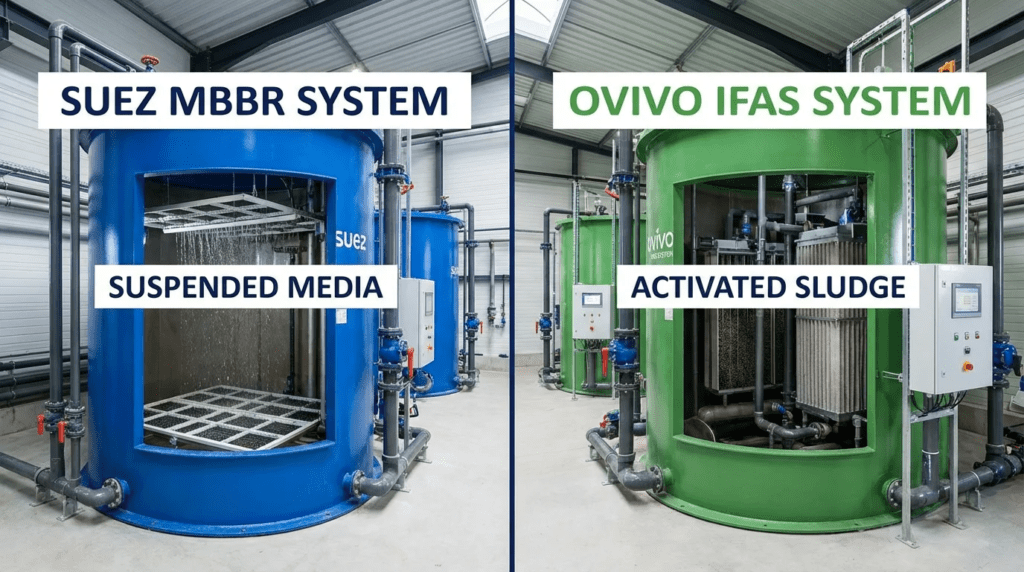
SUEZ vs Ovivo MBBR/IFAS Equipment: Comparison & Best Fit
Introduction
For municipal and industrial wastewater engineers, the decision to implement Moving Bed Biofilm Reactor (MBBR) or Integrated Fixed-Film Activated Sludge (IFAS) technology usually stems from a single pressing constraint: more biological treatment capacity is needed within a fixed, often land-locked footprint. The concept of biofilm carriers is well established, but treating plastic media as a commodity leads to critical specification errors. The failure point is rarely the media. It is the integration of media retention, aeration grids and hydraulic profile.
A corporate note belongs up front in any SUEZ vs Ovivo MBBR/IFAS Equipment: Comparison & Best Fit evaluation. SUEZ Water Technologies & Solutions was acquired by Veolia, so the SUEZ technologies discussed here are now supplied through Veolia Water Technologies. The METEOR brand and other legacy product names remain in existing specifications, engineering archives and equipment nameplates, which is why the older name persists in procurement documents. Ovivo remains an independent supplier.
These technologies are primarily used in activated sludge retrofits to achieve biological nutrient removal, or in industrial pretreatment for high-rate organic removal. The operating environment is harsh: screens face constant abrasion, and aeration grids must manage the altered oxygen transfer characteristics the media creates. Poor selection produces media washout, screen blinding requiring manual cleaning, or dead zones where carriers stagnate.
Broader supplier positioning is covered in our overview of the top MBBR and IFAS manufacturers.
How to Select and Specify
Duty Conditions & Operating Envelope
The primary driver is the biological objective — typically nitrification or bulk organic removal. Engineers must define:
- Temperature profiles: Biofilm kinetics are strongly temperature sensitive. In cold climates the required surface area loading rate changes drastically, and sizing must follow the minimum monthly temperature rather than the annual mean.
- Hydraulic peaking: These systems place screens directly in the flow path. High wet weather flow creates head loss across them. Screen geometries — cylindrical against flat panel — behave differently under hydraulic surge.
- Variable loading: Industrial applications with fluctuating loads benefit from systems allowing variable fill fraction. The equipment must allow media addition without structural modification of the retention sieves.
Materials & Compatibility
- Sieve metallurgy: Stainless steel is standard for retention screens, but verify the corrosion allowance in high-chloride industrial service or anaerobic zones. Wedge wire is common, though the wire profile affects propensity for stapling of fibers.
- Media wear: Cheap carriers abrade quickly, creating microplastics and losing active surface area. Specify virgin HDPE with verified crush strength. Recycled plastics often lack structural integrity for a twenty-year municipal design life.
Hydraulics & Process Performance
- Head loss constraints: Sieves add head loss. Where the plant has limited hydraulic profile available, the open area of the screen becomes the deciding factor in selection.
- Mixing energy: Keeping media in suspension requires specific mixing energy density. In IFAS zones aeration air usually supplies it; in anaerobic or anoxic MBBR zones mechanical mixers are required, and the blade design must be media-safe — backswept or slow-speed — to avoid grinding carriers.
Installation Environment & Constructability
Retrofitting an existing basin is far more complex than a greenfield build.
- Basin geometry: Long, narrow plug flow basins challenge MBBR because media migrates to the effluent end. Multiple stages with intermediate baffles mitigate this but require more concrete work.
- Access hatches: Retention sieves eventually need maintenance. Designs allowing screen removal without draining the basin are preferable for plants without redundant trains.
Reliability & Failure Modes
- Media washout occurs when screens breach or seals fail. Specify double-welded screens and rigorous seal testing during installation.
- Screen blinding occurs when biofilm sloughs rapidly or rags accumulate. Air knives or integral scouring systems are effectively mandatory. Compare the air demand of the cleaning systems — this is a parasitic load that raises operating cost.
Controls & Automation
- Air scour cycles: If intermittent air scouring is used for screens, the control logic must be robust and independently verifiable.
- Dissolved oxygen control: Control in IFAS systems is complex because the biofilm layer creates diffusion resistance. Setpoints are typically higher than conventional activated sludge, and blower control loops must be tuned for the dampening effect of the media.
Maintainability, Safety & Access
- Ergonomics: Are air sparge manifolds accessible from the walkway?
- Confined space: Does screen maintenance require basin entry? Wall-mounted screens with top-access guides are superior to floor-mounted screens for safety.
Lifecycle Cost Drivers
- Aeration efficiency: Media in the water interferes with bubble coalescence and rise time, lowering the alpha factor relative to clean water or standard mixed liquor. This drives larger blower sizing and higher electrical cost.
- Media replacement: Although carriers theoretically last decades, assume a modest annual top-up rate for attrition and minor spills.
- Screen cleaning labor: Quantify the hours required for manual screen spraying if automatic scour fails.
Comparison Tables
| Characteristic | SUEZ (now Veolia) — METEOR and legacy lines | Ovivo MBBR/IFAS | Engineering Implications |
|---|---|---|---|
| Media strategy | Engineered carrier configurations with emphasis on effective protected surface area | Range of carrier types including standard HDPE and specialized geometries | Verify protected surface area against total area. Higher protected area means a smaller tank but higher fouling risk. |
| Retention sieve design | Typically cylindrical stainless wedge wire assemblies mounted to effluent walls or manifolds | Flat panel or cylindrical wedge wire, customizable to basin geometry | Cylindrical screens generally offer better scouring hydraulics in low-velocity zones |
| Aeration integration | Medium to coarse bubble grids designed to promote media rolling and resist clogging | Compatible with various diffuser types; emphasis on retrievable grids for maintenance | Medium bubble preferred in pure MBBR to shear biofilm; fine bubble acceptable in IFAS with robust access |
| Biofilm control | Hydraulic shear from aeration pattern and tank geometry | Similar shear approach with emphasis on minimizing dead zones | Ensure blower turndown does not drop mixing energy below the suspension threshold |
| Typical applications | Large municipal nutrient removal retrofits; high-load industrial | Municipal retrofits, decentralized plants, industrial pretreatment | Both are capable. Reference lists differ in scale and sector; request installations matching your size and wastewater type. |
| Application | Constraint | Best Fit Considerations | Critical Decision Factor |
|---|---|---|---|
| Municipal nitrogen removal upgrade | Existing aeration basins cannot be expanded | IFAS. Mixed liquor handles carbon while media manages nitrification. | Screen head loss: where hydraulic profile is tight, cylindrical screens with air scour become essential |
| Industrial high-strength organic load | Highly variable loads; toxicity shocks | Pure MBBR. Biofilms are more resilient to shock than suspended growth. | Media durability: industrial chemicals can soften HDPE. Verify chemical compatibility. |
| Cold weather nitrification | Slow growth rates require long solids retention | Both configurations decouple hydraulic and solids retention time | Mixing energy: viscosity rises in cold water. Size mixers and blowers for cold conditions. |
| Seasonal population | Load varies several-fold between seasons | MBBR. Biofilm goes dormant and recovers faster than re-seeding mixed liquor. | Turndown: aeration must turn down enough to save energy off-season without letting media pile up |
Engineer & Operator Field Notes
Commissioning & Acceptance Testing
- Clean water testing: Before adding media, run the hydraulic test with clean water to verify screen seals. Use a dye tracer or physical probing around the frame to confirm no gap exceeds a fraction of the carrier’s smallest dimension.
- Media wetting: HDPE is hydrophobic. New carriers float excessively and take weeks to develop biofilm and approach neutral buoyancy. During this period verify the floating raft does not overtop basin walls or block overflow weirs.
- Mixing verification: Perform a dead zone analysis. Inspect corners and floor areas. If media piles up, adjust the aeration grid or mixer orientation immediately, before biology takes hold.
Common Specification Mistakes
Engineers often size retention screens on average daily flow. But screens blind partially from biofilm growth and rag stapling. Size screens for peak hourly flow with a safety factor accounting for partial blinding, or specify an automated air sparge system linked to a differential level switch.
- Ambiguous media specs: Specifying generic MBBR media lets contractors source low-quality carriers. Specify virgin HDPE with a defined specific gravity range and guaranteed crush strength.
- Ignoring alpha factors: Using standard fine-bubble alpha factors for IFAS design undersizes blowers. Media shearing changes bubble dynamics. Request the supplier’s empirical alpha curves at the design fill fraction.
O&M Burden & Strategy
- Screen maintenance: High-pressure washing is typically required annually or semi-annually even with air scour. Design walkways for easy access to the screen face.
- Media patterns: Operators should log visual media movement daily. Sluggish movement indicates overgrowth or insufficient aeration, and is often the first sign of an impending upset.
- Foam management: These systems generate significant foam, particularly at startup. Surface sprayers or defoamant dosing points belong in the design.
Troubleshooting
Media piling at the effluent screen. Longitudinal flow velocity exceeds the mixing roll velocity. Increase aeration at the effluent end to create an air curtain, or install baffles to break the short circuit.
Loss of nitrification. Biofilm is either too thick, creating an anoxic deep layer, or too thin from excessive scouring. Adjust scour intensity accordingly and check pH and alkalinity.
Design Details & Calculations
Sizing Methodology
The core parameter is the surface area loading rate, in grams of substrate per square meter of protected surface area per day.
Step 1: Determine required surface area
Required surface area = daily load / design loading rate
Loading rates differ substantially between tertiary nitrification, combined IFAS nitrification and high-rate organic removal, and all are quoted at a reference temperature that must be adjusted to site conditions.
Step 2: Calculate media volume
Media volume = required surface area / protected specific surface area of media
Use the protected surface area value, not total area. The difference is significant and suppliers do not always state which figure they quote.
Step 3: Check fill fraction
Fill fraction = media volume / reactor volume
Keep fill fraction in a moderate range. Too high and mixing becomes impractical; too low and the economics may favor a larger tank or a different process entirely.
Specification Checklist
- Media retention sieves: material grade, wedge wire, designed for stated peak flow with a maximum head loss limit
- Media carriers: material certification, dimension verification, abrasion testing results
- Aeration grids: retrievable versus fixed; minimum piping material grade
- Performance guarantee: process guarantee for specific effluent parameters at a stated temperature
Standards
- Ten States Standards for general redundancy and safety factors
- ASTM methods for plastic density and tensile strength testing
- Applicable noise standards for blower installations
Frequently Asked Questions
Is SUEZ still a separate supplier from Veolia?
No. SUEZ Water Technologies & Solutions is part of Veolia, so the MBBR and IFAS technologies discussed under the SUEZ name are supplied through Veolia Water Technologies. Legacy brand names remain in circulation because they appear throughout existing specifications and installed equipment. Ovivo remains independent, so a genuine competitive comparison exists between the two.
What is the primary difference between MBBR and IFAS?
The presence of return activated sludge. MBBR is a once-through system where all biomass is attached to carriers, with no sludge recycling. IFAS is a hybrid combining suspended growth with biofilm carriers, typically used to add nitrification capacity to an existing activated sludge plant without increasing basin volume.
How do the two differ in media retention technology?
Mainly in screen geometry. The METEOR lineage frequently employs cylindrical sieve assemblies mounted on manifolds, using flow patterns around the cylinder to help keep the screen clear. Ovivo offers both flat panels and cylindrical screens, often tailored to specific basin geometry. Where hydraulic profile is tight, cylindrical screens can offer better open area in a constrained footprint.
What is the typical lifespan of MBBR media?
Quality virgin HDPE has a long design life, though physical attrition reduces effective volume gradually. Topping up media every few years to maintain design surface area is common practice. Inferior recycled media becomes brittle and fractures sooner, which then blocks screens.
How does cold water affect sizing?
Nitrifying bacteria slow markedly in cold water. Sizing must follow the minimum monthly temperature, and required surface area at the low end of the temperature range can be a multiple of what warm-weather conditions would suggest. Verify the design loading rate at minimum temperature, never the average.
Why is head loss critical in selection?
Retention screens act as a hydraulic bottleneck. In gravity flow plants there may be only inches of freeboard before upstream processes back up. Screen head loss curves differ between suppliers. Selection must ensure that at peak hourly flow plus a blinding allowance, the water level does not overtop basin walls.
What happens if aeration fails?
Aeration provides both oxygen and mixing. If it fails, media floats or sinks depending on biofilm density and packs together. Anaerobic conditions develop rapidly and the packed mass can structurally stress retention screens or overflow weirs. Redundant blowers and standby power are critical.
Conclusion
- Constraint driven: Use these processes when you cannot pour more concrete but need more biology.
- Screen criticality: The media rarely fails; the screens do. Prioritize sieve design, open area and cleaning mechanism over carrier shape.
- Hydraulics first: Calculate head loss across the sieves at peak hourly flow with a blinding allowance.
- Mixing energy: Ensure blower turndown never drops below the minimum required to keep media in suspension.
- Ownership: SUEZ technology is now accessed through Veolia. Verify parts and service arrangements for legacy installations.
There is no single winner for every application. The Veolia portfolio brings a large global installed base and standardized sieve designs that perform well in large municipal retrofits where reliability is paramount. Ovivo typically offers agility and customization, making it a strong contender for projects with unusual geometries, industrial variability, or specific media preferences.
The path to success runs through rigorous specification of the unglamorous components: retention sieves, scour systems and hydraulic profile. Related evaluations appear in our comparison of Evoqua and Xylem MBBR/IFAS equipment and our review of the top OEMs for MBBR and IFAS systems.