
Thermo Fisher vs Siemens Flocculation Equipment: Comparison & Best Fit
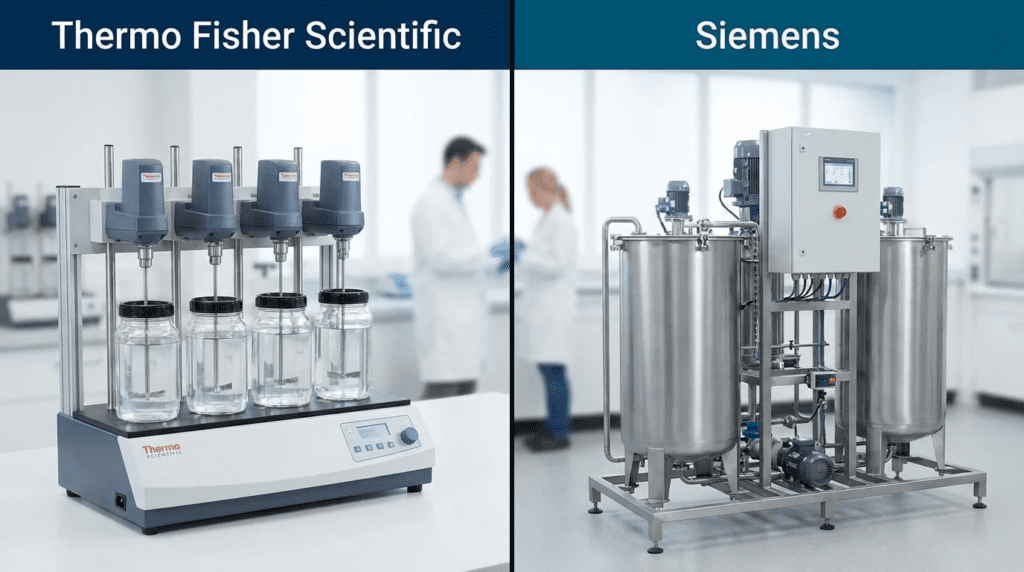
Thermo Fisher vs Siemens Flocculation Equipment: Comparison & Best Fit
Introduction
Chemical coagulation and flocculation consume a substantial share of the annual consumables budget at most surface water treatment plants — frequently the single largest line item. Despite those stakes, the specification of control and monitoring equipment for the process often relies on outdated paradigms or brand habit rather than engineering analysis. A critical decision point is selecting the right ecosystem for monitoring and controlling floc formation, which is where the Thermo Fisher vs Siemens Flocculation Equipment: Comparison & Best Fit question arises.
Clarify the scope first, because “flocculation equipment” covers two distinct categories. There is the analytical and monitoring instrumentation — streaming current monitors, turbidimeters, jar testers — that determines how much chemical to dose. And there is the mechanical process equipment — vertical turbine flocculators, horizontal paddle wheels — plus the automation hardware that physically executes the mixing.
Neither company makes the mechanical flocculators. Those come from process equipment manufacturers such as WesTech, Ovivo, Walker Process and Xylem. Thermo Fisher Scientific is a dominant force in laboratory and online analytical instrumentation through the Orion and Eutech lines, providing the sensors that optimize the chemistry. Siemens holds a large footprint in process automation, drive technology and instrumentation.
One historical note matters for specification writing: Siemens exited water treatment equipment in 2013, when Siemens Water Technologies — which held the Wallace & Tiernan chemical feed line — was divested, became Evoqua, and is now part of Xylem. Legacy specifications still naming Siemens for chemical feed equipment are more than a decade out of date and will generate change orders at submittal. What Siemens supplies today is instrumentation, controllers and drives.
The consequences of poor selection are real. Overdosing coagulant shortens filter runs, increases sludge production and destabilizes pH. Under-dosing risks turbidity breakthrough and regulatory violation. Broader supplier positioning is covered in our overview of the top flocculation manufacturers for water and wastewater.
How to Select and Specify
Duty Conditions & Operating Envelope
For analytical equipment, the water matrix is the primary driver.
- Turbidity range: High-turbidity river sources require non-contact or self-cleaning sensors. Evaluate optical sensors for their upper detection limits, not just their low-range precision.
- Ionic strength: For streaming current monitors, significant fluctuations in raw water conductivity skew readings. Control algorithms need compensation factors tuned to those changes.
- Response time: In flash mix applications, the delay between dosing and sensing is critical. Equipment must have a response time compatible with the hydraulic retention time of the mixing chamber.
Materials & Compatibility
Corrosion resistance is non-negotiable in the coagulation zone, where ferric chloride or alum lowers local pH and raises corrosivity.
- Sensor housings: Mandate PVDF, PEEK or 316L stainless for all wetted parts. Analytical probes often use epoxy or glass bodies, so verify they are protected from impact by debris at raw water intakes.
- Drive assemblies: For mechanical flocculator drives, specify severe-duty motors with appropriate enclosure and epoxy coatings to withstand high humidity and chemical vapors. IEEE 841 is a common benchmark.
Hydraulics & Process Performance
Process performance in flocculation is defined by the velocity gradient and the collision potential it produces over time.
- Energy input: When specifying variable frequency drives for mechanical flocculators, ensure the turndown ratio allows the full range of velocity gradients from tapered flocculation through flash mix without motor overheating.
- Shear sensitivity: Analytical sampling loops must be designed to avoid shearing the floc before it reaches the sensor. High-velocity sample pumps destroy the very floc the instrument is trying to measure.
Installation Environment & Constructability
- Footprint: Analytical transmitters are typically compact, rail or panel mounted. Automation cabinets can be substantial. Account for NEMA 4X enclosure requirements where installed near open tanks.
- Sample lines: Keep lines to analyzers as short as practical to minimize lag time, and heat-trace them where the gallery is unconditioned.
Reliability, Redundancy & Failure Modes
- Signal validation: Specify controllers that accept dual inputs and vote on the signal, or revert to flow-paced control on signal loss.
- Cleaning mechanisms: Optical and electrochemical sensors foul rapidly in raw water. Require automatic ultrasonic or water-jet cleaning for any immersion sensor.
Controls & Automation
- Communication protocols: Siemens equipment natively favors its own fieldbus protocols. Thermo Fisher instrumentation often defaults to Modbus or analog with HART. Where these ecosystems mix, the integrator must account for gateways.
- Control logic: Does the logic reside in the sensor transmitter or the central controller? Centralized logic is generally preferred for municipal security and data logging.
Maintainability, Safety & Access
- Calibration access: Sensors should be retractable under pressure or installed in bypass loops with isolation valves. Equipment that is hard to calibrate gets bypassed.
- Reagents: Some colorimetric analyzers require monthly reagent replenishment. Verify shelf life and disposal requirements.
Lifecycle Cost Drivers
- Capital: Analytical instrumentation is competitively priced but may require more frequent probe replacement.
- Operating: Automation hardware offers long service life but carries software licensing and support costs.
- Consumables: Calculate the multi-year cost of buffer solutions, replacement electrodes and reference junctions.
Comparison Tables
| Category | Thermo Fisher Scientific | Siemens | Engineering Note |
|---|---|---|---|
| Lab and bench testing (jar testers, benchtop meters) |
Industry leader. Orion and Eutech lines are standard for benchtop pH, conductivity and turbidity, with high precision. | Not present. Siemens focuses on process automation rather than laboratory instrumentation. | Thermo Fisher is the default for plant laboratories. Siemens is not specified for bench analysis. |
| Online process analyzers | Strong. Orion online instruments offer capable sensing technology and varied communication protocols. | Strong on physical parameters. SITRANS instrumentation covers flow and level well. Note that the Wallace & Tiernan chemical feed analyzers moved to Evoqua and then Xylem in 2013. | Thermo Fisher excels in sensor accuracy and chemistry; Siemens excels in integration with the wider plant control system. |
| Flocculation control logic | Device-centric. Logic often embedded in the transmitter or controller, which suits standalone loops. | System-centric. Plant control systems handle complex, multi-variable loops combining feed-forward and feedback. | Use device-level control for simple loops; specify a plant control system for plant-wide predictive coagulation control. |
| Mechanical equipment (drives, motors, mixers) |
Not applicable. Thermo Fisher does not manufacture mixing equipment. | Drives and motors only. Siemens motors, drives and gearboxes are standard for driving flocculators, but the flocculator mechanisms themselves come from process equipment OEMs. | Engineers must pair analytical sensors with drives from Siemens or an equivalent supplier, and flocculator mechanisms from a process equipment manufacturer. |
| Scenario | Small Plant | Medium Municipal | Large or Complex | Industrial |
|---|---|---|---|---|
| Primary constraint | Budget and simplicity | Reliability and compliance | Operating cost optimization and automation | Variable waste stream |
| Best fit strategy | Thermo Fisher standalone. Analyzers with local analog control to dosing pumps. Low integration cost. | Hybrid. Analytical sensors feeding a centralized control system. | Siemens ecosystem. Full integration for predictive control, managing mechanical energy and dosing together. | Thermo Fisher. Ion-selective electrodes may be needed for specific contaminants. |
| Maintenance profile | Operator handles calibration manually | Instrument technicians perform weekly checks | Dedicated automation staff manage loop tuning | High frequency cleaning required |
Engineer & Operator Field Notes
Commissioning & Acceptance Testing
- Buffer verification: For pH and ORP units, ensure the transmitter recognizes the specific buffer sets the utility uses. Mismatched buffer tables are a common cause of initial calibration failure.
- Loop tuning: When integrating variable frequency drives for flocculator paddles, site acceptance must verify the drive does not induce harmonic interference on sensitive analog signals from the streaming current monitor or turbidimeters. Proper shielding and grounding are critical.
Common Specification Mistakes
Engineers often specify laboratory-grade sensors for raw water intakes. Ceramic junctions clog instantly with algae or silt. Always specify ruggedized or process-grade sensors with double-junction references and large surface area junctions for pretreatment applications.
- Over-integration: Pulling dozens of data points over a digital protocol from a simple pH analyzer creates unnecessary network traffic. Usually only the process variable and a general fault bit are needed for operations.
- Ignoring lag time: Placing the sample tap far downstream of the static mixer creates a multi-minute dead time. No control loop, from any manufacturer, tunes out that dead time effectively under variable flow.
O&M Burden & Strategy
Analytical equipment: Requires disciplined electrode cleaning. In ferric and alum applications, coating occurs rapidly, so an acid wash or ultrasonic cleaner is effectively mandatory. Keep at least one spare sensor head on the shelf, bearing in mind shelf life limits how much can be stocked.
Automation and drives: Drive cooling fans and filters need quarterly checking. Controller input cards are generally robust but warrant spares for critical analog inputs. Use the diagnostic buffer in the controller to track intermittent faults before they become hard failures.
Troubleshooting
Streaming current monitor reading drifts constantly. Usually the piston or annulus is coated with coagulant, insulating the charge measurement. Mechanical cleaning is the fix. If the issue persists, check for electrical ground loops between the analyzer and the main panel.
Flocculator drive trips on overcurrent. Usually mechanical binding or sludge buildup in the basin rather than an electrical fault. Drain the basin and inspect bearings and paddles, and check the motor service factor.
Design Details & Calculations
Calculating the Velocity Gradient
For the mechanical side, the velocity gradient determines the motor horsepower required:
G = √(P / (μ × V)), where G is the velocity gradient in reciprocal seconds, P is power input to the water in watts, μ is dynamic viscosity and V is basin volume in cubic meters.
Typical design range: roughly 20 to 70 reciprocal seconds for flocculation, with higher values for flash mix.
Control Loop Lag Time
For the analytical side, loop dead time is critical. Lag time equals sample line volume divided by sample flow rate. As a working guideline, total lag — process transit plus sample line transit — should stay within a few minutes for effective feedback control of coagulant dosing.
Specification Checklist
For analytical instrumentation
- Measurement range and accuracy stated explicitly for each parameter
- Automatic temperature compensation
- Galvanically isolated analog outputs
- NEMA 4X enclosure rating
For automation and drives
- Harmonic mitigation via line reactors or DC link chokes
- Native industrial Ethernet capability without external gateways
- Conformal coating on all circuit boards to resist hydrogen sulfide and chlorine corrosion
Standards
- AWWA C653: Disinfection of water treatment plants, relevant for material compatibility
- Standard Methods: Governs conductivity and pH measurement protocols
- IEEE 519: Harmonic control in electric power systems, critical for drive specification
- UL 508A: Industrial control panels
Frequently Asked Questions
Do Thermo Fisher or Siemens make flocculators?
No. Vertical turbine flocculators, horizontal paddle wheels and the associated basin equipment come from process equipment manufacturers such as WesTech, Ovivo, Walker Process and Xylem. Thermo Fisher supplies the analytical instrumentation that determines chemical dose. Siemens supplies the motors, drives and control systems that power and coordinate the mechanical equipment. Neither supplies the flocculator itself.
Does Siemens still make chemical feed equipment?
Not since 2013. Siemens Water Technologies, which held the Wallace & Tiernan chemical feed and disinfection lines, was divested and became Evoqua, now part of Xylem. Siemens today supplies process instrumentation, automation and drives. Specifications naming Siemens for chemical feed equipment need updating.
What is the difference between a streaming current monitor and a zeta potential analyzer?
Both measure particle charge to optimize coagulation but work differently. A streaming current monitor is an online continuous device using a reciprocating piston to measure the current generated by charged particles, which suits real-time trend monitoring and feedback control. A zeta potential analyzer, typically a laboratory instrument, measures the potential at the shear plane of the particle using electrophoresis. Zeta potential is an absolute measurement; streaming current is an empirical, relative measurement requiring calibration against a target.
How do I integrate analytical sensors with a Siemens controller?
Through hardwired analog signals or digital communication. The most robust method for critical control is analog signals — one for the process variable, one for temperature or faults — wired directly into analog input cards. For data-rich integration, use a protocol gateway. Ensure the memory map of the analytical transmitter is documented so registers map correctly in the controller environment.
Why does my flocculation control loop oscillate?
Usually hydraulic dead time or overly aggressive tuning. Where the time for coagulant to mix, react and travel to the sensor is long, high proportional gain causes overshoot. Increase the integral time constant and reduce proportional gain, or switch to flow-paced feed-forward control with a slow-acting feedback trim from the analyzer.
Is analytical instrumentation suitable for industrial wastewater flocculation?
Yes, but sensor selection is critical. For industrial wastewater with high oil, grease or solids, standard pH or streaming current sensors foul quickly. Flat-surface or self-cleaning electrodes are designed for difficult matrices. In extreme cases, non-contact measurement or automatic retraction and cleaning assemblies are required to maintain data integrity.
What is the typical lifecycle of a flocculator drive?
A quality variable frequency drive typically lasts well over a decade in a clean, climate-controlled environment. Internal cooling fans usually require replacement every few years, and DC bus capacitors may need attention after several more. Failure to maintain enclosure filters is the leading cause of premature failure from overheating.
Conclusion
Key Takeaways
- Neither makes flocculators: Mechanical flocculation equipment comes from process equipment OEMs. This comparison covers the sensing and automation around it.
- Siemens left water treatment equipment in 2013: Wallace & Tiernan moved to Evoqua and then Xylem. Update legacy specifications accordingly.
- Distinct roles: Thermo Fisher excels in the analytical and laboratory domain, sensing the chemistry. Siemens dominates the automation and drive domain, powering the process.
- Integration is key: Effective plants use analytical sensors to drive control logic. Protocol compatibility must be defined early.
- Material selection: Coagulation zones are corrosive. Specify appropriate enclosure ratings and corrosion-resistant wetted parts for all instrumentation.
- Hydraulics first: No sensor corrects for poor hydraulic mixing. Confirm velocity gradients and retention times before blaming the instrumentation.
This is rarely an either/or choice for an entire plant, but a selection of the best tool for each subsystem. The goal is a clean interface between high-precision analytical capability and a robust industrial control backbone.
When specifying, prioritize the water matrix. High-turbidity, abrasive river water demands self-cleaning sensors and heavy-duty mechanical drives. Cleaner, more stable reservoir water permits more sensitive analytical setups. Acknowledging the strengths of each supplier — sensors on one side, drives and logic on the other, and flocculator mechanisms from a third — produces flocculation systems that remain reliable and cost-effective across their lifecycle.