Top 10 Instrumentation Manufacturers for Water and Wastewater
Top 10 Instrumentation Manufacturers for Water and Wastewater
Introduction
In municipal and industrial water treatment, data integrity is the bedrock of process control. Nuisance alarms are a persistent drain on operator attention at most plants, and a substantial share trace not to process failures but to instrumentation drift, fouling, or improper specification. The cost of poor instrumentation is rarely limited to the replacement price of the sensor — it shows up as energy waste from over-aeration, chemical budget overruns from poor pacing, and compliance risk from inaccurate effluent monitoring.
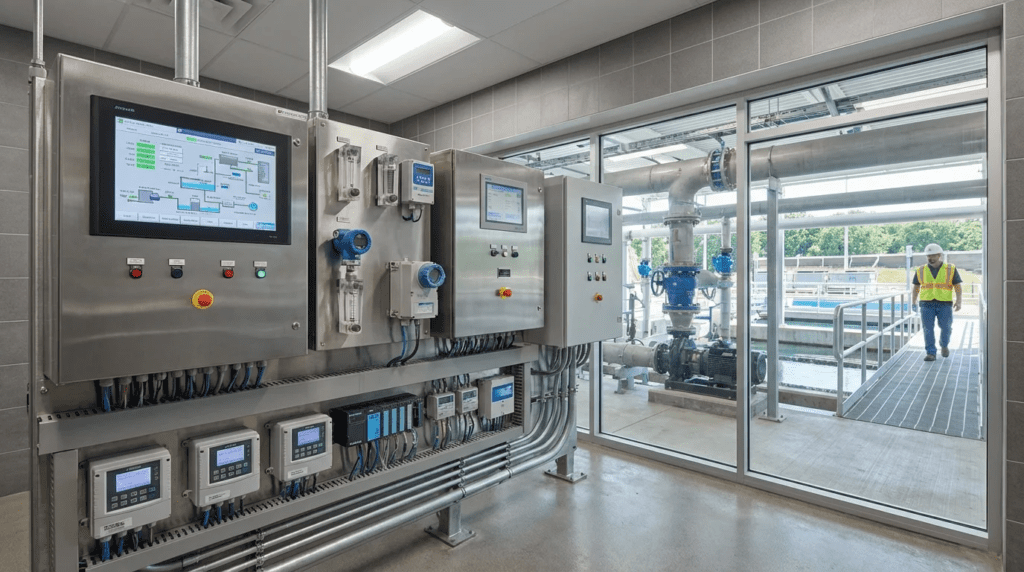
Navigating the vendor landscape is a critical task on any capital improvement project. Identifying the Top 10 Instrumentation Manufacturers for Water and Wastewater is not about finding the brand with the best marketing, but about identifying manufacturers with proven track records in harsh, corrosive and hydraulically variable environments. These manufacturers provide the sensory nervous system of a treatment plant, covering flow, level, pressure, temperature and analytical parameters.
This article is a technical specification guide, examining the engineering constraints, material compatibility issues and lifecycle considerations that drive selection. Broader supplier positioning is covered in our overview of the top OEMs for water and wastewater instrumentation.
How to Select and Specify
Duty Conditions & Operating Envelope
- Turndown ratio: Wastewater flows vary drastically between diurnal peaks and dry weather minimums. A magnetic flow meter must hold accuracy across the entire range. A meter accurate at peak flow but lost in noise at low flow creates blind spots in the control logic.
- Over-pressure and water hammer: Pressure transducers in pump stations face transient spikes. Higher-tier transmitters offer dual-diaphragm protection or higher proof-pressure ratings that survive events which rupture budget sensors.
- Submergence: In wet wells and vaults, accidental submergence is a question of when, not if. Distinguish between temporary submergence ratings and continuous submersion capability, which requires potted electronics and specialized cable entries.
Materials & Compatibility
- Chemical compatibility: For sodium hypochlorite dosing, standard ceramic or stainless sensors may corrode or embrittle. Titanium, high-nickel alloys or PVDF wetted parts are frequently mandatory.
- Abrasion: In grit systems or sludge lines, standard sensor linings wear prematurely. Soft rubber, polyurethane or ceramic linings for magnetic flow meters extend service life considerably.
- Fouling: Analytical sensors in aeration basins accumulate biofilm. Self-cleaning mechanisms — air blast or mechanical wipers — are essential for data validity between maintenance visits.
Hydraulics & Process Performance
Fluid mechanics and sensor technology interact. Ultrasonic level sensors suffer in foam-heavy environments such as anaerobic digesters, producing loss-of-echo faults. In those applications, 80 GHz frequency-modulated continuous-wave radar penetrates foam and condensation far better, because microwaves are unaffected by air density and vapor.
Installation Environment & Constructability
- Straight run requirements: Flow meters require defined upstream and downstream pipe diameters for a fully developed flow profile. Some manufacturers offer reduced straight-run options for restricted spaces, with their own pressure drop considerations.
- Hazardous locations: Headworks and digester gas zones require intrinsically safe or explosion-proof certification. The manufacturer must supply verified loop drawings and certified barriers matching the hazard classification.
Reliability & Failure Modes
Evaluate how an instrument fails. Smart instrumentation supporting NAMUR NE 107 classifies alerts into maintenance required, out of specification, functional check and failure. This lets SCADA distinguish a soft warning — a dirty lens — from a hard electronics fault, enabling proactive maintenance rather than reactive scrambling.
Controls & Automation Interfaces
- HART: Allows remote configuration and extraction of secondary variables over the legacy wire pair.
- Fieldbus and Ethernet: EtherNet/IP, PROFIBUS and Modbus TCP carry rich data, but the benefits must be weighed against the cybersecurity implications of networking field devices.
Maintainability & Access
If an operator cannot safely reach an instrument, it will not be maintained. Specify remote transmitters for sensors in hazardous or inaccessible locations. Hot-tap retractable assemblies for pH or DO probes let operators remove sensors for cleaning without shutting down the process line — critical for continuous compliance monitoring.
Lifecycle Cost Drivers
Purchase price is a minority of lifecycle cost. The bulk sits in calibration labor, reagents and replacement parts. Optical dissolved oxygen sensors largely displaced membrane-based sensors because they eliminate electrolyte replacement and frequent calibration, delivering lower total cost despite higher initial price.
Comparison Tables
These tables compare the leading manufacturers by application fit rather than ranking quality. Use Table 1 to identify vendors for specific loops and Table 2 to match technology to plant application.
Table 1: Manufacturer Capabilities & Strengths
| Manufacturer | Primary Strengths | Key Product Lines | Maintenance Profile | Engineering Considerations |
|---|---|---|---|---|
| Endress+Hauser | Comprehensive portfolio; advanced digital sensor integration; flow and analysis | Promag, Liquiline, Micropilot | Low — digital sensors store calibration data | Strong diagnostics, typically at a premium price point |
| Hach | Industry reference for analytical chemistry and process analyzers | LDO, Solitax, sc-series controllers | Moderate — reagents and wipers | Ubiquitous in municipal labs; integration between lab and process data |
| Siemens | Ultrasonic and radar level; magnetic flow; large-scale automation | SITRANS FM, SITRANS Probe | Low to moderate | Strongest when integrated into a full Siemens control environment |
| ABB | Robust magnetic flow meters; drives and motor integration | WaterMaster, Aztec | Low | Calibration memory modules simplify transmitter swaps |
| Emerson (Rosemount) | Pressure and DP flow; reliability in demanding industrial service | 8700 Series, 3051 | Very low | Industrial standard for pressure; can be over-specified for simple water duty |
| Krohne | Flow innovation; sludge handling; biogas measurement | Optiflux, Optisonic, WaterFlux | Low | Options for restricted straight-run and open channel applications |
| VEGA | Concentrated focus on level and pressure | VEGAPULS (80 GHz radar), VEGAWELL | Very low | High-frequency radar penetrates foam and condensation better than ultrasonic |
| Badger Meter | Revenue metering; AMI/AMR integration | ModMAG, ultrasonic series | Low | Focus on distribution and billing accuracy rather than complex process treatment |
| Yokogawa | High-reliability analytical measurement; control systems | ADMAG, SENCOM | Low | Strong reputation for stability in harsh chemical dosing service |
| Teledyne ISCO | Open channel flow; portable sampling; stormwater monitoring | LaserFlow, Signature | Moderate — field dependent | The common choice for sewer studies, open channel work and automatic sampling |
Table 2: Application Fit Matrix
| Application | Recommended Technology | Key Constraints | Why Specification Matters |
|---|---|---|---|
| Raw sewage influent | Magnetic flow meter | High solids, ragging, grease | Requires signal filtering to reject noise from solids striking electrodes |
| Lift station level | Radar or hydrostatic | Fats, oils, grease; turbulence | Radar cuts through condensation; hydrostatic needs anti-clog diaphragms |
| Aeration basin DO | Optical dissolved oxygen | Biofilm growth | Robust sensor caps and air-blast cleaning integration |
| Chemical dosing | Coriolis or lined magnetic flow | Corrosion, pulsating flow | Wetted material certification prevents leaks and premature failure |
| Digester gas | Thermal mass or ultrasonic | Wet gas, low pressure, classified area | Must handle variable gas composition and moisture without drift |
| Effluent compliance | Open channel ultrasonic or magnetic flow | Accuracy verification | Regulatory reporting requires verifiable accuracy and secure totalizers |
Engineer & Operator Field Notes
Commissioning & Acceptance Testing
Factory testing verifies the instrument works in a box; site testing verifies it works in the pipe.
- Loop power verification: Confirm the supply drives the loop impedance, particularly with local displays, surge protectors and isolators in series.
- Scaling mismatches: A classic error is an instrument scaled 0–1000 gpm feeding a PLC input scaled 0–1200 gpm. The result is a silent linear error that can persist for months.
- Damping settings: Sensors often ship with heavy damping enabled. For control loops this lag causes oscillation. Verify damping matches process requirements.
Common Specification Mistakes
- “Or equal” traps: Specifying a high-end radar transmitter and allowing “or equal” without defining performance characteristics — beam angle, frequency, signal-to-noise ratio — invites lower-tier ultrasonic substitutions that fail in condensation.
- Ignoring cable lengths: Standard cables are short. When the transmitter sits at catwalk level and the sensor sits deep in a wet well, splice boxes appear — and splices are the leading failure point for sensitive analog signals, especially pH and ORP. Specify custom cable lengths to eliminate them.
- Over-specifying accuracy: Demanding very tight accuracy for a general process line drives cost significantly without operational benefit outside custody transfer applications.
O&M Burden & Strategy
- Magnetic flow meters: Verify electrode integrity and coil resistance annually. Modern transmitters perform self-verification that satisfies many regulatory agencies without removing the meter from the line.
- Analytical sensors: pH and chlorine sensors are consumables. Plan for reagent replacement and periodic sensor cap replacement. Automated cleaning reduces manual brushing from daily to weekly or monthly.
- Spare parts: Standardization matters. Four brands of flow meter means four spare transmitters. Standardizing on one or two manufacturers cuts inventory cost substantially.
Troubleshooting
- Check the physics: Is the pipe full? Is the sensor submerged? Is there foam?
- Check the current: Put a multimeter in series. If the mA signal matches the local display, the problem is PLC scaling. If not, the transmitter output is faulty.
- Check the environment: Moisture in the terminal housing, or ground loops — a common issue with magnetic meters in plastic pipe lacking grounding rings.
Design Details & Calculations
Sizing Logic
- Velocity constraints: Magnetic flow meters perform best within a defined velocity band. Below roughly 1 ft/s, signal-to-noise degrades. Where a large pipe carries low flow, installing a smaller meter with eccentric reducers — flat side up to prevent air pockets — is standard practice.
- Turndown: Divide maximum flow by minimum flow and confirm the instrument holds accuracy at the calculated minimum.
Specification Checklist
- Wetted materials compatible with the process fluid
- Process connection: flanged, threaded or sanitary
- Power supply: two-wire loop versus four-wire; large magnetic meters often require line voltage
- Output signal: 4–20 mA HART, Modbus, EtherNet/IP
- Certifications: NSF/ANSI 61 for drinking water; hazardous location approvals where applicable
- Tagging: stainless hang tags matching P&ID numbers
Standards
- AWWA C700 series: cold water meters
- NFPA 70 (NEC): Articles 500–505 for hazardous location installation
- ISA-5.1: instrumentation symbols and identification
Frequently Asked Questions
What differentiates the top instrumentation manufacturers from budget brands?
Long-term stability, diagnostic capability and support. Established manufacturers invest in resisting drift and fouling, and they offer local engineering support, verified calibration certificates and long-term spare parts availability — which matters when the asset lifecycle is measured in decades.
When should radar be specified over ultrasonic level?
Radar is superior where temperature gradients, heavy condensation, foam or wind are present. Ultrasonic sensors rely on sound waves affected by air density and absorbed by foam. Radar uses microwaves, unaffected by air temperature or vapor, making it preferred for digesters, chemical tanks and lift stations.
How often do magnetic flow meters need calibration?
They are remarkably stable, with no mechanical wear to drift. Best practice is annual electronic verification using the manufacturer’s diagnostic tool, which satisfies most regulatory requirements. Wet calibration — pulling the meter — is typically reserved for multi-year intervals or when electronic verification fails.
What is the typical lifespan of analytical sensors?
It varies by parameter. Optical DO caps last one to two years. pH glass electrodes may last six to twelve months depending on coating and cleaning frequency. Chlorine membrane sensors require periodic electrolyte changes. Transmitters themselves last a decade or more; the wetted sensing elements are the consumables.
Why is grounding critical for magnetic meters in plastic pipe?
These meters measure a voltage induced by conductive fluid moving through a magnetic field, referenced to fluid potential. Metal pipe provides that reference. In plastic or lined pipe the fluid is electrically isolated, so without grounding rings or a grounding electrode the reference floats, producing erratic readings or total signal loss.
Is 4–20 mA still standard for new designs?
Yes, for critical process control, owing to simplicity, noise immunity and the ability to carry power on two wires. Many designs now specify 4–20 mA with HART for configuration, or hybrid arrangements where critical control is hardwired while diagnostic data flows over Ethernet to the historian.
Conclusion
KEY TAKEAWAYS
- Standardization wins: Selecting one or two vendors reduces spare parts inventory and simplifies operator training.
- Application trumps brand: Do not force a manufacturer’s weaker product into a critical loop.
- Total cost of ownership: Cheap sensors cost more in labor. Self-cleaning smart sensors repay themselves in reduced O&M hours.
- Detailed specs prevent change orders: Define materials, enclosure ratings, protocols and testing requirements explicitly.
- Verify the envelope: Rate instruments for process extremes — pressure spikes, flood levels — not average conditions.
Selecting from the Top 10 Instrumentation Manufacturers for Water and Wastewater shapes plant efficiency for decades. The goal is not merely to measure a variable but to provide trustworthy data that enables automation, ensures compliance and protects expensive mechanical assets.
The path to a successful design balances the capabilities of these manufacturers against the practical realities of the installation site. Analyzer-specific selection is examined further in our guide to the top pH and ORP analyzer manufacturers.