
Top OEMs for Water & Wastewater Instrumentation
1. Introduction
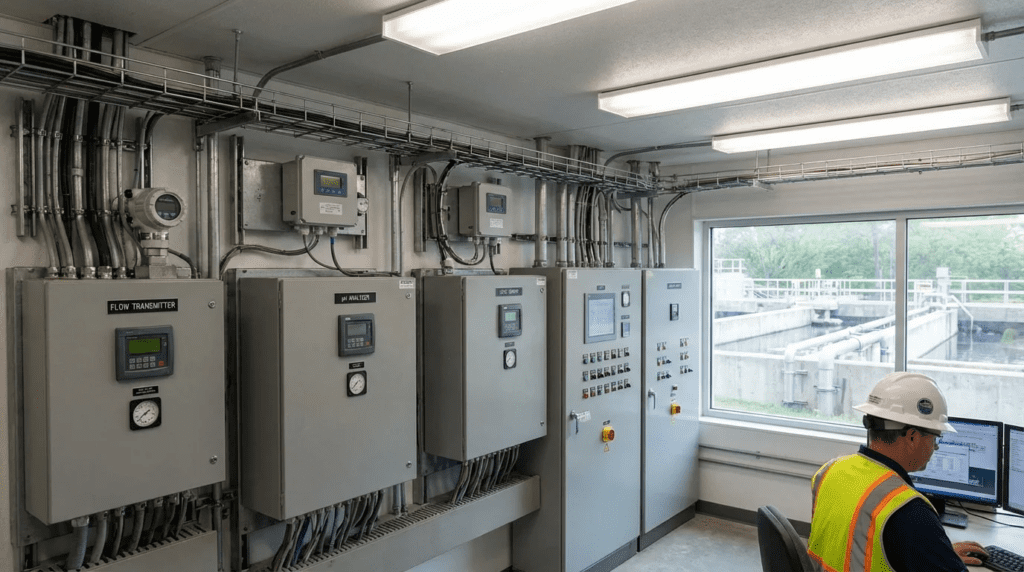
In the architecture of modern municipal and industrial water and wastewater treatment infrastructure, instrumentation serves as the central nervous system. While pumps, blowers, and valves perform the physical work of moving and treating fluids, it is the instrumentation—flow meters, level sensors, pressure transmitters, and analytical probes—that provides the data necessary to control these assets efficiently, safely, and in compliance with regulatory standards.
For consulting engineers, plant managers, and utility superintendents, the selection of Original Equipment Manufacturers (OEMs) for instrumentation is a decision with multi-decade implications. Unlike mechanical equipment, which may be repaired or rewound, instrumentation often represents a “black box” technology where proprietary firmware, sensor physics, and digital communication protocols dictate performance. If a sensor drifts, fails to report data, or provides noisy signals, the Programmable Logic Controller (PLC) or SCADA system makes control decisions based on flawed reality. This can lead to permit violations, chemical wastage, energy inefficiency, and, in severe cases, catastrophic process failure such as tank overflows or untreated discharge.
The operating environment in water and wastewater facilities is notoriously hostile to sensitive electronics. Instruments must survive submersion, corrosive atmospheres (such as hydrogen sulfide in headworks), direct sunlight, lightning strikes, and physical ragging. Furthermore, the fluid media itself varies from potable water with low conductivity to thickened sludge with high solids content and abrasive grit. Consequently, the “set it and forget it” mentality is only viable if the correct technology is specified for the exact application and manufactured by an OEM with a proven track record of sensor stability and ingress protection.
This article provides an in-depth, engineering-focused analysis of the primary instrumentation OEMs serving the water and wastewater sector. Instrument selection is one component of a facility’s broader monitoring strategy, which also encompasses data architecture, alarm management, and the integrity of the signal path between the field and the control room. This article moves beyond marketing claims to examine the technical merits, lifecycle considerations, and application fit of the industry’s major players. The focus is strictly on the primary manufacturers of the sensors and transmitters, evaluating them based on measurement physics, build quality, and long-term supportability.
2. Instrument Manufacturer Categories
The five OEMs profiled in detail below represent the process automation and analytical mainstream, but instrument procurement in a water utility rarely resolves into a single supplier decision. Two adjacent manufacturer landscapes shape most specifications: the broader field of instrumentation suppliers across all measurement categories, and the specialist field serving the analytical parameters that carry regulatory weight.
The Broader Instrumentation Manufacturer Field
Beyond the five names examined here, the wider field of instrumentation manufacturers for water and wastewater includes regional specialists, single-technology innovators, and suppliers whose strength lies in one measurement domain rather than across a portfolio. This matters at specification time because plant-wide standardization—the usual justification for choosing a broad-portfolio supplier—is only genuinely valuable where the supplier is competitive in every category the plant needs.
The practical test is to list the measurement points on the P&ID by category, then ask whether the preferred supplier is the right answer for each. A plant with forty flow points and four analytical points is well served by broad-portfolio standardization. A plant with a heavy analytical burden and modest flow requirements is better served by standardizing analytics with a specialist. Standardization lowers lifecycle cost as a means, not an end, and it stops paying when it forces a poor technology fit at a critical measurement point.
pH and ORP Analyzer Manufacturers
Analytical instrumentation carries a maintenance burden an order of magnitude above flow and level, and pH and ORP measurement sits at the top of that burden. The field of pH and ORP analyzer manufacturers is therefore worth evaluating on its own terms rather than inheriting the choice from a plant-wide automation decision.
Three factors separate the field. Sensor construction determines survivability: flat-glass and non-glass designs resist coating and breakage far better than conventional bulb electrodes, and differential designs with a salt bridge protect the reference from sulfide poisoning. Digital versus analog signal handling determines reliability of the signal path, since an analog pH signal is a high-impedance millivolt measurement that degrades badly with moisture ingress. And calibration workflow determines whether the instrument is actually maintained: a sensor permitting bench calibration with data stored in the head gets calibrated on schedule; one requiring buffers carried up an aeration basin in bad weather does not.
3. How to Select Water & Wastewater Instrumentation
Selecting instrumentation requires a granular understanding of process dynamics. A “flow meter” is not a universal commodity; the physics required to measure raw sewage influent differ fundamentally from those required to measure sodium hypochlorite dosing or finished water distribution. Engineers must evaluate selection based on four primary domains: Flow, Level, Pressure, and Analytical Chemistry.
Flow Measurement Technologies
Flow is the most critical variable in treatment balance and billing. The dominant technology in the sector is the Electromagnetic Flow Meter (Magmeter), but alternatives like Ultrasonic and Thermal Mass are essential for specific niches.
Electromagnetic Flow Meters: Magmeters operate on Faraday’s Law of Induction. As a conductive fluid moves through a magnetic field, a voltage is induced proportional to the velocity.
- Liner Selection: The liner is the primary failure point. Hard rubber or polyurethane is standard for general water and wastewater due to abrasion resistance. However, for chemical dosing (acids and caustics) or high-temperature industrial wastewater, PTFE or PFA liners are required. Engineers must specify liner retention mechanisms, as vacuum conditions caused by pipe draining can collapse loose liners.
- Electrode Material: Stainless steel 316L is standard but insufficient for ferric chloride or highly aggressive sludges. Nickel alloy or titanium electrodes are necessary specifications for coagulant lines to prevent pitting and signal loss.
- Installation Requirements: Magmeters typically require 5 pipe diameters of straight run upstream and 2 downstream to ensure a fully developed flow profile. Reduced straight-run options exist but often come with accuracy trade-offs or pressure drop penalties due to internal flow conditioners.
Ultrasonic Flow Meters: These are used where pipe intrusion is impossible or for large open channels. The distinctions between transit-time and Doppler configurations, and between clamp-on and wetted designs, matter enough that a dedicated review of ultrasonic flow meters is worth conducting before assuming a clamp-on retrofit will work on a given line.
- Transit-Time (Clamp-on): Excellent for retrofits on clean water lines. They struggle with wastewater containing entrained air bubbles or solids, which scatter the beam.
- Doppler: Used specifically for slurries or fluids with sonic reflectors such as bubbles and particles. They are generally less accurate than magmeters but useful for heavy sludge lines where intrusion is risky.
Level Measurement Technologies
Level measurement has shifted significantly from mechanical floats and ultrasonic sensors to radar technology, though each has its place.
- Ultrasonic Level: Historically the standard for wet wells and tanks. It uses sound waves to calculate distance. However, the speed of sound varies with temperature and vapor density. In wastewater lift stations, heavy fog or methane layers can cause signal loss or ghosting. Foam on the surface absorbs the acoustic pulse, leading to loss-of-echo alarms.
- Radar (Microwave): Radar is increasingly preferred because microwaves are largely unaffected by temperature, pressure, vapor, or wind.
- Pulse vs. FMCW: Frequency Modulated Continuous Wave (FMCW) radar offers better resolution and signal-to-noise ratio in difficult environments than pulse radar.
- Frequency: Higher frequency radar (80 GHz) creates a narrower beam angle, allowing installation near tank walls or obstructions such as ladders and pumps without false echoes. This is an advantage over older 6 GHz or 26 GHz systems for confined wet wells.
- Hydrostatic Pressure (Submersible): Simple and effective for deep wells or reservoirs. The sensor sits at the bottom and measures the weight of the water column. The primary failure mode is the breather tube in the cable, required for atmospheric reference, becoming blocked, or moisture ingress migrating down the cable.
Analytical Measurement
Analytical sensors track pH, dissolved oxygen, turbidity, chlorine, and nutrients. This category carries the highest maintenance burden, and its selection logic differs enough from flow and level that a structured approach to sensor and analyzer selection repays the effort.
- pH/ORP: Glass electrodes are prone to fouling and aging. In wastewater, flat-glass designs are specified to allow self-cleaning by the flow velocity. Differential pH sensors utilize a salt bridge to protect the reference electrode from poisoning by sulfides. The construction and mounting choices available across the pH sensor category directly determine how often an operator has to visit the installation.
- Dissolved Oxygen (DO): The industry has moved almost exclusively to optical luminescent DO sensors. Unlike older galvanic membrane sensors, optical DO does not consume oxygen, requires far less frequent calibration, and has no electrolyte to replace. The principal maintenance item is periodic replacement of the sensor cap.
- Turbidity: For regulatory compliance in drinking water, instruments must meet EPA Method 180.1 (tungsten lamp) or ISO 7027 (infrared LED). Engineers must specify bubble-rejection systems, as entrained air is read as turbidity.
Integration and Digital Protocols
The era of purely 4-20 mA analog signals is fading. Modern specifications should consider digital integration.
- HART: Superimposes digital data on the 4-20 mA loop. Allows for remote configuration and access to secondary variables, such as a magmeter reporting conductivity or temperature alongside flow.
- Fieldbus/Ethernet: Protocols like EtherNet/IP, PROFINET, or Modbus TCP allow the instrument to transmit diagnostic data directly to the SCADA system. This enables predictive maintenance, alerting operators to electrode coating or low radar signal strength before the measurement fails outright.
Lifecycle and Total Cost of Ownership (TCO)
Low-bid procurement often produces high TCO. An instrument costing a few hundred dollars less but requiring monthly rather than annual maintenance is a liability. Engineers must evaluate:
- Verification vs. Calibration: Can the instrument be verified in situ without removal? Several manufacturers now offer built-in verification that generates a pass/fail report for compliance without stopping the process.
- Consumables: What is the cost and shelf life of reagents for chlorine and ammonia analyzers, or of optical sensor caps?
- Proprietary Cables: Some OEMs require expensive, pre-terminated proprietary cables that cannot be shortened or lengthened easily in the field.
4. Selection & Specification Framework
The criteria above are individually well understood. What produces underperforming instrument packages is applying them out of order—most often by selecting a manufacturer for plant-wide standardization, then fitting each measurement point to whatever that supplier offers rather than to the physics of the measurement.
Step 1: Classify Every Measurement Point by Duty, Not by Category
Build a point list recording, for each measurement, the fluid, expected range including turndown, the accuracy actually required (control, regulatory reporting, or billing), the consequence of failure, and the accessibility of the location. A magmeter on a chemical feed line and one on plant influent are the same word and different specifications. This list, not a supplier catalog, is the basis for everything that follows.
Step 2: Distinguish Control Accuracy from Compliance Accuracy
Most points in a plant need repeatability rather than absolute accuracy, because the control loop responds to change. A small number of points—permit reporting, custody transfer, chemical accountability—need traceable absolute accuracy and periodic verification. Specifying laboratory-grade accuracy across every point inflates capital cost without improving control, while specifying commodity accuracy at a reporting point creates a compliance exposure. Mark the point list accordingly before pricing anything.
Step 3: Worked Magmeter Sizing Example
Consider a plant influent line on 24-inch pipe with a peak wet weather flow of 14 MGD, average daily flow of 4 MGD, and minimum night flow near 1.2 MGD. In the 24-inch line, 14 MGD is roughly 21.7 cubic feet per second, a velocity of about 6.9 feet per second—well within a magmeter’s comfortable range. At minimum night flow, 1.2 MGD gives about 1.86 cubic feet per second and a velocity near 0.59 feet per second. That is below the threshold at which most magmeters hold stated accuracy, and below the velocity needed to keep liner and electrodes swept clean.
The remedy is to reduce the meter size rather than match the line. An 18-inch meter raises minimum velocity to roughly 1.05 feet per second and peak to about 12.3—still within range for a rubber-lined meter but approaching where abrasive grit accelerates liner wear. A 20-inch meter is the balanced answer at roughly 0.85 feet per second minimum and 9.9 at peak. The cost is a pair of reducers and their head loss; the benefit is a meter reporting usable data across the full flow range rather than only during the day. Running this arithmetic at every flow point is the highest-value discipline in instrument specification.
Step 4: Design the Installation, Not Just the Instrument
Straight-run requirements, grounding provisions, sunshades, isolation valves for analytical sensors, retractable assemblies where the process cannot be shut down, and physical access for calibration all belong in the design rather than in the contractor’s means and methods. An instrument specified correctly and installed without its required straight run is a permanently inaccurate instrument, and no amount of configuration recovers it.
Step 5: Settle the Protocol Architecture Before Selecting Devices
Decide the plant’s standard signal and communication architecture first, then require every instrument to meet it natively. Retrofitting gateways to bridge protocol mismatches introduces failure points, obscures diagnostics, and creates a support burden that outlives everyone who made the original decision.
Step 6: Evaluate on Lifecycle Cost With Maintenance Labor Counted
Build the comparison from installed capital, consumables at the actual service interval, calibration and verification labor including travel and access time, expected replacement interval, and the cost of each technology’s failure modes. Analytical instruments routinely invert their first-cost ranking on this basis, because labor rather than hardware dominates their twenty-year cost.
5. Comparison Tables
The following table outlines the primary strengths and typical application focus for the five OEMs examined in this guide. Engineers should use this to align OEM strengths with specific project needs—for instance, distinguishing between providers who excel in general process automation versus those specialized in complex analytical chemistry.
| OEM | Core Competency | Primary Strengths | Limitations / Considerations | Best-Fit Application |
|---|---|---|---|---|
| Endress+Hauser | Process Automation & Broad Portfolio | Very broad portfolio suited to single-source supply; digital Memosens technology for analytics; built-in verification; strong magmeter and radar lines. | Premium pricing on some commodity items; the breadth of options can be difficult to navigate during specification. | Plant-wide standardization; critical process control; digital and smart instrument integration. |
| Siemens | Integrated Automation (PLC plus instrumentation) | Close integration with Siemens PLC and SCADA environments; strong ultrasonic heritage from Milltronics; cost-effective magmeters. | Analytical portfolio is less extensive than specialist competitors; emphasis is on integration rather than sensor physics innovation. | Projects utilizing Siemens PLCs; large-scale water distribution; level measurement in lift stations. |
| ABB | Power & Water Measurement | Large diameter flow metering; in-situ verification tooling; strong presence in District Metered Areas and battery-powered remote metering. | Analytical interface can be less intuitive for newer operators; market focus spans both power and water sectors. | Transmission mains; custody transfer flow; remote flow metering with battery options. |
| Hach | Water Quality Analysis | Deep specialization in lab and process analysis (turbidity, chlorine, nutrients); optical DO technology; pre-packaged analyzer panels. | Not a primary supplier for flow, level, or pressure; systems are specialized and often operate as standalone skids. | Regulatory compliance monitoring; nutrient removal control. |
| Yokogawa | Industrial Precision & Stability | High stability in pressure measurement; strong noise immunity in magmeters through dual-frequency excitation; industrial-grade durability. | Less focused on municipal water-specific features; higher cost; interface designed for industrial engineers. | Industrial wastewater; desalination; high-pressure RO systems; critical control loops. |
| Technology | Measured Variable | Fluid Suitability | Installation Constraint | Maintenance Burden | Primary Failure Mode |
|---|---|---|---|---|---|
| Electromagnetic Flow | Volumetric flow | Conductive fluids; excellent on wastewater and sludge | Full pipe required; 5D upstream, 2D downstream | Low | Liner damage; electrode coating; grounding faults |
| Transit-Time Ultrasonic | Volumetric flow | Clean water; degrades with air or solids | Clamp-on; needs good pipe wall condition | Low | Signal loss from entrained air or scale |
| Doppler Ultrasonic | Volumetric flow | Requires reflectors; suits slurries | Clamp-on or insertion | Low | Reduced accuracy as solids concentration varies |
| Ultrasonic Level | Level and open channel flow | Any; affected by foam and vapor | Requires clear line of sight and blanking distance | Low to moderate | Loss of echo from foam, fog, or condensation on the face |
| Radar Level (80 GHz) | Level | Any; largely immune to vapor and temperature | Narrow beam permits mounting near obstructions | Low | False echoes from internals if poorly aimed |
| Hydrostatic Level | Level | Any; suits deep wells | Submerged; cable routing critical | Moderate | Blocked breather tube; moisture migration in cable |
| pH / ORP | Water chemistry | All; construction must match fouling risk | Needs access for calibration or retractable assembly | High | Reference poisoning; glass fouling and aging |
| Optical Dissolved Oxygen | Water chemistry | Aeration basins and effluent | Mounted on rail or float in basin | Moderate | Cap degradation; biofouling of the optical window |
| Turbidity | Water quality | Drinking water compliance and filter effluent | Requires representative sample and bubble rejection | Moderate to high | Bubble interference; optical window fouling |
6. Top OEMs / System Integrators
Endress+Hauser
Endress+Hauser is among the most comprehensive instrumentation manufacturers globally, often serving as a single-source solution for complex water and wastewater plants. A privately held, family-owned company, it has invested heavily in research and development, particularly in digital sensor integration.
Technical Strengths:
A central product for the water sector is the Promag electromagnetic flow meter series. These meters feature a built-in verification function that checks device health, including coil integrity and electrode resistance, and generates a traceable verification report without requiring external tools or process interruption. This supports regulatory compliance and reduces maintenance intervals.
In the analytical space, Endress+Hauser developed Memosens technology. Traditional analog sensors send a weak, interference-prone signal through a cable to the transmitter. Memosens sensors digitize the signal in the sensor head and transmit it via a non-contact inductive coupling, eliminating moisture corrosion at the connection point—a significant failure mode in humid wastewater environments. The sensors also store their calibration data, so operators can calibrate in the shop and snap the sensor into the field transmitter, removing the need to carry calibration fluids to the top of aeration basins in poor weather.
Portfolio Coverage:
The company covers every variable: flow (magnetic, ultrasonic, Coriolis, vortex), level (radar, ultrasonic, hydrostatic), pressure, temperature, and a full suite of analysis including pH, DO, chlorine, UV, and sludge level. Their 80 GHz radar is particularly effective in foam-heavy digesters and narrow wet wells.
Siemens
Siemens approaches instrumentation from the perspective of total plant automation. While they manufacture high-quality sensors, their primary value proposition to engineers is the integration of these sensors into the broader control environment, particularly where the facility utilizes Siemens PLCs and SCADA systems.
Technical Strengths:
Siemens acquired Milltronics, inheriting a strong position in ultrasonic level measurement. The SITRANS LUT400 series remains a common standard for open channel flow monitoring and pump control, featuring echo processing algorithms that filter out pump noise and agitator interference.
For flow, the SITRANS F M series is a staple in the municipal market. The sensor and transmitter combination is a workhorse specification—simple, rugged, and equipped with a memory unit that stores calibration data and settings. If a transmitter fails, an operator can swap the transmitter and transfer the memory unit, and the device is programmed without manual reconfiguration. This reduces downtime and lowers the technical skill required of maintenance staff.
Portfolio Coverage:
Siemens is strong in flow and level. Their pressure and weighing technologies are also robust. While they offer analytical instrumentation, it is generally less specified for complex nutrient analysis than specialist competitors, though their clamp-on ultrasonic flow meters are well regarded for retrofit applications.
ABB
ABB has deep roots in power and water infrastructure globally. Their instrumentation division is noted for high-accuracy flow metering and robust field devices designed for remote, harsh environments.
Technical Strengths:
ABB is strong in large diameter flow measurement. The WaterMaster and AquaMaster series are frequently specified for large transmission mains and distribution networks. The AquaMaster in particular is designed for District Metered Areas and leak detection, offering battery-powered operation with internal data logging and cellular communication. This allows utilities to monitor flow and pressure at remote points in the distribution network without running mains power.
For verification, ABB offers software-based in-situ verification of flow meters to confirm that accuracy has not drifted, which matters for custody transfer and revenue billing applications. Modern touchscreen interfaces across their transmitter lines simplify the user experience for operators.
Portfolio Coverage:
ABB offers a complete range of flow (magnetic, swirl, vortex, thermal mass), pressure, and level (laser, ultrasonic, radar). Their analytical line includes silica, phosphate, and ammonia analyzers, though they are most visible in the flow metering category for municipal water.
Hach
Hach stands apart from the other OEMs on this list. While the others are automation generalists, Hach is a specialist in water quality analysis. For many municipal engineers, the name is closely associated with analytical measurement—the instruments that determine what is actually in the water.
Technical Strengths:
Hach was influential in moving dissolved oxygen monitoring toward optical luminescent technology, shifting the industry away from maintenance-heavy membrane probes. In turbidity, their process turbidimeter lines are widely used for verifying regulatory compliance in drinking water filtration.
Hach is also prominent in process nutrient monitoring for ammonia, nitrate, and phosphate in wastewater treatment control. Their process analyzers provide near-laboratory accuracy in the field, enabling real-time control of blowers and chemical dosing pumps. While they do not manufacture general process flow or level meters, their specialized open channel flow products are used for influent and effluent monitoring.
Portfolio Coverage:
Almost exclusively analytical: pH, conductivity, DO, turbidity, chlorine, organics, and nutrients. They also provide the laboratory reagents and spectrophotometers used by plant chemists, creating a unified ecosystem between the lab and the process basins.
Yokogawa
Yokogawa is a Japanese engineering firm known for precision and industrial durability. Their reputation is built in the oil, gas, and petrochemical sectors, but their technologies are valued in critical water and industrial wastewater applications where reliability is non-negotiable.
Technical Strengths:
Yokogawa’s DPharp differential pressure sensor technology is noted for long-term stability. Unlike capacitance sensors, it uses a resonant silicon element that is highly resistant to hysteresis and static pressure effects. In water treatment, this translates to level transmitters and differential pressure cells that hold calibration for years, even under pressure spikes.
Their ADMAG series magnetic flow meters utilize dual-frequency excitation. Standard magmeters struggle with slurry noise, common in sludge or grit lines, causing the signal to jump. Yokogawa excites the coils at two frequencies simultaneously—high frequency for noise immunity and low frequency for zero stability—producing a stable reading even in high-concentration slurries.
Portfolio Coverage:
Strongest in pressure and flow. Their analytical line is robust, particularly for pH and conductivity in harsh industrial wastewater environments involving high temperature or aggressive acid and caustic streams. They are less common in standard municipal drinking water analysis but well established in desalination and industrial pretreatment.
7. Application Fit Guidance
Selecting the right OEM often depends on the specific sub-sector of the water industry.
Municipal Drinking Water
Primary Focus: Compliance, accuracy, billing.
Guidance: Hach is a common choice for the regulatory parameters of turbidity and chlorine. ABB and Siemens fit well for distribution network flow metering given their magmeter portfolios and leakage detection capabilities. Endress+Hauser is often selected for main treatment plant automation because flow, level, and pressure integrate on a single digital platform.
Municipal Wastewater (Resource Recovery)
Primary Focus: Durability, ragging resistance, nutrient control.
Guidance: Endress+Hauser is a strong contender here because the ability to hot-swap pre-calibrated sensors in aeration basins is a substantial operational benefit. Hach matters where the plant requires low-limit nutrient removal control strategies. Siemens ultrasonic and radar solutions are widely trusted for wet well level control and lift stations.
Industrial Wastewater
Primary Focus: Chemical compatibility, temperature, pH extremes.
Guidance: Yokogawa is well suited here. Their magmeters and pressure transmitters withstand the aggressive chemicals and thermal shocks common in food and beverage or chemical plant effluent. Endress+Hauser is also a strong fit given their range of wetted material options including tantalum, ceramic, and PFA.
Remote / Unmanned Sites
Primary Focus: Low power, remote communications, reliability.
Guidance: ABB and Siemens both offer established battery-operated flow metering lines. For level, Endress+Hauser and Siemens offer radar solutions that integrate well with RTUs for cellular backhaul.
8. Engineer & Operator Considerations
Installation Best Practices
Even the best OEM equipment will fail if installed incorrectly.
- Straight Run Requirements: Engineers must defend the space required for flow meters during the mechanical drawing phase. Compromising on the 5D upstream and 2D downstream requirement for a magmeter results in permanent accuracy errors.
- Grounding: In plastic piping systems (PVC or HDPE), the liquid is electrically isolated. Magmeters must use grounding rings or grounding electrodes to reference the fluid potential to the meter body. Without this, the meter reads erratic noise.
- Sun Shades: Transmitters usually have LCD screens. In direct sunlight, these screens fade and the electronics can overheat. Specifying UV sunshades is a low-cost measure that significantly extends electronics life.
- Analytical Access: Specify retractable assemblies or isolation valving wherever a sensor sits in a line or vessel that cannot be taken out of service for calibration. A sensor that can only be reached during a plant shutdown will be calibrated at shutdown frequency.
Integration Challenges
Avoid mixing protocols without a reason. If the plant standard is EtherNet/IP, ensure every instrument specified supports it natively without requiring third-party gateways. Mixing PROFIBUS, Modbus, and 4-20 mA in a single facility creates a lasting maintenance burden for instrumentation and controls technicians.
Maintenance & Spare Parts
Standardization supports operations. A plant should ideally standardize on one or two OEMs for instrumentation. This allows the maintenance shop to stock a limited number of spare transmitters and sensors. If a plant has five different brands of magmeters, it needs five different user interfaces, five software tools, and five sets of spare parts. Engineers should write “no substitutions” or base-bid specifications to enforce uniformity where justifiable.
Commissioning and Verification
Instrument commissioning should produce a record, not just a working display. For each device, document the as-configured range and units, the verification method and result, the loop check from field device through to the SCADA tag, and the alarm setpoints as configured. Where built-in verification exists, run it at commissioning to establish the baseline for later comparison. Where it does not, establish how the device will be verified in service before the plant accepts it—a compliance instrument with no practical verification method is a finding waiting to happen.
Cybersecurity and Network Segmentation
As instruments move from analog signals to Ethernet protocols, they become network endpoints carrying firmware, web servers, and configuration interfaces designed for convenience rather than exposure. Specify that instrument networks are segmented from business networks, default credentials are changed at commissioning, firmware update paths are documented, and vendor remote access is brokered rather than direct. This is a design requirement, not an IT afterthought, and far cheaper to specify than to retrofit.
9. Design Details & Standards
Applicable Standards and References
Instrumentation specifications commonly reference ISA-5.1 for instrumentation symbols and identification on P&IDs and ISA-20 for specification form content. Accuracy and terminology follow ISA-51.1. Enclosure ingress protection is stated to NEMA 250 ratings or the equivalent IEC 60529 IP codes, and hazardous location classification for headworks and digester areas follows NFPA 820 together with NFPA 70. Turbidity instruments for drinking water compliance must meet EPA Method 180.1 or ISO 7027, and analytical methods generally are governed by 40 CFR Part 136. Wetted components in potable service require certification to NSF/ANSI/CAN 61, with lead content under NSF/ANSI/CAN 372. Electromagnetic compatibility follows IEC 61326, and safety-instrumented applications reference IEC 61508 and IEC 61511 for functional safety.
Specification Checklist
- Point Definition: Tag number, measured variable, fluid, service conditions, and the P&ID reference for every device.
- Range and Turndown: Minimum, normal, and maximum process values, with the required accuracy stated at each rather than as a single percentage.
- Accuracy Basis: Whether the point requires control repeatability, regulatory reporting accuracy, or billing-grade traceable accuracy.
- Wetted Materials: Liner, electrode, body, and sensor materials with a compatibility statement for the process fluid at design concentration and temperature.
- Installation: Required straight run, orientation, grounding provisions, mounting arrangement, and access for calibration or removal.
- Environment: Enclosure rating, area classification, ambient temperature range, sunshade requirement, and surge protection.
- Signal and Protocol: Output type, communication protocol, and the requirement for native support without gateways.
- Diagnostics: Required diagnostic variables and their mapping to SCADA tags, including sensor health and predictive indicators.
- Verification: In-situ verification capability, method, and reporting format where the point carries compliance significance.
- Consumables: Reagents, caps, and buffers with expected consumption rate, shelf life, and unit cost.
- Documentation: Instrument index, loop diagrams, configuration records, calibration certificates, and spare parts list.
- Cybersecurity: Credential management, firmware update path, and network segmentation requirements for Ethernet-connected devices.
10. Frequently Asked Questions
Which flow meter technology is best for wastewater?
The electromagnetic flow meter is the default for full-pipe wastewater and sludge service: no obstruction in the flow path, tolerant of solids and grit, and independent of density, viscosity, and temperature. It requires a conductive fluid, a full pipe, adequate straight run, and proper grounding. Ultrasonic transit-time is the alternative where the pipe cannot be broken into, though entrained air degrades it. Doppler suits heavy slurries where trending matters more than accuracy. Open channel measurement is a separate problem, solved by a flume or weir with a level sensor above it.
Why does a magmeter need straight pipe upstream and downstream?
The meter measures average velocity across the electrode plane and assumes a fully developed, symmetric profile. An elbow, valve, or pump immediately upstream leaves the profile distorted and swirling, so the velocity the meter sees is not the true average. The conventional requirement is five pipe diameters upstream and two downstream. Reduced straight-run designs use internal flow conditioners, restoring the profile at the cost of head loss and, in wastewater, a potential ragging point.
Should the flow meter be the same size as the pipe?
Frequently not. Meter selection should be driven by velocity across the full flow range rather than by line diameter. Most magmeters hold their stated accuracy above roughly 1 foot per second and perform best in the middle of their velocity range, so a line-size meter on a system with substantial turndown will drop below its accurate range at minimum flow. Reducing the meter one or two sizes raises minimum velocity into the usable band and also helps keep the liner and electrodes swept clean. The cost is a pair of reducers and modest head loss.
Radar or ultrasonic for wet well level?
Radar is generally the stronger choice in wet wells. Ultrasonic depends on the speed of sound, which varies with temperature, humidity, and vapor composition, and it is defeated by foam, fog, and condensation on the transducer face—all common in lift stations. Radar is largely immune to these, and 80 GHz devices produce a beam narrow enough to mount close to walls and piping without false echoes. Ultrasonic remains reasonable and lower-cost in clean, open, well-ventilated tanks.
How much maintenance do analytical instruments actually require?
Considerably more than flow and level, and the interval depends on the parameter and fluid rather than the manufacturer. Optical DO sensors need routine cleaning and periodic cap replacement. pH sensors in wastewater require regular cleaning and calibration, and the glass ages out regardless of care. Reagent-based analyzers consume consumables continuously and need scheduled replacement plus servicing. Budget the labor honestly at design time; neglected analytical instruments do not degrade gracefully, they report plausible wrong numbers.
What is the difference between calibration and verification?
Calibration adjusts the instrument against a known reference so its output matches the true value. Verification confirms the instrument still performs within specification without adjusting it. Many modern devices offer built-in verification checking internal parameters such as coil integrity and electrode resistance, producing a traceable pass or fail report without process interruption. Verification does not replace calibration where regulation requires it, but it reduces how often a device must be pulled from service and provides an auditable record between calibrations.
Should a plant standardize on one instrumentation manufacturer?
Standardization within measurement categories is worth pursuing; standardization across all categories at any cost is not. Fewer spare transmitters, one interface to train on, and one configuration toolset are real savings. But a supplier excellent in flow and mediocre in analytics should not be forced onto the analytical points to preserve uniformity. Standardize by category—one supplier for flow and level, one for analytics—and write the specification tightly enough that substitutions are evaluated on merit.
How should instrument diagnostics be used in maintenance planning?
Modern instruments report far more than the process variable, but the data is only useful if mapped into SCADA and acted on. Bring sensor health, fouling detection, signal strength, and temperature into the historian alongside the measurement, then alarm on trend rather than threshold alone. A radar signal strength declining steadily over six months tells you something before it produces a loss-of-echo alarm at three in the morning. This shifts maintenance from calendar-based to condition-based and is one of the few low-cost reliability improvements available in a treatment plant.
11. Conclusion
Key Takeaways
- Classify every point by duty, not by category — a magmeter on a chemical feed line and one on plant influent share a name and require different specifications entirely.
- Separate control accuracy from compliance accuracy — most points need repeatability; a small number need traceable absolute accuracy, and pricing everything at the higher standard wastes capital.
- Size flow meters on velocity, not line diameter — a line-size magmeter on a system with real turndown will fall below its accurate range at minimum flow and coat while it does so.
- The installation is part of the instrument — straight run, grounding, sunshades, and calibration access determine whether a correctly specified device performs as specified.
- Settle the protocol architecture before selecting devices — gateways bridging protocol mismatches introduce failure points and a support burden that outlives the decision.
- Analytical instruments are a labor commitment — they carry the highest maintenance burden in the plant and report plausible wrong numbers when neglected rather than failing visibly.
- Standardize by category, not at any cost — the stocking and training savings are real, but not worth forcing a poor technology fit at a critical measurement point.
The selection of instrumentation OEMs for water and wastewater facilities is a balance of precision, durability, and data integration. While Endress+Hauser and Siemens offer comprehensive, plant-wide automation portfolios that simplify integration, specialized players like Hach are valuable for regulatory compliance and complex analytics. ABB provides robust solutions for the distribution network, while Yokogawa offers industrial-grade stability for the harshest process conditions.
For the consulting engineer, the goal is to specify instruments that not only meet the immediate P&ID requirements but also support the long-term operability of the utility. This means prioritizing digital connectivity, easing the maintenance burden, and selecting OEMs with established local support networks. Ultimately, the instrument is the only connection the control system has to the physical reality of the process; investing in high-quality, reputable OEMs is an investment in the safety and efficiency of the entire treatment facility.