
Top 10 Non-Clog Wastewater Pumps Manufacturers for Water and Wastewater
Introduction
For municipal and industrial engineers, few operational challenges are as persistent and costly as the fouling of pumping equipment. The modern wastewater stream has evolved significantly over the last two decades, with the proliferation of non-dispersible synthetics (wipes) and an increase in solids loading. Consequently, “ragging” has shifted from an occasional nuisance to a primary driver of operational expenditure (OPEX) and safety risk. Engineers are often tasked with retrofitting lift stations or designing new headworks where the margin for error in equipment selection is effectively zero. A single clog event not only disrupts hydraulic capacity but requires maintenance personnel to physically interact with the equipment, introducing hazardous energy and biological risks.
When evaluating the Top 10 Non-Clog Wastewater Pumps Manufacturers for Water and Wastewater, engineers must look past marketing brochures and focus on hydraulic geometry, free passage capabilities, and mechanical robustness. These pumps serve as the heartbeat of collection systems, influent pump stations, and sludge transfer processes. The relevance of this technology cannot be overstated; the efficiency of a biological treatment process relies entirely on the consistent, reliable conveyance of influent.
Improper specification often results from a mismatch between the pump’s hydraulic design (e.g., impeller type) and the specific characteristics of the waste stream. Selecting a pump based solely on Best Efficiency Point (BEP) energy calculations, while ignoring solids handling capability, often results in a lifecycle cost that is multiples higher due to emergency call-outs and premature deragging. This article provides a rigorous, technical analysis to help engineers evaluate the Top 10 Non-Clog Wastewater Pumps Manufacturers for Water and Wastewater, ensuring specifications lead to resilient, long-term infrastructure.
How to Select / Specify
Selection of non-clog pumping equipment requires a multi-dimensional analysis that balances hydraulic efficiency against solids-handling reliability. When reviewing the Top 10 Non-Clog Wastewater Pumps Manufacturers for Water and Wastewater, the following engineering criteria must be defined prior to vendor engagement.
Duty Conditions & Operating Envelope
Defining the operating envelope goes beyond identifying a single design point. Wastewater influent flows are highly variable, often requiring pumps to operate across a wide range of the H-Q (Head-Capacity) curve. Engineers must define:
- System Curves: Develop minimum (low friction/low static) and maximum (high friction/high static) system curves to identify the full operating range.
- Variable Frequency Drives (VFDs): Analyze the pump’s performance at reduced speeds. Ensure the pump can maintain minimum scouring velocity (typically 2.0–3.0 ft/sec) in the discharge force main even at turned-down speeds.
- Net Positive Suction Head (NPSH): Calculate NPSH Available (NPSHa) conservatively, accounting for worst-case atmospheric pressure and wastewater temperature. Ensure a safety margin (NPSHa > NPSH3 + 5ft or 1.3 ratio) to prevent cavitation damage, which is accelerated in solids-laden fluids.
Materials & Compatibility
Standard cast iron (ASTM A48 Class 30) is the baseline for volutes and impellers, but modern wastewater streams often require upgraded metallurgy.
- Abrasion Resistance: If the influent contains grit or sand, specify high-chrome iron (Hard Iron) impellers. These typically offer hardness ratings exceeding 60 HRC, significantly extending the life of the hydraulic wet end compared to standard cast iron.
- Corrosion Resistance: For industrial wastewater or septic municipal sewage with high H2S concentrations, Duplex Stainless Steel (e.g., CD4MCu) provides superior resistance to pitting and chloride attack compared to 304 or 316 stainless steel.
- Wear Rings: Specify replaceable wear rings (where applicable) made of materials harder than the impeller to protect the more expensive rotating assembly.
Hydraulics & Process Performance
The “Non-Clog” designation is defined by the Hydraulic Institute and typically requires the passage of a spherical solid of at least 3 inches (76mm) for smaller pumps, scaling up for larger discharge sizes. However, sphere passage does not equate to rag handling.
- Impeller Geometry: Evaluate the trade-off between efficiency and clog resistance.
- Semi-Open / Single Vane: Excellent solids handling, susceptible to stringy materials if leading edges aren’t designed to shed rags.
- Vortex (Recessed): Minimizes contact between solids and impeller, reducing abrasive wear, but suffers from lower hydraulic efficiency (typically 30-50%).
- Chopper/Grinder hybrid elements: Some non-clog designs incorporate cutting features at the suction eye to precondition solids before they enter the volute.
- Efficiency Considerations: While premium efficiency motors (IE3/IE4) are standard, the hydraulic efficiency is the dominant factor. A 2% gain in wire-to-water efficiency is meaningless if the pump clogs weekly.
Installation Environment & Constructability
The physical configuration of the pump station drives the selection of the Top 10 Non-Clog Wastewater Pumps Manufacturers for Water and Wastewater.
- Submersible (Wet Pit): Requires guide rail systems (typically dual rail) for easy retrieval. Verify the auto-coupling (discharge elbow) design ensures a leak-free seal without relying solely on pump weight, particularly for high-head applications.
- Dry Pit Submersible: A growing trend where submersible-rated motors are installed in dry pits. This provides flood protection—if the dry pit floods, the pump continues to operate without damage.
- Vertical Pedestal: Traditional coupled designs with motors on the operating floor. These require precise shaft alignment and take up more vertical space but offer easier motor access.
Reliability, Redundancy & Failure Modes
Wastewater pumps typically operate in an N+1 redundancy configuration. Reliability analysis should focus on seal and bearing life.
- Mechanical Seals: Specify dual mechanical seals with a barrier fluid (oil chamber). Silicon Carbide vs. Silicon Carbide (SiC/SiC) is the industry standard for the lower seal due to its hardness and thermal conductivity.
- Bearings: Specify L10 bearing life of at least 50,000 hours (100,000 hours preferred for critical stations) at the Best Efficiency Point.
- Cable Entry: The cable entry point is a common failure mode. Look for designs that feature a distinct terminal board and a sealed cable chamber to prevent capillary action (wicking) of water into the motor stator if the cable jacket is damaged.
Controls & Automation Interfaces
Modern non-clog pumps are intelligent assets. Specification should include:
- Protection Relays: Dedicated pump protection modules that monitor motor temperature (winding stats) and seal leakage sensors.
- Deragging Functions: VFD integration that detects torque spikes (incipient clogging) and automatically triggers a reverse-spin cycle to clear the obstruction.
- Vibration Monitoring: For larger pumps (>50 HP), integrated vibration accelerometers allow for predictive maintenance integration into SCADA.
Maintainability, Safety & Access
Operational safety is paramount. Designs must facilitate maintenance without confined space entry whenever possible.
- Cartridge Seals: Some manufacturers offer cartridge seal assemblies that simplify replacement without requiring complex measurements or special tools.
- Impeller Clearance Adjustment: As pumps wear, efficiency drops. Look for designs that allow external adjustment of the wear plate/impeller clearance to restore efficiency without disassembling the pump.
- Lifting Points: Ensure certified lifting eyes or bails are stainless steel and rated for the total weight of the assembly + adhered sludge.
Lifecycle Cost Drivers
Total Cost of Ownership (TCO) analysis over a 20-year horizon almost always favors premium equipment over low-bid options.
- Energy Cost: Represents 60-80% of TCO.
- Maintenance Labor: A pump that clogs twice a month can cost a utility $5,000 – $10,000 annually in labor burden alone.
- Repair Costs: Evaluate the cost and availability of major spare parts (stators, impellers) and the density of the manufacturer’s authorized service center network.
Comparison Tables
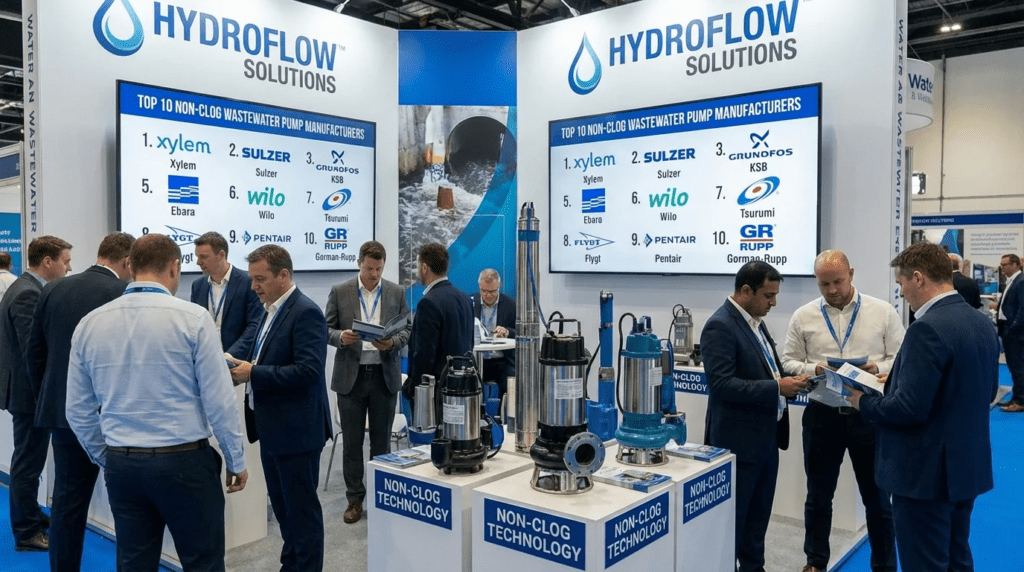
The following tables provide an engineering comparison of the Top 10 Non-Clog Wastewater Pumps Manufacturers for Water and Wastewater. These are based on general industry capabilities, installed base reliability, and technological features. Table 1 focuses on the manufacturers themselves, while Table 2 assists in selecting the right technology type for the application.
Table 1: Top 10 Non-Clog Wastewater Pumps Manufacturers Analysis
| Manufacturer | Primary Technology / Strengths | Typical Applications | Engineering Considerations | Maintenance Profile |
|---|---|---|---|---|
| Xylem (Flygt) | N-Technology (Self-cleaning impeller), Hard Iron metallurgy. | Municipal Lift Stations, Heavy Ragging environments. | Proprietary guide rail systems often required. Excellent hydraulic efficiency in “N” series. | High availability of parts globally. Advanced monitoring relays standard. |
| KSB | Amarex / Sewatec series. High-efficiency hydraulics. | WWTP Intake, Stormwater, Industrial effluent. | Known for robust motor insulation systems. Impellers designed for large free passage. | Long MTBF. Cartridge seals available on larger models. |
| Sulzer | Contrablock impellers, ABS heritage. | Raw Sewage, Sludge recirculation. | Adjustable bottom plate restores efficiency. Very strong in submersible market. | Bottom plate adjustment extends service life before overhaul. |
| Gorman-Rupp | Self-Priming Centrifugal (Above Ground). | Lift stations where wet-well entry is prohibited. | Limited suction lift (approx. 25 ft). Not submersible. Easy access to wet end. | Safest for operators (no crane required). Cover plate removes for instant unclogging. |
| Grundfos | S-Tube Impeller (Tube/Channel hybrid). | Municipal Collection, Commercial buildings. | S-Tube offers high efficiency with large free passage. Smart controllers (Dedicated Controls). | “Auto-adapt” pumps integrate controls into the pump head (careful with specs). |
| Hidrostal | Screw Centrifugal Impeller. | RAS/WAS Pumping, Delicate solids, High viscosity. | Original screw impeller. Steep H-Q curve. Excellent for non-shear applications. | Impeller acts like an inducer; low NPSH required. Handles high solids % well. |
| Wilo | EMU heritage, SOLID impellers. | Deep tunnel pumping, Municipal sewage. | Ceram coatings available for internal protection. Heavy-duty submersible motors. | Closed cooling loop options for dry pit installations are robust. |
| Cornell Pump | Cutter Pump, Redi-Prime (Dry Prime). | Bypass pumping, Industrial wastewater. | Cycloseal system extends seal life by removing grit from seal chamber. | External hydraulic balance line reduces axial loading. |
| Homa | A-Series, Vortex and Channel. | Standard municipal lift stations. | Often a cost-effective alternative with robust cast iron construction. High interchangeability. | Simple construction, easy for general mechanics to rebuild. |
| Ebara | DL Series (Cast Iron Submersible). | Stormwater, Sump service, Municipal. | Focus on heavy-duty cast iron. Reliable basic technology without complex electronics. | Rugged, typically lower CAPEX, reliable for standard duties. |
Table 2: Application Fit Matrix
| Application Scenario | Recommended Technology | Key Constraint | Cost Implication | Operator Skill Impact |
|---|---|---|---|---|
| High Rag Content (Wipes/String) | Semi-Open with Relief (e.g., N-type) or Chopper | Must maintain minimum speed for self-cleaning | High Initial / Low OPEX | Moderate (VFD tuning) |
| High Grit / Sand Load | Vortex or Hardened Channel | Lower hydraulic efficiency | Medium | Low |
| Sludge / High Viscosity | Screw Centrifugal | Steep performance curve | High Initial | High (Process knowledge) |
| Limited Access / No Crane | Self-Priming (Above Ground) | Suction lift limits (NPSH) | Medium | Low (Easy cleanout) |
| Large Flow / Low Head | Axial / Mixed Flow | Column installation requirements | High (Civil works) | High (Rigging complex) |
Engineer & Operator Field Notes
Real-world performance often diverges from the theoretical curves found in catalogs. The following field notes provide practical guidance for managing the Top 10 Non-Clog Wastewater Pumps Manufacturers for Water and Wastewater.
Commissioning & Acceptance Testing
Acceptance testing is the final gate before a utility assumes ownership. Rigorous testing prevents “infant mortality” issues.
- Vibration Baseline: Establish a vibration baseline (ISO 10816-1) immediately upon startup. Record velocity (in/s or mm/s) at the inboard and outboard bearings. Any reading over 0.15 in/s on a new pump warrants investigation.
- Drawdown Test: Perform a volumetric drawdown test to verify actual flow rates against the pump curve. Magnetic flow meters can be inaccurate if not installed with sufficient straight-pipe runs; a drawdown test is the “truth” metric.
- Amp Draw & Phase Balance: Measure current on all three legs. Voltage unbalance greater than 1% can lead to a 6-10% current unbalance and significant temperature rise in the windings.
- Documentation: Ensure O&M manuals include specific part numbers for the mechanical seals and bearings, not just generic assembly drawings.
Common Specification Mistakes
Engineers often unintentionally undermine their own projects through vague specifications.
- The “Or Equal” Trap: While competitive bidding is required, defining “equal” loosely allows vendors to substitute lighter-duty pumps. Specify minimum weights, shaft diameters, and bearing B-10 life explicitly.
- Undersizing Cables: For long submersible cable runs, voltage drop can be significant. Specify cable gauge based on the distance to the control panel, not just the motor amp rating.
- Ignoring Air Release: In systems with high points or self-priming pumps, failure to specify proper air release valves leads to air binding and perceived pump failure.
- Over-Sizing: Safety factors on top of safety factors result in pumps running far to the left of BEP. This causes shaft deflection, seal failure, and recirculation cavitation.
O&M Burden & Strategy
Maintenance strategies for the Top 10 Non-Clog Wastewater Pumps Manufacturers for Water and Wastewater generally fall into three categories.
- Routine (Monthly): Check seal fail relays, monitor amp draws, inspect discharge check valves for chatter. Verify alternator logic in the control panel.
- Preventive (Annual): Pull submersibles. Change oil in the seal chamber (inspect for water intrusion—milky oil indicates seal failure). Check impeller clearance and adjust if necessary. Megger the motor windings.
- Predictive: Use SCADA trends to watch for slowly increasing amp draws (indicating drag/wear) or decreasing flow rates (indicating internal recirculation).
Troubleshooting Guide
- Symptom: Pump runs but no flow.
Cause: Air bound volute, closed discharge valve, or reversed rotation (very common in new installs).
Action: Check rotation, bleed air. - Symptom: High Amps.
Cause: Dragging impeller (rubbing), bad bearings, high specific gravity fluid (heavy sludge), or running too far to the right of the curve (low head).
Action: Check clearance, test fluid density, throttle valve to push back on curve. - Symptom: Frequent Clogging.
Cause: Velocity too low, impeller clearance too wide, or wrong impeller type for trash content.
Action: Increase VFD minimum speed, adjust wear plate, or consider grinder/chopper retrofit.
Design Details / Calculations
Accurate design calculations are the foundation of reliable pumping systems. When applying equipment from the Top 10 Non-Clog Wastewater Pumps Manufacturers for Water and Wastewater, the following methodologies apply.
Sizing Logic & Methodology
- Determine Flow (Q): Based on peak hourly flow (peaking factor) or storage constraints.
- Calculate Static Head: The vertical distance from the “pump off” level in the wet well to the highest point of discharge.
- Calculate Friction Head: Use the Hazen-Williams equation ($h_f = 0.2083 times (100/C)^{1.85} times Q^{1.85} / d^{4.8655}$). For wastewater, use a C-factor of 100 to 120 (conservative) to account for slime layer buildup over time.
- System Curve Generation: Plot Total Dynamic Head (TDH) vs. Flow. Overlay the pump curves from selected manufacturers.
- Intersection Analysis: Ensure the intersection of the pump curve and system curve falls within the Preferred Operating Region (POR), typically 70% to 120% of BEP.
Specification Checklist
A robust specification for non-clog pumps should include:
- Standard: Pumps shall meet Hydraulic Institute (HI) Standards for submersible solids-handling pumps.
- Solids Capability: Minimum 3-inch (76mm) non-compressible sphere passage.
- Flanges: ANSI B16.1 Class 125 discharge flanges.
- Shaft: 400-series stainless steel or carbon steel with full stainless steel shaft sleeve.
- Motor Service Factor: Minimum 1.15 service factor, Class F or H insulation, rated for continuous duty in 40°C ambient.
- Testing: Factory Performance Test (witnessed or non-witnessed) certified to HI level 1U or 1B.
Standards & Compliance
- AWWA: Adherence to relevant sections of AWWA standards for wastewater equipment.
- NEC/NFPA 70: Explosion-proof (Class 1, Division 1, Group C & D) ratings are mandatory for most enclosed wet wells containing sewage.
- NEMA: Motors should meet NEMA MG-1 standards for efficiency and construction.
FAQ Section
What constitutes a “non-clog” pump in wastewater applications?
A “non-clog” pump is defined by its ability to pass solids without jamming. Historically, the Hydraulic Institute defined this as the ability to pass a 3-inch (76mm) spherical solid. However, modern definitions also include the ability to handle fibrous materials (rags, wipes) without “roping” or binding the impeller. This is achieved through specific impeller geometries like single-vane, vortex, or screw-centrifugal designs.
How do I choose between a grinder pump and a non-clog pump?
Select a grinder pump for low-flow, high-head applications using small diameter pipe (e.g., pressure sewer systems, 1.25″ to 2″ discharge). Select a non-clog pump for larger municipal stations (3″ discharge and up) where flows exceed 50 GPM. Grinders are maintenance-intensive and should be avoided in larger stations unless the discharge pipe diameter is the limiting constraint.
What is the typical lifespan of a submersible wastewater pump?
A high-quality submersible pump from the top manufacturers should last 15–20 years with proper maintenance. The “wet end” (impeller and wear plate/ring) typically requires refurbishment or replacement every 5–7 years depending on grit load. Bearings and seals typically last 5–10 years before requiring an overhaul.
Why is the Top 10 Non-Clog Wastewater Pumps Manufacturers for Water and Wastewater list important for specification?
The manufacturers on this list have established supply chains, proven hydraulic designs, and service networks necessary for municipal infrastructure. Utilizing “off-brand” or “white label” pumps can lead to issues with parts availability, lack of local support, and unverified hydraulic efficiency, ultimately increasing the Total Cost of Ownership.
What causes pumps to run at high amperage?
High amperage is usually caused by one of three factors: 1) Mechanical drag (bad bearings, rubbing impeller, or debris stuck in the volute); 2) Electrical issues (voltage imbalance, phase loss); or 3) Hydraulic operation (pumping fluid with high specific gravity, or operating too far to the right on the pump curve due to lower-than-expected system head).
How often should wastewater pumps be maintained?
A typical maintenance schedule involves: Daily/Weekly visual checks (panel indicators, noise); Quarterly external inspections (amp draws, check valve operation); and Annual comprehensive PMs (pulling the pump, checking oil, meggering stator, inspecting cable). See the [[O&M Burden & Strategy]] section for more details.
Conclusion
Key Takeaways
- Process over Price: Selecting a pump based on lowest bid without evaluating hydraulic suitability for solids handling is the most expensive mistake an engineer can make.
- Solids Handling: “Sphere passage” does not equal “rag handling.” Look for specific impeller technologies (relief grooves, cutters, screw-centrifugal) for high-rag environments.
- System Curve Criticality: Always plot the pump curve against the system curve. Ensure operation within the Preferred Operating Region (POR) to maximize seal and bearing life.
- Material Selection: Use Hard Iron for grit/abrasion and Duplex Stainless for corrosion. Standard cast iron is often insufficient for aggressive modern wastewater.
- Reliability: Specify dual mechanical seals and moisture detection sensors to prevent catastrophic motor failure.
Selecting the right equipment from the Top 10 Non-Clog Wastewater Pumps Manufacturers for Water and Wastewater is a critical engineering task that dictates the reliability of the entire treatment chain. The industry has moved beyond simple centrifugal physics; success now depends on the integration of advanced materials, geometric design for solids management, and intelligent controls.
Engineers should approach this selection process by first rigorously defining the waste stream characteristics and the system curve. Only then should manufacturer-specific technologies be evaluated. By focusing on Total Cost of Ownership—prioritizing energy efficiency, ease of maintenance, and resistance to clogging—utilities can build resilient infrastructure that protects public health and the environment for decades. Whether the application demands the sheer ruggedness of a hard-iron submersible or the delicate handling of a screw-centrifugal unit, the manufacturers detailed in this guide provide the engineering solutions necessary to keep the flow moving.