
Top 10 Centrifuges (Dewatering) Manufacturers for Water and Wastewater
Introduction
For municipal and industrial treatment plant engineers, sludge handling often represents the single largest line item in the operational budget. With biosolids disposal costs frequently accounting for 30% to 50% of a facility’s total operating expenses, the efficiency of the dewatering process is not merely a technical detail—it is a critical financial lever. A variance of just 1% in cake solids dryness can translate to hundreds of thousands of dollars in reduced hauling and disposal costs annually for a mid-sized utility. Consequently, selecting the right equipment from the Top 10 Centrifuges (Dewatering) Manufacturers for Water and Wastewater is one of the most high-stakes decisions a design engineer or plant manager will face.
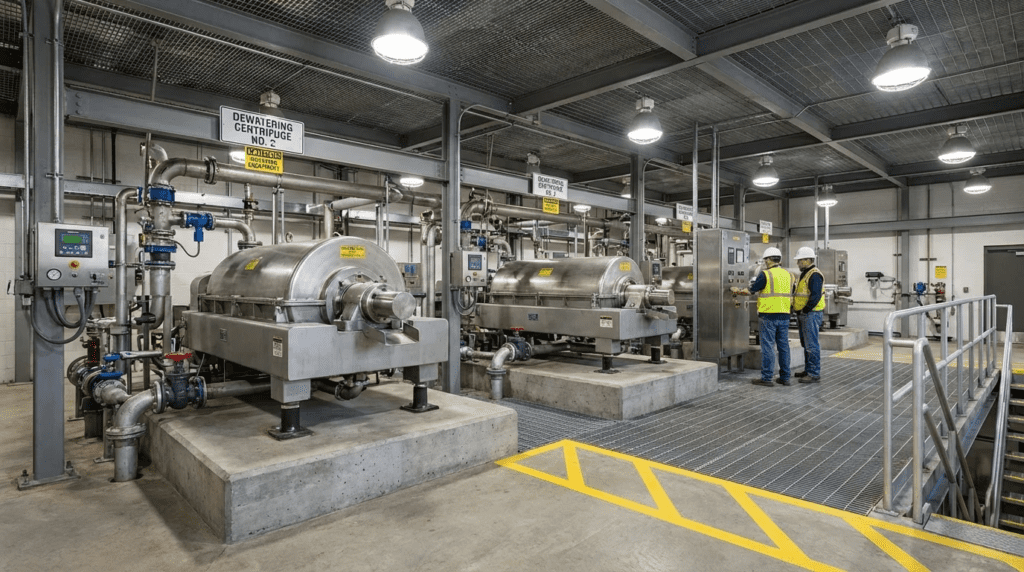
Decanter centrifuges have become the dominant technology for high-volume dewatering applications due to their continuous operation, enclosed odor containment, and ability to handle varying feed solids without the constant wash-water demands of belt filter presses. However, the market is crowded with options ranging from high-speed, high-G-force European designs to rugged, high-torque North American iterations. Many engineers overlook the nuances of scroll geometry, backdrive technology, and wear protection, leading to specifications that favor low capital cost over long-term process capability.
This article provides a rigorous, unbiased technical analysis of the leading manufacturers and the engineering principles required to specify them. We will move beyond marketing brochures to examine torque characteristics, hydraulic limitations, and the realities of maintenance. Our goal is to equip engineers with the data necessary to evaluate the Top 10 Centrifuges (Dewatering) Manufacturers for Water and Wastewater based on performance, reliability, and total lifecycle cost.
This guide sits within our broader coverage of the centrifuge dewatering process. For the mechanics of the machine itself, see our guides to the sludge dewatering centrifuge, how a sludge dewatering centrifuge works, and centrifuge wastewater treatment.
Editorial note: the manufacturer table below previously carried an unresolved drafting instruction in place of a tenth entry, along with a duplicate reference to a manufacturer already listed. The row has been corrected to list GN Solids Control, and two brand names have been updated to reflect current corporate naming (GEA, formerly presented as GEA Westfalia, and HAUS).
How to Select and Specify Dewatering Centrifuges
Specifying a decanter centrifuge requires balancing three competing process goals: maximum cake dryness, maximum solids capture (centrate quality), and minimum polymer consumption. The following criteria define the engineering operating envelope.
Duty Conditions & Operating Envelope
The “nameplate capacity” of a centrifuge is frequently misleading. Engineers must distinguish between hydraulic capacity (limit of liquid flow) and solids capacity (limit of the conveyor torque to move sludge). In wastewater applications, the solids load is usually the limiting factor.
- Solids Loading Rate: Specified in lbs/hour or kg/hour of dry solids. A robust specification requires the machine to handle peak solids loading (often 125% of average) without torque overload.
- Hydraulic Loading: Specified in GPM or m³/hr. This dictates the residence time within the bowl. Insufficient residence time results in poor capture rates (dirty centrate).
- Feed Variability: Centrifuges are sensitive to rapid changes in feed consistency. The specification must account for feed solids ranging typically from 0.5% (WAS) to 3-5% (Digested Sludge).
- G-Force and Bowl Speed: High G-force (3,000+ G) improves settling but increases wear and energy consumption. The trend in municipal specifications is toward medium-G (2,000–2,800 G) machines that balance dewatering performance with longevity.
Materials & Compatibility
The abrasive nature of grit and the corrosive potential of hydrogen sulfide in wastewater demand strict material standards.
- Bowl and Scroll Material: Duplex Stainless Steel (e.g., CD4MCu, 2205, or 2304) is the industry standard for wetted parts due to its superior yield strength and resistance to stress corrosion cracking compared to 304 or 316 austenitic stainless steel.
- Wear Protection: This is a critical specification point.
- Sintered Tungsten Carbide Tiles: The gold standard for the scroll edge. These are brazed or bolted and are replaceable.
- Flame Spray/Hard Surfacing: Generally lower cost but requires shop rework to repair. Acceptable for low-abrasion applications but risky for municipal grit.
- Feed Zone Liners: The feed acceleration zone sees the highest abrasion; replaceable liners are mandatory for longevity.
Hydraulics & Process Performance
The internal geometry of the centrifuge dictates its separation efficiency.
- Length-to-Diameter (L/D) Ratio: Modern high-performance dewatering centrifuges typically feature an L/D ratio of 4:1 or higher. A longer bowl provides more clarification area and longer retention time, improving capture rates.
- Beach Angle: The conical section where solids are lifted out of the pond. Steep angles (common in thickening) compress solids less, while shallow angles allow for better dewatering but require higher torque.
- Pond Depth Adjustment: The ability to adjust weir plates (dams) is standard. Deep ponds improve capture (clarity) but may result in wetter cake. Shallow ponds yield drier cake but risk solids carryover.
Installation Environment & Constructability
Centrifuges are dynamic machines generating significant vibration and requiring substantial structural support.
- Structural Loads: The supporting structure must account for the static weight plus dynamic loads (typically 2.5x to 3x static weight) to handle imbalance events.
- Vibration Isolation: Spring isolators are standard to decouple machine vibration from the building structure.
- Access for Maintenance: A bridge crane or monorail is mandatory. The hoist must be rated to lift the heaviest component (usually the rotating assembly), often exceeding 5 tons for large municipal units.
- Noise: Centrifuges are loud (85-95 dBA). Sound attenuating enclosures are often required to meet OSHA standards for 8-hour exposure.
Reliability, Redundancy & Failure Modes
In 24/7 plants, redundancy is non-negotiable, usually in an N+1 configuration.
- Bearings: Main bearings are the most common wear item. L10 life should be specified at minimum 100,000 hours. Grease lubrication is common for smaller units; oil recirculation is preferred for large, continuous-duty machines for better heat dissipation.
- Scroll Drive (Backdrive): The differential speed between the bowl and scroll controls solids transport.
- Hydraulic Backdrive: Extremely high torque density, self-lubricating, robust under shock loads.
- Electric Backdrive (VFD/Gearbox): Higher efficiency, easier integration into SCADA, no hydraulic fluid handling.
Controls & Automation Interfaces
Modern dewatering is an automated process relying on feedback loops.
- Torque Control Mode: The control system monitors scroll torque and adjusts differential speed automatically to maintain a constant solids pile, ensuring consistent cake dryness.
- Polymer Pacing: Feed forward loops (based on flow) and feedback loops (based on torque or filtrate turbidity) optimize polymer usage.
- Vibration Monitoring: Accelerometers on main bearings must be hardwired to the E-Stop circuit to prevent catastrophic failure during severe imbalance.
Lifecycle Cost Drivers
The purchase price (CAPEX) is often only 10-15% of the 20-year Total Cost of Ownership (TCO).
- Polymer Consumption: The largest OPEX driver. A machine that requires 35 lbs/ton of polymer vs. one that requires 28 lbs/ton will cost significantly more over time.
- Cake Dryness: As noted, hauling water is expensive. A 2% difference in dryness affects disposal volume linearly.
- Energy Efficiency: “Turbo” or energy-recovery designs (where the discharge energy helps drive the bowl) can reduce power consumption by 20-30%.
- Energy in context: decanter centrifuges are the most energy-intensive of the common mechanical dewatering options, typically drawing on the order of 30 to 60 kWh per dry ton of solids, against roughly 10 to 20 for a belt filter press and lower still for a screw press. That penalty is usually justified by the drier cake and the enclosed, odor-contained operation, but it belongs in the lifecycle comparison rather than being left out of it.
- Polymer in context: the 28 to 35 lb/ton figures cited above sit at the upper end of the normal municipal range. Centrifuges generally run somewhere between 15 and 35 lb of dry polymer per dry ton on anaerobically digested sludge, higher than a belt press on the same feed, because the high shear environment demands a stronger floc. Waste activated sludge pushes toward the top of that band; well-digested primary-heavy sludge sits lower.
Manufacturer Comparison and Application Fit
The following tables provide an engineering comparison of the major OEMs available in the global market. These assessments focus on technical capabilities, typical application fits, and maintenance profiles rather than commercial availability.
Table 1: Leading Centrifuge Manufacturer Analysis
| Manufacturer | Primary Strengths & Technology | Typical Applications | Limitations / Considerations | Maintenance Profile |
|---|---|---|---|---|
| Alfa Laval | High-speed technology; strong separation efficiency; energy-reduction features; advanced connectivity and automation. | Large municipal plants; difficult-to-dewater biological sludges. | Premium pricing; proprietary parts can be expensive; sophisticated controls require skilled operators. | Global service centers; requires specialized tools. |
| GEA | Deep pond designs; high torque capability; energy-efficient variable pond systems; robust gearbox designs. | High-capacity municipal; industrial wastewater; potable water sludge. | Complex hydraulic optimization; longer lead times for some spare parts. | High reliability; complex field service. |
| Andritz | Heavy-duty industrial design adapted for municipal; very high torque gearboxes; large frame sizes available. | Large municipal plants; mining and aggregates; high-grit environments. | Large footprint; heavy weight requires substantial structural support. | Rugged; field-replaceable wear tiles standard. |
| Flottweg | Simp-Drive® technology (transmission separating bowl and scroll drive); adjustable impeller allowing pond depth changes while running. | Variable sludge streams; plants requiring frequent process adjustments. | Proprietary drive system limits third-party repair options. | Low maintenance but proprietary. |
| Centrisys | US-based manufacturing; hydraulic backdrive systems; high-torque scroll designs; dedicated municipal focus. | Mid-to-large US municipalities; retrofits requiring US-made equipment. | Less focus on ultra-high G-force clarification compared to some European counterparts. | Designed for ease of field service. |
| Pieralisi | Cost-effective; strong history in agro-industry adapted to wastewater; compact designs. | Small to mid-sized municipalities; seasonal operation plants. | May have lower ultimate torque capacity than heavy industrial peers. | Simple mechanics; parts widely available in Europe and the Mediterranean. |
| Hiller | High-performance hydraulics; DecaPress series for wastewater; advanced weir designs. | Municipal sludge requiring very high cake dryness. | Market penetration varies by region. | High-precision dynamic balancing required. |
| IHI / Tomoe | Japanese precision engineering; tight balance and vibration tolerances; long bearing life. | Asian markets; industrial plants valuing extreme reliability. | North American support network is smaller; higher initial CAPEX. | Very low unplanned maintenance. |
| HAUS | Competitive pricing; rapid delivery; modern dual-motor drive designs. | Design-build projects; cost-constrained municipal upgrades. | Shorter track record in the North American municipal market than legacy brands. | Standard VFD architecture; growing service network. |
| GN Solids Control | Economical solutions; modular skid packages; electric VFD drive focus. | Industrial wastewater; temporary dewatering; smaller municipal plants. | Lower maximum G-force range; industrial rather than sanitary finish. | Simplified design for operator-level maintenance. |
Table 2: Application Fit Matrix
This matrix assists engineers in matching plant constraints with equipment characteristics.
| Scenario | Primary Constraint | Recommended Technology Focus | Critical Specification Parameter |
|---|---|---|---|
| Anaerobic Digested Sludge | Cake Disposal Cost | High-Torque, Deep Pond | High torque rating relative to bowl diameter; tiles on entire scroll |
| Waste Activated Sludge (WAS) | Capture Rate / Polymer Usage | High G-Force (>2800G), Long L/D | L/D Ratio > 4:1; High differential speed capability |
| Water Treatment (Alum Sludge) | Shear Sensitivity | Low Shear Feed, Moderate G | Axial feed zone design; Flux-controlled inlet |
| Small Rural Plant | Operator Availability | Simple Hydraulics, Auto-Shutdown | Automated startup/shutdown sequences; Remote monitoring |
| Industrial (Oily Waste) | Explosion Risk / Chemistry | 3-Phase Separation, NEMA 7/ATEX | Explosion-proof motors; Nitrogen purging systems |
Engineer & Operator Field Notes
Successful implementation of dewatering centrifuges depends as much on operational strategy as it does on the hardware itself. The following notes are compiled from field experience in commissioning and troubleshooting.
Commissioning & Acceptance Testing
The Factory Acceptance Test (FAT) confirms mechanical integrity, but the Site Acceptance Test (SAT) validates process guarantees.
- Hydraulic Baseline: Run the machine with water only to establish baseline vibration and bearing temperatures. If vibration exceeds 2-3 mm/s RMS on water, do not proceed to sludge.
- Solids Recovery Test: Verify capture rate by measuring Total Suspended Solids (TSS) in the centrate. A typical specification requires >95% capture. Remember that capture rate is inversely proportional to hydraulic flow rate.
- 24-Hour Endurance Run: Critical for identifying thermal issues in the hydraulic backdrive unit or electrical room (VFD overheating) that don’t appear in short tests.
Pro Tip: During commissioning, ensure the polymer system is not the bottleneck. Engineers often size the centrifuge for future flows but leave the existing polymer unit, limiting the centrifuge to 60% capacity because the polymer needs “aging” time to be effective.
Common Specification Mistakes
Avoid these errors in your Request for Proposal (RFP):
- Specifying “Bowl Speed” instead of G-Force: Different diameters yield different G-forces at the same RPM. Always specify the G-force requirement.
- Ignoring Struvite Access: In anaerobically digested sludge, struvite (magnesium ammonium phosphate) forms glass-like scale inside the centrate discharge. Specify easy access hatches or integrated acid-wash headers to manage this without full disassembly.
- Under-specifying the Conveyor Torque: Manufacturers may offer a “standard” torque gearbox to win a low-bid project. For wastewater, always specify “High Torque” options to handle upset conditions or heavier-than-expected sludge.
- Accepting a performance guarantee without defining the feed: a cake dryness guarantee is meaningless unless the specification fixes the feed characteristics it applies to — solids concentration, volatile solids fraction, grit content, and degree of digestion. Vendors will guarantee against the feed you name, and a plant whose actual sludge differs will have no recourse. Require a bench or pilot test on the actual sludge where the project scale justifies it.
- Forgetting the centrate load: centrate from anaerobically digested sludge returns a substantial ammonia and phosphorus load to the head of the plant, commonly 15 to 25 percent of the influent nitrogen load. Where the plant has nutrient limits, this return stream must be accounted for in the liquid train design or managed through equalization or sidestream treatment.
O&M Burden & Strategy
Centrifuges are high-maintenance relative to static dewatering equipment.
- Lubrication: Automatic greasers are helpful, but manual verification is required. Over-greasing is a common cause of high bearing temperatures.
- Scroll Resurfacing: Even with tungsten carbide tiles, the scroll will eventually wear. Plan for a scroll swap-out every 15,000–25,000 hours. This requires a spare rotating assembly (or at least a spare scroll) to avoid weeks of downtime.
- Vibration Analysis: Do not rely solely on the machine’s trip panel. Perform quarterly spectral analysis to detect bearing defects (inner/outer race frequencies) before they become catastrophic.
Troubleshooting Guide
- Symptom: High Vibration.
Check: Uneven solids loading (plugging), failed main bearings, or flexible connection stiffness (pipe strain). - Symptom: Wet Cake.
Check: Torque too low (increase differential speed?), pond depth too deep, or polymer dosage insufficient. - Symptom: Dirty Centrate (Black Water).
Check: Hydraulic flow too high (residence time too low), differential speed too high (stirring up the pond), or worn scroll flighting.
Design Details and Calculations
To properly size and integrate a centrifuge from the Top 10 Centrifuges (Dewatering) Manufacturers for Water and Wastewater, engineers must perform specific calculations beyond basic flow matching.
Sizing Logic & Methodology
Do not size based on hydraulic flow alone. Follow this logic:
- Determine Mass Load: Calculate dry solids load (flow multiplied by solids concentration). Apply a peaking factor (typically 1.25 to 1.5).
- Check Hydraulic Residence: Ensure the unit volume allows for adequate retention time at peak hydraulic flow.
- Calculate Sigma Value: This is the theoretical capacity index of the centrifuge, equivalent to the area of a gravity settling tank. Compare Sigma values between manufacturers to gauge relative theoretical performance.
Specification Checklist
Ensure these items are in your Division 46 specification:
- Scroll Material: 316SS or Duplex SS (specification should dictate Duplex for yield strength).
- Wear Protection: Sintered tungsten carbide tiles (avoid hard facing alone for grit service).
- Drive Type: Variable frequency drives for both main and backdrive motors with regenerative braking capability.
- PLC Protocol: EtherNet/IP or Modbus TCP/IP for SCADA integration (map out all status words).
- Noise Guarantee: Maximum 85 dBA at 1 meter (requires enclosure).
Standards & Compliance
- Electrical: Motors should be NEMA MG-1 Premium Efficient. Enclosures NEMA 4X (stainless) for corrosion resistance.
- Safety: OSHA machine guarding standards. Zero-speed switches for lid locks (lid cannot open until rotation stops).
- Testing: ASME PTC 19.3 for vibration testing procedures.
Frequently Asked Questions
What is the difference between a thickening and a dewatering centrifuge?
While the hardware looks similar, the geometry differs. Thickening centrifuges (increasing solids from ~1% to ~5-7%) use a steep beach angle and deep pond to maximize liquid clarity and hydraulic capacity. Dewatering centrifuges (increasing solids from ~3% to ~25%+) use a shallow beach angle, high torque gearboxes, and modified scroll flighting to compress solids into a dry cake. Do not use a thickener for dewatering applications.
How does differential speed affect performance?
Differential speed is the speed difference between the bowl and the scroll. A lower differential speed increases the time solids stay in the machine (residence time), leading to drier cake but higher torque and potential clogging. A higher differential speed clears solids faster, reducing torque but often resulting in wetter cake and dirtier centrate due to turbulence. Optimizing differential speed is key to process control.
What is the typical lifecycle of a dewatering centrifuge?
A well-maintained municipal centrifuge typically lasts 20-30 years. However, major overhauls are required periodically. Main bearings last 3-5 years. The scroll usually requires re-tiling or hard-surfacing every 5-7 years depending on grit levels. Electronic components (VFDs/PLCs) typically require modernization every 10-12 years.
Why is my centrifuge consuming excessive polymer?
Excessive polymer use is often caused by poor mixing energy at the injection point, incorrect polymer activation (insufficient aging time), or running the centrifuge hydraulically overloaded. Additionally, worn scroll tiles can increase shear, breaking floc structures and requiring more chemical to compensate. Check the injection ring inside the feed tube for scaling or blockage.
Can a centrifuge handle struvite?
Centrifuges are prone to struvite scaling in anaerobic sludge applications because the turbulence releases CO2, raising pH and encouraging precipitation. While they can handle it better than belt presses (which blind), the discharge chutes and centrate pipes will scale. The best defense is chemical dosing (ferric) upstream to bind phosphorus, or specifying an automated acid-wash cycle for the centrifuge.
How do I choose between hydraulic and electric backdrives?
Hydraulic backdrives offer the highest torque-to-weight ratio and handle shock loads exceptionally well, making them ideal for heavy industrial or high-grit inputs. Electric backdrives (VFD/gearbox) are more energy-efficient, cleaner (no hydraulic oil leaks), and offer easier integration with modern plant SCADA systems for data analytics. Most new municipal installations favor electric drives unless the application is extremely severe.
Conclusion
Key Takeaways for Engineers
- Solids Load Drives Selection: Size the machine based on peak solids loading (lbs/hr), not just hydraulic flow (GPM).
- Torque is King: For dewatering, invest in high-torque gearboxes and backdrives. High torque capability enables the formation of drier cake, directly reducing hauling costs.
- Wear Protection Matters: Specify replaceable tungsten carbide tiles for municipal wastewater. Avoid simple hard-facing for any stream containing grit.
- Total Cost of Ownership: Evaluate bids based on a 20-year lifecycle including polymer consumption and cake dryness, not just the initial equipment price.
- Integration: Ensure the feed pumps, polymer systems, and cake conveyance are sized to match the centrifuge’s peak capacity, not its average.
Selecting the right equipment from the Top 10 Centrifuges (Dewatering) Manufacturers for Water and Wastewater requires a departure from generic specifications. Engineers must rigorously evaluate the specific sludge characteristics—abrasiveness, dewaterability, and variability—against the machine’s mechanical capabilities.
While manufacturers like Alfa Laval, GEA, and Andritz offer robust, high-capacity machines suitable for large metropolises, specialized players like Centrisys, Flottweg, and Hiller offer unique drive technologies and service models that may better suit mid-sized utilities or specific industrial constraints. The “best” centrifuge is not the one with the highest theoretical G-force, but the one that offers the widest operating window (torque and volume) to handle the inevitable process upsets of a treatment plant while minimizing polymer and energy usage.
By focusing on the engineering fundamentals outlined in this guide—torque density, wear protection, and control integration—utilities can secure a dewatering asset that delivers reliability and financial efficiency for decades.