
Top OEMs for Channel and Inline Grinder Systems in Wastewater Headworks
Introduction
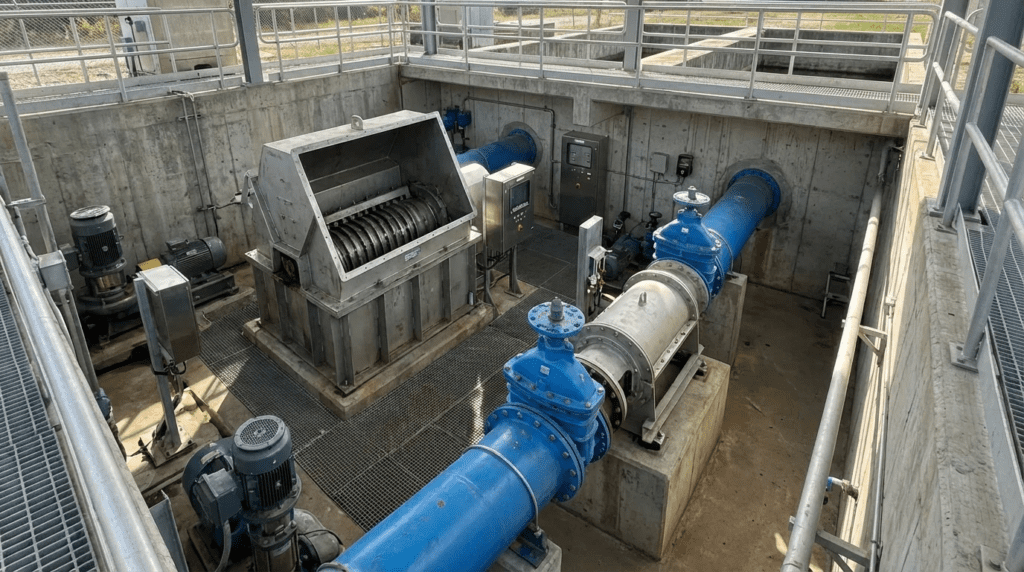
In the architecture of modern wastewater treatment, the protection of downstream assets is a foundational priority. Channel and inline grinder systems serve as the first line of active defense in headworks and sludge processing lines. Unlike passive screening technologies that remove solids, grinders modify solids, reducing rags, wood, plastics, and non-dispersibles into smaller particulates that can pass through pumps, pipes, and dewatering equipment without causing blockage or damage.
For municipal consulting engineers and plant operators, the selection of a grinder system is a determinant of plant reliability. The increase in non-dispersible consumer products entering the waste stream has shifted the grinder from an optional refinement to a routine requirement. A failure at the grinder stage often results in clogging of raw sewage pumps, damage to centrifuge scrolls, or fouling of heat exchangers in anaerobic digestion loops.
This article provides an engineering review of channel and inline grinder systems. It explores the hydraulic and mechanical principles governing their selection, analyzes the design philosophies of the market’s dominant manufacturers, and offers specification guidance for lifecycle optimization.
One consolidation and one reclassification in this revision. The earlier version listed Sulzer and JWC Environmental as two separate manufacturers in a list of five, while noting in the Sulzer entry that JWC was its parent company. They are one supplier: Sulzer acquired JWC Environmental, and with it the Muffin Monster and Channel Monster lines, in 2018. Listing both made a five-supplier field look broader than it is, which matters when the list is being used to assemble a bid slate. The entries are now consolidated, and Moyno has been added as a distinct inline maceration supplier.
The Huber entry has also been re-scoped. Huber’s strength is screening rather than grinding, and the honest framing is that the company represents the alternative strategy — remove the solids rather than reduce them — rather than a competing grinder line.
This article is filed under wastewater screen manufacturers, though its subject is grinders, which sit in their own category. The filing should be corrected. For related coverage see our guides to wastewater grinders and screening equipment manufacturers, and our comparisons of channel grinder equipment and inline grinder equipment.
How to Select This Equipment Type
Hydraulic Performance and Head Loss
In channel applications, the hydraulic profile is the primary constraint. Engineers must calculate head loss across the grinder unit under peak wet weather flow conditions. Grinders introduce a restriction in the channel; as debris accumulates on the cutter stack between cleaning cycles, the upstream water level rises.
- Open Area Ratio: The ratio of open flow area through the cutter stack to the channel area dictates baseline head loss.
- Drum Design: Many high-flow channel grinders use perforated diverter drums to route fluid around the cutter stack while capturing solids. Perforation size and drum speed directly impact capture efficiency and hydraulic resistance.
- Submergence: Inline units require net positive suction head consideration to prevent cavitation across the cutter elements, particularly when placed on the suction side of positive displacement pumps.
Solids Handling and Reduction Technology
- Dual-Shaft, Slow-Speed, High-Torque: The industry standard for headworks. Two counter-rotating shafts with intermeshing cutters shear solids. Superior for rags, heavy clothing, and wood.
- Macerators: Typically single-shaft or plate-based designs using a shearing action against a cutting plate. Better suited to sludge lines where particle size uniformity is critical for downstream process protection.
- Cutter Tooth Geometry: The number of teeth per cam and the cam profile determine final particle size. Fewer teeth allow larger solids intake, while multipoint cutters create finer particulates suitable for sludge.
Materials of Construction
- Cutters: Hardened alloy steels heat treated to a defined Rockwell C range are common. For abrasive applications involving grit, tungsten carbide impregnated cutters extend life.
- Housings: Ductile iron is standard for inland municipal applications. In coastal areas with saline intrusion or industrial applications with low pH, 304 or 316 stainless steel housings are appropriate to prevent structural corrosion.
- Shafting: Hexagonal shafting is preferred over keyed round shafting in high-torque applications to distribute load evenly across the cutter stack and prevent rotational failure.
Seal Assembly and Bearing Protection
- Cartridge Seals: Modern specifications should favor cartridge seal assemblies that are pre-assembled and pressure-tested by the manufacturer, eliminating installation errors during field maintenance.
- Pressure Rating: Seals must be rated for the maximum static head of the system, which can be significant in deep wet wells or high-pressure sludge force mains.
- No Flushing Required: Ideally, mechanical seals should not require an external flush water source, which adds operational complexity and cost.
Controls and Logic
- Jam Sensing: The system must detect over-current conditions and initiate an auto-reverse sequence to clear the obstruction.
- Clearing Logic: Specifications should define the number of reversals permitted before the unit triggers a fault alarm to protect the motor.
- Variable Speed: While many grinders run at fixed speeds, variable frequency drives allow operators to adjust cutter speed based on flow rates or torque requirements, optimizing energy usage and reducing wear during low-flow periods.
Comparison Table
| Manufacturer | Core Technology | Primary Configuration | Key Strengths | Limitations / Considerations | Best-Fit Application |
|---|---|---|---|---|---|
| Franklin Miller | Taskmaster (dual-shaft) / Super Shredder (inline) | Channel & Inline | Robust cutter cartridge design eliminates stack tightening; heavy-duty construction. | Heavy equipment weight can complicate manual removal without lifting gear. | Headworks with high inorganic loading; heavy industrial sludge lines. |
| Sulzer / JWC Environmental | Muffin Monster and Channel Monster (dual-shaft); inline macerators; grinder pumps | Channel, Inline & Submersible | Originator of the dual-shaft grinder with a large install base; specialized cutter technologies for wipes; strong integration with pump systems. | Individual cutter stacking requires precise tensioning during rebuilds unless the cartridge option is specified. | Municipal headworks with high rag volumes; pump station and downstream pump protection. |
| Vogelsang | XRipper (twin-shaft) / RotaCut (macerator) | Inline & Channel | Maintenance-in-place design; monolithic rotors allow quick change-out without removing the unit. | RotaCut screens require regular adjustment to maintain cutting tension against the plate. | Inline sludge grinding; applications prioritizing rapid maintenance access. |
| Huber | Screening and screenings handling systems | Channel | Integration of screening with screenings washing and compaction; high-quality stainless steel fabrication standards. | Focus is on screening and washing; standalone grinding options are more limited than competitors. | Complete headworks packages where solids removal rather than reduction is the strategy. |
| Moyno | Inline macerators and progressive cavity pump packages | Inline | Macerator heads engineered to protect progressive cavity pumps; matched pump and conditioning packages. | Product range is oriented to sludge and pump protection rather than headworks channel duty. | Protection of downstream pumps in sludge and dewatering feed loops. |
Manufacturer Detail
Franklin Miller
Franklin Miller is a US-based manufacturer with a reputation for heavy-duty engineering. Their design philosophy leans toward maximizing mass and structural rigidity to withstand shock loads.
- Taskmaster Series: Their flagship dual-shaft grinder. A distinguishing feature is the cutter cartridge. Unlike traditional designs that stack individual cutter disks and spacers on a shaft, the cutters and spacers are machined from a solid block of alloy steel. This monolithic approach increases the strength of the rotating assembly and eliminates the risk of stack loosening or individual cutter cracking.
- Super Shredder: A distinct inline unit often used in sludge lines, providing high-shear grinding with low head loss. It is effective in reducing solids to a fine consistency, protecting downstream nozzles or centrifuges.
- Serviceability: The cartridge design simplifies rebuilds, as operators replace a few large modules rather than many individual disks. This reduces labor hours for overhaul, though the capital cost of replacement cartridges can be higher.
Sulzer / JWC Environmental
JWC Environmental, now part of Sulzer, is synonymous with the term grinder in the municipal sector, having established the dual-shaft grinder market with the Muffin Monster. These systems are characterized by low-speed, high-torque operation.
- Muffin Monster and Channel Monster: A broad range of configurations, including the Channel Monster, which integrates rotating screening drums to divert solids into the grinder while allowing liquid to pass, handling high flow rates with lower head loss.
- Wipes-oriented cutter technology: In response to non-dispersible wipes, specific cutter geometries were developed to catch and shear synthetic fibers that slip through standard cutters, using knurled spacers and specialized tooth profiles to prevent roping.
- Individual cutters vs. cartridge: Traditional units rely on individual cutters and spacers, offering flexibility in customizing tooth counts for specific applications but requiring rigorous adherence to torque specifications during rebuilds to prevent shaft fatigue. Pre-stacked replacement options are available.
- Pump integration: Within the wider Sulzer portfolio, inline macerators and submersible grinder pumps are engineered alongside the pump lines they protect, so that the particle size output of the conditioning device matches the solids handling capability of the pump.
Vogelsang
Vogelsang approaches the market with a philosophy centered on maintenance in place. Their designs prioritize the ability of operators to service the equipment without removing it from the pipeline or channel.
- XRipper: A twin-shaft grinder using monolithic ripper rotors rather than stacked plates. The rotors are keyed to the shaft and accessed by opening the front cover of the housing, allowing rotor replacement in a fraction of the time required for stacked designs. The design is compact, suiting tight inline retrofits.
- RotaCut: Distinct from the dual-shaft concept, the RotaCut is an inline macerator featuring a heavy object separator and a self-sharpening cutting head pressing against a cutting screen. It is favored in sludge applications because it homogenizes the medium, protecting downstream pumps and improving digestion efficiency.
- Engineering Focus: Units are often specified where uptime is paramount and crane access is limited. The integration of stone traps in the RotaCut line adds protection against non-grindable objects that would otherwise jam a dual-shaft unit.
Huber
Huber Technology, a German manufacturer, is recognized for high-efficiency stainless steel headworks equipment. They are best known for screens, and their contribution to this category is primarily through the screening strategy rather than through grinding.
- Screening and screenings handling: Huber approaches the solids problem through removal rather than reduction, combining a step screen or drum screen with a screenings wash press.
- Construction: Equipment is typically fabricated entirely from stainless steel, contrasting with the ductile iron construction common among US-based grinder manufacturers, which favors installations with corrosive atmospheres.
- Application Fit: Huber is the preferred specification for plants seeking a holistic headworks solution where solids are captured, washed, compacted, and hauled off site rather than passed downstream in smaller pieces.
Moyno
Moyno’s contribution to this category is inline maceration in support of progressive cavity pumping, rather than headworks channel grinding.
- Inline macerators: Designed specifically for the protection of sludge pumps, engineered to handle high-viscosity sludge containing fibers and solids.
- System synergy: Specifying the macerator and the pump from a single source ensures that the particle size output of the conditioning device matches the solids handling capability of the pump stator, which is the parameter that actually governs stator life.
Application Fit Guidance
Municipal Headworks (Channel)
For the main influent channel, the dual-shaft channel grinders from the established manufacturers are the dominant choices where grinding is the selected strategy.
- Selection Driver: High flow capacity and the ability to handle large, random debris.
- Why: These units offer the highest torque and the most robust drum options to manage peak wet weather flow without blinding.
Sludge and Biosolids Recirculation (Inline)
For protecting heat exchangers and sludge pumps in digestion loops, macerator-style technologies and inline shredders excel.
- Selection Driver: Maintenance access and particle size uniformity.
- Why: A macerator with an integrated stone trap prevents grit from damaging heat exchangers. Inline maintenance capability is crucial in complex piping galleries where removing a unit is difficult.
Septage Receiving Stations
- Selection Driver: Extreme rock and debris handling.
- Why: Septage trucks discharge rocks and metal tools. Heavy-duty dual-shaft grinders with rock traps are essential to prevent catastrophic failure.
Pump Station Protection
- Selection Driver: Ragging prevention.
- Why: For lift stations susceptible to ragging, installing an inline grinder on the suction side or a channel grinder in the wet well prevents pump ragging. Integrating grinding at the pump suction is an alternative where a separate unit cannot be accommodated.
Engineer & Operator Considerations
Maintenance Access and Removal
- Bypass Loops: All inline grinders must be installed in a bypass loop with isolation valves, allowing the plant to continue operation while the grinder is serviced.
- Lifting Rails: Channel grinders are heavy. Guide rails and dedicated jib cranes or hoists must be specified.
- Clearance: Ensure vertical clearance to pull the unit. Some channel grinders have tall drive motors that can interfere with overhead piping or walkways.
Where the Ground Solids End Up
The distinction drawn at the top of this article — that screens remove solids while grinders modify them — has a consequence that deserves more weight than it usually gets at design stage. Everything a headworks grinder cuts remains in the plant.
Shredded wipes and textiles do not dissolve. They travel on to the primary clarifiers, the digesters, and eventually the dewatering equipment, and fibrous material has a well-documented tendency to reassemble downstream. Rag accumulation around digester mixers and centrifuge scrolls frequently originates as material that a headworks grinder passed through in pieces rather than captured whole. The clog is not eliminated; it is relocated to a point where clearing it is more expensive.
This is why practice at larger staffed plants has moved toward fine screening with washing and compaction at the headworks, sending the material to a dumpster, and reserving grinders for the duties where removal is impractical:
- Grinding is the right answer at unmanned lift stations with no screenings handling, immediately upstream of specific equipment requiring protection, in sludge and recirculation lines where the solids must remain in the process, and at septage receiving where the load is unpredictable.
- Screening is usually the better answer at a staffed headworks, where the solids load can be taken out of every downstream process rather than redistributed through them.
Where a grinder is selected for a headworks, the design should account for the downstream fate of the ground material, not only for whether the influent pumps stop clogging.
Spare Parts and Lead Times
- Cutter Stacks: Lead times for replacement cutter stacks can be lengthy. Plants should either stock a spare cartridge or specify a unit whose manufacturer offers a rotatable spare program.
- Seal Assemblies: Mechanical seals are the most frequent replacement part. Ensure the local representative stocks seal kits.
Common Failure Modes and Mitigation
- Shaft Deflection: Caused by attempting to grind an object that is too hard. Mitigation: specify controllers with fast-acting current sensing and auto-reverse.
- Dry Running: Running a grinder dry damages the mechanical seals. Mitigation: interlock grinder operation with channel level sensors or pump run signals.
- Seal Contamination: Mitigation: specify automatic lubricators or positive pressure oil reservoirs where available to maintain seal face lubrication.
Specification Pitfalls
- Ignoring Head Loss: Engineers must account for the blinded head loss condition. If a grinder fails or blinds, the channel level will rise. Overflow weirs or bypass channels must be designed to handle peak flow in this scenario to prevent flooding.
- Oversizing: Oversizing a channel grinder can lead to low velocities, allowing grit to settle in the channel upstream of the unit. The channel velocity should maintain self-cleaning speeds.
Conclusion
The selection of channel and inline grinder systems is a pivotal decision in the protection of wastewater treatment infrastructure. While the fundamental physics of particle reduction remain consistent, design execution varies significantly among manufacturers.
Franklin Miller offers structural robustness for heavy-duty applications. Sulzer and JWC Environmental provide the deepest application history and specialized solutions for non-dispersible wipes, together with pump-protection synergy. Vogelsang leads on maintainability and inline sludge processing. Huber provides high-quality integrated stainless screening solutions for plants that choose removal over reduction, and Moyno offers matched maceration and pumping for sludge service.
For the consulting engineer and plant manager, the goal is not simply to specify a machine that cuts solids, but to specify a lifecycle solution. This requires rigorous evaluation of hydraulic profiles, maintenance accessibility, and the specific nature of the waste stream.