
Top OEMs for Screening Equipment
1. INTRODUCTION
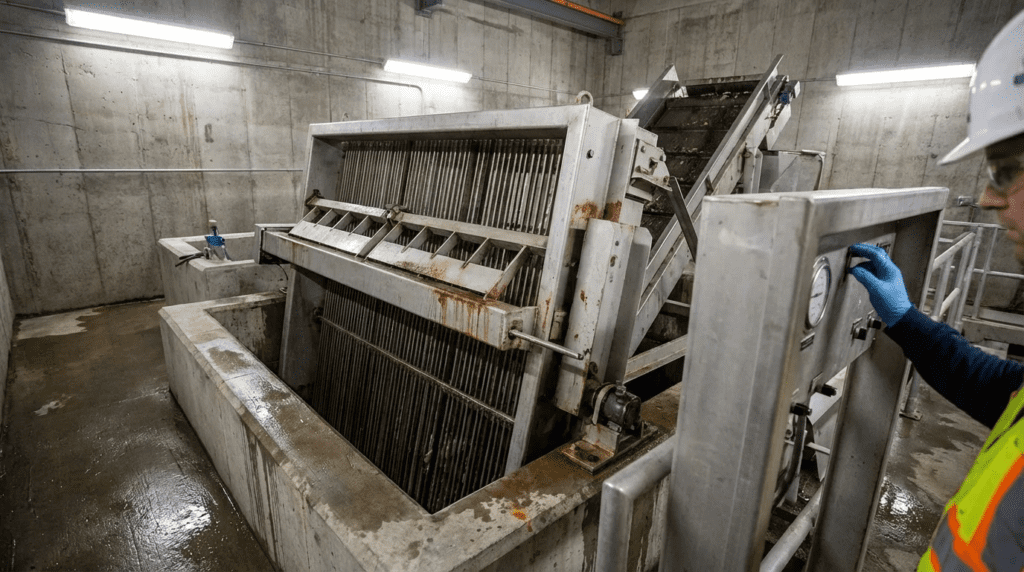
Screening equipment constitutes the first unit operation in the preliminary treatment phase of municipal and industrial wastewater treatment plants (WWTPs). Positioned at the headworks, these systems are critical for the physical removal of gross solids, rags, plastics, and inorganic debris from the influent stream. The primary engineering objective of screening is the protection of downstream mechanical equipment—such as raw sewage pumps, comminutors, pipelines, and aeration diffusers—from clogging, abrasion, and catastrophic mechanical failure. Furthermore, modern biological nutrient removal (BNR) processes and Membrane Bioreactor (MBR) facilities impose stricter requirements on screening performance to prevent the accumulation of inert solids in bioreactors and the fouling of membrane cassettes.
The operating environment for screening equipment is among the most aggressive in the water sector. These units are subjected to variable hydraulic loading, including peak wet weather flows (PWWF) that can carry heavy grit loads and large debris. The atmosphere is typically corrosive, characterized by high humidity and the presence of hydrogen sulfide (H2S), necessitating robust material specifications and explosion-proof electrical classifications (Class 1, Division 1 or 2).
From a regulatory and compliance standpoint, the efficiency of screening impacts the total solids load processed by the facility and the quality of the biosolids produced. Inadequate screening can lead to the “ragging” of pumps and mixers, resulting in increased energy consumption, frequent maintenance interventions, and potential permit violations due to sanitary sewer overflows (SSOs) caused by headworks flow restrictions.
OEM selection in this category is rarely about finding a generic commodity; it involves selecting a technology partner capable of addressing specific hydraulic profiles, channel geometries, and debris characteristics. Within the broader screening equipment category, manufacturer capability varies sharply by technology family, and a supplier that dominates coarse mechanical raking may have no credible offering for membrane-grade perforated plate. The difference between a well-specified screen and a mismatched unit is often measured in years of operational uptime versus weekly operator intervention.
2. GRINDER AND MACERATION SYSTEMS WITHIN THE SCREENING CATEGORY
Screening and grinding are often treated as competing philosophies, but most headworks specifications end up containing both. Screens remove solids from the flow stream; grinders reduce solids so downstream equipment can pass them. The two fail in different ways, and the OEM landscape for grinding equipment is largely distinct from the screen manufacturers profiled later in this guide. The subsections below examine the grinder comparisons that sit alongside screen selection in a complete headworks specification.
The fundamental engineering distinction is one of mass balance. A screen creates a screenings stream that must be washed, compacted, conveyed, and hauled—a recurring operating cost, but one that permanently removes inert material from the plant. A grinder creates no separate waste stream, which is operationally attractive, but the reduced material remains in the flow and reports downstream to clarifiers, digesters, or the biosolids process. Macerated fibrous material can re-weave in pump volutes and mixer shafts, particularly in low-velocity zones. This is why grinders are best specified as pump protection at lift stations and as pre-treatment ahead of a screen, rather than as a substitute for capture at a treatment plant headworks.
Channel Grinder Equipment: Xylem (Flygt) and Wilo
Channel-mounted grinders sit directly in the open flow path, typically in the influent channel upstream of screens or pumps, and are sized to the full channel width. The comparison of Xylem (Flygt) vs Wilo channel grinder equipment is instructive because both manufacturers approach the same duty from a pumping heritage rather than a screening heritage, which shapes their design priorities toward protecting rotating equipment. Channel units must handle the full hydraulic range of the site, including peak wet weather flow, without creating an unacceptable restriction, and they must tolerate the grit loading that arrives with storm flow.
Key selection criteria include cutter stack height relative to channel depth, torque and stall behavior under a heavy rag load, the bypass or overflow path when the unit jams, and cutter cartridge accessibility. Cutter wear is the dominant consumable cost, and units in grit-heavy channels often require service well short of the catalog interval. Specify the removal method explicitly—rail-mounted units that lift clear of the channel avoid the dewatering and confined-space entry a fixed-mount unit forces.
Inline Grinder Equipment: Wilo and Xylem (Flygt)
Inline grinders are installed in a pressurized or gravity pipeline rather than an open channel, most commonly immediately upstream of a pump suction or in a force main receiving line. The Wilo vs Xylem (Flygt) inline grinder equipment comparison turns on a different set of constraints than the channel case: headloss through the cutter stack becomes a direct hydraulic penalty on the pumping system, and the unit must be rated for the pipeline pressure class rather than merely for submergence.
Specification attention belongs on the pressure drop curve across the clean and partially fouled unit, since an inline grinder in a marginal suction condition can push a pump into cavitation. Isolation valving on both sides is essential; without it, cutter service requires draining a section of main. Inline units suit sites with no open channel—packaged lift stations, institutional building sewers, septage receiving—where the objective is pump protection rather than solids removal.
The Grinder OEM Landscape
Beyond the two manufacturers compared above, the broader field of channel and inline grinder OEMs includes specialists whose entire product identity is built around solids reduction rather than pumping or screening. This matters at specification time: grinder-first manufacturers typically offer deeper cutter metallurgy options, more granular torque ratings, and better-documented service intervals, while pump-heritage manufacturers offer tighter integration with their own pump lines and a single point of accountability for the wet well package.
The practical guidance is to decide first whether the grinder is protecting a specific pump model or serving as general headworks pre-treatment. If the former, vendor consolidation with the pump supplier usually wins on warranty and coordination grounds. If the latter, the specialist manufacturers deserve serious evaluation, particularly where the debris profile is severe. Either way, the grinder specification should be written alongside the screen specification rather than as an afterthought, because the two together determine what actually reaches the plant.
3. HOW TO SELECT THIS PROCESS EQUIPMENT
Selecting screening equipment requires a multidimensional engineering analysis that goes beyond simple flow capacity. Engineers must balance capture efficiency (Screenings Capture Ratio – SCR) with headloss constraints and maintenance accessibility. The following criteria define the specification process.
Process Function and Performance Requirements
Screens are generally categorized by the size of the openings: Coarse (6mm to 150mm), Fine (1mm to 6mm), and Micro (<1mm).
- Coarse Screens: Typically used as primary protection for raw sewage pumps. Bar racks (trash racks) are standard here, and the mechanically raked bar screen remains the most widely installed configuration in North American headworks. The goal is to remove large objects (timber, rocks, large rags) that could damage impellers.
- Fine Screens: The industry standard for headworks. Technologies include step screens, perforated plates, and drum screens. For conventional activated sludge plants, 6mm openings are common. For MBR plants, 2mm or 3mm perforated plates are mandatory to protect membranes from hair and fibrous material. The performance differences between the available fine screen architectures are substantial enough that opening size alone is an inadequate specification.
- Capture Efficiency: Engineers must evaluate the Screenings Capture Ratio (SCR). Perforated plates generally offer higher SCR than bar screens for the same opening size because they prevent “stapling” (long thin objects passing through) better than unidirectional bars.
Hydraulic and Process Loading Considerations
Hydraulic calculations are paramount. The screen creates a physical restriction in the channel, inducing headloss.
- Headloss Management: Specifications must define the maximum allowable headloss at Peak Wet Weather Flow (PWWF) with a specific blinding factor (often 30% to 50% blinded). If the headloss exceeds the channel depth capabilities, it can cause upstream flooding or surcharging of the collection system.
- Approach Velocity: To prevent grit deposition in the channel, approach velocity should typically be maintained above 0.4 m/s (1.25 ft/s). However, velocity through the screen face should not exceed 0.9 m/s to 1.2 m/s (3-4 ft/s) to prevent forcing solids through the openings and to limit headloss.
- Flow Variations: The equipment must handle the turn-down ratio between minimum night flows and storm events without bypassing untreated flow.
Materials of Construction
Given the H2S-rich environment, material selection determines the structural longevity of the asset.
- Stainless Steel: AISI 304L is the baseline standard. However, for coastal areas or headworks with high septic conditions, AISI 316L is strongly recommended due to its resistance to pitting and crevice corrosion.
- Duplex Stainless Steel: For extreme industrial applications or high-chloride environments, Duplex 2205 provides superior strength and corrosion resistance.
- Non-Metallic Components: Wear strips, brushes, and spacer gears often utilize HDPE or UHMWPE. These must be UV stabilized if exposed to sunlight and chemically resistant to common cleaning agents.
Integration with Upstream and Downstream Processes
A screen does not operate in isolation. It is the first step in a “screenings handling system” which includes transport, washing, and compaction.
- Screenings Conveyance: The discharge height of the screen must align with the intake of the washer/compactor or conveyor. Screw conveyors or sluice troughs are common.
- Washer/Compactors: To reduce disposal costs and odors, screenings should be washed (to return organics to the flow) and compacted (to increase dry solids content). High-performing systems can achieve over 40% dry solids.
- Controls Integration: The screen operation is typically triggered by a differential level sensor (upstream vs. downstream water level) or a timer. Integration with SCADA for high-level alarms and fail-over logic is critical.
Operations and Maintenance Impacts
The most frequent failure modes in screening involve drive systems and submerged bearings.
- Submerged Bearings: Engineers should prioritize “bottomless” designs or designs where no bearings or sprockets are submerged in the wastewater. Submerged components are difficult to inspect and prone to fouling by grit and hair.
- Cleaning Mechanisms: Screens can be self-cleaning (e.g., rotary drums with spray bars) or mechanically cleaned (rakes). Spray water consumption is a key O&M cost; using plant non-potable water (NPW) is preferred over potable water.
- Operator Safety: Enclosures should be provided to contain aerosols and odors. Access hatches must be large enough for safe removal of jams but interlocked to prevent operation while open.
4. SELECTION & SPECIFICATION FRAMEWORK
The criteria above are individually well understood; the failures occur in sequencing them. A specification written around a preferred manufacturer and then back-filled with performance language produces a document that cannot reject a bad substitution. The framework below orders the decisions so that manufacturer selection falls out of the analysis rather than driving it.
Step 1: Define the Downstream Protection Requirement
The opening size is not a preference; it is dictated by the most sensitive downstream asset. Conventional activated sludge with well-designed pumps tolerates 6mm coarse-to-fine screening. Membrane bioreactors require 2mm to 3mm perforated plate or mesh without exception, because hair and fibrous material that passes a bar screen of nominal 2mm spacing will braid onto membrane fibers. Anaerobic digestion with recirculation pumps and heat exchangers argues for fine screening even where the liquid train would not require it, since rag accumulation in digesters is expensive to remove. Write this requirement first, in performance terms, and let it eliminate technology families before any OEM is named.
Step 2: Establish the Hydraulic Envelope and Blinding Assumption
Define minimum flow, average daily flow, peak hourly flow, and peak wet weather flow, then state the allowable headloss at each condition together with an explicit blinding factor. A screen evaluated clean will always look adequate. The meaningful question is the upstream water surface elevation at PWWF with the screen 30 to 50 percent blinded, compared against the freeboard of the channel and the crown of the incoming sewer. This single calculation determines more retrofit failures than any other.
Step 3: Worked Headloss Example
Consider a headworks channel 4 feet wide carrying a peak wet weather flow of 12 MGD, with a downstream water depth of approximately 3.0 feet set by the outlet weir. The resulting approach velocity is roughly 1.5 ft/s, comfortably above the 1.25 ft/s threshold for grit transport. A 6mm perforated plate screen with an effective open area near 40 percent produces a clean headloss on the order of a few inches at this loading. Applying a 40 percent blinding factor reduces the effective open area substantially, and because headloss scales approximately with the square of the velocity through the openings, the loss rises sharply—commonly into the range of 10 to 18 inches depending on the specific screen geometry. If the channel offers only 12 inches of freeboard above the PWWF water surface, that screen will surcharge the upstream sewer during a storm. The design responses are a wider channel, a second parallel screen unit, a larger opening size with compensating downstream protection, or a technology with a higher effective open area. Selecting the manufacturer before running this calculation forecloses three of those four options.
Step 4: Screen the Field on Submerged Components and Access
Rank candidate designs by what has to be touched during a failure. Designs with no submerged bearings, sprockets, or load-bearing shafts can be serviced without dewatering the channel, and designs that pivot or lift clear of the channel eliminate confined-space entry from routine maintenance. This criterion has no bearing on capture performance but dominates twenty-year labor cost.
Step 5: Evaluate the Screenings Handling Package as One System
The screen, washer, compactor, and conveyance form a single chain that fails at its weakest link. A high-capture screen paired with an undersized compactor simply relocates the jam. Where possible, procure the package from one supplier; where multiple suppliers are unavoidable, define the physical and control interfaces explicitly—discharge elevation, chute geometry, run and fault signal exchange, and responsibility for interlock logic.
Step 6: Compare on Lifecycle Cost
Build a twenty-year comparison covering installed capital, wash water volume, preventive maintenance labor hours, wear-part replacement intervals, screenings hauling volume as affected by achieved dry solids, and the downstream energy and maintenance benefit of higher capture. Screens with different first costs frequently converge or invert on this basis—the core argument for evaluating headworks equipment on lifecycle rather than lowest bid.
5. COMPARISON TABLE
The following table contrasts the five mandated OEMs for screening equipment. Engineers should utilize this data to align specific project constraints—such as channel width, MBR requirements, or retrofit limitations—with the manufacturer’s core technical competencies. This is a high-level differentiation based on equipment architecture and historical application data.
| OEM Name | Typical Applications | Engineering Strengths | Limitations | Best-Fit Scenarios | Maintenance Considerations |
|---|---|---|---|---|---|
| JWC Environmental | Headworks, Pump Stations, Prisons/Institutions, Sludge Screening. | Pioneers of dual-shaft grinding technology (Muffin Monster). Strong portfolio of combined screening/grinding systems. High torque capabilities. | Grinders reduce particle size but do not remove solids from the flow (unless paired with a screen). Reconstituted solids can re-weave downstream. | Pump protection in lift stations; applications requiring aggressive size reduction (grinding) alongside screening; constrained footprints. | Cutter cartridge replacement is a specialized maintenance task. Drum screens require spray water for cleaning. |
| Parkson Corporation | Municipal Headworks, Industrial Pre-treatment, Membrane Protection. | Aqua Guard® filter screen is an industry standard for stepped screening. Exceptional capture rates due to filter element design. Robust chain systems. | Mechanically complex chain-and-sprocket assemblies. High capital cost for premium models. | Large municipal headworks requiring fine screening (6mm or less); retrofits into existing channels; high-capture requirements. | Chain tensioning and brush replacement are routine. Inspecting links for wear is critical to prevent tracking issues. |
| Lakeside Equipment | Small to Large Municipal Plants, Septage Receiving, Industrial. | Raptor® series integrates screening, washing, and compacting in a single unit. Efficient cylindrical/rotary designs. 35-degree installation saves space. | Rotary basket designs can be sensitive to heavy grease loads if spray wash is insufficient. | Complete headworks systems (screen + grit); installations requiring integrated washing/compacting; MBR pre-screening. | Spray nozzles require regular checking. Brush wear on rotating drums needs monitoring. |
| Vulcan Industries | Coarse and Fine Screening, Large Pumping Stations, Stormwater. | Heavy-duty custom fabrication. Strong focus on mechanical bar screens and stair screens. Capable of handling very large hydraulic loads. | Less focus on ultra-fine membrane protection compared to perforated plate specialists. | Severe duty applications; large channel widths; stormwater intakes; coarse screening requirements. | Mechanical bar screens have moving parts (rakes) that require lubrication and alignment checks. Robust but traditional maintenance profile. |
| Hendrick Screen | Water Intakes, Passive Screening, Fish Diversion, Industrial Process. | Specialists in wedge wire and profile wire technology. High precision manufacturing of screen surfaces. Passive intake screens (no moving parts). | Primarily a screen surface/component specialist; fewer “full system” mechanical wastewater headworks installations compared to others. | Surface water intakes; passive screening needs; industrial dewatering surfaces; applications requiring precise slot openings (wedge wire). | Passive screens rely on airburst systems for cleaning (low mechanical maintenance). Wedge wire is durable but difficult to repair if dented. |
| Technology Family | Typical Opening Range | Relative Capture (SCR) | Headloss Profile | Submerged Components | Best-Fit Duty |
|---|---|---|---|---|---|
| Mechanically Raked Bar Screen | 6–50 mm | Low to moderate; vulnerable to stapling | Low when clean; rises steeply when blinded | Varies by model; front-rake designs often avoid bottom bearings | Coarse protection, stormwater, large-flow pump stations |
| Step / Stair Screen | 3–6 mm | Moderate to high; matting effect improves capture | Moderate; benefits from self-forming mat | Generally none | Municipal headworks fine screening in shallow channels |
| Moving Filter Element Screen | 2–6 mm | High; interlocking elements resist stapling | Low relative to capture achieved | Bushings or guides rather than load-bearing shafts in most designs | Deep channels, high-capture municipal duty |
| Rotary Drum / Cylindrical Basket | 1–6 mm | High; large surface area per channel width | Low; large effective open area | Typically none in modern angled designs | Constrained footprints, integrated wash and compaction, MBR pre-screening |
| Band / Perforated Panel Screen | 1–3 mm | Very high; continuous barrier eliminates carryover | Moderate; requires attentive spray wash | Design dependent | MBR protection, membrane and hair-sensitive processes |
| Static / Wedge Wire | 0.25–3 mm | Moderate; depends entirely on hydraulic loading | Gravity driven; no powered restriction | None | Passive intakes, industrial primary separation, sieve bend duty |
| Grinder / Macerator | Not applicable (size reduction) | Zero capture — solids remain in flow | Channel restriction or inline pressure drop | Cutter stack is submerged by design | Pump protection at lift stations; pre-treatment ahead of a screen |
6. TOP OEM MANUFACTURERS
The following section details the specific engineering capabilities and product lines of the top OEMs designated for Screening Equipment. The focus is on technical differentiation, drive mechanisms, and screening philosophies.
JWC Environmental
JWC Environmental is arguably most famous for the “Muffin Monster” grinder, a technology that revolutionized solids size reduction in wastewater. However, in the context of screening, JWC leverages this heritage to offer hybrid and standalone screening solutions. Their engineering philosophy often centers on the “grind and screen” or “capture and wash” approach.
Technical Highlights:
JWC’s screening portfolio includes the Monster Separation Systems. A notable technology is the Bandscreen Monster®, which utilizes UHMWPE perforated panels attached to a drive chain. This design eliminates the “carryover” problem often seen in bar screens, as the panels form a continuous barrier. For finer applications, the Finescreen Monster® utilizes continuous stainless steel bands to achieve high capture rates essential for MBR protection.
Engineering Considerations:
JWC equipment is frequently specified in retrofit applications where space is tight. Their “Screenings Washer Monster” is a heavy-duty compactor that can be paired with their screens to produce a very dry cake, reducing hauling costs. Engineers should note that JWC systems are particularly robust in institutional settings (prisons, hospitals) where the debris load is non-standard and heavy.
Parkson Corporation
Parkson Corporation has established itself as a dominant force in the North American headworks market, primarily through the Aqua Guard® screen. The Aqua Guard is a continuous, self-cleaning moving media screen that utilizes a filter element system rather than simple bars or perforated plates.
Technical Highlights:
The core of the Parkson design is the interlocking filter elements. These elements form a grid that captures solids much smaller than the nominal slot size due to the matting effect of the screenings themselves. The screen utilizes a two-stage cleaning process: the elements flex as they go over the head shaft to release solids, followed by a rotating brush. This design allows for high hydraulic throughput with relatively low headloss.
Engineering Considerations:
Parkson offers the Aqua Guard in various configurations (Standard, High Flow, Ultra). For deep channels, high-strength frames are available. Engineers often specify Parkson when “capture ratio” is the primary driver, as the stepped element design prevents long, fibrous materials from orienting themselves to pass through the screen. Parkson also manufactures the Hycor® line of rotoscreens, which are internally fed drum screens suitable for industrial and scum screening applications.
Lakeside Equipment
Lakeside Equipment Corporation is renowned for its focus on complete headworks engineering. Their Raptor® line of screens is distinct for integrating screening, washing, conveying, and compacting into a single, cohesive mechanical unit. This “all-in-one” approach simplifies the layout for engineers and reduces the number of drive motors required.
Technical Highlights:
The Raptor® Fine Screen features a rotating cylindrical basket angled typically at 35 degrees. As wastewater flows into the basket, solids are captured inside. A rotating rake and spray bar system cleans the basket, transporting solids up a central screw conveyor. The screw conveyor has an integrated compaction zone at the top discharge.
Engineering Considerations:
The cylindrical design provides a large surface area relative to the channel width, helping to minimize headloss. The Lakeside design is particularly effective for removing grease and floating solids that can plague flat screens. For MBR applications, the Raptor® Micro Strainer uses a similar rotary drum architecture but with a specific capture basket designed for 1mm to 3mm separation.
Vulcan Industries
Vulcan Industries operates with a philosophy of heavy-duty, custom mechanical fabrication. While they offer standard models, their strength lies in adapting screening technologies to difficult or non-standard civil works. They are a “metal-first” manufacturer, emphasizing structural rigidity and longevity.
Technical Highlights:
Vulcan’s portfolio is broad, covering the Mensura (measuring) Bar Screen, which is a reciprocating rake screen. The design is simple, robust, and utilizes a “back-cleaning” mechanism where the rakes engage the bars from behind (or front, depending on model) to lift debris. They also manufacture the Stair Screen, a step-type screen ideal for fine screening in channels.
Engineering Considerations:
Vulcan screens are often favored in large municipal pump stations and storm intakes where the debris load can be massive and unpredictable (tires, logs, heavy rag balls). Their mechanical bar screens are designed to stall without damage or to utilize slip clutches, protecting the drivetrain. Maintenance is generally straightforward due to the open, accessible design of the mechanical components.
Hendrick Screen
Hendrick Screen occupies a unique niche in this list. While the other OEMs are primarily known for mechanical wastewater screens (moving parts), Hendrick is a global leader in the manufacture of the screening surface itself, specifically wedge wire and profile wire. However, they also supply complete intake screen systems.
Technical Highlights:
The proprietary “Profile Bar” and wedge wire construction offers non-clogging characteristics for static and passive screening. Hendrick’s intake screens are often used in raw water abstraction, utilizing an airburst system to clear debris from the screen surface without removing the screen from the water. In wastewater, they provide run-down screens (static) and components for mechanical screens.
Engineering Considerations:
Hendrick is the go-to specification for passive water intakes where protecting aquatic life (low intake velocity) and minimizing moving parts underwater are the goals. In industrial wastewater, their static sieve bend screens are highly effective for primary separation without energy consumption (gravity feed).
7. APPLICATION FIT GUIDANCE
Correctly matching the OEM and technology to the application is the primary responsibility of the design engineer.
Municipal Wastewater (Headworks)
For standard Activated Sludge plants, Parkson and Lakeside are dominant. The Parkson Aqua Guard is often preferred for large, deep channels in major metropolitan plants due to its heavy-duty chain construction. Lakeside’s Raptor is an excellent fit for medium-sized plants where footprint is constrained, as the integrated compactor removes the need for separate screenings handling equipment.
Membrane Bioreactor (MBR) Protection
MBR plants require screening to < 3mm, preferably with perforated plates to capture hair. JWC Environmental (Finescreen Monster) and Lakeside (Micro Strainer) and Parkson (Aqua Guard Ultra) offer specific models for this. The “stapling” effect of bar screens makes them unsuitable for MBR protection; perforated plate or mesh designs are mandatory.
Coarse Screening & Stormwater
For large trash racks, lift station protection, and combined sewer overflow (CSO) screening, Vulcan Industries excels. Their mechanical bar screens are designed to handle the brute force of large debris flows. JWC grinders are also applicable here to protect pumps from ragging, though they do not remove the load. Where the duty is genuinely pump protection rather than solids capture, the broader family of wastewater grinders should be evaluated on equal footing with coarse screens, since the two technologies address the same failure mode by opposite means.
Water Intake & Passive Screening
For raw water intakes from rivers or lakes, Hendrick Screen is the primary choice among this group. Their passive wedge wire screens ensure compliance with environmental regulations regarding fish impingement and entrainment, relying on airburst systems rather than mechanical rakes.
8. ENGINEER & OPERATOR CONSIDERATIONS
Beyond the catalog specifications, the reality of installing and running screening equipment dictates long-term satisfaction.
Installation and Commissioning
Channel Tolerances: Civil construction of concrete channels is rarely perfect. Screens, however, are precision machines. Engineers must specify side-wall seals (neoprene or brushes) that can accommodate ±1 inch of civil variance to prevent flow bypass.
Retrofits: When retrofitting a screen into an existing channel, the “drop-in” capability is key. Lakeside’s cylindrical design often fits easily into varying channel widths. Parkson frames are rigid and may require channel modification if the civil work is out of square.
Maintenance Access
The “Bottom Bearings” Issue: Operators universally despise submerged bottom bearings. When they fail, the channel must be dewatered, creating a confined space entry hazard. Where possible, select designs that pivot out of the channel (like some Vulcan or Lakeside models) or designs that utilize a bottom track without a bearing (like the Parkson Aqua Guard, which uses a ceramic or plastic bushing guide rather than a load-bearing shaft).
Odor Control
Screening rooms are odor hotspots. Enclosed screens (like the Lakeside Raptor or fully enclosed Parkson units) significantly reduce fugitive odors compared to open bar screens. Engineers should specify localized odor control extraction ports directly on the screen housing.
Solids Handling
The screen is only as good as the conveyance system taking the trash away. If the compactor jams, the screen backs up. Engineers should prioritize OEMs that supply the screen and the compactor as an integrated package to avoid “finger-pointing” between vendors when interface issues arise.
Wash Water and Utility Demand
Spray wash is the quiet operating cost of fine screening. Every gallon sprayed returns to the head of the plant as additional hydraulic load. Specify the wash water flow and pressure requirement in the equipment schedule, confirm the NPW system can deliver it at peak screen duty with all units running, and require strainers upstream of spray nozzles. Plants that overlook this discover it when the nozzles plug with the same solids the screen just removed.
Controls and Failure Behavior
Specify what the screen does when it cannot do its job. Differential level control should escalate to continuous run before it alarms, and the alarm should distinguish between high differential (blinding) and drive fault (mechanical). Define the behavior on loss of the compactor: most designs should stop the screen rather than discharge into a blocked chute. Confirm that interlocks fail safe on loss of SCADA communications, since a screen that silently stops during a storm produces exactly the outcome the equipment was purchased to prevent.
9. DESIGN DETAILS & STANDARDS
Applicable Standards and References
Screening equipment specifications commonly reference Ten States Standards (Recommended Standards for Wastewater Facilities) for channel arrangement, bypass provisions, and velocity criteria, and the WEF Manual of Practice No. 8 / ASCE MOP 76 for headworks design methodology. Structural and material requirements draw on ASTM A240 for stainless steel plate and sheet grades, with ASTM A276 for bars and shapes. Electrical classification of headworks spaces follows NFPA 820, which governs whether Class I Division 1 or Division 2 equipment is required in a given screening room or channel enclosure—a determination that materially affects motor and control cost. Confined space entry provisions for channel maintenance are governed by OSHA 29 CFR 1910.146.
Specification Checklist
- Duty Conditions: Minimum, average, peak hourly, and peak wet weather flow, with channel dimensions and downstream control elevation stated.
- Performance: Nominal opening size, effective open area, and headloss at each flow condition at a stated blinding factor.
- Capture: Required Screenings Capture Ratio with the test basis identified, not merely a nominal opening dimension.
- Materials: Body and frame grade (304L / 316L / Duplex 2205), fastener grade, non-metallic wear component material, and finish or passivation requirement.
- Submerged Components: Explicit statement of whether bearings, sprockets, or load-bearing shafts are permitted below the water line.
- Seals: Side and bottom seal type with the civil tolerance the seal must accommodate.
- Screenings Handling: Discharge elevation and geometry, washer/compactor performance in percent dry solids, and conveyance interface.
- Utilities: Spray water flow, pressure, and quality; connected motor load; area electrical classification per NFPA 820.
- Controls: Differential level instrumentation, run logic, alarm points, interlocks, and SCADA signal list.
- Testing and Documentation: Shop testing requirements, field functional testing, O&M manuals, and recommended spare parts list with intervals.
10. FREQUENTLY ASKED QUESTIONS
What are the main types of screening equipment used in wastewater headworks?
The principal families are mechanically raked bar screens for coarse duty, step or stair screens and moving filter element screens for municipal fine screening, rotary drum and cylindrical basket screens where footprint is constrained or integrated washing is desired, band and perforated panel screens for membrane protection, and static wedge wire screens for passive intakes and industrial primary separation. Grinders form a related but distinct category: they reduce solids rather than removing them, and are specified as pump protection rather than as a capture device.
How do I choose between a screen and a grinder?
Ask whether the objective is removing material from the plant or protecting a specific piece of rotating equipment. If inert solids must leave the process—to protect a biological system, a digester, or membranes—a screen is required, because a grinder returns the same mass to the flow in smaller pieces that can re-weave downstream. If the objective is preventing a pump from ragging in a lift station where there is no practical way to handle and haul screenings, a grinder is the appropriate answer. Many headworks use both: a grinder for pump protection and a screen for capture.
What opening size should be specified for a membrane bioreactor?
MBR facilities generally require 2mm to 3mm screening using perforated plate or mesh rather than bars. The distinction matters more than the number: a bar screen with 2mm spacing still permits long fibrous material to align with the flow and pass through, a phenomenon known as stapling, and that hair braids onto membrane fibers. Perforated plate presents a two-dimensional opening that a fiber cannot orient through, which is why membrane suppliers write their warranty language around plate or mesh rather than bar spacing.
How much headloss should a screen be designed for?
Design against the blinded condition at peak wet weather flow, not the clean condition. A typical fine screen may show only a few inches of clean headloss while producing well over a foot when 30 to 50 percent blinded, because loss scales roughly with the square of the velocity through the remaining openings. The governing check is whether the resulting upstream water surface stays below the channel freeboard and the crown of the incoming sewer. State the blinding factor explicitly in the specification so that bidders are compared on the same basis.
What are the most common screening equipment failures?
Submerged bearing and sprocket failure leads the list, because it requires channel dewatering and confined space entry to correct. Next are drive overloads from unanticipated debris, spray nozzle plugging that degrades cleaning and accelerates blinding, compactor jams that back up into the screen, and seal wear at the channel walls that allows unscreened bypass. Notably, most of these are maintainability failures rather than capture failures, which is why access and submerged-component criteria deserve weight equal to performance criteria at selection.
What is a realistic screenings volume and dry solids content?
Screenings quantities vary widely with collection system character, opening size, and wet weather behavior, so site-specific data is a better basis than a generic figure. What is consistent is the effect of washing and compaction: a well-specified washer/compactor can raise dry solids above 40 percent and return putrescible organics to the process. Because hauling is billed by weight and volume, the compactor frequently pays for itself faster than any other item in the headworks package.
Should the screen and compactor come from the same manufacturer?
Where practical, yes. The screen, washer, compactor, and conveyance function as one chain, and split procurement creates interface risk at exactly the point where failures cascade—a jammed compactor backs up into the screen, which blinds, which surcharges the channel. Single-source packaging gives one party responsibility for discharge geometry, control interlocks, and performance. Where separate procurement is unavoidable, define the mechanical and control interfaces in the specification rather than leaving them to shop drawing coordination.
11. CONCLUSION
Key Takeaways
- Downstream protection sets the opening size — the most sensitive asset in the plant dictates the screening requirement, and MBR facilities require perforated plate or mesh at 2mm to 3mm without exception.
- Design against the blinded condition — a screen evaluated clean always looks adequate; the meaningful calculation is upstream water surface at peak wet weather flow with a stated blinding factor.
- Submerged components dominate lifecycle labor — designs with no submerged bearings or load-bearing shafts avoid channel dewatering and confined space entry for routine service.
- Screening and grinding solve different problems — grinders protect pumps but return solids to the flow, so they complement rather than replace capture at a treatment plant headworks.
- The handling chain fails at its weakest link — a high-capture screen paired with an undersized compactor relocates the jam rather than eliminating it.
- Never leave the plant with a single screen and a manual bypass — provide redundancy sized for peak wet weather flow, or accept periods of unscreened flow.
- Specify on lifecycle cost — wash water, maintenance labor, wear parts, hauling volume, and downstream benefit routinely invert a first-cost ranking.
The selection of screening equipment is a critical engineering decision that dictates the maintenance intensity of the entire headworks facility. While the fundamental physics of screening remain constant, the execution varies significantly among the top OEMs.
Parkson offers the gold standard in stepped-screen capture efficiency, ideal for stringent downstream protection. Lakeside provides highly integrated, footprint-efficient rotary solutions perfect for modern, compact plants. JWC Environmental bridges the gap between grinding and screening, solving difficult solids problems in lift stations and headworks. Vulcan Industries provides the heavy mechanical muscle for coarse and large-flow applications, while Hendrick Screen dominates the precision wedge wire and passive intake market.
Engineers must move beyond “lowest bid” mentalities for headworks equipment. Specifying a screen based on Lifecycle Cost (LCC)—accounting for wash water usage, preventive maintenance labor, and capture efficiency benefits to downstream aeration—will invariably lead to a more resilient and operator-friendly treatment facility.