
Top OEMs for PLC & Control Platforms in Water & Wastewater
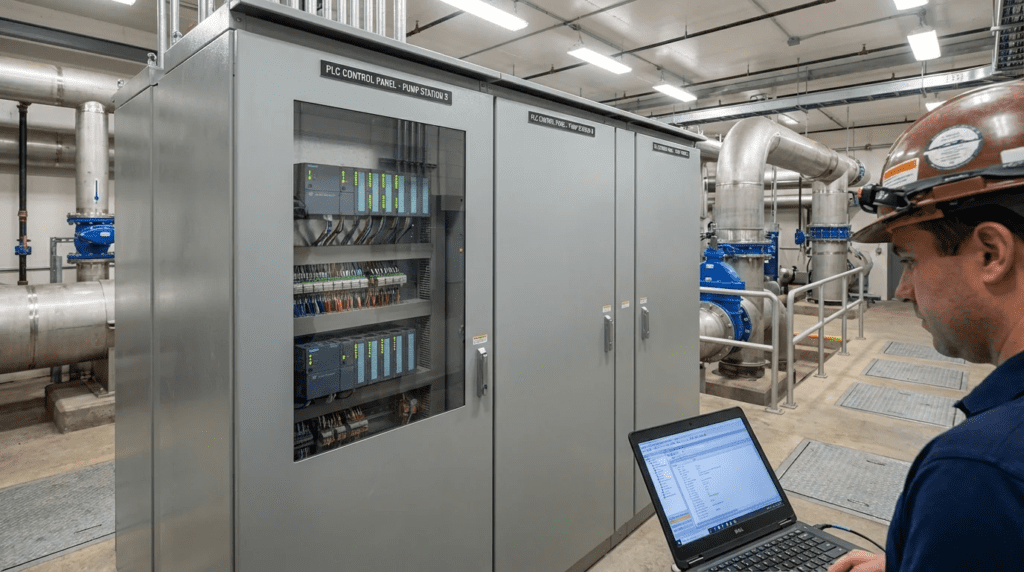
Introduction to PLC & Control Platforms in Water & Wastewater
In the municipal and industrial water sector, the Programmable Logic Controller (PLC)—often evolving into the Programmable Automation Controller (PAC)—serves as the central nervous system of treatment and distribution infrastructure. Unlike discrete manufacturing, where systems may shut down for retooling, water and wastewater treatment plants (WTPs and WWTPs) operate as continuous, critical infrastructure. A control system failure does not merely result in lost production time; it can lead to regulatory violations, environmental contamination, hydraulic overflow events, and risks to public health.
For consulting engineers and utility decision-makers, selecting a control platform is rarely about picking a commodity component. It is a strategic decision that dictates the facility’s operational philosophy for the next 15 to 25 years. The hardware must withstand harsh environments characterized by hydrogen sulfide (H₂S) corrosion, high humidity, and fluctuating temperatures. Furthermore, the software ecosystem defines how easily operators can intervene during upsets, how seamlessly data integrates with SCADA for compliance reporting, and how securely the utility can defend against cyber threats.
The modern water utility landscape is shifting from isolated islands of automation toward fully integrated, plant-wide information networks. As such, the selection of an Original Equipment Manufacturer (OEM) for the control platform must account for open architecture capabilities, support for industrial protocols like EtherNet/IP, PROFINET, and DNP3, and the availability of local integration support. This article provides a rigorous, engineer-focused analysis of the leading control platform OEMs, evaluating their technical merits, architectural philosophies, and long-term viability in municipal applications.
How to Select a PLC/PAC Platform for Municipal Infrastructure
Selection of a control platform requires a multifaceted engineering analysis that moves beyond initial hardware cost. The total cost of ownership (TCO) in automation is heavily weighted toward software licensing, programming efficiency, integration labor, and long-term maintenance. Engineers must evaluate platforms based on the following technical criteria.
1. Processing Power and Architecture
Modern treatment processes, such as Membrane Bioreactor (MBR) filtration or reverse osmosis, require complex PID loop control and high-speed floating-point math that legacy PLCs struggle to handle. Engineers must specify Process Automation Controllers (PACs) that offer multi-tasking capabilities. This allows critical I/O updates to occur in a high-priority periodic task (e.g., 20ms) while complex math, data aggregation, and messaging occur in lower-priority continuous tasks. The architecture must support distributed control, where the processing load is shared across multiple controllers rather than centralized in a single point of failure.
2. Reliability and Redundancy
For critical assets such as raw sewage lift stations or high-service pump stations, redundancy is non-negotiable. Engineers must evaluate the “switchover” mechanics of the platform.
Hot Standby: The backup processor runs in lockstep with the primary, with mirrored memory. Switchover is bumpless (milliseconds), ensuring no drop in outputs or communication.
Warm Standby: The backup processor is powered but requires a synchronization routine upon failure detection. This may result in a momentary “glitch” or reset of non-retentive timers.
The specification must define the required Mean Time Between Failures (MTBF) and whether redundancy extends to the power supplies and communication modules.
3. Environmental Hardening and Conformal Coating
Wastewater environments are notoriously aggressive to electronics. H₂S gas attacks copper traces and silver contacts, leading to “black wire” corrosion and premature board failure. While NEMA 4X (or Type 4X) enclosures provide protection, they are not infallible, especially when panel doors are opened for maintenance. Specifying “conformal coating” (class G3 rating per ISA-71.04) on all processor, I/O, and communication cards is a critical requirement for longevity. Not all OEMs offer this as a standard catalog option for all modules.
4. Communication Protocols and Interoperability
The days of proprietary communication highways (like Data Highway Plus or Modbus Plus) are largely over, yet the choice of Ethernet protocol remains a defining characteristic.
EtherNet/IP: Dominant in North America, standard on Rockwell architectures.
PROFINET: Dominant globally and in Siemens architectures, offering high-speed determinism.
Modbus TCP: A universal standard supported by almost all platforms, though often requiring manual mapping of registers.
DNP3 / IEC 61850: Critical for remote telemetry units (RTUs) and electrical substation integration within the plant.
Engineers must assess the platform’s native ability to talk to Variable Frequency Drives (VFDs), flow meters, and analytical instrumentation without expensive third-party gateways.
5. Cybersecurity and IEC 62443 Compliance
With water infrastructure increasingly targeted by state actors and ransomware, the control platform is the last line of defense. Modern specifications should require controllers with embedded security features, such as digitally signed firmware (to prevent rootkits), role-based access control (RBAC) at the controller level, and the ability to disable unused physical ports. Adherence to ISA/IEC 62443 standards for secure product development lifecycle is a mandatory vetting criterion.
6. Lifecycle Management and Migration
Municipal projects operate on long horizons. A PLC installed today may not be replaced until 2045. Engineers must evaluate the OEM’s history of backward compatibility. Can the new processor run the old code with minimal conversion? Does the OEM offer a “guaranteed availability” period for spare parts? Platforms that require a complete “rip-and-replace” of I/O wiring during an upgrade generate massive labor costs and operational risk.
Comparison of Top Control Platform OEMs
The following table compares the five primary OEMs dominating the water and wastewater sector. This comparison focuses on their architectural philosophy, protocol dominance, and specific utility in municipal engineering contexts. Engineers should use this as a high-level guide to align platform strengths with project requirements.
| OEM Name | Core Architecture | Primary Protocols | Key Strengths | Limitations | Best-Fit Application |
|---|---|---|---|---|---|
| Rockwell Automation (Allen-Bradley) | Logix (ControlLogix / CompactLogix) | EtherNet/IP, CIP | Dominant US market share; vast integrator base; seamless integration with ODVA-compliant devices; PlantPAx DCS capabilities. | High hardware and licensing costs; strictly proprietary backplane; dependence on annual support contracts for software updates. | Large-scale US municipal plants; projects requiring widespread local support availability. |
| Siemens | SIMATIC S7 (S7-1500 / S7-1200) | PROFINET, PROFIBUS | Exceptional diagnostic capabilities; totally integrated automation (TIA) portal; highly efficient code execution; robust cybersecurity. | Steeper learning curve for technicians trained only on ladder logic; lower market penetration in US municipalities compared to industrial. | Technically complex processes (e.g., MBR, Desalination); facilities prioritizing high-density diagnostics and speed. |
| Schneider Electric | Modicon (M580 / M340) | Modbus TCP, EtherNet/IP | Inventor of the PLC; strong DNP3 native support for telemetry; M580 offers “ePAC” ethernet backplane; strong energy monitoring integration. | Software environment (Unity/Control Expert) differs significantly from US standards; market share varies regionally. | Distribution networks; telemetry-heavy systems; plants requiring native integration with power distribution equipment. |
| ABB | AC500 / Freelance | PROFINET, EtherCAT, Modbus | Scalable from small to large; excellent integration with ABB drives and instrumentation; strong “High Availability” libraries. | Smaller installed base in US municipal treatment compared to Rockwell/Modicon; niche expertise required for complex DCS implementations. | Integrated power and automation projects; facilities standardized on ABB VFDs and instrumentation. |
| Emerson | PACSystems (RX3i) / VersaMax | PROFINET, EGD | Legacy of GE Fanuc robust hardware; true hot-standby redundancy; ruggedized hardware options; strong outcome-based control philosophy. | Transition of ownership (GE to Emerson) created some market hesitation; ecosystem rebuilding under Emerson branding. | Mission-critical pump stations requiring high-speed redundancy; retrofit of existing GE Fanuc bases. |
Top OEMs: Detailed Engineering Analysis
The following analysis breaks down the specific hardware families, software environments, and engineering considerations for the five allowable OEMs in this category. The focus is on their application within the specific constraints of water and wastewater treatment.
Rockwell Automation (Allen-Bradley)
Rockwell Automation is the de facto standard for the majority of municipal water and wastewater systems in North America. Their “Logix” platform has largely replaced the legacy PLC-5 and SLC-500 systems, offering a unified programming environment known as Studio 5000 (formerly RSLogix 5000).
Hardware Architecture
For municipal applications, engineers typically specify two families:
- ControlLogix (5580 Series): This is the flagship chassis-based system. It is designed for large treatment plants requiring high I/O counts, complex communications bridging, and hot-standby redundancy. The L8x processors feature quad-core CPUs, significantly increasing scan speeds for massive PID loop counts common in biological nutrient removal (BNR) processes.
- CompactLogix (5380 Series): A rack-less, din-rail mounted system ideal for smaller skid systems, lift stations, or distributed remote I/O panels. While it lacks the chassis-based redundancy of ControlLogix, it shares the same programming instruction set, allowing code reuse.
Engineering Considerations
The primary advantage of specifying Rockwell is the “Add-On Instruction” (AOI) capability. Engineers can develop (or purchase) standardized code blocks for pumps, valves, and chemical feed systems. Once validated, these AOIs can be locked to prevent tampering. Additionally, the prevalence of EtherNet/IP allows for “Plug and Play” integration with VFDs and Motor Control Centers (MCCs), where the PLC can read drive parameters (Amps, Fault Codes, Hz) directly over the network without hardwiring analog signals.
However, engineers must carefully manage firmware revisions. Rockwell hardware is strictly version-dependent. A processor running v32 firmware cannot be accessed by v30 software without flashing. This requires rigorous configuration management policies at the utility level.
Siemens
Siemens dominates the global market and is increasingly specified in North American projects that demand high technical sophistication, particularly in desalination and advanced filtration. Their SIMATIC S7 platform represents a shift toward object-oriented programming within the TIA (Totally Integrated Automation) Portal environment.
Hardware Architecture
- S7-1500: The successor to the S7-300/400, this platform is renowned for its backplane speed and diagnostic capabilities. It features a built-in display on the CPU faceplate for immediate status checking without a laptop—a feature operators appreciate. The S7-1500 supports advanced redundancy (R/H systems) over PROFINET.
- S7-1200: A compact controller often used for standalone OEM skids (e.g., polymer feed systems, UV reactors).
Engineering Considerations
Siemens excels in system diagnostics. If a wire breaks on a specific I/O card, the S7-1500 can report that specific channel fault up to the SCADA system automatically, provided the hardware configuration is set correctly. This “system-generated” alarming reduces the programming burden of creating thousands of manual maintenance alarms.
The use of PROFINET as the backbone allows for Media Redundancy Protocol (MRP), enabling ring topologies for Ethernet cabling. If the ring is cut, traffic reverses instantly, maintaining uptime. This is often more cost-effective than the Device Level Ring (DLR) required in other architectures.
Schneider Electric
Schneider Electric holds a strong position in the water sector, particularly rooted in the legacy of Modicon—the brand that invented the PLC. Their modern offering leverages the EcoStruxure architecture, focusing heavily on the convergence of IT and OT (Operational Technology).
Hardware Architecture
- Modicon M580: Marketed as an ePAC (Ethernet Programmable Automation Controller), the M580 features a backplane that is essentially an Ethernet switch. This allows for massive bandwidth between modules. It is notably strong in cybersecurity, with embedded Achilles Level 2 certification.
- Modicon M340: The mid-range solution, compatible with the same I/O modules (X80 platform) as the M580, making migration and stocking spares efficient.
Engineering Considerations
Schneider is often the preferred choice for utilities with extensive remote telemetry networks. The processors have native support for DNP3 and IEC 60870-5 protocols directly on the CPU or communication modules, without complex third-party converters. This makes them ideal for monitoring wide-area distribution networks and remote lift stations.
Another strength is the “Derived Function Block” (DFB) concept in their Control Expert (formerly Unity Pro) software, which offers flexibility similar to Rockwell’s AOIs but with online editing capabilities that some engineers find more forgiving in live plant environments.
ABB
ABB’s presence in the water sector is often tied to their dominance in the power and drives market. Their control platforms are frequently seen in “Total Plant” solutions where the electrical gear (switchgear, transformers, VFDs) and automation are procured as a single package.
Hardware Architecture
- AC500: This PLC platform is highly modular and supports a wide variety of communication couplers. It is designed to be protocol-agnostic, easily bridging PROFIBUS, CANopen, Modbus, and PROFINET networks.
- AC500-S: The safety PLC variant, integrated into the standard architecture for managing safety instrumented functions (SIF) like high-pressure boiler shutdowns or biogas safety systems.
Engineering Considerations
ABB’s “Freelance” distributed control system (DCS) offers a hybrid approach, bringing DCS functionality to a PLC price point. For water plants, the AC500 is particularly strong when managing large banks of ABB VFDs. The drive integration libraries are pre-written and validated, significantly reducing commissioning time for pump stations. Additionally, ABB offers specific water libraries containing standard function blocks for pump control, alternation, and chemical dosing.
Emerson
Emerson’s position in the PLC market was solidified by the acquisition of GE Intelligent Platforms. This brought the widely installed Series 90-30, 90-70, and RX3i lines under the Emerson umbrella. This is distinct from their Ovation DCS (typically power generation) and DeltaV (oil & gas), positioning the PACSystems hardware specifically for discrete and hybrid markets like water.
Hardware Architecture
- PACSystems RX3i: A high-performance rack-based controller. It is famous for its ruggedness and is often found in the most demanding municipal environments. The RX3i supports High Availability (HA) with redundant CPUs and redundant I/O links.
- VersaMax: A modular I/O architecture that doubles as a compact PLC, widely used for distributed I/O drops in large plants.
Engineering Considerations
The RX3i is a powerhouse for “warm standby” and “hot standby” applications. PROFINET redundancy in the RX3i is implemented efficiently, allowing for bumpless transfer in critical pump stations. For utilities with an installed base of GE Series 90-30 PLCs, the RX3i offers a migration path that often allows the retention of existing wiring harnesses and I/O racks, saving substantial installation costs during retrofits. The programming environment, PAC Machine Edition, supports C programming blocks, allowing engineers to write complex algorithms for flow calculation or proprietary process control.
Application Fit Guidance
While all five OEMs produce hardware capable of controlling a water plant, specific operational profiles often favor one platform over another. Engineers should match the platform to the application characteristics.
Municipal Wastewater Treatment Plants (WWTP)
Large WWTPs are complex, biological chemical processing facilities. They require heavy analog processing, complex sequencing (SBRs, filter backwashes), and plant-wide integration.
- Primary Choice: Rockwell Automation (ControlLogix) or Siemens (S7-1500).
- Reasoning: These platforms offer the richest DCS-like feature sets. Rockwell’s PlantPAx or Siemens’ PCS 7 (utilizing S7 hardware) provide pre-built objects for graphics, alarms, and faceplates, creating a standardized HMI experience for operators.
Remote Lift Stations and Distribution
These assets are geographically dispersed, often rely on radio or cellular telemetry, and require low power consumption.
- Primary Choice: Schneider Electric (Modicon) or Emerson (PACSystems).
- Reasoning: The native support for DNP3 (Distributed Network Protocol) is the deciding factor. DNP3 allows for time-stamped data buffering; if the radio link goes down, the PLC stores the data and backfills the SCADA historian once comms are restored. Rockwell and Siemens can do this but often require additional cards or licensing.
High-Reliability / Mission Critical Pump Stations
Facilities that cannot tolerate even a millisecond of downtime (e.g., stormwater lift stations preventing city flooding).
- Primary Choice: Emerson (RX3i) or Rockwell (ControlLogix Redundancy).
- Reasoning: Both offer true hot-standby redundancy with synchronized memory. However, Emerson’s implementation of PROFINET redundancy is often viewed as highly robust and cost-competitive for pure pumping applications.
Integrated Power and Process Projects
Greenfield projects where the Main Switchgear, MCCs, and Control System are bid as a package.
- Primary Choice: ABB or Siemens.
- Reasoning: Both companies manufacture the heavy electrical gear (transformers, switchgear) alongside the automation. This single-source responsibility mitigates the risk of finger-pointing during commissioning when VFD harmonics interfere with PLC communications.
Engineer & Operator Considerations
Beyond the hardware specs, the long-term success of a control platform depends on human factors and lifecycle strategies.
The “Grey Tsunami” and Workforce Familiarity
The water industry is facing a wave of retirements. When selecting an OEM, the engineer must consider the local labor pool. In the United States, finding a technician proficient in Rockwell’s Studio 5000 is generally easier than finding one expert in Schneider’s EcoStruxure or ABB’s Automation Builder. If the utility performs self-maintenance, sticking to the dominant market player in that specific region reduces hiring risks.
Standardization vs. Innovation
A common pitfall is allowing System Integrators to use “proprietary” coding techniques. Regardless of the OEM selected, the engineer must enforce a programming standard (e.g., ISA-101 for HMI, IEC 61131-3 for logic). Specifications should mandate:
- Open Code: The utility must own the “Source Code” without password protection on logic blocks.
- Tag Naming Conventions: Tags should follow a structural hierarchy (e.g., Site_Area_Equipment_Attribute).
- Comment Density: Rungs and networks must be commented in plain English.
Spare Parts and Obsolescence Management
Electronic components have a shorter lifecycle than concrete tanks. Engineers should require the OEM to provide a formal lifecycle status report. Is the S7-300 being phased out? Is the ControlLogix L7 being replaced by the L8? The specification should require “Active” status hardware at the time of bidding. Furthermore, utilities should standardize on a limited number of card types (e.g., 24VDC Digital Input, 4-20mA Analog Input) to minimize the inventory capital tied up in the warehouse.
Cybersecurity Implementation
Simply buying a secure PLC is insufficient if installed incorrectly. Engineers must design the physical network to isolate the PLCs from the business network (Demilitarized Zone – DMZ). The PLCs from all five OEMs listed offer a “RUN” key switch. In a high-security environment, this physical key should be removed to prevent unauthorized firmware downloads, even if the software firewall is breached.
Conclusion
The selection of a PLC and control platform for water and wastewater applications is a foundational decision that impacts compliance, reliability, and operational budget for decades. While Rockwell Automation remains the dominant force in the North American municipal market due to its extensive support network and technician familiarity, competitors like Siemens and Schneider Electric offer compelling technical advantages in diagnostics, integrated safety, and telemetry applications.
Consulting engineers must move beyond “copy-paste” specifications. The choice should be driven by the specific process requirements—choosing high-speed processing for complex treatment, native telemetry support for distribution networks, or robust redundancy for critical pumping. Ultimately, the best platform is one that balances technical capability with the local availability of integration support, ensuring that the utility can maintain the flow of water and data reliably 24/7/365.