
Top OEMs for SCADA & HMI Platforms for Water Utilities
1. Introduction
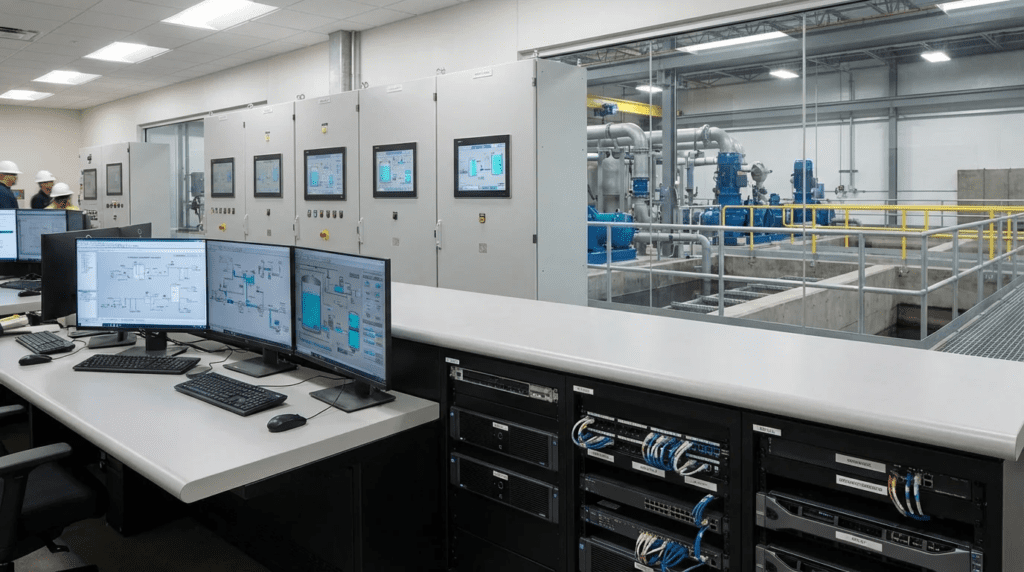
In the water and wastewater utility sector, Supervisory Control and Data Acquisition (SCADA) systems and Human-Machine Interfaces (HMI) serve as the central nervous system of critical infrastructure. Unlike discrete manufacturing, where operations are often contained within a single building, water utilities manage geographically dispersed assets ranging from remote lift stations and booster pumps to complex, centralized treatment facilities. The SCADA/HMI platform acts as the primary interface for operators to monitor process variables, control equipment, manage alarms, and ensure regulatory compliance.
The selection of a SCADA/HMI platform is a foundational engineering decision that dictates the facility’s operational efficiency for decades. These systems are not merely visualization tools; they are the aggregation point for data integrity, situational awareness, and automated decision-making. In the modern regulatory environment, utilities face increasing pressure to provide accurate, timestamped data for reporting, minimize combined sewer overflows, and optimize energy consumption. Consequently, the software platform must be robust, secure, and capable of handling vast historical datasets without latency.
For municipal consulting engineers and utility decision-makers, the software specification is often more complex than hardware selection. Hardware life cycles may span 10 to 15 years, but SCADA software evolves rapidly, requiring a platform that supports backward compatibility, virtualization, and integration with diverse communication protocols such as DNP3, Modbus TCP, and EtherNet/IP. Furthermore, the convergence of Information Technology and Operational Technology demands that modern platforms adhere to rigorous cybersecurity standards (IEC 62443) while providing business-layer connectivity.
This article analyzes the engineering characteristics, architectural strengths, and limitation profiles of the leading platforms for SCADA and HMI specifically within the context of water and wastewater treatment. The focus is strictly on technical capability, long-term maintainability, and application fit for municipal infrastructure.
A note on vendor ownership, which has changed in ways that affect how these platforms are compared. An earlier version of this article listed Citect SCADA as a Schneider Electric product alongside a separate AVEVA entry. Those are no longer separate portfolios. Schneider Electric took full ownership of AVEVA in 2023, and Citect SCADA has been rebranded as AVEVA Plant SCADA. Listing Citect under Schneider and System Platform under AVEVA double-counts one vendor and makes the field look broader than it is.
What remains genuinely distinct on the Schneider side is EcoStruxure Geo SCADA Expert (formerly ClearSCADA), the telemetry-focused platform, which is where the Schneider entry below now sits. The practical consequence for a utility is that a shortlist which appears to hold five independent vendors may in fact hold four, and standardizing on “AVEVA” and “Citect” is standardizing on one corporate relationship rather than hedging across two.
This guide sits within our coverage of top SCADA system manufacturers. See also our guides to automation system OEMs and integrators, PLC and control platform OEMs, and our roundup of SCADA systems manufacturers.
2. How to Select a SCADA & HMI Platform
Selecting a SCADA platform requires a holistic engineering approach that evaluates the software architecture against the specific operational realities of the utility. Engineers must look beyond initial licensing costs and consider the Total Cost of Ownership, which includes development hours, training, annual support contracts, and migration complexity.
Architecture: Client/Server vs. Distributed
The fundamental architecture of the SCADA system defines its scalability.
Standalone/Thick Client: Historically common, where the HMI software runs locally on a PC connected to a PLC. This is simple but creates data silos and maintenance headaches, as every change must be deployed to individual terminals.
Server/Client (Networked): The standard for modern treatment plants. A centralized server (or redundant pair) hosts the tag database and screen definitions. Clients connect to the server to visualize the process. This ensures a single version of the truth for data.
Distributed/Web-Based: The emerging standard. Utilizing HTML5 and web technologies allows clients to be OS-agnostic (running on tablets, phones, or Linux terminals) and simplifies deployment, as no software installation is required on the client side.
Redundancy and High Availability
Water treatment is a critical process; therefore, SCADA downtime is unacceptable. Engineers must specify the level of redundancy required.
Server Redundancy: Primary and backup servers synchronized in real-time. Upon failure, the backup assumes control seamlessly.
Network Redundancy: Support for dual-path Ethernet rings or parallel network schemes.
Data Buffering: The ability of the platform to handle store-and-forward data. If the connection between a remote site and the central server is lost, the local PLC or edge device must buffer data and upload it chronologically once the connection is restored to prevent data gaps in regulatory reports.
Data Historian and Reporting
In water and wastewater, the historian is as critical as the real-time control. It stores time-series data such as flow rates, turbidity, and chlorine residuals.
Selection Criteria: Does the platform use a proprietary flat-file database or a standard SQL database? SQL-based historians generally offer better interoperability with third-party reporting tools but may require higher storage overhead. Efficient compression algorithms are essential to manage disk space without losing data fidelity.
Alarm Management (ISA 18.2)
Modern specifications should mandate compliance with ISA 18.2 standards for alarm management. The platform must support features that prevent alarm floods and nuisance alarms. Key features to specify include:
Shelving: Allowing operators to temporarily suppress alarms during maintenance.
State-Based Alarming: Alarms that are only active when equipment is in a specific state, so that a low-flow alarm does not trigger if the pump is commanded off.
Escalation: Routing unacknowledged alarms to different user groups or mobile devices.
Graphics and HMI Standards (ISA 101)
The industry is moving away from complex, P&ID-style graphics with 3D animations toward High-Performance HMI (ISA 101). This design philosophy uses muted colors for static equipment and reserves bright colors strictly for alarms and abnormal states. The selected platform must possess a graphics library capable of supporting this methodology, including sparklines, radar charts, and situational awareness symbols, rather than just static bitmaps.
Licensing Models
Licensing structures vary significantly between vendors and impact long-term costs.
Tag-Based: Cost increases with the number of I/O points. This can be restrictive for large utilities that want to track extensive diagnostic data.
Client-Based: Cost is based on the number of concurrent viewers.
Server-Based / Unlimited: A flat fee for the server, regardless of tags or clients. This model encourages data density and broad access but often carries a higher initial server cost.
3. Comparison Table
The following table compares the primary SCADA/HMI platforms encountered in the North American water sector. Engineers should interpret scalability as the system’s ability to grow from a single lift station to a regional authority without platform replacement, and database openness as the ease of accessing historical data via standard IT tools.
| Platform | Primary Architecture | Licensing Model | Historian Type | Strengths | Limitations | Best-Fit Application |
|---|---|---|---|---|---|---|
| AVEVA (InTouch / System Platform / Plant SCADA) |
Object-Oriented / Distributed | Tag & Client Count | Proprietary (high compression) & SQL | Extremely scalable System Platform; object-oriented templating allows rapid deployment for standardized assets; large install base. | High complexity and learning curve for System Platform; licensing can be expensive for medium systems; legacy migration can be complex. | Large regional utilities requiring standardization across multiple plants. |
| Inductive Automation (Ignition) |
Server-Centric (Web/Java) | Unlimited (Server-based) | SQL Native | Unlimited tags and clients model; native HTML5 (Perspective); cross-platform (Linux/Windows); built-in Python scripting. | Requires knowledge of SQL and Python for advanced customization; newer paradigm for operators used to legacy systems. | Modernizations, enterprise-wide SCADA, utilities pursuing IT/OT convergence. |
| Siemens (WinCC) |
Integrated TIA Portal / OA | Tag & Feature based | Proprietary & SQL | Deep integration with Siemens hardware; WinCC OA handles very large tag counts; robust redundancy. | Integration with non-Siemens hardware is possible but less streamlined; complex licensing tiers. | Plants utilizing Siemens PLCs; large-scale infrastructure projects. |
| Rockwell Automation (FactoryTalk View) |
Distributed / Standalone | Display & Screen Count | Proprietary (FactoryTalk Historian) | Native integration with Allen-Bradley Logix; faceplate synergy; dominant market share in North America ensures support availability. | Proprietary ecosystem; distributed architecture can be complex to maintain; historical reliance on legacy technologies. | Utilities standardized on Allen-Bradley ControlLogix/CompactLogix. |
| Schneider Electric (EcoStruxure Geo SCADA Expert) |
Telemetry-Centric | Point & Client Count | Integrated historian | Purpose-built for telemetry and remote sites; native DNP3 and IEC 60870 handling; automatic backfill from outstations. | Narrower fit for inside-the-fence plant control; distinct toolset from the rest of the Schneider portfolio. | Remote telemetry networks; utilities with high DNP3 usage. |
4. Platform Detail
AVEVA (InTouch, System Platform, Plant SCADA)
AVEVA, having acquired the heritage Wonderware brand, offers one of the most prevalent SCADA solutions in the water industry. The portfolio is split primarily between AVEVA InTouch HMI for machine-level or smaller plant control and AVEVA System Platform for large multi-site deployments.
System Architecture: For large water utilities, AVEVA System Platform is the flagship. It utilizes an object-oriented approach based on a central repository. Instead of creating individual tags for every pump, engineers define a pump object template containing the graphics, alarms, PLC I/O mapping, and historization scripts. Instances of this object are then deployed. If a change is made to the template, it propagates to all instances automatically. This ensures strict standardization across large facilities.
Technical Strengths:
- Device Integration: Operations Integration servers provide robust drivers for virtually every PLC brand, decoupling communication from the application layer.
- Graphics: Industrial Graphics are vector-based and highly customizable.
- Historian: The AVEVA Historian is a high-speed, compressing database capable of handling burst data, making it suitable for process analysis.
Engineering Considerations: System Platform is resource-intensive and typically requires significant server infrastructure, often virtualized. The complexity of the architecture requires specialized training to maintain. Engineers should specify System Platform for large, multi-site utilities where the object-oriented efficiency outweighs the initial setup complexity.
Inductive Automation (Ignition)
Inductive Automation has disrupted the SCADA market with Ignition, a platform built on modern IT standards. It is distinct because it is sold by the server license rather than by tag or client count, which fundamentally changes the architecture design for utilities.
System Architecture: Ignition acts as a central hub (Gateway). It connects to PLCs via OPC UA and connects to any standard SQL database for history.
Perspective Module: A mobile-responsive visualization module that runs purely in a web browser. It allows operators to view SCADA on mobile devices without app installation.
Vision Module: The Java-based desktop client for dedicated control room workstations.
Technical Strengths:
- Interoperability: The platform bridges PLCs and SQL databases, allowing for complex transaction groups, such as writing flow totals to a database row when a backwash completes.
- MQTT/Sparkplug B: Native support for MQTT makes it a leading choice for efficient telemetry over cellular networks.
- Scripting: Uses Python, a powerful, non-proprietary language familiar to many modern engineers.
Engineering Considerations: While the unlimited licensing is attractive, engineers must ensure the hardware specifications are sized correctly to handle the load of a single server managing many connections. Redundancy configuration is straightforward but requires two full licenses.
Siemens (WinCC)
Siemens offers a broad range of HMI and SCADA products under the WinCC umbrella. For the North American water market, the focus is typically on WinCC Professional within the TIA Portal framework and WinCC Open Architecture.
System Architecture:
WinCC Professional: Integrated directly into the TIA Portal. This provides a unified engineering environment where the PLC and HMI are programmed in the same interface. Variables are shared automatically, eliminating tag duplication errors.
WinCC OA: A platform designed for massive scale and complexity. It is object-oriented and supports distributed systems with very high tag counts. It allows for dynamic system changes without stopping the runtime engine.
Technical Strengths:
- Hardware Integration: When paired with Siemens PLCs, diagnostic capabilities are strong. System diagnostics such as wire break or module failure are reported to the HMI automatically without additional code.
- Web Access: Platform-independent access via HTML5 browsers for remote monitoring.
- Security: Default configurations align with IEC 62443.
Engineering Considerations: WinCC is most effective when the utility is standardized on Siemens hardware. While it supports third-party drivers via OPC, the integrated diagnostics advantage is lost. WinCC OA is a high-end solution often reserved for the largest metropolitan utilities or complex infrastructure projects.
Rockwell Automation (FactoryTalk View)
Rockwell Automation is a dominant player in the US municipal market. Their SCADA solution, FactoryTalk View Site Edition, is the standard for facilities utilizing Allen-Bradley ControlLogix and CompactLogix controllers.
System Architecture: FactoryTalk View SE operates on a distributed architecture utilizing the FactoryTalk Services Platform. This directory-based service manages security, alarms, and communications across the network, in either a single-computer station configuration or a distributed configuration with separate HMI servers, data servers, and multiple clients.
Technical Strengths:
- Logix Integration: The HMI can directly reference tags in the PLC without creating an intermediate HMI tag database. This reduces development time and memory usage.
- Library Objects: The PlantPAx library provides pre-engineered process objects that link automatically to Add-On Instructions in the PLC, enforcing consistency.
- Trending: A robust trending tool is embedded within the software.
Engineering Considerations: FactoryTalk View SE relies heavily on Microsoft Windows technologies. Patch management and domain integration are critical. Version mismatch between the FactoryTalk Services Platform and the application can cause issues, so strict revision control is necessary.
Schneider Electric (EcoStruxure Geo SCADA Expert)
Schneider Electric maintains EcoStruxure Geo SCADA Expert, formerly ClearSCADA, which is specifically engineered for telemetry and remote SCADA applications.
System Architecture: Geo SCADA Expert has a built-in object-oriented database and includes an integrated historian. Its core differentiator is its native handling of DNP3 and IEC 60870 protocols. It manages the complexities of polling remote sites over low-bandwidth radios, backfilling data from outstations automatically.
Technical Strengths:
- Telemetry Management: It treats the communication link as a variable. If a radio link goes down, the system knows to retrieve the buffered data from the RTU once the link is restored. This is critical for regulatory reporting on remote lift stations.
- Driver Library: Extensive support for legacy protocols often found in older water systems.
Engineering Considerations: For a utility with hundreds of remote sites communicating over radio or cellular, Geo SCADA is often the superior engineering choice due to its specialized telemetry features. For inside-the-fence plant control, a different platform is usually the better fit. Engineers must clearly define the use case, plant versus network, to select the correct tool.
5. Application Fit Guidance
Municipal Wastewater Treatment Plants (Inside the Fence)
For centralized treatment plants with high I/O counts and complex process loops, AVEVA System Platform and Rockwell FactoryTalk View SE are the market leaders. Their ability to handle complex redundancy, large-scale historization, and standardized object libraries makes them suited to mission-critical process control where high availability is paramount.
Water Distribution and Collection Systems (Telemetry)
For systems that are geographically dispersed and rely on radio or cellular telemetry, Geo SCADA Expert and Ignition are top contenders. Geo SCADA is purpose-built for buffering data from remote terminal units. Ignition’s MQTT capabilities allow for report-by-exception bandwidth efficiency, which reduces cellular data costs and improves response times compared to traditional polling.
Small to Medium Municipalities (Cost-Conscious)
For smaller utilities where IT support is limited, maintaining a complex distributed server architecture is challenging. Ignition is often favored here due to its simplified licensing and ease of backup and restore. AVEVA InTouch is also a frequent choice for single-workstation applications due to its reliability and ease of use for operators.
Retrofit and Heterogeneous Environments
When a utility has a mix of PLC brands, Ignition and AVEVA are advantaged due to their platform-agnostic nature. They can aggregate data from diverse hardware more easily than hardware-centric platforms, which favor their own hardware families.
6. Engineer & Operator Considerations
Installation and Deployment
Modern SCADA deployment is shifting towards virtualization. Engineers should specify that the SCADA system runs on virtual machines. This decouples the software from the physical server hardware. If a server fails, the SCADA image can be spun up on a new physical host in minutes.
Best Practice: Ensure the platform supports thin client deployment for operator stations to eliminate the need for maintaining software on desk computers.
Cybersecurity and Network Segmentation
The SCADA network must be segmented from the business network, typically separated by a demilitarized zone with firewalls.
Integration Challenge: Engineers must verify that the chosen platform supports directory integration for user management. This ensures that when an operator leaves the utility, their access is revoked centrally. The platform should also support encrypted communications between the server and the clients.
Two further requirements belong in any current specification. First, the America’s Water Infrastructure Act of 2018 requires community water systems serving more than 3,300 people to periodically assess risk and resilience, explicitly including their electronic and automated systems, and to maintain emergency response plans. The SCADA platform and its deployment either support that assessment or complicate it, which makes architecture a compliance matter rather than a preference.
Second, the SCADA server is a high-value target and is frequently the entry point in documented water sector intrusions. Specify that no SCADA server or HMI is reachable from the internet, that remote access runs through an accountable, logged, multi-factor path the utility controls and can revoke, and that the vendor delivers an asset inventory with firmware versions and open ports at handover. Confirm that remote support does not depend on a permanently installed modem the integrator dials into. WaterISAC and CISA both publish sector advisories covering these platforms.
Maintenance and Long-Term Support
Software maintenance agreements are mandatory for receiving security patches. Engineers must budget for these recurring costs.
Version Control: A common failure mode in SCADA management is version drift, where different machines run different versions of the runtime software. Centralized deployment eliminates this risk.
Human Factors (HMI Design)
Operators are the primary users. The design must minimize cognitive load.
Grayscale Efficiency: Specify that the platform must support High-Performance HMI libraries. A screen full of animated 3D pumps and flowing water pipes distracts from critical data. The HMI should be visually quiet; if it looks busy, something is wrong.
7. Conclusion
The selection of a SCADA/HMI platform for water and wastewater utilities is a decision that balances current operational needs with future scalability and cybersecurity requirements. There is no single best platform; rather, there is a best fit based on the utility’s specific architecture and legacy infrastructure.
Rockwell Automation and Siemens offer strong integration when the underlying control hardware is uniform. AVEVA provides a robust, object-oriented framework suited to large, standardized regional utilities. Inductive Automation has reshaped the market with a flexible licensing model and modern web standards that appeal to utilities seeking digital transformation. Schneider Electric remains a strong choice for telemetry-heavy applications where data integrity from remote sites is the priority.
For the consulting engineer and utility manager, the goal is to specify a system that delivers reliable data, complies with environmental regulations, and empowers operators to make informed decisions. By focusing on open standards such as SQL, HTML5, and OPC UA, and on robust redundancy, utilities can invest in platforms that will remain viable and secure for the long term.