
Val-Matic vs Henry Pratt for Plug Valves: Pros/Cons & Best-Fit Applications
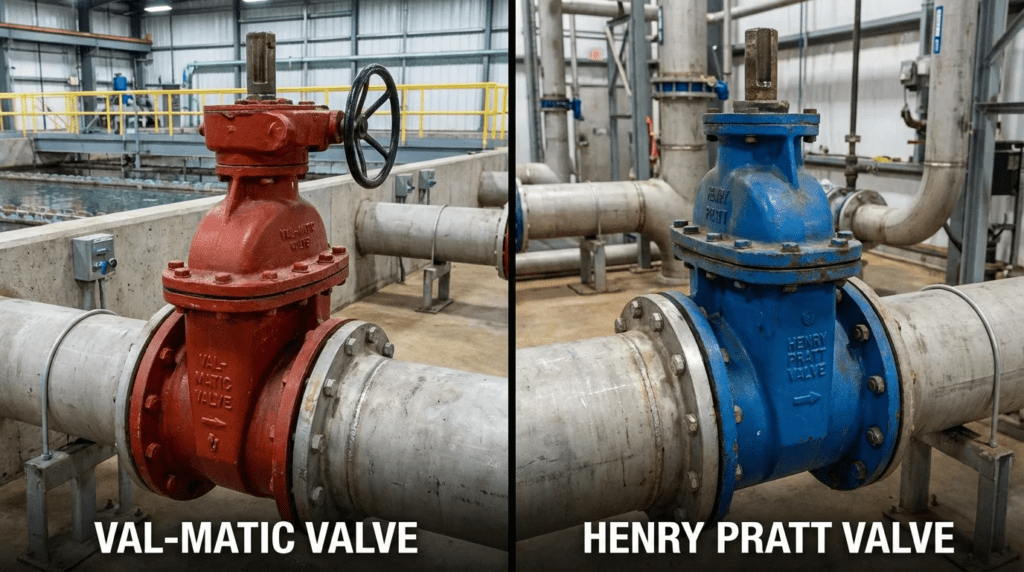
Introduction
In the design of municipal wastewater treatment plants and pumping stations, the eccentric plug valve serves as the workhorse for isolation and throttling of sludge, slurry, and raw sewage. However, a persistent challenge for consulting engineers is navigating the specific mechanical nuances between major manufacturers. Often, specifications are copied from previous projects without a critical analysis of how hydraulic geometry and seat mechanics affect long-term reliability. Engineers frequently overlook the substantial impact that port geometry—specifically round versus rectangular—has on pumping energy efficiency and clogging potential.
This article provides a detailed engineering analysis of Val-Matic vs Henry Pratt for Plug Valves: Pros/Cons & Best-Fit Applications. While both manufacturers produce valves compliant with AWWA C517, their design philosophies diverge significantly regarding internal flow geometry, seat construction, and actuation torque requirements. These differences manifest directly in head loss calculations, maintenance intervals, and total lifecycle costs.
Eccentric plug valves are ubiquitous in Return Activated Sludge (RAS), Waste Activated Sludge (WAS), digestion processes, and raw sewage lift stations. The harsh nature of these fluids—containing grit, ragging material, and variable solids concentrations—demands robust equipment. A poor specification choice here can lead to premature seat failure, “frozen” valves that refuse to operate after long periods of inactivity, or excessive energy consumption due to high hydraulic resistance. This guide aims to equip engineers and operators with the technical data necessary to make informed, defensible selection decisions based on process requirements rather than brand habit.
Both product lines named here are real and correctly characterized: the Pratt Ballcentric and the Val-Matic Cam-Centric are established eccentric plug valve lines, and the round-versus-rectangular port distinction between them is genuine rather than marketing.
One omission is worth naming up front, however. DeZURIK is the dominant manufacturer in this category, and its PEC eccentric plug valve is the line most municipal specifications are actually written around. Any real bid for eccentric plug valves in North American wastewater will include DeZURIK alongside these two, and an engineer treating this as a two-way comparison is working from an incomplete field. Milliken is a further competitor in larger diameters. Treat the analysis below as a comparison of two of the three or four lines that will actually be quoted.
For the broader supplier landscape, see our guide to top plug valve manufacturers, and our related comparison of Henry Pratt plug valve options.
How to Select / Specify
Selecting between Val-Matic (Cam-Centric) and Henry Pratt (Ballcentric) requires moving beyond the catalog cover and examining the engineering data sheets. The decision process must account for the specific rheology of the fluid and the criticality of the isolation point.
Duty Conditions & Operating Envelope
The first step is defining the operating envelope. Both manufacturers typically offer pressure ratings of 175 psi up to 12 inches, and 150 psi for larger sizes, consistent with AWWA C517. However, the hydraulic performance within that envelope differs.
Engineers must calculate the fluid velocity carefully. While plug valves can handle velocities up to 8-10 ft/s, high velocities combined with grit loads will accelerate wear on the rubber encapsulated plug. Conversely, velocities below 3 ft/s in sludge lines promote settling in the valve body belly. Val-Matic’s rectangular port design generally provides a larger flow area relative to nominal pipe size (often exceeding 80-90%), whereas Pratt’s round port design, while matching the pipe shape, may have a more restricted flow area in certain sizes, resulting in higher head loss coefficients and lower flow coefficients. For systems with marginal Net Positive Suction Head available or high energy costs, the head loss difference becomes a critical selection factor.
Materials & Compatibility
The longevity of an eccentric plug valve is dictated by the interaction between the plug facing and the body seat.
- Plug Encapsulation: Both manufacturers offer plugs encapsulated in resilient polymers. Chloroprene (Neoprene) is standard for general wastewater. Nitrile (Buna-N) is preferred for oils, fats, and greases (scum lines). EPDM is necessary for higher temperatures or specific chemical exposures.
- Body Seat Construction: This is a major differentiator. The standard requirement is a corrosion-resistant welded overlay (typically 90% pure nickel) on the cast iron body.
- Pratt: Utilizes a nickel seat welded to the body. Historically, older designs or lower-spec versions might have used epoxy or merely machined iron, but modern municipal specs should mandate the nickel weld.
- Val-Matic: Markets their welded nickel seat as a standard feature that covers a significant width to accommodate plug adjustment.
- Grit & Abrasion: If the application involves grit chambers or raw influent, the hardness of the seat and the tear resistance of the rubber are paramount. Soft rubber is susceptible to cutting by sharp grit, leading to corrosion of the underlying iron plug core.
Hydraulics & Process Performance
The hydraulic comparison is often the deciding factor. The fundamental design difference lies in the port shape:
Rectangular Port (Val-Matic Style): The rectangular geometry allows for a linear flow characteristic and typically a higher percentage of port opening. This reduces head loss (pumping energy) and provides a wider throttling range before cavitation onset.
Round Port (Pratt Style): The round port matches the connecting pipe, theoretically reducing turbulence at the inlet and outlet transition. However, to accommodate the eccentric motion within the body, the round port area is often reduced, creating a venturi effect. While this handles solids well, it imposes a permanent pressure drop.
Installation Environment & Constructability
Space constraints in valve vaults are notorious. Engineers must verify the face-to-face dimensions (ANSI/ASME B16.10 is standard, but short-pattern options exist). Additionally, consider the actuator orientation. Plug valves generally require high-torque actuators (worm gear or heavy pneumatic). The actuator can overhang significantly. Val-Matic and Pratt may have different centerline-to-top dimensions, which can cause clashes with vault ceilings or adjacent piping in retrofit scenarios.
Reliability, Redundancy & Failure Modes
The primary failure mode for eccentric plug valves in wastewater is “freezing” or seizure due to solids accumulation in the bearing journals or between the plug and body.
Bearing Protection: Look for grit excluders or grit seals in the specification. These are seals located at the bearing journals to prevent fine grit from entering the radial bearings. Both manufacturers offer these, but they must be explicitly specified in the data sheet.
Packing vs. Seals: Val-Matic typically utilizes a V-type packing that is adjustable without disassembling the actuator in most configurations. Pratt also uses adjustable packing. The accessibility of the packing follower bolts is critical for maintenance personnel.
Controls & Automation Interfaces
Automating plug valves requires careful torque sizing. Because the plug sits in the seat (interference fit) for sealing, the breakaway torque is significantly higher than the running torque. If a valve sits closed for weeks (e.g., a redundant pump isolation), the rubber can adhere to the nickel seat, and solids can dewater and cement around the plug.
When specifying electric actuators for either manufacturer, engineers should apply a safety factor of at least 1.5x to 2.0x over the published seating torque to account for stiction and aging. Automation integration via Modbus or EtherNet/IP is handled by the actuator vendor (Rotork, Limitorque, AUMA), but the mechanical interface (ISO 5211 mounting pads) must be verified.
Lifecycle Cost Drivers
CAPEX: Generally, Henry Pratt Ballcentric valves are competitively priced and widely stocked, making them attractive for design-bid-build projects with tight budgets. Val-Matic Cam-Centric valves may carry a premium, particularly in larger sizes or with specialized coatings.
OPEX: The OPEX calculation should weigh the energy cost of head loss. For a high-flow lift station running continuously, a meaningful difference in head loss coefficient translates to real electricity cost annually. Val-Matic’s rectangular port design often yields lower lifecycle energy costs, potentially offsetting a higher initial purchase price.
Comparison Tables
The following tables provide a direct comparison to assist specifying engineers. These comparisons are based on standard municipal product lines (Pratt Ballcentric and Val-Matic Cam-Centric).
| Feature / Criteria | Henry Pratt (Ballcentric) | Val-Matic (Cam-Centric) | Engineering Implication |
|---|---|---|---|
| Port Geometry | Round Port (Standard) | Rectangular Port (Standard) | Round matches pipe shape but may restrict area; rectangular offers higher flow coefficient and lower head loss. |
| Seat Design | Welded Nickel (Typical) | Welded Nickel (Standard) | Both offer corrosion resistance; verify weld thickness and purity (90%+) in specs. |
| Eccentric Action | Balanced eccentric motion | Cam action lifts plug off seat | Val-Matic emphasizes plug lifting to reduce wear; Pratt emphasizes scouring action. |
| Flow Coefficient | Generally moderate | Generally high | Higher flow coefficient means lower pumping energy costs. |
| Solids Handling | Excellent (round port passes spheres well) | Excellent (large open area) | Both resist clogging, but round ports are intuitive for passing spherical solids. |
| Top Access | Bonnet design varies by size | Full top access cover (larger sizes) | Affects ability to inspect internals without removing valve from line. |
| Market Position | High volume, economical, large install base | Performance-focused, premium features | Pratt is often the base bid; Val-Matic is often the performance alternative. |
| Application | Best-Fit Characteristics | Val-Matic Strength | Pratt Strength | Decision Driver |
|---|---|---|---|---|
| Raw Sewage Lift Station (Pump Isolation) | High reliability, grit resistance, low head loss | Low head loss saves energy on high-volume pumping. | Proven grit handling; economical for large diameters. | Energy: If electricity cost is high, lean Val-Matic. If budget is tight, lean Pratt. |
| Sludge Recirculation (RAS/WAS) | Throttling capability, resistance to ragging | Linear throttling curve. | Round port maintains velocity to prevent settling. | Control: Val-Matic offers superior linear control characteristics. |
| Digester Isolation (Gas/Sludge) | Bubble-tight shutoff, H2S resistance | Cam action ensures tight seal without excessive torque. | Robust body design; reliable seal integrity. | Sealing: Both perform well; focus on plug coating compatibility. |
| Scum / Grease Lines | Non-stick coating, heat resistance | Glass-lined options available for grease prevention. | Glass-lined options available. | Coating Availability: Verify glass-lining lead times. |
Engineer & Operator Field Notes
Beyond the catalog data, real-world performance is determined by how the valve is commissioned and maintained. The following notes are derived from field experience in municipal wastewater plants.
Commissioning & Acceptance Testing
When commissioning plug valves, the definition of “closed” is critical. Unlike gate valves that seat by wedging, plug valves seat by rotating into an interference fit.
- Stop Adjustment: Both manufacturers’ valves feature adjustable open and closed stops on the actuator. During acceptance testing, the closed stop must be set such that the plug engages the seat firmly but is not over-rotated, which can damage the rubber.
- Leak Testing: Do not rely solely on the actuator position indicator. Verify shutoff via pressure gauges upstream and downstream, or by opening a downstream drain if available.
- Direction of Flow: Verify the installation orientation. Eccentric plug valves are typically uni-directional for highest pressure rating (seating assistance from line pressure) but bi-directional for lower pressures. Ideally, install so that line pressure pushes the plug into the seat.
Common Specification Mistakes
Unlike ball valves, most eccentric plug valves are NOT full port. They are typically 80-90%. Demanding 100% port area often forces vendors to quote full port models which may have vastly different face-to-face dimensions or much higher costs. Specify “minimum 80% port area” or specify the required flow coefficient directly.
Another frequent error is neglecting the shaft orientation. In horizontal piping carrying high solids, the valve should be installed with the plug shaft horizontal, so the plug rotates upwards to open. If the plug rotates sideways or downwards, solids can pack into the body cavity or the bearing area, preventing full closure. Engineers must specify: “Valves installed in horizontal sludge lines shall have horizontal shafts with the plug rotating to the top of the body when open.”
O&M Burden & Strategy
- Exercising: The most critical maintenance task is exercising the valve. In wastewater, grease and struvite can bond the plug to the seat. Valves should be fully cycled at least once per quarter.
- Packing Adjustments: Leaking shaft seals are common. Both designs allow for packing adjustment. Maintenance supervisors should train staff on tightening the follower evenly to avoid cocking the gland, which scores the shaft.
- Lubrication: If the valve has a worm gear actuator, the grease fitting on the gearbox is often ignored. It requires annual inspection and regreasing.
Troubleshooting Guide
- Symptom: Valve will not close completely.
Cause: Debris trapped in the bottom of the body or hardened sludge on the seat.
Fix: Bump the valve open and closed while flow is moving to flush debris. Do not force the actuator, as this can twist the shaft. - Symptom: Shaft seal leaking.
Cause: Worn packing or scored shaft.
Fix: Tighten packing bolts. If leak persists, replacement of packing is required. Note that U-cup seals, where equipped, are generally not adjustable and must be replaced. - Symptom: High torque / actuator tripping.
Cause: Swollen rubber plug (chemical attack) or stiction.
Fix: Verify chemical compatibility. If stiction, a larger actuator may be required, or the stop settings need checking to ensure the plug isn’t being jammed too hard into the seat.
Design Details / Calculations
To produce a robust specification, engineers should utilize specific calculation methodologies.
Sizing Logic & Methodology
Sizing a plug valve is a balance between line velocity and pressure drop.
Step 1: Determine Design Flow. Identify minimum, average, and peak flow rates.
Step 2: Calculate Velocity. Rule of Thumb: Keep velocity between 3 and 8 ft/s. Below 3 ft/s allows grit settling; above 10 ft/s causes erosion and cavitation risk.
Step 3: Check Valve Flow Coefficient. Consult the manufacturer’s curves and calculate the resulting pressure drop at design flow.
Step 4: Cavitation Check. Calculate the cavitation index if the valve is used for throttling. If the index falls below the manufacturer’s limit, cavitation damage will occur rapidly.
Specification Checklist
When writing the plug valve specification section, include these mandatory items:
- Compliance: Must meet AWWA C517.
- Body Material: Ductile Iron (ASTM A536) is preferred over gray iron for durability, though gray iron is acceptable for lower pressures.
- Seat: Welded nickel (90% pure minimum). Prohibit sprayed or screwed-in seats for critical wastewater service.
- Bearings: Sintered, oil-impregnated stainless steel type 316 or equivalent permanent lubrication.
- Actuator Sizing: Actuator must be sized for maximum differential pressure plus a 1.5 safety factor.
- Testing: Require factory hydrostatic testing per AWWA C517. Request a certified test report.
- Proof of design: require an affidavit of compliance with the proof-of-design provisions of the current edition of AWWA C517. Cycle-test counts and test conditions are set by the standard and have changed between editions, so cite the current edition rather than a cycle count carried over from an older specification.
Where the Eccentric Plug Valve Is the Wrong Choice
The eccentric plug valve is the default for wastewater isolation, which means it also gets specified where something else would serve better:
- Severe throttling with high pressure drop. Plug valves throttle acceptably but are not control valves. Where the pressure drop is large and continuous, a plunger valve or a purpose-built control valve will last longer and control better.
- Abrasive slurry service. Lime slurry, grit slurry, and similar duties cut rubber plug facings quickly. A pinch valve with a replaceable elastomer sleeve is the conventional answer, since the wear part is cheap and changed in place.
- Channel and open-channel isolation. A slide gate or stop gate is the right device; a plug valve in a full pipe is not an alternative.
- Frequent modulation at small openings. Continuous operation near the seat wire-draws the nickel overlay and tears the plug facing. If the duty requires sustained operation below roughly 20 percent open, the valve is oversized for its control function.
Standards & Compliance
- AWWA C517: Resilient-Seated Cast-Iron Eccentric Plug Valves. This is the governing standard.
- NSF-61: Required only if the valve is used in potable water (treated effluent reuse) applications. Not required for raw sewage or sludge.
- ANSI B16.1: Flange dimensions. Ensure flange drilling matches the piping spec (Class 125 vs Class 250).
Frequently Asked Questions
What is the main difference between Val-Matic and Henry Pratt plug valves?
The primary difference lies in the port geometry and internal design philosophy. Henry Pratt (Ballcentric) typically utilizes a round port design that mirrors the pipe shape, which is excellent for solids passage but may have slightly higher head loss in some configurations. Val-Matic (Cam-Centric) utilizes a rectangular port design which generally offers a larger flow area and lower head loss. Val-Matic also emphasizes a cam action that lifts the plug off the seat to minimize wear during rotation.
When should I specify a rectangular port over a round port?
Specify a rectangular port when system head loss is a critical concern, such as in high-volume lift stations where every foot of head loss translates to significant energy costs. Rectangular ports also tend to provide better linear throttling characteristics for flow control applications such as RAS control. Round ports are often preferred when matching pipe geometry is prioritized to minimize turbulence at the immediate valve inlet and outlet.
Do Val-Matic and Pratt valves have the same face-to-face dimensions?
Generally, yes, for standard sizes (3″ to 12″) they follow ANSI/ASME B16.10 or industry-standard short pattern dimensions. However, in larger sizes (14″ and up) or specific long pattern configurations, dimensions can vary between manufacturers. Always verify the dimensional drawings against the existing piping layout for retrofit projects to avoid the need for spool pieces or piping modifications.
Why do eccentric plug valves fail in sludge service?
Failures are rarely due to the valve body bursting. The most common failure modes are: the plug freezing in place due to lack of use and solids cementing the plug to the body; shaft seal leakage due to packing wear; actuator failure due to undersizing that did not account for the high breakaway torque required to unseat the plug after dormancy; and erosion of the rubber plug encapsulation by grit.
Are nickel seats mandatory for wastewater plug valves?
For municipal wastewater applications, welded nickel seats are considered the industry standard best practice. Epoxy-coated seats or bare iron seats will eventually corrode or be scratched by grit, leading to seal failure. Both manufacturers offer welded nickel seats, and this should be explicitly required in the engineering specification.
How often should plug valves be maintained?
Plug valves should be exercised (fully opened and closed) at least quarterly to prevent seizure. Shaft packing should be visually inspected monthly for leaks. Gear actuators should be inspected and greased annually. If the valve is in a throttling application, wear will occur faster, and the plug position should be varied periodically to prevent localized erosion on the seat.
Conclusion
Key Takeaways: Selection Framework
- Hydraulics Matter: Val-Matic’s rectangular port typically offers a higher flow coefficient and lower head loss compared to Pratt’s round port. Use Val-Matic for energy-sensitive or throttling applications.
- Standardization: Henry Pratt has a large install base and is often more economical for standard isolation duties where head loss is negligible.
- Specification Rigor: Always specify welded nickel seat and grit excluders regardless of the brand.
- Sizing: Do not assume full port. Verify the percentage of port opening (typically 80%+) and calculate velocity to avoid settling or scour.
- Torque: Apply a safety factor (1.5x minimum) to actuator sizing to prevent stiction failures in sludge lines.
There is no single winner for every scenario. The decision ultimately rests on the specific constraints of the project. For tight budgets and standard isolation duty in smaller lines, Henry Pratt’s Ballcentric series provides a robust, proven, and economical solution that meets AWWA C517 standards.
However, for critical lift stations, large-diameter headers, or applications requiring precise flow modulation, the Val-Matic Cam-Centric’s hydraulic advantages—specifically the rectangular port geometry and cam-action seating—often justify the potentially higher initial investment through reduced energy consumption and extended seat life. Engineers should perform a lifecycle cost analysis for valves 12 inches and larger to quantify these benefits.
By focusing on the port geometry, seat materials, and actuation safety factors rather than brand loyalty, engineers can ensure reliable, long-term operation for their municipal clients.