
Top OEMs for Thickening Equipment
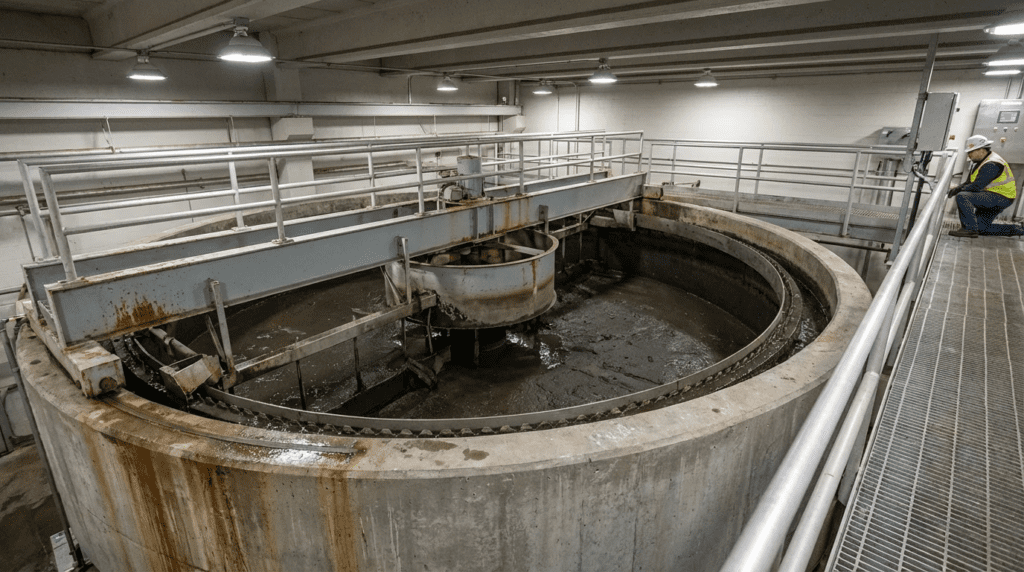
1. Introduction to Thickening Equipment in Water and Wastewater Treatment
In the hierarchy of unit processes within municipal and industrial wastewater treatment facilities, sludge thickening represents a critical intermediate step between liquid treatment and solids handling. While often overshadowed by the biological treatment processes upstream or the final dewatering and disposal downstream, thickening is the primary volume reduction unit operation. By increasing the solids concentration of dilute sludges—typically from 0.5–1.0% to 4.0–8.0% total suspended solids (TSS)—thickening equipment reduces the hydraulic load on downstream processes such as anaerobic digestion, stabilization, and dewatering by 80% to 90%.
For municipal consulting engineers and plant superintendents, the selection of thickening equipment is governed by the necessity to optimize the volumetric capacity of digesters and reduce the capital expense of downstream equipment. A digester fed with unthickened sludge requires significantly larger heating systems and tank volumes to achieve the required volatile solids reduction (VSR). Furthermore, effective thickening ensures a consistent feed rheology, which is paramount for the stable operation of centrifuges, belt presses, or screw presses used in final dewatering.
Typical Applications and Process Drivers
Thickening is predominantly applied to two main streams: Primary Sludge and Waste Activated Sludge (WAS). Primary sludge, characterized by heavier, readily settleable solids, is occasionally thickened via gravity in clarifiers, but increasingly, mechanical thickening is preferred to prevent septicity and odor generation. WAS, being lighter and biological in nature, resists gravity settling and typically requires mechanical thickening with polymer conditioning to achieve desirable concentrations.
Regulatory drivers influencing OEM selection include stringent odor control requirements (driving enclosed designs), energy efficiency mandates (favoring low-horsepower equipment), and the need for high solids capture rates (>95%) to prevent the recycling of fines and phosphorus back to the plant headworks. The engineering challenge lies in balancing these performance metrics against lifecycle costs, maintenance accessibility, and the physical footprint of the equipment.
OEM selection in this category is not merely a commodity purchase; it is an integration of process engineering and mechanical reliability. The manufacturer’s ability to guarantee solids capture, polymer consumption rates, and hydraulic throughput under varying sludge conditions is the differentiator that impacts the facility’s 20-year operational budget.
2. How to Select Thickening Equipment
Selecting the appropriate thickening technology requires a granular analysis of process parameters, hydraulic constraints, and operational philosophies. Engineers must move beyond catalog data and evaluate equipment based on specific site conditions and sludge characteristics. The following engineering considerations are essential for specifying the correct system.
Process Function and Performance Requirements
The primary performance metrics for thickening equipment are the thickened sludge concentration (outputs) and the solids capture rate (efficiency).
- Solids Loading Rate (SLR): Defined as pounds of dry solids per hour per unit of equipment width or area. Equipment must be sized to handle peak solids loading events without blinding or carryover.
- Hydraulic Loading Rate (HLR): The volume of flow the unit can process. For dilute WAS (0.5% solids), HLR often dictates the size of the machine rather than the solids load.
- Thickened Sludge Concentration: The target is typically 4% to 8% dry solids. Exceeding this limit can cause pumping issues (viscosity increases exponentially) and mixing problems in downstream digesters.
- Solids Capture: A minimum capture rate of 95% is the standard engineering specification. Lower capture rates result in a high filtrate solids load returning to the head of the plant, increasing the biological load and potentially causing a “spiral” of accumulating inert fines.
Technology Types and Selection
Gravity Belt Thickeners (GBT): Rely on a porous belt moving over a horizontal deck. Sludge is conditioned with polymer, and free water drains by gravity.
Pros: High hydraulic capacity, simple operation, visibility of the process.
Cons: Large footprint, open design (odor potential), high washwater usage, intensive housekeeping.
Rotary Drum Thickeners (RDT): Utilize a rotating cylindrical screen. Conditioned sludge enters the drum, and water drains radially.
Pros: Fully enclosed (excellent odor containment), compact footprint, lower washwater usage than GBTs.
Cons: Sensitive to polymer overdose, potential for blinding if screen selection is poor.
Centrifugal Thickeners: Use high-speed rotation to separate solids by density difference.
Pros: Smallest footprint, no washwater during operation, closed system.
Cons: High energy consumption, high noise, expensive maintenance (scroll/bowl resurfacing).
Materials of Construction
Given the corrosive nature of wastewater sludge (often containing H2S) and the humid environment of thickening rooms, material specifications are non-negotiable.
- Structural Frames: 304 Stainless Steel is the industry minimum; 316 or 316L Stainless Steel is recommended for aggressive environments or industrial applications. Carbon steel frames, even if hot-dip galvanized, are generally discouraged for wetted parts in modern specifications due to longevity concerns.
- Fasteners: All fasteners should be 316 Stainless Steel to prevent seizing and corrosion.
- Rollers and Bearings: For belt and drum systems, roller deflection must be calculated to prevent belt tracking issues. Bearings should be isolated from the process wetted areas or housed in triple-seal configurations to prevent sludge ingress.
Integration with Upstream and Downstream Processes
Upstream: Feed pumps must be positive displacement (typically rotary lobe or progressive cavity) to prevent shearing of the floc before it enters the thickener. However, for centrifugal thickening, feed consistency is less critical regarding shear, but critical regarding grit removal to prevent abrasion.
Polymer Systems: Mechanical thickening is almost entirely dependent on chemical conditioning. The polymer make-down and dosing system must be integrated into the thickener’s control logic (flow pacing) to optimize consumption (lbs of polymer per ton of dry solids).
Downstream: The thickened sludge pump (typically a progressive cavity pump with a bridge breaker or auger feed) must be located immediately adjacent to the thickener discharge hopper. Engineers must account for the friction loss of thickened sludge, which is significantly higher than liquid sludge.
Operations and Maintenance (O&M) Impacts
From an operator’s perspective, the “best” equipment is the one that requires the least manual intervention.
- Washwater: GBTs and RDTs require continuous washwater to keep filter media clean. Engineers must verify plant water pressure and flow availability. Booster pumps are often required.
- Enclosures: For GBTs, facility engineers must design room-level HVAC and odor scrubbing. For RDTs and Centrifuges, point-source extraction on the equipment ports is usually sufficient, reducing HVAC capital costs.
- Access: Belt replacement on a GBT can take 4-8 hours. Drum changes on an RDT can take longer. Centrifuge rotating assembly swaps require overhead cranes. Layouts must provide clear aisle space and hoist access.
Lifecycle Cost Considerations
Evaluated bid specifications should weigh the 20-year Net Present Value (NPV) rather than low bid capital cost.
- Energy: Centrifuges consume 10x the energy of GBTs or RDTs. This is a massive OPEX factor.
- Polymer: A machine that uses 15 lbs/ton of polymer vs. one that uses 10 lbs/ton will cost the utility significantly more over the lifecycle. Performance testing for polymer efficiency should be a bondable requirement.
- Maintenance Parts: Bearings, seals, spray nozzles, and filter belts are consumables. The cost and availability of these proprietary parts from the OEM must be factored in.
3. Comparative Analysis of Top Thickening OEMs
The following table contrasts the leading Original Equipment Manufacturers (OEMs) for thickening applications. This data is intended to assist engineers in matching specific project constraints—such as footprint, sludge type, and automation level—with the vendor best suited to deliver those parameters.
| OEM | Typical Thickening Technologies | Engineering Strengths | Limitations | Best-Fit Scenarios | Maintenance Considerations |
|---|---|---|---|---|---|
| Andritz | Gravity Belt Thickeners (GBT), Centrifuges, Drum Thickeners | Global installed base; high-capacity heavy-duty designs; advanced automation and rheology control systems. | Higher capital cost for small facilities; complex proprietary control systems. | Large municipal plants requiring high throughput and automated process control. | Requires specialized technician support for centrifuge balancing and major overhauls. |
| Alfa Laval | Centrifuges, Drum Thickeners (ALDRUM) | Market leader in separation physics; high energy efficiency in centrifuge designs; compact drum thickeners. | Premium pricing; spare parts can be proprietary and costly. | Facilities with limited footprint or those prioritizing minimal odor (enclosed systems). | High-speed rotating assemblies require vibration monitoring and precision maintenance. |
| Evoqua | Gravity Belt Thickeners, Rotary Drum Thickeners | Extensive legacy brands (Envirex, etc.); broad portfolio allowing technology-agnostic recommendations; strong retrofit capabilities. | Large corporate structure can sometimes slow response times for custom engineering queries. | Municipal retrofits where matching existing hydraulic profiles and footprints is critical. | Standard mechanical maintenance (bearings, belts); parts availability is generally high. |
| BDP Industries | Gravity Belt Thickeners, Rotary Drum Concentrators | US-based manufacturing; robust “tank-like” build quality; high customization flexibility for difficult layouts. | Focus is primarily on belt/drum technologies, less on high-speed centrifugation. | Plants valuing durability, domestic sourcing, and direct factory support. | Designed for operator accessibility; uses many non-proprietary standard industrial components. |
| Huber | Disc Thickeners, Rotary Screw Thickeners | Exceptional stainless steel fabrication; innovative enclosed designs (S-Disc); low energy and washwater consumption. | Distinct technology differs from traditional GBT/RDT, requiring operator training adjustment. | Greenfield plants with strict energy and odor requirements; small to medium layouts. | Slow-moving parts reduce wear, but segmented screen/disc replacement requires specific procedures. |
4. Top OEM Manufacturers
The following manufacturers represent the tier-one suppliers for sludge thickening equipment. They are selected based on their established track record, engineering support capabilities, and the reliability of their deployed assets in the water and wastewater sector.
Andritz
Andritz is a global heavyweight in the separation industry, offering a comprehensive suite of thickening solutions ranging from belt technologies to high-performance centrifuges. Their expertise extends beyond the mechanical unit to the process control logic, often integrating advanced automation that adjusts polymer dosing and feed rates in real-time based on incoming load.
For thickening applications, Andritz is particularly noted for their PowerDrain Gravity Belt Thickener and their thickening centrifuges. Their GBT designs feature large open areas and robust frame construction, suitable for massive hydraulic loads found in metropolitan treatment plants. The engineering philosophy of Andritz prioritizes throughput and capture efficiency. Their equipment is frequently specified in projects where the “cost of failure” is high, such as in large regional facilities where a thickening bottleneck would compromise the entire sludge line.
One of Andritz’s key differentiators is their ability to scale. They offer some of the widest belt widths and largest centrifuge bowl diameters in the market. From an operations standpoint, Andritz machines are designed for continuous duty. However, engineers should note that the sophistication of their systems often requires a higher level of operator training and instrumentation maintenance compared to simpler, manual systems.
Alfa Laval
Alfa Laval is synonymous with centrifugal separation. While they manufacture drum thickeners, their core competency and engineering distinctiveness lie in their decanter centrifuge technology adapted for thickening (often referred to as thickening centrifuges). Unlike dewatering centrifuges which aim for maximum dryness, Alfa Laval’s thickening units optimize for liquid separation at lower torque, reducing energy consumption compared to their dewatering counterparts.
The ALDRUM drum thickener is their answer to low-energy, enclosed mechanical thickening. It is designed to be compact and efficient, utilizing a fraction of the floor space required for a GBT. Alfa Laval focuses heavily on the total lifecycle cost, emphasizing energy efficiency and polymer economy. Their “Power Plates” and other fluid dynamic innovations within the centrifuge bowl reduce turbulence, thereby improving separation performance.
For engineers, Alfa Laval is a strong specification choice when footprint is severely constrained or when the facility desires a completely enclosed, aerosol-free environment. The trade-off is often a higher initial capital expenditure and a reliance on OEM-specific service for the rotating assemblies. Their global service network is extensive, which mitigates long-term support risks.
Evoqua
Evoqua (now part of Xylem) holds a unique position in the market due to its acquisition of numerous legacy brands, including Envirex, accumulated over decades. This gives them a massive install base and a deep archive of engineering drawings, making them a go-to for retrofits and rehabilitations of existing municipal infrastructure.
Their thickening portfolio includes the widely installed Gravity Belt Thickener and Rotary Drum Thickener lines. Evoqua’s designs are often characterized as the industry standard for conventional thickening. They do not necessarily push the boundaries of experimental design; rather, they refine proven, robust technologies that operators are already familiar with. This familiarity reduces the training burden on plant staff.
One strength of Evoqua is their ability to provide integrated solutions. Because they manufacture upstream and downstream equipment (clarifiers, digestion mixing, etc.), they can engineer a holistic solids handling train. For consulting engineers, this single-source responsibility can simplify project execution. Their equipment is constructed with a focus on longevity, typically utilizing 304 or 316 stainless steel, and their designs prioritize ease of access for routine maintenance tasks like seal replacement and nozzle cleaning.
BDP Industries
BDP Industries is a highly respected American manufacturer known for building robust, “tank-like” equipment. Originally starting as an aftermarket service provider for other brands, BDP engineered their own line of equipment to address the common failure points they encountered in the field. This history gives their equipment a distinctively operator-centric design philosophy.
Their Gravity Belt Thickeners and Rotary Drum Concentrators are staples in the US municipal market. BDP is particularly flexible regarding customization. Unlike some global conglomerates that have rigid model lines, BDP is often willing to modify dimensions, drive locations, or control interfaces to fit specific engineering constraints. This makes them a favorite for complex retrofit projects in tight mechanical rooms.
Technically, BDP equipment emphasizes hydraulic capacity and structural rigidity. Their frames are heavy-duty, designed to resist vibration and torque over decades of service. They use standard, high-quality industrial components (motors, gearboxes, bearings) that are often non-proprietary, simplifying supply chain issues for plant maintenance managers. While they may not have the global marketing reach of Andritz or Alfa Laval, their reputation for reliability and post-sale support is top-tier in the domestic market.
Huber
Huber Technology brings a distinct German engineering ethos to the thickening market, characterized by precision manufacturing and high-quality stainless steel fabrication. Huber is a leader in enclosed, low-speed thickening technologies, specifically their S-Disc Thickener and Rotary Screw Thickeners.
The S-Disc Thickener is a unique inclined disc design that offers a very small footprint and extremely low washwater consumption compared to traditional GBTs. The slow rotation results in minimal wear and low noise, creating a very operator-friendly environment. Huber focuses on “clean” mechanical rooms; their equipment is fully enclosed, preventing sludge splatter and odor escape.
For engineers, Huber is an excellent fit for small-to-medium plants or facilities located in sensitive areas where odor and noise are critical concerns. Their equipment is often modular and skid-mounted, simplifying installation. While the technology (Disc/Screw) differs from the conventional belt thickener, the process benefits regarding capture rate and low operational costs are significant. The limitation lies in scalability for extremely large metropolitan flows compared to massive GBTs, though multiple units can be run in parallel.
5. Application Fit Guidance
Selecting the right OEM and technology is not a one-size-fits-all process. The following scenarios highlight where specific manufacturers and technologies typically excel.
Municipal Water vs. Wastewater
- Municipal Wastewater (WAS Thickening): This is the most common application. BDP Industries and Evoqua are dominant here with GBTs and RDTs due to the high reliability required for 24/7 biological sludge production. Huber is increasingly favored in this sector for plants prioritizing low energy and enclosed systems.
- Municipal Water (Alum Sludge): Water treatment plant sludge can be gelatinous and difficult to thicken. Andritz and Alfa Laval centrifuges are often preferred here because they can generate higher G-forces to separate the bound water in chemical sludges, which gravity belts sometimes struggle to dewater effectively without massive polymer doses.
Small vs. Large Facilities
- Small Facilities (< 5 MGD): Huber and Alfa Laval (smaller drum units) are excellent fits. The Huber Disc Thickener is ideal because it requires little operator attention, has low power requirements, and fits in small buildings.
- Large Facilities (> 20 MGD): Andritz and Evoqua excel here. When a plant produces hundreds of thousands of gallons of sludge daily, the massive hydraulic width of Andritz GBTs or the high-throughput capabilities of large Andritz/Alfa Laval centrifuges become the most economic choice. BDP also scales well into this range with their larger belt units.
Retrofit vs. Greenfield Installations
- Retrofits: BDP Industries and Evoqua are strong contenders. Their willingness to customize connection points and frame dimensions allows new equipment to replace old units on existing housekeeping pads without expensive structural modifications.
- Greenfield: Huber and Alfa Laval often shine in new designs where the architect/engineer can design the room around the compact, enclosed nature of the equipment, potentially saving on building costs (smaller footprint, less complex HVAC requirements).
6. Engineer and Operator Considerations
Beyond the nameplate performance, the long-term success of a thickening installation depends on practical engineering details and operational realities.
Installation and Commissioning
Thickening equipment imposes dynamic loads. Engineers must verify that the structural slab can handle not just the static weight, but the vibration (for centrifuges) or the moment loads (for belt tensioning). Commissioning requires a reliable supply of representative sludge. Since start-up often happens before the biological process is fully mature, OEMs must be retained for return trips to optimize the polymer dosage once the plant reaches steady-state operation.
Maintenance Access
The “Three-Foot Rule”: Engineers should provide a minimum of three feet of clearance around all sides of a thickener. For GBTs, specific attention is needed for the roller removal path—can a roller be slid out of the frame without hitting a wall or piping? For centrifuges, overhead cranes or monorails are mandatory for lifting the scroll and bowl. Neglecting hoist access is a common design oversight that complicates future maintenance.
Spare Parts and Consumables
Belts and Seals: These are the most frequent consumables. Operators prefer standard belt sizes that can be sourced competitively. Some OEMs use proprietary seam types or dimensions that lock the utility into a single source. This should be clarified during the submittal phase.
Polymer: The cost of polymer over 20 years will likely exceed the cost of the equipment. Operators should track “active lbs of polymer per dry ton of solids” as a Key Performance Indicator (KPI). Equipment that degrades in capture efficiency will spike polymer usage.
Operational Lessons Learned
A common operational failure in thickening is the blinding of filter media (belts or drums). This is often caused by inadequate washwater pressure. Engineers must specify booster pumps dedicated to the thickening system rather than relying on general plant utility water pressure, which fluctuates. Additionally, mist containment is critical. Even “enclosed” GBTs can leak aerosols. Ensuring the room has negative pressure relative to the corridor prevents migration of odors and corrosive mist to electrical rooms.
Long-Term Reliability Risks
Corrosion is the enemy. Specifying 316SS for all wetted parts and frames is the safest engineering decision. While 304SS is common, the aggressive nature of septic sludge and the use of ferric chloride or other coagulants can accelerate pitting in 304SS. Electrical panels should be located in a separate, conditioned room away from the thickener to prevent H2S attack on copper components.
7. Conclusion
Selection of thickening equipment is a pivotal decision that dictates the efficiency of the entire solids handling train. An undersized or poorly performing thickener hydraulically overloads digesters, reduces volatile solids reduction, and increases the volume of wet sludge sent to dewatering—cascading inefficiencies that inflate operational budgets.
For the consulting engineer and plant manager, the choice between OEMs like Andritz, Alfa Laval, Evoqua, BDP Industries, and Huber involves weighing hydraulic capacity against footprint, and capital cost against long-term polymer and energy consumption.
Andritz and Alfa Laval lead the high-tech, high-throughput segment, particularly where centrifugation is viable or massive scale is required. BDP Industries and Evoqua offer robust, operator-friendly mechanical thickening (GBT/RDT) solutions that are the backbone of many municipal facilities. Huber provides specialized, high-efficiency enclosed systems ideal for modern plants with strict environmental and footprint constraints.
Ultimately, a successful installation relies on a robust specification that demands 316 stainless steel construction, adequate washwater systems, verifiable performance guarantees for capture and polymer usage, and a physical layout that respects the needs of the maintenance team. By focusing on these fundamentals, utilities can ensure their thickening systems provide decades of reliable service.