
Top OEMs for Thickening Equipment
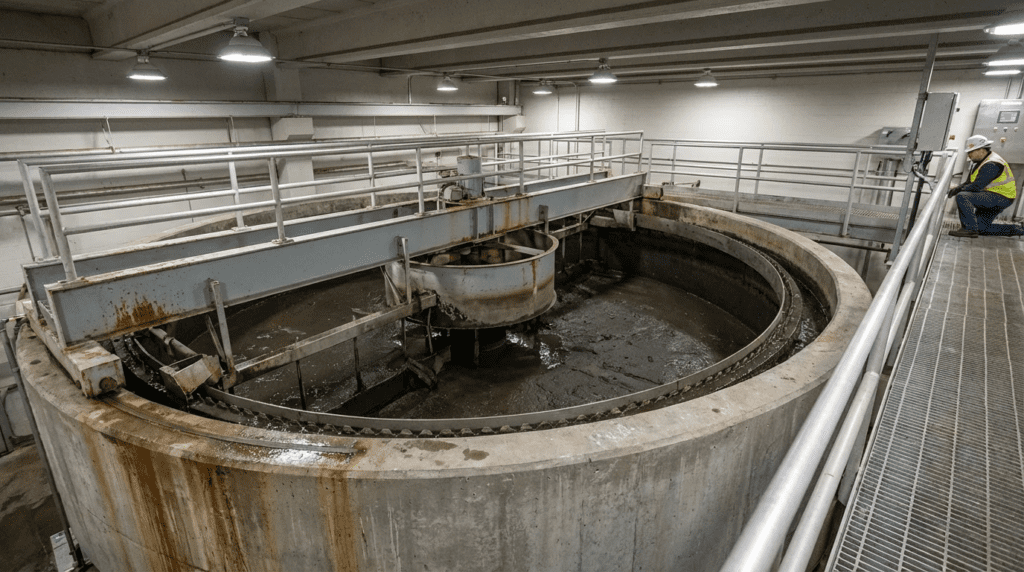
1. Introduction to Thickening Equipment in Water and Wastewater Treatment
In the hierarchy of unit processes within municipal and industrial wastewater treatment facilities, sludge thickening represents a critical intermediate step between liquid treatment and solids handling. While often overshadowed by the biological treatment processes upstream or the final dewatering and disposal downstream, thickening is the primary volume reduction unit operation. By increasing the solids concentration of dilute sludges—typically from 0.5 to 1.0 percent up to 4.0 to 8.0 percent total suspended solids—thickening equipment reduces the hydraulic load on downstream processes such as anaerobic digestion, stabilization, and dewatering by roughly 80 to 90 percent.
For municipal consulting engineers and plant superintendents, the selection of thickening equipment is governed by the necessity to optimize the volumetric capacity of digesters and reduce the capital expense of downstream equipment. A digester fed with unthickened sludge requires significantly larger heating systems and tank volumes to achieve the required volatile solids reduction. Furthermore, effective thickening ensures a consistent feed rheology, which is paramount for the stable operation of centrifuges, belt presses, or screw presses used in final dewatering.
Typical Applications and Process Drivers
Thickening is predominantly applied to two main streams: primary sludge and waste activated sludge (WAS). Primary sludge, characterized by heavier, readily settleable solids, is occasionally thickened by gravity in clarifiers, but mechanical thickening is increasingly preferred to prevent septicity and odor generation. WAS, being lighter and biological in nature, resists gravity settling and typically requires mechanical thickening with polymer conditioning to achieve desirable concentrations.
Regulatory drivers influencing OEM selection include stringent odor control requirements that favor enclosed designs, energy efficiency mandates that favor low-horsepower equipment, and the need for high solids capture rates, generally above 95 percent, to prevent recycling fines and phosphorus back to the plant headworks. The engineering challenge lies in balancing these performance metrics against lifecycle costs, maintenance accessibility, and the physical footprint of the equipment.
OEM selection in this category is not merely a commodity purchase; it is an integration of process engineering and mechanical reliability. Equipment choice sits inside the broader thickening process design, where the technology decision, the polymer program, and the downstream solids train all constrain one another. The manufacturer’s ability to guarantee solids capture, polymer consumption rates, and hydraulic throughput under varying sludge conditions is the differentiator that impacts the facility’s 20-year operational budget.
2. Thickening Equipment Manufacturer Categories
The five OEMs profiled in detail below span several technology families, but procurement rarely resolves into a single cross-technology comparison. In practice, engineers settle the technology family first and then compare manufacturers within it, because the supplier field looks quite different depending on whether the project is buying belt equipment, drum equipment, disc equipment, or centrifuges.
Gravity Belt Thickener Manufacturers
Gravity belt thickening remains the most widely installed mechanical thickening technology in North American municipal plants, and the field of gravity belt thickener manufacturers is correspondingly deep, including both the global separation companies and regional fabricators who compete effectively on customization and service response.
Three considerations separate suppliers within this family. Belt sourcing drives real lifecycle cost: standard belt widths and conventional seam types allow competitive resupply, while proprietary dimensions create a single-source dependency outliving the warranty. Frame and roller construction determines how the machine ages, since roller deflection drives tracking problems and a frame that flexes under belt tension never tracks properly regardless of adjustment. And plow and distribution design determines actual performance, because how sludge is spread and turned during its travel governs drainage far more than nominal belt area.
Selecting the Technology Family First
Before comparing manufacturers, settle the technology decision against footprint, odor requirements, energy budget, washwater availability, and operator capability. A plant committed to enclosed low-energy thickening has narrowed its supplier field before any manufacturer is named; one requiring very high hydraulic throughput has narrowed it differently. Reversing the order—shortlisting manufacturers and accepting whatever technology they lead with—produces specifications that cannot compare bids on a common basis.
3. How to Select Thickening Equipment
Selecting the appropriate thickening technology requires a granular analysis of process parameters, hydraulic constraints, and operational philosophies. Engineers must move beyond catalog data and evaluate equipment based on specific site conditions and sludge characteristics. The following engineering considerations are essential for specifying the correct system.
Process Function and Performance Requirements
The primary performance metrics for thickening equipment are the thickened sludge concentration and the solids capture rate.
- Solids Loading Rate (SLR): Defined as pounds of dry solids per hour per unit of equipment width or area. Equipment must be sized to handle peak solids loading events without blinding or carryover.
- Hydraulic Loading Rate (HLR): The volume of flow the unit can process. For dilute WAS at around 0.5 percent solids, hydraulic loading often dictates the size of the machine rather than the solids load.
- Thickened Sludge Concentration: The target is typically 4 to 8 percent dry solids. Exceeding this range can cause pumping issues, since viscosity rises sharply with solids concentration, and mixing problems in downstream digesters.
- Solids Capture: A minimum capture rate of 95 percent is the standard engineering specification. Lower capture results in a high filtrate solids load returning to the head of the plant, increasing the biological load and potentially causing a compounding accumulation of inert fines.
Technology Types and Selection
Gravity Thickening: The baseline technology, using a circular tank with a slow-moving rake mechanism and no chemical conditioning in most primary applications. Understanding conventional gravity thickening matters even on mechanical thickening projects, because it sets the performance baseline against which mechanical equipment must justify its capital and operating cost.
Pros: Very low energy, minimal moving parts, no polymer required for primary sludge, provides storage volume.
Cons: Large footprint, ineffective on WAS, prone to septicity and odor, limited control over output concentration.
Gravity Belt Thickeners (GBT): Rely on a porous belt moving over a horizontal deck. Sludge is conditioned with polymer, and free water drains by gravity. The operating characteristics of gravity belt thickeners in wastewater treatment make them the default choice where hydraulic throughput dominates the sizing.
Pros: High hydraulic capacity, simple operation, process is visible to operators.
Cons: Large footprint, open design with odor potential, high washwater usage, intensive housekeeping.
Rotary Drum Thickeners (RDT): Utilize a rotating cylindrical screen. Conditioned sludge enters the drum and water drains radially.
Pros: Fully enclosed with good odor containment, compact footprint, lower washwater usage than GBTs.
Cons: Sensitive to polymer overdose, potential for blinding if screen selection is poor.
Centrifugal Thickeners: Use high-speed rotation to separate solids by density difference. The mechanics and operating economics of centrifugal thickening of sludge differ enough from filtration-based technologies that the comparison should be made on lifecycle rather than capital cost.
Pros: Smallest footprint, no washwater during operation, fully closed system.
Cons: High energy consumption, high noise, expensive maintenance including scroll and bowl resurfacing.
Disc and Screw Thickeners: Slow-rotating enclosed designs using inclined discs or a screw within a wedge-wire basket.
Pros: Very low energy and washwater, fully enclosed, low wear from slow rotation, compact.
Cons: Less familiar to operators, scalability limits for very large flows, segmented element replacement procedures.
Materials of Construction
Given the corrosive nature of wastewater sludge, which often contains H2S, and the humid environment of thickening rooms, material specifications are non-negotiable.
- Structural Frames: 304 stainless steel is the industry minimum; 316 or 316L is recommended for aggressive environments or industrial applications. Carbon steel frames, even hot-dip galvanized, are generally discouraged for wetted parts in modern specifications because of longevity concerns.
- Fasteners: All fasteners should be 316 stainless steel to prevent seizing and corrosion.
- Rollers and Bearings: For belt and drum systems, roller deflection must be calculated to prevent belt tracking issues. Bearings should be isolated from the wetted areas or housed in triple-seal configurations to prevent sludge ingress.
Integration with Upstream and Downstream Processes
Upstream: Feed pumps must be positive displacement, typically rotary lobe or progressive cavity, to prevent shearing the floc before it enters the thickener. For centrifugal thickening, feed shear is less critical, but grit removal becomes critical to prevent abrasion of the bowl and scroll.
Polymer Systems: Mechanical thickening is almost entirely dependent on chemical conditioning. The polymer make-down and dosing system must be integrated into the thickener’s control logic through flow pacing to optimize consumption, measured as pounds of active polymer per dry ton of solids.
Downstream: The thickened sludge pump, typically a progressive cavity pump with a bridge breaker or auger feed, must be located immediately adjacent to the thickener discharge hopper. Engineers must account for the friction loss of thickened sludge, which is substantially higher than that of liquid sludge and behaves non-Newtonially at higher concentrations.
Operations and Maintenance Impacts
From an operator’s perspective, the best equipment is the one that requires the least manual intervention.
- Washwater: GBTs and RDTs require continuous washwater to keep filter media clean. Engineers must verify plant water pressure and flow availability; booster pumps are often required.
- Enclosures: For GBTs, facility engineers must design room-level HVAC and odor scrubbing. For RDTs, disc thickeners, and centrifuges, point-source extraction at the equipment ports is usually sufficient, reducing HVAC capital cost.
- Access: Belt replacement on a GBT can take several hours. Drum changes on an RDT can take longer. Centrifuge rotating assembly swaps require overhead cranes. Layouts must provide clear aisle space and hoist access.
Lifecycle Cost Considerations
Evaluated bid specifications should weigh 20-year net present value rather than lowest capital cost.
- Energy: Centrifuges consume dramatically more energy than belt, drum, or disc equipment—often by close to an order of magnitude for the same throughput. This is a major operating cost factor and frequently the decisive one.
- Polymer: A machine consuming 15 pounds of active polymer per dry ton versus one consuming 10 will cost the utility significantly more across the asset life. Performance testing for polymer efficiency should be a guaranteed and enforceable requirement, not an estimate.
- Maintenance Parts: Bearings, seals, spray nozzles, and filter belts are consumables. The cost and availability of these parts, and whether they are proprietary, must be factored in.
4. Selection & Specification Framework
The criteria above are individually well understood. Poor outcomes generally follow from sequencing them badly—usually by selecting a technology on footprint or capital cost, then confirming the loading calculations afterward.
Step 1: Characterize the Sludge Before the Equipment
Establish the stream to be thickened, its solids concentration range, its variability through the day and the year, and whether it is primary, WAS, or a blend. WAS thickening is a fundamentally different duty from primary thickening, and a blend behaves differently again. Where the plant is expected to change its biological process or add a side stream, state the future condition explicitly in the design basis.
Step 2: Determine Whether Solids or Hydraulics Governs
Compute both the solids loading rate and the hydraulic loading rate at design and peak conditions, and identify which one controls the equipment size. For dilute WAS the hydraulic rate almost always governs, which means that concentrating the feed even slightly upstream can materially reduce the machine required. For thicker primary or blended sludge the solids rate is more often controlling.
Step 3: Worked Loading and Sizing Example
Consider a 10 MGD plant producing 6,000 pounds per day of waste activated sludge at 0.7 percent solids. The volumetric flow of that stream is the mass divided by the concentration and the density of water: 6,000 ÷ (0.007 × 8.34), or approximately 103,000 gallons per day. Operating the thickener 6 hours per day, 5 days per week, the machine must process roughly 143,000 gallons per operating day, or about 400 gallons per minute.
Against a typical gravity belt thickener hydraulic loading of 150 to 200 gallons per minute per meter of belt width, that flow requires roughly 2 to 2.7 metres of belt—call it a 2-metre unit with the schedule extended, or a 3-metre unit with margin. Now check the solids side: the corresponding solids loading is 6,000 pounds over 7 days concentrated into 30 operating hours per week, or about 1,400 pounds per hour, which at 800 to 1,000 pounds per hour per metre also indicates roughly 1.4 to 1.75 metres. Hydraulics governs, as it usually does for WAS, and the machine should be sized on the hydraulic figure.
The instructive part is what happens when the schedule changes. Moving to 8 hours a day, 7 days a week reduces the required rate to roughly 180 gallons per minute and brings a 1-metre machine into range—substantially smaller and cheaper, at the cost of weekend staffing or reliable unattended operation. This trade between machine size and operating schedule is among the highest-value conversations to have with plant staff during design, and it is frequently never raised.
Step 4: Set Performance Guarantees That Can Be Enforced
Specify capture rate, thickened solids concentration, and polymer consumption as guaranteed values at a defined feed condition, with test method, duration, and sampling protocol stated. A guarantee without a test protocol is unenforceable, and a test run during startup before the biological process matures will not represent steady-state performance. Require a return visit for testing once the plant reaches normal operation.
Step 5: Design the Support Systems With the Machine
Washwater supply and pressure, polymer make-down and aging capacity, feed pump type and control, thickened sludge pump and suction arrangement, filtrate drainage, ventilation and odor control, and structural support for dynamic loads all belong in the design. Thickening installations disappoint more often because of a support system than because of the machine.
Step 6: Compare on Twenty-Year Cost
Build the comparison from installed capital including building and HVAC implications, energy at the actual duty cycle, polymer at the guaranteed rate, belt or element replacement cycles, bearing and seal service, washwater volume and its treatment cost, and the labor implied by the operating schedule. Polymer alone frequently exceeds equipment cost across the asset life, which is why guaranteeing it matters more than shaving capital.
5. Comparative Analysis of Top Thickening OEMs
The following tables contrast the leading Original Equipment Manufacturers for thickening applications. Table 1 profiles the manufacturers; Table 2 compares the underlying technology families to support the technology-first selection sequence described above.
| OEM | Typical Thickening Technologies | Engineering Strengths | Limitations | Best-Fit Scenarios | Maintenance Considerations |
|---|---|---|---|---|---|
| Andritz | Gravity belt thickeners, centrifuges, drum thickeners | Large global installed base; high-capacity heavy-duty designs; advanced automation and rheology control. | Higher capital cost for small facilities; proprietary control systems add complexity. | Large municipal plants requiring high throughput and automated process control. | Requires specialized technician support for centrifuge balancing and major overhauls. |
| Alfa Laval | Centrifuges, drum thickeners | Deep expertise in centrifugal separation; energy-efficient centrifuge designs; compact drum thickeners. | Premium pricing; spare parts can be proprietary and costly. | Facilities with limited footprint or those prioritizing enclosed, low-odor systems. | High-speed rotating assemblies require vibration monitoring and precision maintenance. |
| Evoqua (Xylem) | Gravity belt thickeners, rotary drum thickeners | Extensive legacy brand portfolio; breadth allows technology-agnostic recommendations; strong retrofit capability. | Large corporate structure can slow response on custom engineering queries. | Municipal retrofits where matching existing hydraulic profiles and footprints is critical. | Standard mechanical maintenance; parts availability is generally high. |
| BDP Industries | Gravity belt thickeners, rotary drum concentrators | US-based manufacturing; heavy structural build; high customization flexibility for difficult layouts. | Focus is primarily on belt and drum technologies rather than high-speed centrifugation. | Plants valuing durability, domestic sourcing, and direct factory support. | Designed for operator accessibility; uses many non-proprietary standard industrial components. |
| Huber | Disc thickeners, rotary screw thickeners | High-quality stainless fabrication; enclosed low-speed designs; low energy and washwater consumption. | Distinct technology differs from conventional belt and drum equipment, requiring operator training adjustment. | Greenfield plants with strict energy and odor requirements; small to medium layouts. | Slow-moving parts reduce wear, but segmented screen or disc replacement requires specific procedures. |
| Technology | Typical Output Solids | Relative Footprint | Energy | Washwater | Polymer Dependence | Best-Fit Duty |
|---|---|---|---|---|---|---|
| Gravity Thickener | 2–6% (primary) | Very large | Very low | None | None to low | Primary sludge; sites with land and no odor constraint |
| Gravity Belt Thickener | 4–8% | Large | Low | High | High | High hydraulic throughput; WAS thickening at scale |
| Rotary Drum Thickener | 4–8% | Compact | Low | Moderate | High; sensitive to overdose | Odor-sensitive sites; moderate throughput in tight rooms |
| Disc / Screw Thickener | 4–8% | Very compact | Very low | Low | High | Small to medium plants prioritizing energy and enclosure |
| Centrifugal Thickener | 4–8%, higher achievable | Smallest | High | None in operation | Moderate | Severely constrained footprint; gelatinous or chemical sludges |
6. Top OEM Manufacturers
The following manufacturers represent established suppliers for sludge thickening equipment, selected on track record, engineering support capability, and the reliability of their deployed assets in the water and wastewater sector.
Andritz
Andritz is a global participant in the separation industry, offering a comprehensive suite of thickening solutions ranging from belt technologies to high-performance centrifuges. Their expertise extends beyond the mechanical unit to the process control logic, often integrating automation that adjusts polymer dosing and feed rates based on incoming load.
For thickening applications, Andritz is noted for their gravity belt thickener lines and their thickening centrifuges. Their GBT designs feature large open drainage areas and robust frame construction suitable for the hydraulic loads found in metropolitan treatment plants. The engineering philosophy prioritizes throughput and capture efficiency, and their equipment is frequently specified where the cost of failure is high, such as regional facilities in which a thickening bottleneck would compromise the entire sludge line.
A key differentiator is scale. Andritz offers some of the widest belt widths and largest centrifuge bowl diameters available. From an operations standpoint their machines are designed for continuous duty, though engineers should note that the sophistication of the control systems requires a higher level of operator training and instrumentation maintenance than simpler equipment.
Alfa Laval
Alfa Laval is closely associated with centrifugal separation. While they manufacture drum thickeners, their core competency lies in decanter centrifuge technology adapted for thickening. Unlike dewatering centrifuges, which aim for maximum cake dryness, thickening units optimize for liquid separation at lower torque, reducing energy consumption relative to their dewatering counterparts.
Their drum thickener line addresses low-energy, enclosed mechanical thickening in a compact package requiring a fraction of the floor space of a GBT. Alfa Laval emphasizes total lifecycle cost, focusing on energy efficiency and polymer economy, and their internal bowl geometry is designed to reduce turbulence and thereby improve separation performance.
For engineers, Alfa Laval is a strong specification choice where footprint is severely constrained or where a fully enclosed, aerosol-free environment is required. The trade-off is typically higher initial capital expenditure and reliance on OEM service for the rotating assemblies. Their global service network is extensive, which mitigates long-term support risk.
Evoqua
Evoqua, now part of Xylem, holds a distinctive position because of its acquisition of numerous legacy brands accumulated over decades. This gives them a large installed base and a deep archive of engineering drawings, making them a common choice for retrofits and rehabilitations of existing municipal infrastructure.
Their thickening portfolio includes widely installed gravity belt thickener and rotary drum thickener lines. Evoqua designs are often characterized as conventional and proven rather than experimental, refining technologies operators already understand. That familiarity reduces the training burden on plant staff.
A particular strength is integrated solutions. Because they manufacture upstream and downstream equipment including clarifiers and digestion mixing, they can engineer a coherent solids handling train, and single-source responsibility can simplify project execution. Their equipment is constructed for longevity, typically using 304 or 316 stainless steel, with designs that prioritize access for routine tasks such as seal replacement and nozzle cleaning.
BDP Industries
BDP Industries is an American manufacturer known for building heavily constructed equipment. The company began as an aftermarket service provider for other brands and engineered its own line to address the failure points it encountered in the field, which gives the equipment a distinctly operator-centric design philosophy.
Their gravity belt thickeners and rotary drum concentrators are staples in the US municipal market. BDP is notably flexible on customization; unlike some global manufacturers with rigid model lines, they will often modify dimensions, drive locations, or control interfaces to fit specific constraints. This makes them a frequent choice for complex retrofit projects in tight mechanical rooms.
Technically, BDP equipment emphasizes hydraulic capacity and structural rigidity, with heavy frames designed to resist vibration and torque over decades of service. They use standard, high-quality industrial components—motors, gearboxes, bearings—that are often non-proprietary, simplifying supply chain management for plant maintenance staff. Their reach is more domestic than global, but their reputation for reliability and post-sale support is strong in that market.
Huber
Huber Technology brings a precision manufacturing approach to the thickening market, characterized by high-quality stainless steel fabrication. Huber is established in enclosed, low-speed thickening technologies, specifically inclined disc thickeners and rotary screw thickeners.
The inclined disc design offers a very small footprint and low washwater consumption compared with traditional GBTs. Slow rotation results in minimal wear and low noise, creating an operator-friendly environment. Huber’s equipment is fully enclosed, preventing sludge splatter and odor escape, which supports clean mechanical rooms.
For engineers, Huber is a good fit for small to medium plants or facilities in odor- and noise-sensitive locations. Their equipment is often modular and skid-mounted, simplifying installation. While disc and screw technology differs from the conventional belt thickener, the process benefits in capture rate and low operating cost are meaningful. The limitation is scalability for very large metropolitan flows compared with wide GBTs, though multiple units can be run in parallel.
7. Application Fit Guidance
Selecting the right OEM and technology is not a one-size-fits-all process. The following scenarios highlight where specific manufacturers and technologies typically excel.
Municipal Water vs. Wastewater
- Municipal Wastewater (WAS Thickening): This is the most common application. BDP Industries and Evoqua are strongly represented here with GBTs and RDTs, given the reliability required for continuous biological sludge production. Huber is increasingly favored in this sector for plants prioritizing low energy and enclosed systems.
- Municipal Water (Alum Sludge): Water treatment plant sludge can be gelatinous and difficult to thicken. Andritz and Alfa Laval centrifuges are often preferred because higher separating forces can release bound water in chemical sludges that gravity belts struggle with absent very high polymer doses.
Small vs. Large Facilities
- Small Facilities (below roughly 5 MGD): Huber and smaller Alfa Laval drum units fit well. The disc thickener suits this range because it requires little operator attention, has low power requirements, and fits in small buildings.
- Large Facilities (above roughly 20 MGD): Andritz and Evoqua excel here. At high sludge production, the hydraulic width of large GBTs or the throughput of large centrifuges becomes the economic choice. BDP also scales into this range with their larger belt units.
Retrofit vs. Greenfield Installations
- Retrofits: BDP Industries and Evoqua are strong contenders. Willingness to customize connection points and frame dimensions allows new equipment to replace old units on existing housekeeping pads without expensive structural modification.
- Greenfield: Huber and Alfa Laval often suit new designs where the building can be laid out around compact, enclosed equipment, potentially saving on construction through a smaller footprint and simpler HVAC.
8. Engineer and Operator Considerations
Beyond nameplate performance, the long-term success of a thickening installation depends on practical engineering details and operational realities.
Installation and Commissioning
Thickening equipment imposes dynamic loads. Verify that the structural slab can handle not just static weight but vibration from centrifuges or moment loads from belt tensioning. Commissioning requires representative sludge, and since startup often precedes a mature biological process, the OEM should be retained for return visits to optimize polymer dosage at steady state.
Maintenance Access
The three-foot rule: Engineers should provide a minimum of three feet of clearance around all sides of a thickener. For GBTs, particular attention is needed for the roller removal path—can a roller be slid out of the frame without hitting a wall or piping? For centrifuges, overhead cranes or monorails are mandatory for lifting the scroll and bowl. Neglecting hoist access is a common design oversight that complicates all future maintenance.
Spare Parts and Consumables
Belts and Seals: These are the most frequent consumables. Operators prefer standard belt sizes that can be sourced competitively. Some OEMs use proprietary seam types or dimensions that lock the utility into a single source, and this should be clarified during the submittal phase rather than discovered at the first belt change.
Polymer: The cost of polymer across twenty years will likely exceed the cost of the equipment. Operators should track active pounds of polymer per dry ton of solids as a key performance indicator. Equipment that degrades in capture efficiency will show up first as rising polymer usage, well before it appears as a process complaint.
Operational Lessons Learned
A common operational failure is blinding of the filter media, whether belts or drums, frequently caused by inadequate washwater pressure. Specify booster pumps dedicated to the thickening system rather than relying on general plant utility water, which fluctuates with demand. Mist containment is equally critical: even enclosed GBTs leak aerosols, and holding the room at negative pressure relative to adjacent corridors prevents migration of odors and corrosive mist to electrical rooms.
Long-Term Reliability Risks
Corrosion is the dominant long-term risk. Specifying 316 stainless for all wetted parts and frames is the safest engineering decision. While 304 stainless is common, the aggressive nature of septic sludge and the use of ferric chloride or other coagulants can accelerate pitting. Electrical panels should be located in a separate, conditioned room away from the thickener to prevent H2S attack on copper components and circuit boards.
Polymer System Design
The polymer system deserves as much design attention as the thickener, because it is where most performance problems originate. Provide adequate aging time for emulsion or dry polymer to hydrate fully before injection, since under-aged polymer performs poorly at any dose. Specify injection mixing energy deliberately: too little and the polymer never disperses, too much and the floc shears before reaching the drainage zone. Provide flow pacing on both sludge and polymer feed so the dose ratio holds as conditions change, and a means of adjusting dilution water so the operator can tune injection concentration without changing the neat rate.
9. Design Details & Standards
Applicable Standards and References
Thickening equipment specifications commonly reference Ten States Standards (Recommended Standards for Wastewater Facilities) for solids handling criteria, together with the WEF Manual of Practice No. 8 / ASCE MOP 76 for design methodology and WEF MOP No. 31 for wastewater solids process design. Stainless steel plate and sheet are specified to ASTM A240, with bars and shapes to ASTM A276 and fasteners to ASTM F593. Gearbox ratings follow AGMA standards with the service factor basis stated. Motors follow NEMA MG-1, with Part 31 applicable to inverter-duty machines. Electrical area classification in solids handling buildings follows NFPA 820 together with NFPA 70. Rotating equipment guarding is governed by OSHA 29 CFR 1910.212, confined space entry by 29 CFR 1910.146, and occupational noise exposure by 29 CFR 1910.95, which is directly relevant where centrifuges are selected. Where thickened biosolids are ultimately land applied, the governing regulation is 40 CFR Part 503.
Specification Checklist
- Design Basis: Sludge type, solids production in pounds per day at average and peak, feed concentration range, and expected seasonal variability.
- Operating Schedule: Hours per day and days per week the equipment is expected to run, stated explicitly, with the resulting required throughput.
- Loading: Solids loading rate and hydraulic loading rate at design and peak, with the governing parameter identified.
- Performance Guarantees: Solids capture rate, thickened solids concentration, and active polymer consumption per dry ton, each at a defined feed condition.
- Test Protocol: Method, duration, sampling frequency, laboratory procedures, and the acceptance criteria for the performance test, scheduled after steady-state operation is achieved.
- Materials: Frame, wetted component, roller, and fastener grades, with 316 stainless as the default for wetted service unless justified otherwise.
- Filter Media: Belt or screen type, width, seam construction, and an explicit statement of whether the media is proprietary or commercially available from multiple sources.
- Washwater: Flow, pressure, and quality requirement, with dedicated booster pump provisions and strainer requirements.
- Polymer System: Make-down capacity, aging time, injection mixing energy, dilution water control, and flow pacing interlocks with the sludge feed.
- Drives and Controls: Motor ratings, gearbox service factors, speed control range, instrumentation, alarms, and the SCADA signal list.
- Odor and Ventilation: Enclosure requirement, point-source extraction connections, and the room ventilation basis.
- Access and Structural: Clearance dimensions, roller or element removal path, hoist or crane provisions, and dynamic load data for structural design.
10. Frequently Asked Questions
What solids concentration should a thickener achieve?
The usual target is 4 to 8 percent dry solids, though the appropriate figure depends on what is downstream. Anaerobic digestion generally benefits from feed near the upper end of that range, since it reduces required tank volume and heating load. Going substantially above 8 percent begins to create pumping and mixing difficulties, because sludge viscosity rises sharply and behaves non-Newtonially, and digester mixing systems designed for a thinner feed may no longer turn the contents over.
Why is solids capture rate so important?
Whatever the thickener fails to capture returns to the head of the plant in the filtrate. At 95 percent capture that recycle load is manageable; at 85 percent it becomes a significant additional solids and nutrient load, and because much of the escaping material is fine and inert it accumulates rather than being removed. The result is a slow degradation in liquid train performance rarely traced back to the thickener where it originated.
How do I choose between a gravity belt, rotary drum, and disc thickener?
Start with footprint, odor requirements, and washwater availability rather than with capture performance, since all three technologies achieve comparable output solids when properly operated. Belt equipment offers the highest hydraulic throughput per machine and the most visible process, at the cost of footprint, washwater, and housekeeping. Drum equipment offers enclosure and a smaller footprint with moderate washwater. Disc and screw equipment offers the lowest energy and washwater in the most compact enclosed package, at the cost of operator familiarity and some scalability limit. The technology matrix above compares these directly.
When does a centrifuge make sense for thickening rather than dewatering?
Centrifugal thickening earns its energy cost where footprint is severely constrained, where a fully enclosed aerosol-free installation is required, or where the sludge is gelatinous enough that filtration-based technologies need excessive polymer to perform. Alum sludge from water treatment is a frequent example. Where none of those conditions applies, the energy differential relative to belt, drum, or disc equipment is difficult to justify on a lifecycle basis.
How much polymer should thickening consume?
Polymer consumption is expressed as active pounds per dry ton and varies with sludge characteristics, polymer selection, and equipment performance, so a single figure is not meaningful across plants. What matters is that the value be guaranteed by the manufacturer at a stated feed condition and then tracked as an operating indicator. A rising trend in pounds per dry ton at constant feed conditions is the earliest reliable signal that capture efficiency is degrading, whether from media blinding, worn components, or a polymer system problem.
Why do thickener belts and drums blind?
The most common cause is inadequate washwater pressure or flow, which fails to clear the media between passes. Others include polymer overdose, which produces a sticky floc that plugs the media rather than draining; grease and fibrous material in the feed; and struvite or calcium scaling in plants with high phosphorus or hardness. Diagnosing correctly matters, because increasing polymer to compensate for blinding caused by overdose makes the situation worse.
What operating schedule should thickening equipment be designed around?
This is a staffing decision as much as an engineering one, and it should be settled with plant operations before sizing. Longer operating hours permit a smaller and cheaper machine but require either weekend coverage or confidence in unattended operation with adequate alarming. Shorter schedules require a larger machine but concentrate operator attention. The important discipline is that the assumed schedule appears in the design basis, so that a later change in staffing is recognized as a capacity change rather than an unexplained shortfall.
Does thickening equipment need redundancy?
Generally yes, though the form varies. Because sludge production is continuous while thickening is usually intermittent, a single machine out of service for a belt change can be absorbed if there is adequate sludge storage upstream and schedule flexibility. Longer outages cannot be. The practical options are a second thickening unit, sufficient upstream storage volume to ride through the longest expected repair, or a documented arrangement for temporary rental equipment. Choosing none of these is a decision, not an oversight to be discovered later.
11. Conclusion
Key Takeaways
- Determine whether solids or hydraulics governs — for dilute WAS the hydraulic loading almost always controls the machine size, which means small changes in feed concentration have outsized effects on equipment cost.
- The operating schedule is a sizing input — a machine sized for 8 hours a day, 7 days a week is substantially undersized if the plant actually runs it 6 hours on weekdays, and this is a staffing conversation to have during design.
- Guarantee polymer, capture, and solids with an enforceable test — a guarantee without a defined test protocol and a post-startup test date cannot be enforced.
- Polymer dominates lifecycle cost — consumption across twenty years commonly exceeds the equipment cost, so guaranteeing it matters more than shaving capital.
- Capture failures propagate upstream — poor capture recycles fine inert solids to the head of the plant, degrading liquid train performance in ways rarely traced back to their source.
- Specify 316 stainless for wetted service — septic sludge and coagulant chemistry accelerate pitting in 304, and the differential cost is small against the replacement it avoids.
- Design the support systems with the machine — washwater pressure, polymer aging and mixing, ventilation, and hoist access account for more disappointing installations than the thickener itself.
Selection of thickening equipment is a pivotal decision that dictates the efficiency of the entire solids handling train. An undersized or poorly performing thickener hydraulically overloads digesters, reduces volatile solids reduction, and increases the volume of wet sludge sent to dewatering—cascading inefficiencies that inflate operational budgets.
For the consulting engineer and plant manager, the choice among OEMs such as Andritz, Alfa Laval, Evoqua, BDP Industries, and Huber involves weighing hydraulic capacity against footprint, and capital cost against long-term polymer and energy consumption.
Andritz and Alfa Laval are strongest in the high-throughput segment, particularly where centrifugation is viable or large scale is required. BDP Industries and Evoqua offer robust, operator-friendly belt and drum solutions that form the backbone of many municipal facilities. Huber provides specialized, high-efficiency enclosed systems suited to plants with strict environmental and footprint constraints.
Ultimately, a successful installation relies on a robust specification that demands appropriate stainless steel construction, adequate washwater systems, verifiable and enforceable performance guarantees for capture and polymer usage, and a physical layout that respects the needs of the maintenance team. By focusing on these fundamentals, utilities can ensure their thickening systems provide decades of reliable service.