
USA vs Auma Actuators for Valve Actuators: Pros/Cons & Best-Fit Applications
Introduction
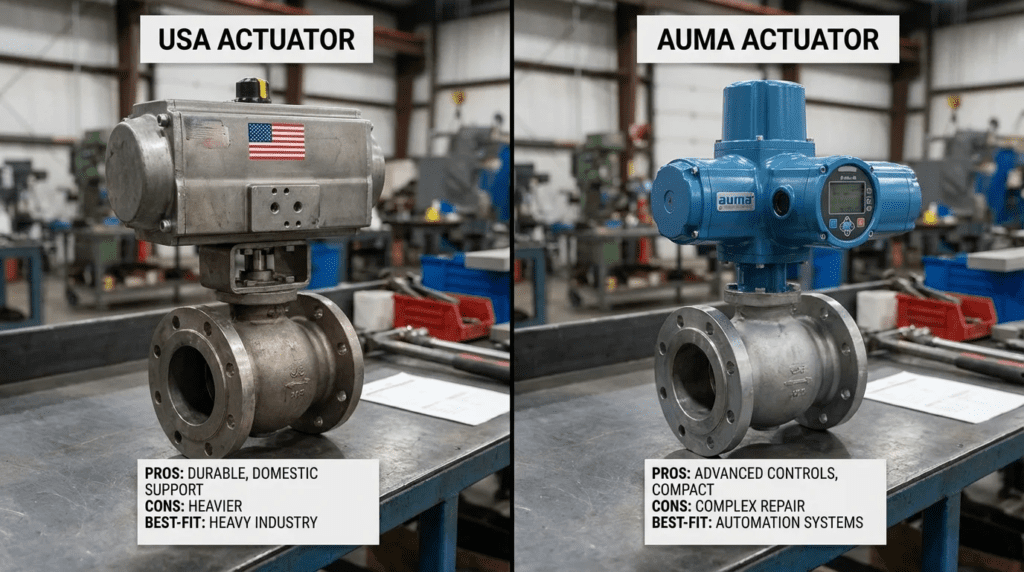
In the municipal water and wastewater sector, the failure of a critical valve actuator is rarely a minor inconvenience; it is often a precursor to permit violations, process upsets, or catastrophic flooding. For decades, design engineers and plant superintendents have faced a choice when specifying electric actuation: adhere to traditional domestic manufacturing philosophies, typified by brands like Limitorque, EIM, or Rotork’s US-based lines, or adopt the European modular approach spearheaded by AUMA. The debate surrounding USA vs Auma Actuators for Valve Actuators: Pros/Cons & Best-Fit Applications represents a divergence in engineering philosophy, control integration, and maintenance strategy.
Electric actuators operate everything from massive influent isolation gates to precise modulating air control valves in aeration basins. While the fundamental physics of converting electrical energy into mechanical torque remains constant, the execution differs between the domestic style, characterized by robust, NEMA-rated, integrated housings, and the AUMA style, which prioritizes modularity, IEC standards, and separate control heads. A poor selection leads to scope gaps during installation, integration difficulties with SCADA systems, or premature failure due to environmental incompatibility. This article sits within our coverage of valve actuator manufacturers.
A note on the title: “USA” here is not a manufacturer. It is shorthand for the domestic design tradition represented by Limitorque (Flowserve), EIM (Emerson) and Rotork’s US-built lines, as distinct from AUMA’s European modular approach. Readers looking for a specific brand comparison should see our article on Rotork Controls vs AUMA actuators.
How to Select / Specify
Duty Conditions & Operating Envelope
- Isolation (Class A/B): For valves that operate infrequently, the primary concern is breakaway torque after long periods of inactivity. Domestic-style actuators often utilize heavy bronze gears and high-torque motors designed to power through stuck valves. AUMA units are equally capable but rely on a more precise torque sensing mechanism.
- Modulation (Class C/D): In active control loops, the motor must handle frequent starts and stops, up to 1,200 per hour. AUMA has historically offered dedicated modulating ranges with variable speed options and high thermal capacity, including through SIPOS, a separate brand under the same corporate ownership that specializes in variable-speed actuation. Domestic manufacturers have responded with solid-state starters and integrated drives, but the selection must match the process dynamics.
Materials & Compatibility
- Coating Systems: AUMA typically utilizes a powder coating system developed for marine environments as a standard or near-standard option. Domestic manufacturers often use two-part epoxy systems. In highly corrosive headworks, the specification must explicitly require a coating thickness and type regardless of the manufacturer.
- Enclosure Ratings: This is a major point of divergence. US specs rely on NEMA 4X for corrosion protection and NEMA 6P for submersibility. AUMA relies on IP ratings. While broadly comparable, the testing protocols differ. Engineers must ensure that an IP68 actuator specified for a US project also meets the NEMA 250 corrosion requirements.
Hydraulics & Process Performance
- Variable Speed: Variable speed actuation allows soft starts and soft stops, reducing wear on valve seats and mitigating surge. Both camps offer variable-speed units. The choice often comes down to the resolution of control required.
Installation Environment & Constructability
- Clearance: AUMA’s modular design allows the controls to be mounted remotely from the gear train, up to 100 meters away. This is a significant advantage in confined vaults where an operator cannot safely access the handwheel or display. Domestic actuators usually allow remote mounting of the control station, but separating the motor starter from the motor often requires a specific split model.
- Conduit Entries: A critical detail. Domestic actuators standardly come with NPT threaded entries. AUMA actuators often come with metric entries or require adapters. If the contractor is not warned, they may arrive with rigid conduit that cannot interface with the supplied cable glands.
Reliability, Redundancy & Failure Modes
- Electronics Failure: The most common failure mode for modern intelligent actuators is the logic board. AUMA’s modularity allows the swapping of the entire control head without removing the actuator from the valve or losing the valve position limit settings.
- Mechanical Failure: The declutch mechanism for manual override is a common point of mechanical wear; robustness here is key.
Controls & Automation Interfaces
- Network Protocols: Both camps support Modbus, Ethernet/IP, and Profibus. AUMA’s European heritage gives it an edge in Profibus implementations, while domestic manufacturers often have more robust native support for common North American industrial Ethernet topologies.
- Diagnostics: Modern actuators monitor torque profiles, motor temperature, and vibration. The ease of extracting this data is a major selection criterion.
Maintainability, Safety & Access
- Non-Intrusive Setup: Both modern domestic and AUMA actuators allow setting limits without opening the housing. This preserves the seal and prevents moisture ingress, the leading cause of actuator failure.
- Battery Reliance: Check whether the actuator requires a battery to maintain position sensing during power loss. Absolute encoders generally do not, but some lower-spec models rely on batteries to update position if the valve is moved manually during an outage.
Lifecycle Cost Drivers
- Standardization: If a plant has hundreds of one brand, introducing a second creates a training and spare parts burden. The cost of stocking two types of control boards and training staff on two menu structures often outweighs a modest unit price difference.
- Repair vs. Replace: Traditional mechanical actuators are often rebuilt by motor shops. Highly electronic, modular actuators are more often module-swapped, which is faster but can be more expensive in material costs.
Comparison Tables
Table 1: Design Philosophy Comparison
| Feature/Criteria | Domestic Style (e.g., Limitorque/EIM) | AUMA Modular Style | Engineering Implication |
|---|---|---|---|
| Housing Construction | Typically monolithic, heavy cast aluminum or ductile iron with integrated gear and motor housing. | Modular: gearbox, motor, and controls are distinct, separable units. | Domestic style is often more mechanically robust against impact; modular style offers superior flexibility for retrofits and upgrades. |
| Control Interface | NEMA-rated knobs and switches, often integrated directly into the main housing. | Mountable in 90-degree increments and separable up to 100 m. | Modular provides better ergonomics for valves in pits or high overhead locations. |
| Conduit/Cable Entry | NPT threads, rigid conduit ready. | Metric threads or plug and socket options, often requiring adapters for US rigid conduit. | Domestic style is easier for traditional electrical contractors; AUMA requires attention to cable glands and adapters. |
| Torque Sensing | Often mechanical torque springs or electronic monitoring of motor current. | Electronic torque sensing, often calibrated digitally. | Both are reliable; digital calibration is often viewed as more precise for protecting sensitive valve seats. |
| Standards | NEMA, ANSI, FM, UL, CSA. | IEC, EN, ISO, with UL and FM options available. | Ensure the domestic spec requires NEMA ratings; ensure the AUMA spec requires UL certification for insurance compliance. |
| Typical Maintenance | Grease and oil changes; motor rebuilds possible. | Module replacement and component swaps. | Domestic style favors mechanic-centric repair; modular favors technician and instrumentation-centric repair. |
Table 2: Application Fit Matrix
| Application Area | Service Type | Domestic Style Fit | AUMA Fit | Decision Driver |
|---|---|---|---|---|
| Raw Sewage Pump Station | Isolation | Excellent | Good | Robustness. Vibration resistance is key; heavy-duty mechanical units tolerate pump vibration well. |
| Aeration Control | Modulating | Good with variable speed options | Excellent | Precision. Dedicated modulating ranges handle high duty cycles with tight deadbands. |
| Filter Gallery | Modulating and isolation | Good | Excellent | Space and wiring. Compact modular design fits crowded pipe galleries; fieldbus integration is strong. |
| Distribution Vaults (Remote) | Intermittent | Excellent | Good | Submersibility. Both offer IP68 and NEMA 6P, but traditional US specs have a long track record in flooded vaults. |
| Hazardous Areas (Digesters) | Explosion proof | Excellent | Good | Certification. US units are natively designed for NEC Class and Division standards; AUMA requires specific FM-approved configurations. |
Engineer & Operator Field Notes
Commissioning & Acceptance Testing
- The Handshake Issue: When integrating actuators into a SCADA network, data mapping is critical. Intelligent actuators provide a large amount of diagnostic data. Engineers often fail to map the heartbeat signal correctly. If the PLC stops seeing the heartbeat, it should trigger an alarm.
- Phase Correction: Modern actuators from both camps usually feature automatic phase correction, so the valve does not run backward if the phases are reversed. Verify this feature is active during the factory acceptance test.
- Torque Seating vs. Position Seating: For wedge gate valves, it is best practice to seat by torque to ensure a tight seal. For butterfly or plug valves, seat by position to avoid jamming the disc into the liner. Ensure the actuator setup menu allows independent configuration for open and close directions.
Common Specification Mistakes
- Over-Specifying Torque: Applying a 2.0 safety factor on top of a conservative valve torque requirement results in an oversized actuator that can damage the valve stem if torque limit switches are not set correctly. A 1.25 to 1.5 safety factor is typically sufficient.
- Ignoring Latency: In high-speed control loops, the time it takes for the actuator to process a signal and begin moving matters. Ensure the specified update rate matches the hydraulic requirements.
- “Or Equal” Ambiguity: Stating “Limitorque or equal” allows contractors to bid lower-tier equipment that may not meet submergence requirements. Define equal by performance rather than brand name.
O&M Burden & Strategy
- Lubrication: Traditional mechanical actuators may have oil baths that require sampling and changing. AUMA gearboxes are often sealed for life or require specific high-performance grease. Mixing greases is a serious error.
- Backup Power: If the facility relies on portable generators, ensure the actuator’s locked rotor amps are calculated. Older mechanical actuators have high inrush; modern actuators with soft-start capabilities reduce this burden.
Troubleshooting Guide
- Check the Local/Remote Switch: A substantial share of reported actuator failures turn out to be an actuator left in local or off after maintenance. It costs nothing to check first.
- Torque Faults: If the actuator trips on torque in mid-travel, look for debris in the valve seat or a lack of lubrication on the valve stem. Do not simply increase the torque limit setting; this will bend the stem.
- Loss of Phase: If the motor hums but does not move, check for a blown fuse on one leg of the three-phase power.
Design Details / Calculations
Sizing Logic & Methodology
- Determine Valve Torque: Obtain the seating, unseating, and running torque from the valve manufacturer. Breakaway torque after long inactivity is usually the governing value.
- Apply Safety Factor: Standard practice is 1.25 for clean water and 1.5 for wastewater or sludge.
- Select Actuator Gear: Select a unit where the rated output torque exceeds design torque within the mid-range of the actuator’s capability. Avoid sizing an actuator to run at the extreme low end, which gives poor control, or at the very top, which leaves no margin for aging.
- Check Stem Factor: For multi-turn applications, the actuator turns a stem nut. The conversion of torque to thrust depends on stem thread friction. Ensure the actuator’s thrust rating exceeds the valve’s required thrust.
Specification Checklist
- Voltage/Phase/Frequency: for example 460V, three phase, 60Hz.
- Enclosure Rating: NEMA 4X for corrosion and NEMA 6P for submersible.
- Duty Cycle: S2-15min for isolation or S4 modulating duty.
- Controls: Integral, non-intrusive, with display.
- Communication: Hardwired I/O or bus protocol, specifying the exact version.
- Conduit Entry: State NPT entries or factory-installed adapters explicitly, since this is the most common source of field delay on imported units.
- Testing: AWWA C542 where applicable for the valve assembly.
Standards & Compliance
- AWWA C542: The standard for Electric Motor Actuators for Valves and Slide Gates, ensuring the unit is built for waterworks service.
- UL / FM: Crucial for hazardous locations such as digester galleries or enclosed headworks.
- ISO 5210 / 5211: Defines the mounting flange dimensions. AUMA defaults to these metric standards. Ensure the mounting flange on the actuator matches the valve bonnet or specify an adaptor.
FAQ Section
What is the primary difference between AUMA and domestic US actuators?
The primary difference lies in design philosophy. Domestic actuators traditionally feature integrated, monolithic housings designed for mechanical robustness and NEMA standards. AUMA actuators utilize a modular design where the motor, gearbox, and controls are separate, interchangeable units designed around IEC standards. This makes AUMA highly flexible for configuration but requires attention to interface details for electricians accustomed to US rigid conduit systems.
How do I decide between modulating and isolation actuators?
Select based on the process requirement. Isolation actuators are rated for intermittent duty and prioritize high breakaway torque. Modulating actuators are rated for continuous duty and prioritize thermal management and positioning accuracy. Using an isolation actuator for modulating service will overheat the motor and burn out the contactors.
Are AUMA actuators compatible with NEMA 4X requirements?
Yes, with caveats. AUMA actuators are tested to IP68, which generally covers submersibility comparable to NEMA 6P. However, NEMA 4X also includes specific corrosion resistance tests. When specifying AUMA for US projects, ensure the submittal confirms compliance with NEMA 250 Type 4X and 6P equivalence, and that the coating system is rated for the environment.
Why does my actuator display a torque fault even when the valve moves freely?
This often occurs because the torque bypass setting, which ignores high torque during the initial unseating movement, is set too short. Alternatively, the voltage supply may be dropping during inrush, causing the motor to lose torque capability while the electronics register a fault. Check the voltage at the actuator terminals during startup.
Can I mix different actuator brands in one facility?
Technically yes, but operationally it is discouraged. Mixing brands complicates spare parts inventory and operator training. SCADA integration also becomes more complex, as data registers will differ between brands, requiring unique PLC code blocks for each manufacturer.
Conclusion
Key Takeaways
- Philosophy Matters: Choose domestic-style units for mechanical robustness, NEMA adherence, and contractor familiarity. Choose AUMA for modular flexibility, advanced diagnostics, and complex control applications.
- Define the Duty: Never apply an isolation duty actuator to a modulating control loop. It will fail thermally.
- Watch the Interface: The biggest friction point is the conduit entry, metric versus NPT, and the mounting flange.
- Standardize: The lifecycle cost of training and spares usually outweighs the initial bid savings.
- Spec for the Environment: Require marine-grade or NEMA 4X corrosion protection explicitly. Hydrogen sulfide does not discriminate by brand.
This comparison is not resolved by declaring a single winner. It is resolved by matching the machine to the mission. For heavy-duty, infrequent isolation in a flood-prone raw sewage pump station, the mechanical heritage of domestic actuators offers peace of mind. For intricate, high-speed flow control in a filter gallery where space is tight and data matters, the modular precision of AUMA is often superior.
Engineers must move beyond brand loyalty and perform a rigorous analysis of the specific application constraints. By focusing on constructability, interface compatibility, and long-term maintainability, you can specify an actuation system that serves the utility reliably for decades. Supplier overviews appear in our guides to the top OEMs for electric valve actuators and top OEMs for pneumatic valve actuators.