
Valves – Construction Service Installation Mistakes That Cause Leaks
INTRODUCTION
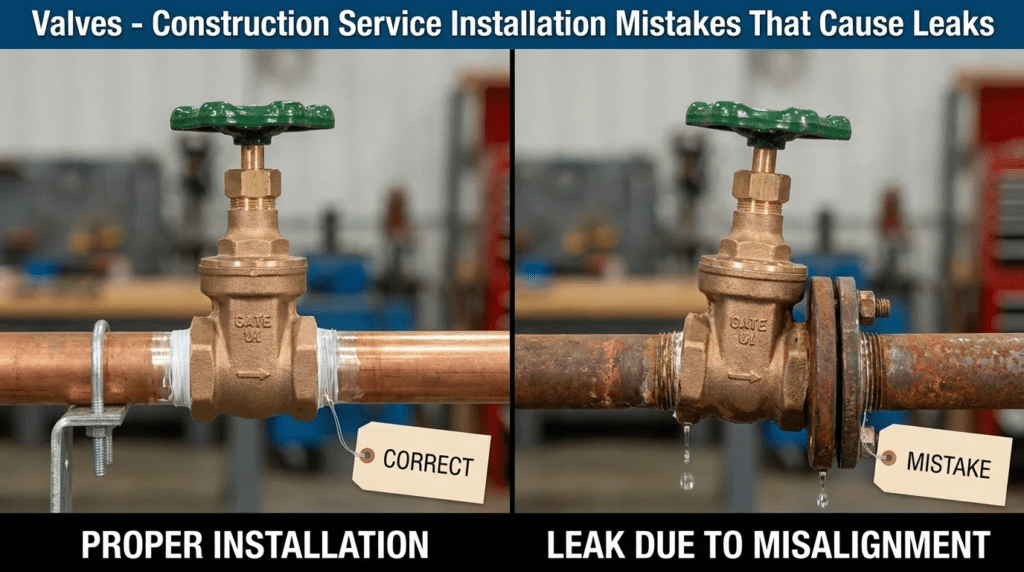
In municipal water distribution, wastewater collection, and industrial treatment processes, fluid containment is paramount. Yet, when commissioning new pipelines or upgrading pump stations, engineers and operators frequently encounter unexpected hydrostatic test failures or premature fugitive emissions. When analyzing these failures, experts routinely point to Valves – Construction Service Installation Mistakes That Cause Leaks as the primary culprit. A staggering percentage of non-revenue water (NRW) and hazardous process spills originate not from manufacturing defects, but from subtle errors in field execution, improper handling, or flawed interface design.
Most engineers meticulously specify valve body materials, pressure classes, and coating systems, but often overlook the critical mechanical interfaces during construction. A butterfly valve pinched by misaligned flanges, a resilient seated gate valve closed on construction debris, or a control valve bearing the structural weight of adjacent piping will inevitably fail, regardless of its specification. These failures lead to delayed commissioning, catastrophic blowouts, flooded dry-pit vaults, and severe lifecycle cost overruns.
This technology is deployed across all facets of water management: from high-pressure transmission mains and raw water intakes to abrasive sludge handling and corrosive chemical dosing. Operating environments range from deeply buried direct-bury applications to highly accessible but vibration-prone pump discharge headers. Proper specification—coupled with strict installation oversight—is critical. The consequences of poor choices or lax construction management manifest as seat leaks, stem seal blowouts, and fractured flanges.
This article will help consulting engineers, utility decision-makers, and plant maintenance supervisors understand the mechanical realities of valve installation. By detailing exact points of failure, identifying critical installation prerequisites, and providing a robust framework for specification and commissioning, this guide aims to eliminate the preventable construction mistakes that compromise fluid systems.
HOW TO SELECT AND SPECIFY TO PREVENT LEAKS
Preventing Valves – Construction Service Installation Mistakes That Cause Leaks begins long before the contractor mobilizes. Engineer-level selection criteria must account for how the valve will actually be handled, mounted, and stressed in the field.
Duty Conditions & Operating Envelope
Valve specifications must accurately reflect the true operating envelope to prevent installation-induced failures later.
- Flow rates, pressures, and temperatures: Specify not just steady-state conditions, but transient pressure spikes (water hammer). Valves installed at the end of long pipe runs without proper surge relief or surge-anticipating features can suffer blown gaskets or deformed discs. Typical pressure ratings (e.g., AWWA Class 150B or 250B) must account for surge, not just static head.
- Operating modes: Continuous throttling versus rare isolation dictates the seat type. Using an isolation-only gate valve for throttling will cause high-velocity wire-drawing across the seat, virtually guaranteeing a leak regardless of installation quality.
- Future capacity: Oversized valves installed for future capacity often operate near the closed position, creating localized high-velocity zones that erode seats and cause chronic leakage.
Materials & Compatibility
Material mismatches at the flanged connection are a leading cause of installation failures.
- Flange Face Compatibility: Mating a flat-face cast iron valve to a raised-face steel pipe flange is a severe installation mistake. When the bolts are torqued, the raised face exerts bending stress on the cast iron flange, often causing it to fracture and leak.
- Gasket Selection: Utilizing elastomeric ring gaskets on flat-face flanges instead of full-face gaskets concentrates stress and causes deformation. Furthermore, chemical compatibility between the fluid and the gasket (e.g., using standard EPDM in a hydrocarbon-contaminated wastewater line) leads to gasket degradation and leaks.
- Galvanic Corrosion: Installing dissimilar metals (e.g., carbon steel piping directly to a bronze valve) without dielectric isolating flange kits accelerates anodic dissolution at the joint face, compromising the sealing surface over time.
Hydraulics & Process Performance
Hydraulic anomalies often manifest as physical leaks due to severe vibration and material loss.
- Cavitation: Control valves installed with high pressure drops (high recovery valves) without anti-cavitation trim will experience collapsing vapor bubbles. This implosion removes metal from the valve body downstream of the seat, eventually resulting in a through-wall leak.
- NPSH and Air Entrainment: Valves installed on pump suction lines must be completely airtight. Minor installation leaks that allow air ingress can cause pump cavitation, which in turn causes pipe vibration, loosening flange bolts and exacerbating the leak.
- Upstream/Downstream Pipe Runs: Modulating valves typically require 5 to 10 pipe diameters of straight run upstream to ensure laminar flow. Installing a control valve immediately downstream of an elbow creates turbulent flow that unevenly wears the seat and stem packing.
Installation Environment & Constructability
The physical environment heavily dictates the likelihood of installation mistakes.
- Space constraints and access: Confined vaults prevent mechanics from properly using a calibrated torque wrench on the bottom bolts of a large diameter valve. Uneven torque inevitably causes gasket creep and leakage.
- Structural considerations: Valves are not pipe anchors. A frequent installation mistake is failing to provide independent pipe supports adjacent to heavy valves. The weight of the valve sags the pipe, causing high bending moments at the flanges, leading to gap formation and leakage at the top of the joint.
- Thrust Restraint: For buried applications, failing to properly size and pour concrete thrust blocks or install adequate restrained joint lengths behind dead-end valves will cause the valve to push off the pipe during hydrostatic testing.
Reliability, Redundancy & Failure Modes
Understanding how a valve fails informs how it must be installed to mitigate that failure.
- Common failure modes: Stem packing leaks are highly common. In many instances, this is due to operators or contractors failing to adjust the packing gland during commissioning, or conversely, overtightening it and scoring the stem.
- Redundancy requirements: In critical wastewater force mains, single points of isolation are inadequate. Dual isolation allows one valve to act as the primary wear component, preserving the secondary valve for tight shutoff.
- MTBF (Mean Time Between Failures): Typically, the elastomeric seats in resilient seated gate valves or butterfly valves last 10-20 years. However, if installed with the disc slightly open during pipe welding, weld slag will permanently damage the elastomer, reducing MTBF to zero days.
Controls & Automation Interfaces
Actuator setup is intrinsically linked to valve integrity.
- Limit and Torque Switches: A ubiquitous installation error is improperly setting the torque switches on an electric motor actuator. If the close limit switch fails or is miscalibrated, and the torque switch is set too high, the actuator will force the stem downward until the stem bends, the seat fractures, or the bonnet cracks.
- Stroke Speeds: Pneumatic or electric actuators set to stroke too quickly cause severe water hammer, leading to joint separation and leakage elsewhere in the piping system.
Maintainability, Safety & Access
If a valve cannot be maintained safely, minor leaks will be ignored until they become catastrophic.
- Operator access: Valves installed 15 feet in the air without permanent platforms or chainwheel operators will not be routinely serviced. Packing glands will dry out and leak.
- Ergonomics: Gear operators must be orientated so the handwheel is accessible. Contractors sometimes rotate the valve 90 degrees to fit a space, placing the handwheel against a wall.
- Lockout/Tagout provisions: Isolation valves must be installed with verifiable locking mechanisms to ensure zero energy state for downstream pipe maintenance.
Lifecycle Cost Drivers
The upfront savings of rushed construction are eclipsed by the OPEX of repairing leaks.
- CAPEX vs OPEX tradeoffs: Spending additional capital on adjustable pipe supports, dismantling joints, and premium gasket materials vastly reduces the long-term O&M burden of repairing flange leaks.
- Labor requirements: A buried valve that leaks requires excavation, shoring, dewatering, and repaving. The repair cost is often 10 to 50 times the cost of the valve itself.
- Total cost of ownership: True TCO analysis proves that specifying certified installers and mandating third-party inspection of torqueing procedures yields the lowest lifecycle cost.
COMPARISON TABLES
The following tables provide an objective analysis of how different valve architectures respond to installation errors, and how engineers can match valve technologies to specific environmental constraints to mitigate leakage risks. Use Table 1 to understand inherent vulnerabilities, and Table 2 to select the most robust option for your specific site conditions.
Table 1: Valve Technologies & Susceptibility to Installation Errors
| Valve Technology | Features & Best Fit | Primary Installation Mistake Causing Leaks | Vulnerability / Limitations | Typical Maintenance Profile |
|---|---|---|---|---|
| Resilient Seated Gate Valve (AWWA C509/C515) | Clear waterway, bi-directional isolation. Best for buried water mains and wastewater force mains. | Leaving construction debris (gravel, pipe shavings) in the line. The gate forces debris into the elastomeric bottom, creating a permanent leak path. | Highly susceptible to overtightening by operators using “cheater bars,” which can break the stem or strip the operating nut. | Low. Occasional exercising and stem packing adjustment/replacement if not O-ring sealed. |
| Butterfly Valve (AWWA C504) | Compact face-to-face dimension, excellent for large diameter isolation and basic throttling in pump stations. | Installing without verifying disc clearance. Disc strikes adjacent thick-walled pipe or eccentric reducer during operation, bending the disc and causing seat leakage. | Elastomer seat on the body can be rolled or pinched if flanges are not perfectly aligned before bolting. | Medium. Actuator/gearbox lubrication, periodic seat inspections in exposed applications. |
| Eccentric Plug Valve | Excellent for high-solids wastewater and raw sewage. Designed to shear through debris. | Installing backwards. Plug valves are directional for tight shut-off; installing with the seat on the low-pressure side reduces sealing capability under high delta-P. | Requires specific orientation in horizontal pipes (plug must rotate to the top of the pipe to prevent grit accumulation in the bearing). | Medium. Regular greasing of bearings/journals and packing adjustments required. |
| Swing Check Valve (AWWA C508) | Prevents reverse flow. Best for pump discharge headers. | Installing on vertical lines with downward flow, or without adequate upstream straight pipe, causing disc flutter, hinge pin wear, and eventual seat failure. | High susceptibility to slamming (water hammer) if not specified with a lever and weight/spring or air-cushion cylinder. | High. Hinge pins wear over time, requiring replacement to ensure proper disc seating. |
| Air Release / Air Vacuum Valve (AWWA C512) | Vents entrained air or breaks vacuums at pipeline high points. | Failing to install an isolation valve beneath it for maintenance, or lack of proper vent piping, leading to vault flooding when the internal float eventually fouls. | Requires vertical installation; even a slight tilt off-axis can cause the float mechanism to bind and continuously leak water. | High. Requires frequent cleaning, especially in wastewater (sewage air valves) to prevent grease buildup. |
Table 2: Installation Constraint Matrix (Application Fit)
| Application Scenario | Key Constraints | Highest Leak Risk Factor | Best-Fit Valve / Interface Specification | Relative Cost Impact |
|---|---|---|---|---|
| Direct Buried Transmission Main | No visual access, high excavation cost for repair, shifting soils. | Inadequate thrust restraint or settling soil putting shear stress on flanged or mechanical joints. | Restrained mechanical joint (MJ) Gate Valves or fully welded connections; massive concrete thrust blocks. | Moderate (Valve) / High (Installation) |
| Confined Space Pump Station Vault | Tight clearances, difficult maintenance access, potential for submergence. | Inability to torque flange bolts evenly; galvanic corrosion in damp environments. | Wafer or Lug style Butterfly Valves to save space; specified with dismantling joints for future removal without pipe stress. | Moderate |
| Exposed Plant Piping (Vibrating) | Pump-induced vibration, thermal expansion/contraction of long pipe runs. | Vibration loosening flange bolts over time; thermal expansion crushing the valve body. | Flanged valves with heavy-duty restrained dismantling joints or flexible expansion joints to absorb pipe stress. Anti-vibration washers on bolting. | High (Due to accessories) |
| High-Solids Sludge Line | Abrasive media, grease buildup, frequent blockages. | Debris settling in the seat area, preventing closure and causing wire-drawing leakage. | Eccentric Plug Valves or Knife Gate Valves installed with the stem horizontal to prevent bottom cavity buildup. | High |
ENGINEER & OPERATOR FIELD NOTES
Translating a perfect specification into a leak-free physical reality requires rigorous oversight. Here is how engineers and operators can identify and correct Valves – Construction Service Installation Mistakes That Cause Leaks in the field.
Commissioning & Acceptance Testing
Commissioning is the last line of defense before a system goes live. Rushing this phase obscures installation errors.
- Factory Acceptance Test (FAT): Ensure the manufacturer provides certified hydrostatic test reports confirming zero leakage past the seat at rated pressure, and zero shell leakage at 1.5x rated pressure. If it leaks at the factory, it will leak in the field.
- Site Acceptance Test (SAT) / Hydrostatic Testing: When performing pipeline hydro-tests (typically 1.5x working pressure for 2 hours per AWWA C600), the testing must isolate against the valve seat. A common mistake is testing with the valve open, testing only the shell and flanges. The valve must be operated under flow and pressure to verify the actuator torque limits are correct.
- Pipeline Flushing: The most destructive event for a resilient seated valve is the first time it is closed. If the pipeline has not been thoroughly flushed (“pigged” or high-velocity flushed) to remove rocks, welding slag, and tools, the valve will crush this debris into its seat, permanently ruining the seal.
Common Specification Mistakes
Engineers often inadvertently encourage installation errors through ambiguous specifications.
- Missing Torque Specifications: Merely stating “install per manufacturer’s instructions” is inadequate. The specification should mandate that the contractor submit a flange torqueing procedure, utilizing a star-pattern sequence, using calibrated torque wrenches, documented and witnessed by the inspector.
- Dismantling Joints Omission: Omitting dismantling joints or flanged coupling adapters next to large valves in rigid pipe systems forces the contractor to use “come-alongs” and hydraulic jacks to pull pipe flanges together. This pre-stresses the valve body, leading to immediate or eventual cracking and severe leakage.
- Ambiguous Actuator Sizing: Specifying an actuator without providing the maximum differential pressure and expected pipeline velocity leads to undersized actuators (which fail to close the valve fully, causing seat leakage) or oversized actuators (which snap stems).
O&M Burden & Strategy
Post-installation, mitigating leaks shifts to the maintenance team.
- Valve Exercising: Valves left static for years will scale, and elastomeric seals will adhere to the metal body (cold welding). A routine exercising program (full cycle open and close) every 6-12 months breaks scale and verifies operability, preventing stem shear when emergency operation is required.
- Packing Gland Maintenance: Most packing gland leaks are easily resolved by evenly tightening the packing gland nuts. However, operators must tighten them symmetrically; uneven tightening binds the stem, scoring the metal and turning a minor leak into a requirement for full stem replacement.
- Predictive Maintenance: On critical actuated valves, utilize the smart actuator’s datalogger to monitor torque profiles over time. An increasing torque requirement at the seating position indicates scale buildup or seat swelling, allowing operators to intervene before a failure occurs.
Diagnosing Valves – Construction Service Installation Mistakes That Cause Leaks
When a leak occurs, accurate diagnosis is critical to avoid unnecessary teardowns.
- Flange Leak vs. Shell Leak: Wipe the area completely dry. Use a flashlight and mirror to trace the water path. If water is emerging from the gap between flanges, check torque. If torque is correct, the gasket may have blown due to a pressure surge or incorrect material selection.
- Packing/Stem Leak: Water weeping from the top of the valve around the stem indicates loose packing or worn O-rings. If tightening the gland does not stop the leak, the stem may be bent (due to misalignment with the actuator) or deeply scored.
- Seat Leak (Passing Fluid): If a valve is closed but downstream pressure continues to rise or flow is detected, the seat is leaking. Root causes include debris trapped in the invert, damaged elastomeric seats, or an actuator limit switch that is stopping the travel prematurely.
DESIGN DETAILS & CALCULATIONS
Engineers must integrate precise calculations and rigorous standards into their designs to eliminate ambiguities that contractors might exploit or misinterpret.
Sizing Logic & Methodology
Improper sizing directly leads to hydraulic phenomena that cause leaks.
- Velocity Constraints: Rule-of-thumb: Size valves to maintain fluid velocities between 3 to 8 feet per second (fps) for water. Velocities exceeding 15 fps across a partially open gate or butterfly valve will cause severe cavitation, vibration, and eventual leakage.
- Flange Bolt Torque Calculations: Torque requirements are not universal. They depend on gasket material (e.g., PTFE requires higher compressive loads than soft EPDM), bolt grade (e.g., Grade B7 vs. 316 Stainless Steel), and lubrication. Using anti-seize compound drastically changes the K-factor in the torque equation (T = K x D x P). Over-torqueing lubricated bolts stretches the bolts past their yield point, resulting in loose flanges and leaks.
- Thrust Restraint Sizing: Calculate thrust forces at dead-end valves using the formula: Thrust (lbs) = Pressure (psi) x Area (sq. in). A 24-inch valve tested at 150 psi generates over 67,000 lbs of thrust. Failing to design a thrust block or restrained pipe length to counteract this will result in the valve launching off the pipeline.
Specification Checklist
Include the following must-have items in the master specification:
- Flange Alignment Tolerances: Explicitly state that pipe flanges must be aligned to within 1/16 inch prior to bolting, without the use of excessive force or mechanical advantage to pull pipes together.
- Gasket Specifications: Specify ring gaskets for raised-face flanges and full-face gaskets for flat-face flanges. Prohibit the use of tape, sealants, or adhesives on flange faces unless explicitly approved.
- Fastener Yield Strengths: Specify exact ASTM designations for bolting (e.g., ASTM A193 Grade B7) and mandate specific thread lubricants to prevent galling on stainless steel fasteners.
- Installation Orientation: Specify valve stem orientation (vertical, horizontal) and flow direction for asymmetric valves (like plug valves or specific check valves).
Standards & Compliance
Leverage industry standards to enforce quality control:
- AWWA Standards: Reference AWWA C500-series for valve manufacturing (e.g., C504 for Butterfly, C509/C515 for Gate) and critically, AWWA C600 for installation of ductile iron water mains and appurtenances.
- ANSI/ASME B16.5 & B16.1: Dictate flange dimensions and pressure classes. Ensure class 125/150 flanges are not inadvertently mated to class 250/300 flanges, which possess different bolt circles and will not align.
- NSF/ANSI 61: Mandatory for potable water systems, dictating that all wetted materials (including gaskets and lubricants used during installation) do not leach contaminants.
FREQUENTLY ASKED QUESTIONS
What is the most common cause of a newly installed flanged valve leaking?
The most common cause is uneven torque applied to the flange bolts. If a contractor does not use a calibrated torque wrench in a “star” or cross-pattern sequence, the gasket will be compressed unevenly (gasket creep). This creates a gap on the undertorqued side, allowing pressurized fluid to escape. See the [[Commissioning & Acceptance Testing]] section for proper torque protocols.
How do you select the right gasket to prevent installation leaks?
Gasket selection depends on flange faces and fluid media. Use full-face elastomeric gaskets for flat-face cast iron valves to prevent flange cracking. Use ring gaskets for raised-face steel piping. The material must be chemically compatible with the process fluid (e.g., EPDM for water/wastewater, Nitrile/NBR for systems with hydrocarbon exposure). Never reuse a gasket once it has been fully torqued and decompressed.
Why do resilient seated gate valves leak after hydro-testing?
This is almost always an installation mistake involving pipe cleanliness. If the pipeline is not thoroughly flushed prior to testing, rocks, gravel, or pipe shavings are swept into the valve. When the gate is closed for the hydro-test, the debris is driven deep into the rubber seating surface on the bottom of the wedge, permanently compromising the seal.
What is the difference between a shell leak and a seat leak?
A shell leak occurs when fluid escapes from the valve’s pressure boundary to the external environment (e.g., through a cracked body, a blown flange gasket, or a leaking stem packing). A seat leak occurs entirely internally; fluid passes through the valve from the upstream to the downstream pipe even though the valve is fully closed. Seat leaks are often caused by debris, worn elastomers, or actuator misalignment.
How much does it cost to repair a leaking buried valve?
Repairing a buried valve is exponentially more expensive than the equipment itself. While a 12-inch water main valve might cost $1,500 – $3,000, the cost to excavate, shore the trench, dewater, cut out the valve, install a new one, and repave the road typically ranges from $15,000 to $40,000+. This underscores the necessity of getting the installation right the first time.
Why does my butterfly valve leak past the seat even though the actuator says it is closed?
This is likely due to the actuator’s limit switches being improperly set during commissioning. If the “close” limit switch stops the actuator travel before the disc is perfectly perpendicular (90 degrees) to the pipe centerline, the disc will not fully compress the elastomer seat. Re-calibrate the limit switches and verify closure against the actual physical position indicator on the valve stem.
How often should isolation valves be exercised to prevent failure?
In municipal water and wastewater applications, large isolation valves should be exercised (fully closed and fully opened) at least once every 12 months. In highly corrosive or scaling environments, a 6-month interval is recommended. Regular exercising prevents cold-welding of elastomers and clears scale buildup, ensuring the valve seals tightly when an emergency isolation is required.
CONCLUSION
KEY TAKEAWAYS
- Prevent Flange Stress: Valves must never act as structural anchors. Always support adjacent piping independently and utilize dismantling joints to avoid transferring bending moments to the valve body.
- Clean Before Closing: Pipeline debris is the number one cause of ruined elastomeric seats. Mandate high-velocity flushing before any valve is operated.
- Enforce Torque Protocols: Uneven tightening causes gasket creep and broken flanges. Specify star-pattern torque sequences and require documented use of calibrated torque wrenches.
- Match Flange Faces: Never mate a flat-face cast iron flange to a raised-face pipe flange without proper modifications; the bending stress will fracture the cast iron.
- Clearance is Critical: Ensure butterfly and check valve discs have adequate clearance to swing fully open without striking thick-walled pipe or eccentric reducers.
Selecting and specifying the proper valve is only half the battle in municipal and industrial fluid handling. The integrity of the system relies heavily on bridging the gap between design engineering and field execution. By understanding the specific mechanisms behind Valves – Construction Service Installation Mistakes That Cause Leaks, engineers and plant managers can proactively draft specifications that physically prevent contractors from making these errors.
A successful, leak-free installation requires a holistic approach. It begins with acknowledging the operating envelope—including transients and water hammer—and selecting materials and face configurations that are intrinsically compatible. The design must accommodate the reality of the installation environment, providing adequate space for tools, incorporating dismantling joints to eliminate pipe strain, and ensuring proper thrust restraint for buried applications. Furthermore, commissioning protocols must shift from being a mere formality to a rigorous, documented process that proves the integrity of both the valve seat and the external pressure boundaries.
When operating parameters are extreme, or when valves are placed in highly inaccessible environments, engineers should not hesitate to involve valve specialists to review the interface designs or mandate third-party inspectors during the torqueing and hydro-testing phases. Balancing the capital cost of these preventive measures against the massive operational expense of excavating and repairing a buried leak makes the lifecycle economics clear. Ultimately, a properly supported, aligned, torqued, and tested valve will easily outlast its warranty, securing the reliability of the critical infrastructure it serves.