
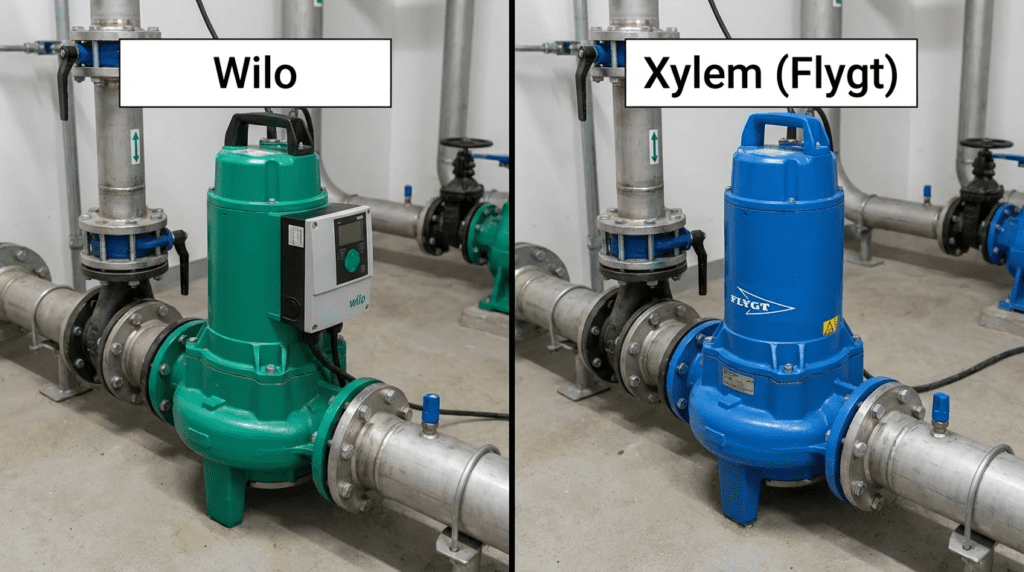
Wilo vs Xylem (Flygt) Inline Grinder Equipment: Comparison & Best Fit
Introduction
The escalation of non-dispersible solids in modern wastewater—primarily synthetic wipes, rags, and fibrous materials—has fundamentally changed the operational baseline for municipal lift stations and treatment plants. Engineers are increasingly forced to move beyond simple solid-handling pumps to aggressive solids reduction strategies. A critical decision point in this defense strategy is the selection of Wilo vs Xylem (Flygt) Inline Grinder Equipment: Comparison & Best Fit. While pump technology has evolved, the strategic placement of inline grinders (or macerators) remains the primary insurance policy against pump clogging events that lead to sanitary sewer overflows (SSOs) and unscheduled maintenance.
A staggering statistic in the industry suggests that reactive maintenance costs due to ragging have risen by over 35% in the last decade for utilities that have not upgraded their solids handling protocols. Many engineers overlook the hydraulic penalty associated with inline grinding or misapply the technology where a chopper pump or solids separation system might be more appropriate. The distinction between Xylem’s approach (heavily integrated with their JWC Environmental acquisition) and Wilo’s approach (often focusing on separation systems or integrated macerators) represents a divergence in philosophy as much as machinery.
Inline grinders are typically deployed on the suction side of dry-pit pumps, in sludge recirculation lines, or in septage receiving stations. Their primary function is to condition solids into small, pumpable particles, protecting downstream pumps, valves, and dewatering equipment. However, the operating environment is harsh; these units face variable loading, abrasive grit, and potential shock loads from metal or stone. Consequences of poor selection include rapid cutter wear, shaft breakage, significant head loss reducing system capacity, and “roping”—where long fibers pass through uncut.
This article aims to provide a rigorous, specification-safe analysis for engineering professionals. We will dissect the technical nuances, hydraulic implications, and lifecycle considerations required to make an informed decision between these two market leaders and their respective technologies.
How to Select / Specify
Selecting the correct inline grinder is not merely a matter of matching flange sizes. It requires a holistic review of the process hydraulics and the physical composition of the waste stream. When evaluating a Wilo vs Xylem (Flygt) Inline Grinder Equipment: Comparison & Best Fit scenario, the following criteria must be defined in the specification documents.
Duty Conditions & Operating Envelope
The operating envelope for an inline grinder is defined by flow rate, pressure, and solid loading. Unlike pumps, grinders do not generate head; they consume it. Therefore, the hydraulic throughput is the first constraint. Engineers must specify:
- Peak Hourly Flow (PHF): The grinder must pass peak flow without creating a head loss that forces the pumps to operate left of their allowable operating region (AOR).
- Solids Loading Rate: Defined typically in pounds per day or concentration (mg/L TSS). High-loading applications (sludge lines) require higher torque and lower cutter stack speeds compared to raw sewage applications.
- Pressure Rating: Inline units are pressure vessels. Standard ratings are often 90 PSI or 150 PSI (ANSI Class 150). For high-head lift stations where the grinder is on the discharge side (less common but possible) or in high-pressure sludge lines, the housing burst pressure and seal ratings are critical.
Materials & Compatibility
The longevity of a grinder is dictated by metallurgy. Specifications should be explicit regarding:
- Cutter Material: Standard specifications often call for heat-treated alloy steel (e.g., 4130 or 4140) hardened to 45-50 Rockwell C. However, for abrasive environments, specifications should differentiate between the base metal and the cutting edge. Tungsten carbide impregnation or specialized coatings can extend life but increase CAPEX.
- Housing Construction: Ductile iron (ASTM A536) is standard for municipal wastewater. However, for industrial applications or septic receiving with low pH, 304 or 316 Stainless Steel housings may be required to prevent corrosion that undermines the bearing housings.
- Shafting: Hexagonal shafting is the industry standard to drive the cutter stack. The tensile strength of the shaft material is the limiting factor for the maximum torque the unit can apply to a jam.
Hydraulics & Process Performance
This is the most critical and often ignored aspect of inline grinder specification. The introduction of a grinder creates a restriction similar to a partially closed valve.
- Head Loss Coefficient (K-value): Manufacturers must provide head loss curves based on water. Engineers must apply a correction factor for sludge viscosity.
- Capture Efficiency: Not all grinders cut everything. “Roping” occurs when fibrous materials pass through the gaps between cutters without being sheared. Dual-shaft low-speed high-torque designs generally offer better capture efficiency than single-shaft macerators.
- Net Positive Suction Head (NPSH): If installed on the suction side of a pump, the head loss across the grinder effectively reduces the NPSHa (Available). Calculations must verify that NPSHa > NPSHr (Required) + Margin, accounting for the dirty-grinder condition.
Pro Tip: The Dirty State Calculation
Never size the system hydraulics based on a brand-new, clean grinder. Specify the head loss at a “50% blinded” condition to ensure the pumps can still deliver required flow when the grinder is partially fouled or approaching maintenance intervals.
Installation Environment & Constructability
- Spatial Constraints: Inline grinders are often retrofitted into existing pipe galleries. The face-to-face dimension is critical. While spool pieces can make up length, a unit that is too long cannot be installed without major piping modifications.
- Submersibility: Even for dry-pit installations, specifying IP68 (submersible) rated motors and cable entries is industry best practice to protect against accidental flooding of the vault.
- Access for Removal: These units are heavy. Overhead lifting rails or dedicated davit cranes must be positioned directly over the unit. The design must allow the cutter cartridge to be removed without disassembling the entire pipeline if the housing design supports it.
Reliability, Redundancy & Failure Modes
In the context of Wilo vs Xylem (Flygt) Inline Grinder Equipment: Comparison & Best Fit, reliability strategies differ. Xylem (via JWC) often utilizes dual-shaft designs that self-clean. Wilo’s approach may involve maceration or solids separation.
- Redundancy: Critical applications require N+1 redundancy or a bypass channel with a manual bar screen. An inline grinder jam should not shut down the lift station.
- Seal Failure: This is the most common failure mode. Cartridge mechanical seals (tungsten carbide faces) are preferred over component seals for ease of replacement and reliability.
- Bearing Protection: The “wetted” bearings near the cutters are vulnerable. Look for designs that do not require bearings at the bottom of the cutter stack (cantilevered) or have robust labyrinth isolators.
Controls & Automation Interfaces
The brain of the grinder is the controller. It protects the motor and clears jams.
- Jam Sensing Logic: Current sensing (Amps) is standard. When high amps are detected, the controller should stop, reverse rotation to clear the obstruction, and retry. Specifications should define the “Retry Count” (typically 3) before faulting out.
- SCADA Integration: The controller must provide dry contacts or Modbus/Ethernet IP outputs for: Running, Fault, Seal Fail, and High Torque Alarm.
- Soft Starts: For larger motors (5HP+), VFDs or soft starters reduce mechanical stress on the shafts during startup and reversal sequences.
Maintainability, Safety & Access
Operator safety is paramount. The primary risk is interaction with sharp cutters.
- Zero Energy State: Lockout/Tagout (LOTO) points must be clearly accessible.
- Cutter Cartridges: Top-tier designs allow the removal of the cutter stack as a single cartridge without removing the motor or the main housing from the pipe. This significantly reduces downtime (OPEX).
- Auto-Reverse Safety: The system must be designed so it cannot auto-restart while maintenance hatches are open (interlocks).
Lifecycle Cost Drivers
- Cutter Replacement: This is the single largest OPEX cost. Analyze the cost of a replacement cutter stack vs. individual cutter replacement.
- Energy: While motors are generally small (3-10 HP), continuous operation adds up. Intermittent operation (run only when pump runs) saves energy but risks startup jams.
- Rebuild Intervals: Typical rebuilds occur every 5-7 years depending on grit load. Compare the cost of an “OEM Rebuild Program” (cutter exchange) between manufacturers.
Comparison Tables
The following tables provide a structured comparison to assist engineers in evaluating the specific offerings typically associated with these OEMs. Note that Xylem’s primary offering in this space is via their JWC Environmental brand (Muffin Monster), while Wilo offers both macerators and the alternative EMUport solids separation system. The comparison highlights the technological differences rather than marketing claims.
Table 1: Technology & Manufacturer Profile
| Manufacturer / Brand | Primary Technology | Primary Strengths | Limitations / Considerations | Maintenance Profile |
|---|---|---|---|---|
| Xylem (JWC Environmental) Series: Muffin Monster / Channel Monster |
Dual-Shaft Low-Speed High-Torque Grinder Intermeshing cutters operating at differential speeds. |
|
|
Moderate/High Requires periodic cutter stack replacement (cartridge swap). Minimal daily maintenance. |
| Wilo Series: Wilo-Macerator / Wilo-Rexa (Integrated) |
Single-Shaft Macerator or Integrated Grinding High-speed rotating cutting head against a stationary plate. |
|
|
Moderate Cutter adjustment required to maintain shear tolerances. Wear plate replacement. |
| Wilo (Alternative) System: EMUport / Solids Separation |
Solids Separation System Solids are filtered out before the pump and back-flushed. |
|
|
Low No cutters to sharpen. Maintenance focuses on valves and pumps. |
Table 2: Application Fit Matrix
Use this matrix to identify the “Best Fit” technology based on specific project constraints.
| Application Scenario | Primary Constraint | Best Fit Technology | Engineering Rationale |
|---|---|---|---|
| High-Head Lift Station (>100ft) | Pump Protection & Efficiency | Wilo EMUport (Separation) | Grinding solids creates smaller particles that can still bind high-head impellers. Separation removes the threat entirely, allowing efficient hydraulic pump selection. |
| Existing Dry Pit Retrofit | Space & Pipe Layout | Xylem (JWC) Inline Grinder | Dual-shaft grinders are compact and can be installed directly into suction piping with spool pieces. High torque handles the varied trash in older collection systems. |
| Sludge Recirculation / Transfer | Viscosity & % Solids | Xylem (JWC) Inline Grinder | The “positive feed” nature of intermeshing cutters helps process thick sludge. Macerators may cavitate or lose prime capability in thick sludge. |
| Small Municipal Station (<100 GPM) | Budget & Simplicity | Wilo Grinder Pump (Integrated) | For low flows, a separate inline grinder is overkill. An integrated grinder pump (submersible) provides sufficient protection at a lower lifecycle cost. |
| Prison / Institutional | Extreme Trash (Clothing/Bedding) | Xylem (JWC) Muffin Monster | Institutional waste is the hardest duty. Dual-shaft, low-speed, high-torque is mandatory to shear bedding, uniforms, and contraband without jamming. |
Engineer & Operator Field Notes
Experience from the field dictates that specification is only half the battle. The following notes address installation, commissioning, and operational realities.
Commissioning & Acceptance Testing
When commissioning Wilo vs Xylem (Flygt) Inline Grinder Equipment, the Site Acceptance Test (SAT) must verify control logic, not just rotation.
- Rotation Check: Ensure cutters rotate inward (toward the center) for dual-shaft units. Outward rotation will reject solids rather than grind them.
- Jam Simulation: Do not use a 2×4 piece of wood for acceptance testing unless specified. A better test involves monitoring the amperage draw during a simulated jam (using a brake or torque simulation if possible) to verify the controller initiates the reversal sequence exactly at the setpoint.
- Seal Leakage: Verify seal leak detection sensors are active. Disconnect the sensor wire to ensure the SCADA system registers the specific alarm.
Common Specification Mistakes
Common Mistake: Ignoring Velocity
Engineers often specify grinders based on flange size (e.g., 6-inch grinder for 6-inch pipe). However, if the flow velocity is too low (< 2 ft/s) in the grinder chamber, grit will settle out, destroying the bottom seals. If velocity is too high (> 7 ft/s), head loss spikes exponentially.
- Ambiguous “Or Equal”: Specifying “Inline Grinder” generally yields the cheapest single-shaft macerator. If the application requires the torque of a dual-shaft unit, the specification must detail “Two counter-rotating shafts with intermeshing cutters.”
- Missing Bypass: Installing a grinder without a bypass loop is a critical failure. If the grinder jams or needs maintenance, the station is dead. Always design a valved bypass with a manual bar rack.
O&M Burden & Strategy
The operational burden differs significantly between technologies.
- Inspection Intervals: Visual inspection of cutters should occur monthly. Operators should look for “rolling” of the cutter teeth (rounding off), which indicates the need for replacement.
- Lubrication: Most modern inline grinders are oil-filled or grease-packed for life (until rebuild). However, auto-lubers for top bearings should be checked monthly.
- Spare Parts: For a fleet of grinders, keeping a spare “cutter cartridge” is more efficient than keeping individual cutters. A cartridge swap takes 4 hours; a stack rebuild takes 2 days.
Troubleshooting Guide
Symptom: Frequent “Ghost” Jams (Tripping without debris)
- Root Cause: Amperage setpoint too low or voltage imbalance.
- Action: Check VFD/Soft Start settings. Tighten electrical connections. Verify cutter stack isn’t binding due to failed bearings.
Symptom: Reduced Flow Rate
- Root Cause: Excessive cutter wear (large gaps) allowing rags to accumulate (blinding), or excessive face clearance.
- Action: Measure head loss across the unit. If loss exceeds design curve by >20%, clean the unit. If clean but loss persists, cutters are likely worn and effectively acting as a closed valve.
Design Details / Calculations
Engineering the integration of an inline grinder requires specific hydraulic calculations.
Sizing Logic & Methodology
The sizing process should follow this logic:
- Establish Peak Flow (Q_peak): Determine the maximum flow rate the line will experience.
- Calculate Velocity: $V = Q / A$. Ensure velocity through the cutter stack (based on open area, not flange area) is within manufacturer limits (typically 2-7 fps).
- Determine Head Loss: Use the manufacturer’s specific $K$ value or head loss curve.
General Formula: $H_L = K times (V^2 / 2g)$
Note: Inline grinders typically generate 0.5 to 2.0 feet of head loss at nominal flow. - Derate for Sludge: If pumping sludge > 2% solids, apply a safety factor of 1.3 to 1.5 to the calculated head loss.
- Check System Curve: Superimpose the new system curve (Static Head + Friction Head + Grinder Head Loss) onto the pump curve. Verify the pump is not pushed into an unstable operating zone.
Specification Checklist
When writing the CSI specifications (typically Section 46 24 23 or similar), ensure these items are included:
- Shaft Deflection: “Shafts shall be designed such that deflection does not exceed 0.005 inches at the seal face under full load.”
- Cutter Hardness: “Cutters shall be heat-treated alloy steel, surface ground to thickness +0.000/-0.001 inches, with a minimum hardness of 45-50 HRC.”
- Controller: “NEMA 4X enclosure with PLC-based logic for jam sensing, auto-reverse (3 attempts), and fail-safe shutdown.”
- Warranty: Require a performance warranty that covers clogging, not just mechanical defects.
Frequently Asked Questions
What is the difference between an inline grinder and a macerator?
While often used interchangeably, “grinder” usually refers to dual-shaft, low-speed, high-torque units (like the Xylem/JWC Muffin Monster) that shear solids using intermeshing cutters. “Macerator” often refers to single-shaft, high-speed units that chop solids against a cutting plate. Grinders are generally superior for heavy rags and clothing, while macerators are effective for food waste and lighter sewage applications.
How does an inline grinder affect pump energy consumption?
An inline grinder increases the Total Dynamic Head (TDH) of the system due to head loss across the cutters. This pushes the pump operating point back on the curve, potentially reducing flow and slightly altering efficiency. However, the primary energy cost is the grinder motor itself (typically 3-5 HP), which runs continuously or concurrently with the pump.
When should I choose a Wilo EMUport system over a Xylem inline grinder?
The Wilo EMUport (solids separation) is best fit for high-head applications or where pump clogging is chronic despite grinding. If the pumps are clogging due to “roping” of ground wipes, or if the pumps are operating at high pressures where grinding allows solids to slip through wear rings, the separation system removes the solids entirely during the pump cycle, solving the hydraulic issue at the source.
What is the typical lifecycle of a grinder cutter stack?
In typical municipal raw sewage applications, a cutter stack lasts 5 to 7 years. In harsh industrial or institutional (prison) applications, this can drop to 2-3 years. Grit is the enemy; high sand content will wear the cutter teeth and spacers, opening gaps that reduce grinding efficiency and increase head loss.
Can inline grinders handle stones and metal?
Inline grinders are designed to handle organic solids, plastics, and fabrics. While they can often crush small rocks or aluminum cans, large stones or heavy steel (bolts, tools) will jam the unit. The auto-reverse logic protects the motor, but frequent metal impact will chip cutter teeth and bend shafts. A rock trap or settling manhole upstream is recommended.
How do I calculate the cost of ownership for Wilo vs Xylem (Flygt) Inline Grinder Equipment?
Total Cost of Ownership (TCO) = Initial Capital Cost + Installation + (Energy Cost × Years) + (Cutter Exchange Cost × Frequency).
Usually, Xylem/JWC units have a higher CAPEX but longer intervals between major rebuilds in heavy trash applications. Wilo macerators may have lower CAPEX but potentially higher maintenance if applied in heavy-ragging environments.
Conclusion
Key Takeaways for Engineers
- Flow Physics: Inline grinders are hydraulic restrictions. Always account for head loss (dirty condition) in your pump system curves.
- Technology Fit: Use dual-shaft low-speed grinders (Xylem/JWC style) for heavy ragging/institutional waste. Use macerators or integrated grinder pumps (Wilo style) for lower flows or uniform solids. Consider solids separation (Wilo EMUport) for high-head lift stations.
- Material Specs: Verify shaft deflection ratings and cutter hardness (Rockwell C) to ensure longevity against grit.
- Maintenance Strategy: Specify “cartridge” style removal to minimize operator time in the vault.
- Redundancy: Never install an inline grinder without a bypass channel and manual screen.
The choice between Wilo vs Xylem (Flygt) Inline Grinder Equipment: Comparison & Best Fit ultimately depends on the specific problem the engineer is trying to solve. If the goal is to retrofit an existing pipe gallery to stop ragging in a standard lift station, Xylem (via the JWC Muffin Monster line) remains the industry benchmark for inline grinding due to its high-torque, dual-shaft architecture. It is a robust, brute-force solution to modern trash.
However, if the project allows for a holistic station redesign, or involves high-head pumping where ground solids still pose a threat to pump efficiency, Wilo’s approach—particularly the EMUport solids separation system—offers a sophisticated alternative that bypasses the “grind and pump” paradigm entirely. For smaller, lower-criticality stations, Wilo’s integrated grinder pumps offer a cost-effective, space-saving compromise.
Engineers must move beyond brand loyalty and analyze the waste stream composition. Heavy rags and wipes demand high torque and shearing (Grinders). High heads and efficiency demands require solids removal (Separation). By aligning the technology with the hydraulic and physical constraints of the application, utilities can break the cycle of reactive maintenance.