
Xylem Wedeco vs Atlantium Disinfection Equipment: Comparison & Best Fit
Xylem Wedeco vs Atlantium Disinfection Equipment: Comparison & Best Fit
Introduction
UV disinfection systems are frequently oversimplified in preliminary design as pipes with lights, which produces operational headaches later. A common challenge is distinguishing between conventional UV reactor designs and newer optical technologies when high pathogen log removal or difficult water matrices are involved. Systems in challenging applications regularly fail to hold their validated dose because water quality variability or fouling rates were underestimated at design. Operators then run at full power continuously, destroying the energy savings the project was justified on.
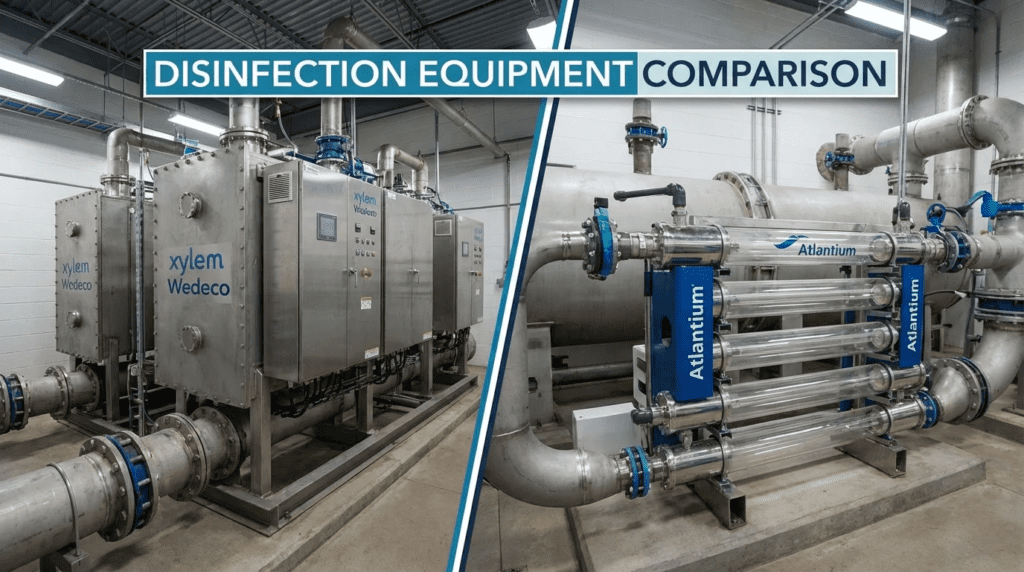
The Xylem Wedeco vs Atlantium Disinfection Equipment: Comparison & Best Fit analysis is a choice between two distinct engineering philosophies. Wedeco, Xylem’s UV and ozone brand, represents the established standard in both low pressure high output and medium pressure systems, dominating large municipal infrastructure with open channel and closed vessel solutions. Atlantium uses Hydro-Optic technology — an approach applying fiber-optic principles with medium pressure lamps to achieve high intensity and real-time monitoring in a compact footprint.
These technologies serve municipal drinking water, wastewater reclamation, aquaculture and industrial process water. Operating environments range from pristine permeate to low-transmittance wastewater. A mismatch leads to excessive lamp replacement cost, inability to meet permit limits during poor-quality events, or hydraulic bottlenecks. Broader supplier positioning is covered in our overview of the top disinfection equipment manufacturers.
How to Select and Specify
Duty Conditions & Operating Envelope
The primary differentiator is UV transmittance and the target pathogen. Wedeco’s low pressure high output systems are highly efficient at the germicidal wavelength, making them ideal for standard disinfection duties in waters with stable transmittance. Where the application requires high-log adenovirus inactivation, medium pressure lamps are generally favored for their polychromatic output, which is more effective against adenovirus repair mechanisms.
Atlantium’s Hydro-Optic technology is exclusively medium pressure based. It excels where transmittance is low or variable, or where high dose is required in a single pass. Engineers must specify the reduction equivalent dose required. For continuous flow with variable demand, Wedeco’s bank sequencing in open channels allows large turndown ratios. Atlantium systems modulate lamp power but have a narrower hydraulic operating window per unit due to the physics of the optical water block.
Materials & Compatibility
Wedeco reactors are typically 316L stainless or duplex for corrosive environments such as seawater, with lamps housed in quartz sleeves. In aggressive industrial wastewater or highly saline service, the stainless body is a potential corrosion point if not properly passivated.
Atlantium takes a different approach. The core of the system is a quartz tube using total internal reflection to recycle UV light. This minimizes metal-to-water contact in the irradiation zone, an advantage for pharmaceutical or high-purity applications where metal ion leaching is a concern. But evaluate temperature limits: medium pressure lamps run extremely hot, and while water cools them, sudden flow stoppage requires robust safety interlocks to prevent heat damage to reactor materials.
Hydraulics & Process Performance
Hydraulics define dose distribution. In a standard Wedeco vessel, baffles or mixing plates create turbulence approximating plug flow so all fluid particles receive exposure, and head loss is predictable and moderate. In Wedeco open channel systems, head loss is managed by level control gates or weirs keeping lamps submerged.
Atlantium relies on the light pipe principle, so the hydraulic profile is tightly controlled to ensure light recycling. This generally results in higher head loss than a similarly sized conventional vessel. Verify head loss against flow curves carefully. Where the plant has limited hydraulic grade line available, the higher pressure drop may require booster pumping, which changes the operating cost calculation entirely.
Installation Environment & Constructability
Wedeco’s low pressure high output systems are energy efficient but have a larger footprint, because low intensity per lamp means more lamps to reach the target dose. For retrofits in tight galleries this is problematic, and large open-channel systems require significant civil work.
Atlantium units are power dense. A single unit can often replace a much larger rack of low pressure lamps. The footprint is small but the electrical infrastructure requirement is high. Account for larger amp draw and heat dissipation in the electrical room serving medium pressure ballasts. Hydro-Optic units also require specific straight pipe runs upstream and downstream to protect the optical path.
Reliability, Redundancy & Failure Modes
Reliability in UV is defined by lamp life and sleeve fouling.
- Low pressure high output: Long lamp life with gradual output decline
- Medium pressure, both suppliers: Shorter lamp life with more abrupt intensity drop-off
Redundancy strategies differ. In a Wedeco channel, redundancy is typically at bank level. In Atlantium, it is at unit level. A critical failure mode for Atlantium is fouling of the quartz reactor wall, since the wall is the reflector — if it fouls, the internal reflection effect is lost and dose drops sharply. Atlantium therefore uses a rigorous automated wiping system. Wedeco also uses mechanical or chemical wiping, but a dirty wall in a stainless reactor has less severe consequences than in an optical recycling reactor.
Controls & Automation
Wedeco uses controller platforms integrating with plant SCADA over standard industrial protocols, with a control philosophy typically based on flow pacing or dose pacing from a calculated dose algorithm verified by sensors.
Atlantium emphasizes real-time monitoring. Its optical arrangement is designed to measure transmittance and intensity integrated across the water column rather than at a single sensor point. Their controllers provide extensive data logging for compliance, and for industries requiring electronic records compliance, the software is often pre-validated for audit trails.
Maintainability, Safety & Access
Wedeco open channel: Lamps are pulled vertically from the channel, ideally with the bank lifted clear of the water. Labor-intensive but accessible.
Wedeco closed vessel: Requires isolation valves and drain-down. Low pressure lamps are long, requiring significant clearance for removal.
Atlantium: Lamps are shorter and easier to handle, but units are pressurized and run at high intensity and heat. Lockout procedures must account for both high voltage and thermal hazards.
Lifecycle Cost Drivers
Capital: Low pressure high output is generally higher because of lamp count, stainless volume and civil works. Atlantium is often lower capital for equivalent dose in high-flow, high-dose scenarios due to compactness.
Operating: This is the swing factor. Low pressure lamps convert electricity to germicidal output substantially more efficiently than medium pressure. For a plant running continuously at stable flow, Wedeco will almost always win on power cost. Where the plant runs intermittently, or requires dosages at which low pressure lamp counts become impractical, the medium pressure system becomes competitive. Consumables are more frequent on Atlantium but fewer in quantity.
Comparison Tables
| Parameter | Xylem Wedeco | Atlantium | Engineering Implications |
|---|---|---|---|
| Primary technology | Low pressure high output and medium pressure | Medium pressure with Hydro-Optic internal reflection | Low pressure gives energy efficiency; Hydro-Optic gives intensity and small footprint |
| Reactor configuration | Open channel or stainless closed vessel | Closed quartz optical tube | Wedeco suits gravity flow profiles; Atlantium requires pressurized piping |
| Lamp lifespan | Long, typical of low pressure amalgam lamps | Shorter, typical of medium pressure lamps | Expect substantially more frequent lamp changes with medium pressure |
| Energy efficiency | High conversion to germicidal output | Moderate conversion to germicidal output | Low pressure significantly reduces long-term electrical cost for continuous flow |
| Dose monitoring | Calculated from flow, transmittance and sensor intensity | Integrated real-time measurement | Atlantium offers a more direct measurement of delivered dose, useful under strict compliance regimes |
| Head loss | Low in channel, moderate in vessel | Moderate to high | Check hydraulic profile; booster pumping may be triggered in gravity systems |
| Cleaning system | Mechanical or chemical-mechanical wiping | Automated wiping or air-based cleaning | Both robust, but Atlantium efficacy depends heavily on clean quartz walls for reflection |
| Application | Best Fit | Primary Decision Driver | Operator Skill Impact |
|---|---|---|---|
| Large municipal wastewater, gravity flow | Xylem Wedeco open channel | Low head loss, energy efficiency, scale | Moderate — occasional manual bank cleaning |
| Drinking water, protozoan credit | Xylem Wedeco closed vessel | Validated performance, electrical efficiency | Low — automated systems standard |
| Drinking water, high-log adenovirus | Atlantium or Wedeco medium pressure | Polychromatic light required for effective inactivation | High — strict validation and monitoring |
| Industrial, pharma, food and beverage | Atlantium | Material safety with no metal contact, compact footprint, dose documentation | High — calibration and strict maintenance adherence |
| Aquaculture recirculating systems | Atlantium | Bio-fouling resistance, effectiveness against specific fish pathogens | Moderate — wipers must handle high bio-load |
| Retrofit, limited space | Atlantium | High power density fits tight pipe galleries | Moderate |
Engineer & Operator Field Notes
Commissioning & Acceptance Testing
The most contentious issue at site acceptance is usually the correlation between built-in sensor readings and handheld reference sensors. Require a reference sensor check at multiple power levels during commissioning.
For Atlantium, verify the wiper or air cleaning mechanism function. If it sticks during factory or site testing, it will fail in the field. For Wedeco open channel systems, verify level control. Weirs or gates must hold water level within a tight band relative to lamp arc length. If level drops, lamps overheat and fail; if it rises too high, water passes over the bank untreated.
Common Specification Mistakes
Over-specifying transmittance: Engineers often design for average transmittance. During storm events, wastewater transmittance drops sharply. Equipment selected for average conditions will alarm and underdose during the storm — exactly when disinfection matters most. Always specify on the design low transmittance.
Material mismatch: Specifying standard 316L for high-chloride applications such as brine or seawater without requiring higher alloys or specific passivation. Wedeco offers material upgrades; Atlantium’s quartz body has an inherent advantage here provided flange connections are compatible.
O&M Burden & Strategy
Operators prefer predictability. Wedeco’s low pressure lamps have long life, so changes happen every few years per bank. But changing hundreds of lamps in a channel is a multi-day heavy labor event.
Atlantium systems may have only a handful of lamps, but they must be changed roughly twice a year. The labor is light — minutes rather than days — but the frequency frustrates operators who prefer a set-and-forget asset.
Spare parts: For medium pressure systems from either supplier, ballasts are often proprietary and tuned to the lamp. Spare lamp shelf life is generally good, but ballasts degrade. Keep at least one spare ballast per rack or unit.
Troubleshooting
- Low intensity alarm, either system. Check whether transmittance is actually below design using a handheld meter. Manually cycle the wiper. Check the sensor window itself, which may be fouled even when lamps are clean.
- Lamp failure alarm, medium pressure. Often heat-related. Check cabinet cooling fans and filters. Medium pressure ballasts generate significant heat, and if electrical room cooling fails, ballasts trip or fail.
Design Details & Calculations
Sizing Methodology
The fundamental relationship is dose as the product of intensity and exposure time, but this is too simple for modern regulatory environments. Sizing relies on bioassay validation.
- Determine target log removal for the governing organism
- Identify design transmittance — the lowest expected, not the average
- Select validation standard: the USEPA UV Disinfection Guidance Manual for US drinking water, or NWRI guidelines for wastewater reclamation
- Apply safety factors for end of lamp life and fouling. Low pressure lamps hold output better than medium pressure, so the factors differ by lamp type.
Specification Checklist
- Bioassay validation report submitted with the bid, showing validation at the proposed flow, transmittance and lamp power range
- Head loss constraints defined as maximum allowable water column
- Harmonic distortion limits, since medium pressure systems produce significant electrical noise; require active filters if needed
- Warranty on consumables stating minimum operating hours for lamps
Standards
Ensure compliance with NSF/ANSI 61 for drinking water contact materials and UL 508A for electrical components. For wastewater reuse, reference the applicable NWRI guidelines. Both manufacturers have validated reactors under these protocols, but the validation envelope — the range of flow and transmittance permitted — differs per model.
Frequently Asked Questions
What is the main difference between the two?
Light source and reactor physics. Wedeco is known for low pressure high output lamps in stainless vessels or concrete channels, focusing on energy efficiency at large flow. Atlantium uses medium pressure lamps with internal reflection in a quartz tube to achieve high intensity and monitoring precision in a compact footprint.
When should I choose medium pressure over low pressure?
When you need adenovirus inactivation requiring polychromatic light, when space is severely limited, when water temperature varies drastically, or in industrial intermittent applications where low pressure warm-up time is a hindrance. For continuous municipal flow where energy cost drives the decision, low pressure is usually superior.
How does transmittance affect selection?
Transmittance determines how easily UV penetrates water. In high transmittance water, standard low pressure systems are very efficient. In low transmittance water, light from standard lamps is absorbed within millimeters. High-intensity medium pressure lamps with short optical path lengths penetrate low transmittance water more effectively, though energy cost will be high.
What is the maintenance cost difference?
Wedeco low pressure systems have lower annual consumable costs from long lamp life and low power consumption, but re-lamping is a major labor event. Atlantium has higher consumable and electricity costs but minimal labor time per lamp swap due to low lamp count and easy access.
Are both validated for water reuse?
Yes, both offer systems validated under NWRI guidelines for reuse. But validation applies to specific models and operating ranges. Check the validation report for the exact model proposed to confirm your peak flow and minimum transmittance fall inside the validated envelope.
Why is head loss a major factor?
Open channel systems have negligible head loss, ideal for gravity-fed wastewater plants. Pressurized optical systems use flow restrictors and mixers to ensure optical performance, producing meaningful pressure drop. In gravity systems this may trigger intermediate pumping, changing the project scope and cost.
Conclusion
KEY TAKEAWAYS
- Energy against intensity: Choose low pressure for long-term savings on large continuous flows; choose medium pressure for high-intensity requirements or industrial batch processes.
- Hydraulic constraints: Verify available hydraulic grade line. Channel systems suit gravity profiles; optical systems require pressurized lines.
- Validation is decisive: Require the third-party bioassay validation report bracketing your specific peak flow and minimum transmittance.
- Maintenance philosophy: Wedeco means infrequent but labor-intensive events; Atlantium means frequent but quick ones.
- Space: Atlantium offers significantly higher power density and smaller footprint.
The decision typically bifurcates by application sector. For large municipal plants prioritizing twenty-year energy cost, low pressure high output remains the industry benchmark, because the efficiency of converting electricity to germicidal photons is difficult to beat at scale.
Atlantium has carved a niche for engineers dealing with difficult water — high-log adenovirus credit, fluctuating industrial effluent, aquaculture biosecurity, tight retrofits. The engineer’s role is accurate lifecycle cost analysis balancing higher electricity and lamp costs against civil works savings and process security. Related evaluations appear in our comparison of Ozonia and Evoqua disinfection equipment, our review of the top OEMs for disinfection systems, and our guide to disinfection equipment generally.