
Ozonia vs Evoqua Disinfection Equipment: Comparison & Best Fit
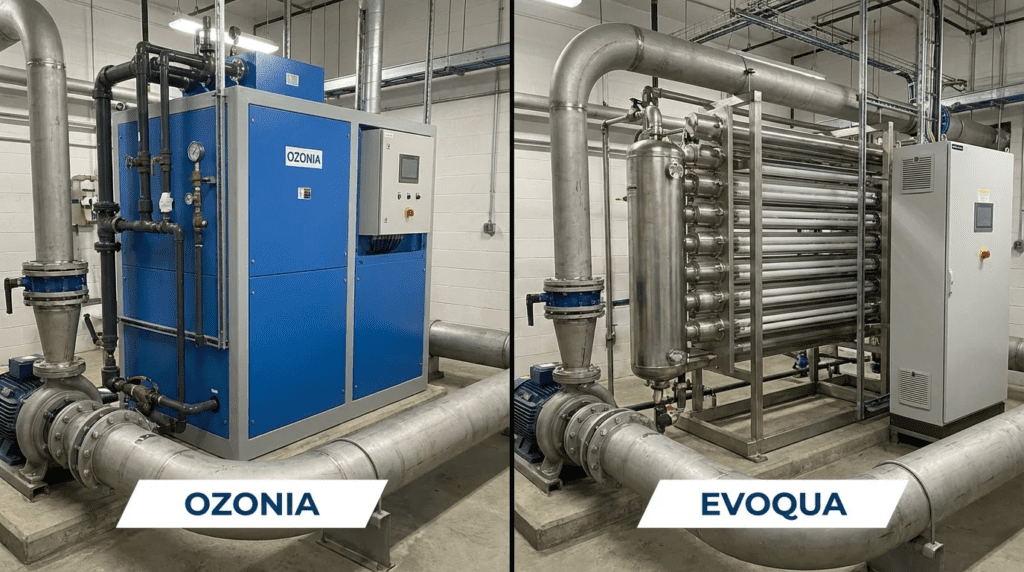
Ozonia vs Evoqua Disinfection Equipment: Comparison & Best Fit
Introduction
Few decisions affect long-term compliance and operating expenditure as heavily as the selection of primary disinfection and oxidation technology. For decades a handful of manufacturers dominated the market, which is why engineers routinely conduct an Ozonia vs Evoqua Disinfection Equipment: Comparison & Best Fit analysis during preliminary design. Recent consolidation has complicated that landscape considerably. Ozonia came into Veolia through the acquisition of SUEZ Water Technologies & Solutions, and Evoqua was acquired by Xylem in 2023. Engineers are no longer simply selecting equipment; they are navigating merged legacy portfolios spanning ozone generation, ultraviolet disinfection and gas chlorination.
The stakes are high. Disinfection is the final barrier protecting public health against pathogens including Cryptosporidium and Giardia. In industrial and potable reuse applications, these systems also destroy emerging contaminants through advanced oxidation. A poor specification produces more than an inefficient plant: it produces energy waste, inability to meet log inactivation credits, or downtime from proprietary parts obsolescence.
This article examines the hydraulic constraints, dielectric reliability, maintenance burdens and control interfaces that define real-world performance. Broader supplier positioning is covered in our overview of the top disinfection equipment manufacturers.
How to Select and Specify Disinfection Systems
Duty Conditions & Operating Envelope
For ozone systems, define not just dosage but ozone concentration by weight. The Ozonia lineage has historically pushed high-concentration generation, which significantly reduces required feed gas flow and oxygen demand. The Evoqua portfolio, incorporating legacy Pacific Ozone and Wallace & Tiernan technologies, offers modular flexibility that suits variable duty points.
For UV systems, the critical parameter is UV transmittance. Evaluate the equipment’s ability to maintain dose pacing during low-transmittance events such as storm flows.
- Turndown ratio: Can the power supplies turn down linearly across the full range? Stepless dimming is critical for energy conservation in both UV and ozone.
- Temperature sensitivity: Ozone generator dielectrics are highly sensitive to cooling water temperature. Specifications must define the maximum cooling water temperature and the required derating if ambient conditions exceed it.
Materials & Compatibility
- Ozone generators: Specify 316L stainless vessel construction as a baseline. The dielectric tubes are the heart of the generator and vary between manufacturers, with glass, ceramic and hybrid designs each carrying different thermal shock and power density characteristics.
- UV reactors: 316L is standard, but internal surface finish affects hydraulic friction and bio-fouling. For aggressive wastewater, higher-alloy stainless may be required to prevent chloride stress corrosion cracking, particularly in coastal regions.
When specifying ozone generators, require individual fuse protection for dielectrics. If one tube fails, its fuse should blow and the generator should continue at slightly reduced capacity rather than tripping the entire unit.
Hydraulics & Process Performance
UV systems: Head loss across the reactor is a critical constraint. Low pressure high output systems have different head loss characteristics from medium pressure systems due to lamp density and arrangement. The specification must set maximum allowable head loss to prevent upstream hydraulic bottlenecks.
Ozone systems: The focus is gas transfer efficiency. Contactor design interacts with the diffusion system, and equipment selection drives required contact time. Sidestream injection, common in modern designs, requires high-pressure motive water pumps, changing the energy balance relative to fine bubble diffusers.
Installation Environment & Constructability
- Footprint: High-concentration ozone generators are generally compact, but ancillary equipment — liquid oxygen storage, evaporators, destruct units — consumes significant area.
- Skid against stick-built: The Evoqua portfolio has a strong history of pre-packaged skid-mounted solutions, reducing field installation labor. Large municipal Ozonia installations are often large vessels requiring substantial on-site mechanical assembly and piping.
- HVAC requirements: Ozone generators dissipate heat into the room, and ozone monitors require specific air change rates for safety. UV ballasts also generate significant heat, so control panel cooling must be accounted for in hot climates.
Reliability, Redundancy & Failure Modes
- Power supply units: Modern designs often use modular power supplies, so one module failure costs only a fraction of capacity. Favor modular architectures over monolithic supplies.
- Cleaning systems: For UV, the automatic wiping system is the most common failure point. Pneumatic and electric mechanical wipers carry different reliability profiles, and wiper ring material compatibility with the quartz sleeve deserves specific review.
Lifecycle Cost Drivers
- Energy consumption: The largest driver. Ozone generation efficiency varies with concentration; UV efficiency is measured by germicidal output per watt.
- Consumables: For UV, lamps, quartz sleeves and wiper seals. For ozone, dielectric replacement at long intervals but high cost, plus oxygen and cooling water.
Detailed Comparison
Note that in the tables below, Evoqua encompasses legacy Wallace & Tiernan, Pacific Ozone and ATG UV lines now within Xylem, while Ozonia represents the ozone and UV portfolio now within Veolia.
| Criteria | Ozonia (Veolia) | Evoqua (Xylem) |
|---|---|---|
| Primary technology focus | High-capacity ozone generation and large-scale UV. Known for heavy industrial and large municipal infrastructure. | Broad portfolio spanning gas chlorination, modular ozone, UV and on-site generation. |
| Ozone generation | IGBT power supplies with controlled gap technology. Optimized for high concentration. Glass and ceramic hybrid dielectrics. | Mixed portfolio from smaller air-cooled units to larger water-cooled systems. Focus on modularity and skid integration. |
| UV disinfection | Aquaray series. Strong in vertical lamp arrangements for open channels and high-output amalgam systems. | ATG lineage. Strong in medium pressure systems and closed vessel UV. |
| Control integration | Proprietary controllers with extensive diagnostics. Often expects adherence to their platform standards. | Wallace & Tiernan controllers are a long-standing standard for chemical feed, with strong analyzer and dosing loop integration. |
| Best fit | Large municipal plants, micropollutant removal, heavy industrial oxidation. | Small to mid-sized municipal, retrofits requiring skid mounts, chlorination and dechlorination projects. |
| Application | Preferred Approach | Key Considerations |
|---|---|---|
| Large municipal wastewater disinfection | Competitive split | Ozonia’s vertical rack UV suits open channels. The Evoqua ATG lineage is strong in closed vessel medium pressure UV where footprint is tight. |
| Potable water taste and odor, advanced oxidation | Ozonia | High-concentration ozone generation minimizes bromate formation and maximizes transfer efficiency. Large-scale generators are standard here. |
| Small to mid industrial skid | Evoqua | Pre-engineered ozone skids install readily. Large custom units are often over-complex for simple industrial loops. |
| Gas chlorination and dechlorination | Evoqua | The Wallace & Tiernan brand remains the reference standard for vacuum gas chlorination. |
| Wastewater reuse | Either | Both have validated systems under NWRI guidelines. Selection comes down to lifecycle cost of lamp replacement and power draw. |
Engineer & Operator Field Notes
Commissioning & Acceptance Testing
- Ozone leak tests: Never rely solely on ambient monitors during commissioning. Use handheld spot checkers at all flange connections, because transport vibration can loosen internal connections even on robust vessels.
- Harmonic distortion: Both manufacturers use complex power supplies to regulate output, creating total harmonic distortion on the electrical bus. Require an IEEE 519 compliance study. Active harmonic filters are often needed on large installations to protect other sensitive electronics.
- UV intensity verification: During site acceptance, verify UV intensity sensors against a reference sensor. Sensor drift is a common issue on any manufacturer’s equipment if initial calibration is sloppy.
Common Specification Mistakes
Engineers often copy specifications from projects several years old. Do not name a brand alone. Specify the performance requirement and list acceptable manufacturers with their current parent companies. Old model numbers may be obsolete, leading to costly change orders during submittal review — and the corporate names on those old specifications may no longer describe independent companies at all.
- Under-specifying cooling water: Ozone generators are water cooled. If plant service water carries high hardness or chlorides, heat exchangers will scale or corrode. Specify a closed-loop chiller if plant water quality is suspect.
- Ignoring system responsibility: Splitting the ozone generator supply from the ozone destruct supply is a common error. The generator manufacturer should be responsible for the destruct unit to ensure safety interlocks function correctly.
O&M Burden & Strategy
Ozonia lineage: Maintenance teams report the dielectrics are durable but difficult to access on older models, with newer designs improved. The primary burden is the cooling water system and the power supply air filters — clogged filters lead directly to power electronics overheating and failure.
Evoqua lineage: For UV systems, the wiping mechanism is the main maintenance item, with seals requiring monthly checks. For gas chlorinators, injector cleaning and diaphragm replacement are routine. Ozone skids are generally accessible but require strict desiccant dryer maintenance where liquid oxygen is not used.
Design Details and Calculations
Sizing Logic: Ozone
Ozone sizing revolves around the CT value — the product of residual dissolved ozone concentration at the contactor outlet and the contact time experienced by the earliest-arriving ten percent of flow.
- Determine the ozone demand of the water from organic carbon, nitrite and iron or manganese content
- Add the required decay demand
- Calculate the required applied dose
- Convert dose and flow to mass per unit time
- Selection point: Select a generator where required output sits well below maximum capacity, allowing margin for aging and fouling
Sizing Logic: UV
UV sizing rests on bioassay validation rather than theoretical calculation. Dose is conceptually intensity multiplied by exposure time, but engineers must apply an end of lamp life factor and a fouling factor appropriate to the lamp type and cleaning system.
- Check the validated range. Ensure the reactor is validated for your required dose at the actual transmittance of your water.
- Verify head loss calculations at peak wet weather flow, not average flow
Standards
- AWWA B304: Liquid oxygen for ozone generation
- NWRI Guidelines: The reference for water reuse UV sizing
- UL 508A: Mandatory for control panels
- NFPA 820: Fire protection for wastewater treatment plants, critical for ozone destruct units in classified areas
Frequently Asked Questions
Are Ozonia and Evoqua still independent companies?
No. Ozonia is part of Veolia Water Technologies, having arrived through the acquisition of SUEZ Water Technologies & Solutions. Evoqua was acquired by Xylem in 2023. Both names persist in specifications, reference lists and equipment nameplates, so engineers encounter them constantly, but procurement now runs through the parent organizations. Verify current parts and service arrangements before relying on an older specification.
What is the main difference between the ozone generators?
Dielectric technology and market focus. The Ozonia lineage typically uses proprietary glass and ceramic dielectrics optimized for very large-scale, high-concentration applications. The Evoqua portfolio offers a broader range including modular skid-mounted units better suited to industrial applications or smaller municipal retrofits, alongside larger legacy systems.
How do maintenance costs compare?
Generally comparable but concentrated differently. Ozonia systems may carry higher individual part costs for proprietary dielectrics and power electronics but potentially longer intervals between major overhauls. Evoqua UV systems depend heavily on wiper maintenance and seal replacement. For ozone, both require strict cooling water maintenance to prevent expensive vessel failures.
Can controllers from one be integrated with the other’s SCADA?
Yes, with careful specification of communication protocols. Both support common industrial protocols. The challenge is data mapping rather than protocol. Specify a unified tag list during design so each controller exposes the necessary alarms and status words in a format matching plant standards.
Which is better for wastewater UV disinfection?
It depends on channel configuration and effluent quality. For open channel systems in large plants, vertical lamp arrangements are well regarded for ease of access, since lamps can be changed without removing racks. For closed vessel applications in pipe runs, medium pressure systems offer high power density suiting footprint-constrained plants, though energy costs run higher than low pressure alternatives.
What is the typical lifespan of ozone dielectrics?
With proper cooling water quality and dry feed gas, dielectrics should give many years of service. But thermal shock from rapid cooling water temperature changes, or moisture in the feed gas, can cause failure in minutes. This vulnerability exists in equipment from both lineages, which is why ancillary system design matters as much as generator selection.
Why is harmonic mitigation critical?
Both ozone power supplies and UV ballasts are non-linear electrical loads drawing current in pulses, creating harmonics that distort the voltage waveform across the plant grid. Without active filters or multi-pulse drives, this distortion causes transformer overheating and nuisance tripping of other equipment. Always specify IEEE 519 compliance at the point of common coupling.
Conclusion
Key Takeaways
- Consolidation matters: Ozonia is now Veolia and Evoqua is now Xylem. Support structures and parts supply chains have merged accordingly.
- Ozone strength: The Ozonia lineage generally holds the edge for large custom infrastructure requiring high-concentration ozone.
- Portfolio breadth: The Evoqua portfolio offers a wider total disinfection range, including gas chlorination and modular ozone and UV skids.
- Total cost of ownership: Energy consumption dominates lifecycle cost. A small difference in generator efficiency outweighs a much larger difference in initial capital.
- Cooling is critical: The great majority of ozone generator failures trace to poor cooling water or feed gas preparation rather than the generator brand.
The decision is rarely about which brand is objectively better, but which platform aligns with project constraints. For large municipal infrastructure where footprint is available and operator expertise is high, high-efficiency ozone generators are a formidable standard. For projects requiring modularity, tight integration of diverse disinfection technologies, or retrofit capability, the broader portfolio often provides superior flexibility.
Focus specifications on performance metrics — specific energy consumption, transmittance validation ranges, material compatibility — rather than brand loyalty. Related evaluations appear in our comparison of Xylem Wedeco and Atlantium disinfection equipment, our review of the top OEMs for disinfection systems, and our guide to disinfection equipment generally.